








Join Djinn Guide: Get 50% Off a Personal Reading
Get new guides to jinn, folklore and occult history. Confirm your subscription to unlock a 50% code for a first personal reading with our partner PuraTarot.
Discover the unseen
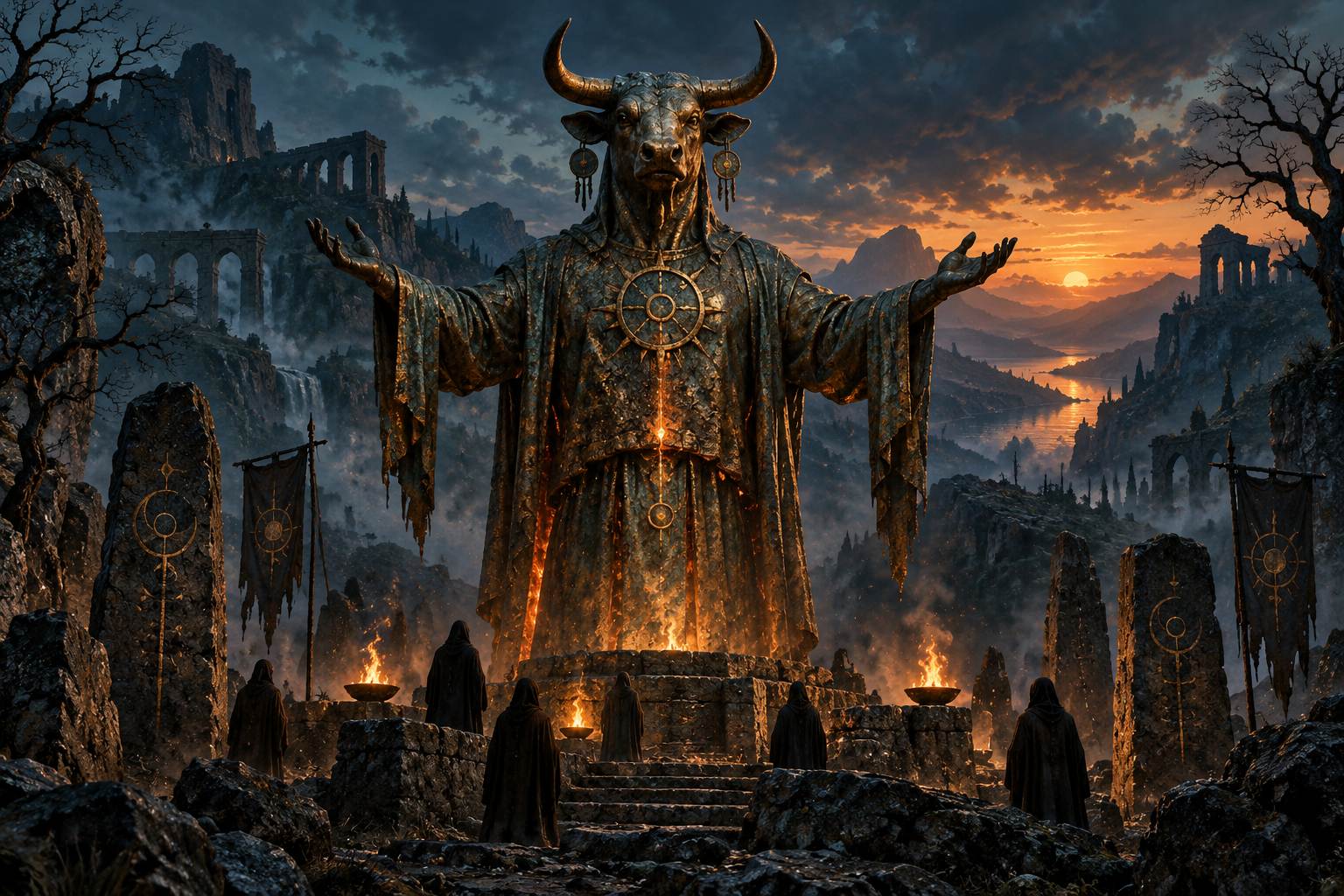
Moloch demon explained: what the Bible says about Molech, the child sacrifice debate, rabbinic legend, Milton, de Plancy and why the name endures.
Quick answer: The Moloch demon is the later, demonized form of Molech (Hebrew mōlek), a name that appears in the Hebrew Bible in connection with child sacrifice in the Valley of Hinnom. The biblical texts treat Molech as a foreign cult that Israel was forbidden to follow; medieval Christian writers, Milton, and the Dictionnaire Infernal then turned the name into a demon of blood and greed. Scholars still debate whether Moloch was a god, a type of sacrifice, or both.
Related guides: list of demon names and origins, what demonology actually studies, Mammon, the demon of wealth, Abaddon, angel of the abyss, Beelzebub and Philistine origins, how angels and demons are ranked.
| Source | Date | How Moloch appears | Role |
|---|---|---|---|
| Leviticus 18:21; 20:2–5 | Hebrew Bible | Molech, a cult to which children are 'passed over' | Forbidden foreign worship |
| 2 Kings 23:10; Jeremiah 32:35 | Hebrew Bible | Linked to Topheth in the Valley of Ben Hinnom | Site of child sacrifice condemned by prophets |
| 1 Kings 11:7 | Hebrew Bible | 'Abomination of the Ammonites' honored by Solomon | Sign of Solomon's late apostasy |
| Septuagint / Acts 7:43 | 3rd c. BCE – 1st c. CE | Greek Moloch, read into Amos 5:26 | Idol carried by Israel in the desert |
| Rabbinic commentary (Rashi, Yalkut) | Medieval | Bronze idol with outstretched arms and compartments | Legendary image of the sacrifice |
| Paradise Lost | 1667 | 'Horrid king besmeared with blood' | Fallen angel, war-party spokesman |
| Dictionnaire Infernal | 1818 / 1863 | Bull-headed demon of the 'country of tears' | Catalogued demon |
| Modern usage | 20th–21st c. | Metaphor for systems that devour the young | Howl, Metropolis, political rhetoric |
Key Takeaways
In the Hebrew Bible the name appears as mōlek (English Molech or Moloch). The consonants m-l-k are the same as the Semitic root for ‘king’ (melek), and many scholars think the odd vowels were deliberately borrowed from bōshet, ‘shame’, so that a hated cult would be pronounced as an insult. The name therefore likely meant something like ‘the king’ before it became a slur. Nothing in the biblical text describes Moloch as a demon; the texts describe a cult that Israel is told never to imitate.
The demonic Moloch is a later construction. When Christian writers in late antiquity and the Middle Ages read the Old Testament, they treated every foreign god as a devil in disguise. Moloch, already linked to the worst imaginable rite, became the devil of child sacrifice. By the seventeenth century John Milton could list him among the fallen angels without explanation, and by the nineteenth century the Dictionnaire Infernal gave him a bull’s head and an oven in his belly.
So when people search for the Moloch demon today they are usually meeting three layers at once: a biblical prohibition, a rabbinic and Christian legend, and a modern literary metaphor. For how this name sits beside other biblical and Goetic figures, see our list of demon names and origins.
Molech is named only a handful of times in the Hebrew Bible, almost always in legal or prophetic condemnations. Leviticus 18:21 forbids giving ‘any of your seed’ to Molech, and Leviticus 20:2–5 prescribes death by stoning for anyone who does so, adding that the community must not look away. The phrase used is often translated ‘to pass through the fire’, which has been read both literally (burning) and figuratively (a dedication ritual).
The narrative books add geography. 2 Kings 23:10 says that King Josiah, during his reform in the late seventh century BCE, defiled Topheth in the Valley of Ben Hinnom ‘so that no one could make his son or daughter pass through the fire to Molech’. Jeremiah 32:35 and 7:31 condemn the same site, and Jeremiah insists that such sacrifice ‘never came into my mind’, a line that suggests some worshippers believed they were honoring Israel’s own God.
1 Kings 11:7 is the passage that connects Moloch to Solomon. In his old age, the text says, Solomon built a high place for Chemosh of Moab and for ‘Molech, the abomination of the Ammonites’ on the hill east of Jerusalem. This verse is one reason later legend made Solomon a king who understood spirits yet fell under their influence.
One further reference comes through translation. Amos 5:26 in Hebrew mentions ‘Sikkuth your king’ (malkekem). The Greek Septuagint rendered this as ‘Moloch’, and Acts 7:43 in the New Testament quotes that Greek form, so Moloch appears once in the Christian scriptures as an idol Israel carried in the wilderness.
Does this touch your own situation? Many readers come to these pages because something in their home, dreams or family feels unexplained. Reading history helps, but it cannot look at your specific case.
Consult the Sheikh Private, confidential, and free to ask.
For most of history readers assumed Moloch was a Canaanite or Ammonite god who received burned children. In 1935 the German scholar Otto Eissfeldt proposed something different. Punic inscriptions from Carthage and other Phoenician colonies use the word mlk (vocalized molk) as a technical term for a type of offering, sometimes a lamb substituted for a child. Eissfeldt argued that the biblical ‘to Molech’ originally meant ‘as a molk-sacrifice’, and that the deity was a later misunderstanding.
The debate has not been settled. Points on each side include:
Whether children were actually burned is also debated. Excavations at the Carthage tophet uncovered thousands of urns containing the cremated remains of infants and young animals. Some archaeologists read this as evidence of regular child sacrifice; others argue it was a cemetery for children who died naturally. The prophets, at least, describe the rite as real and treat it with horror.
The image most people hold of Moloch, a huge bronze idol with outstretched arms heated from within, comes from rabbinic commentary rather than scripture. Medieval Jewish sources such as Rashi’s commentary and the Yalkut Shimoni describe a hollow statue with a calf’s or ox’s head and, in some versions, seven compartments for different offerings, with the child placed in the seventh. Drums were beaten so the parents could not hear the cries. This description is legendary elaboration, but it fixed the picture for later writers.
Christian demonology inherited the idol and gave it a personality. In Paradise Lost (1667) Milton introduces Moloch first among the fallen angels, the ‘horrid king besmeared with blood of human sacrifice’, and in Book II he is the hawk of the infernal council, urging open war on Heaven. Milton draws directly on the Kings and Jeremiah passages, naming Hinnom, Topheth and ‘black Gehenna’.
Collin de Plancy’s Dictionnaire Infernal (first edition 1818, illustrated 1863) catalogued Moloch as a demon worshipped by the Ammonites, and its famous engraving shows a crowned, bull-headed figure seated on a throne with a child in his hands. The accompanying text repeats the rabbinic oven legend. For context on how such catalogues were assembled, see what demonology actually studies.
Moloch belongs to a group of names that began as foreign gods or abstract nouns in the Bible and were later reclassified as demons. Comparing them shows how the process worked.
Baal-zebub was ‘lord of the flies’, a Philistine god of Ekron in 2 Kings 1. The Gospels use the name for the prince of demons, and later demonologies rank him near the top of hell.
Mammon is not a god at all in the New Testament; it is an Aramaic word for wealth in the saying ‘you cannot serve God and mammon’. Medieval writers personified it, and Milton placed Mammon and Moloch side by side in hell. Our guide to Mammon, the demon of wealth follows that path.
Abaddon means ‘destruction’ in Job and Proverbs, then becomes the angel of the abyss in Revelation 9:11. Like Moloch he moved from a concept to a person.
Astaroth descends from the goddess Astarte, another Canaanite deity turned Goetic duke. Asmodeus comes from Persian and Jewish sources rather than Canaan. Neither has Moloch’s specific link to sacrifice, and unlike them Moloch never entered the Lemegeton’s list of 72 spirits.
Because the name carries so much emotional weight, several errors repeat online. The first is that Moloch is one of the 72 demons of the Goetia. He is not; the Lesser Key of Solomon lists spirits with ranks and seals, and Moloch is absent from every manuscript.
A second error is that the Bible describes Moloch’s statue. It does not. The bronze idol with heated arms is medieval rabbinic legend, possibly influenced by classical accounts of Carthage such as Diodorus Siculus, who described a bronze statue of Kronos into which children were rolled. Diodorus wrote about Carthage, not Jerusalem.
A third is the modern conspiracy claim that elites ‘worship Moloch’ at secret gatherings. This rests on a nineteenth-century novelty owl statue and a misreading of the name; there is no owl connected with Moloch in any ancient source, where the animal, when one appears at all, is a bull or calf. Finally, Moloch is sometimes confused with Melqart, the Tyrian city god, and with Milcom, the Ammonite god of 1 Kings 11:5. Milcom and Molech may be related or may have been conflated by scribes; the texts do not allow certainty.
Moloch outlived the cult because the name became shorthand for any system that devours the young or the innocent. Gustave Flaubert’s novel Salammbô (1862) staged a lurid Carthaginian sacrifice to Moloch that shaped later fiction. Fritz Lang’s film Metropolis (1927) shows the hero hallucinating the city’s great machine as a Moloch idol swallowing workers. Allen Ginsberg’s poem Howl (1956) turns ‘Moloch’ into a chant against industrial capitalism and the cold logic of the modern city.
Political writers have used Moloch for war, the state, the market or the factory, and the usage continues in essays about technology. In games and comics Moloch appears as a bull-headed villain borrowing the de Plancy engraving. In none of these cases is a real cult described; the figure mirrors whatever the writer fears is consuming people.
For readers of occult history the name is also a reminder that demonology is a library, not a single book. A figure can have scriptural roots, legendary accretions, literary fame and no place whatsoever in the ritual grimoires. Understanding how angels and demons are ranked in different systems helps explain why Moloch is prominent in Milton yet absent from the Goetia.
Start with the biblical passages in a modern translation that marks textual notes: Leviticus 18:21 and 20:2–5, 1 Kings 11:7, 2 Kings 23:10, Jeremiah 7:31 and 32:35, and Acts 7:43 with its source in Amos 5:26. Note how often the word ‘Molech’ is accompanied by a footnote on the vowels, which shows the uncertainty is ancient. Then read a scholarly survey of the Eissfeldt debate; any good Bible dictionary entry on ‘Molech’ summarizes the positions.
For the demonic image, read Milton’s Paradise Lost Book I and the council scene of Book II, then look at de Plancy’s entry and engraving. Milton’s Moloch is a raging warrior; de Plancy’s is a grotesque with a furnace belly. The furnace legend predates both yet appears in neither scripture nor archaeology.
Finally, treat modern claims with the same care. Any source that calls Moloch a Goetic demon, gives him an owl, or quotes a ‘Moloch ritual’ is mixing categories or inventing. This site does not provide ritual instructions and describes these figures as history and belief, not as working systems.
Still have a question about your own experience? Describe what you are seeing, feeling or dreaming, and when it started. The Sheikh reads every message personally and replies in private.
Have a question of your own? The story of Moloch is a hard one, and reading it often raises bigger questions about meaning and belief. If something personal is on your mind, a Full Personal Reading from our partner PuraTarot offers a calm, reflective perspective. Join the free Djinn Guide newsletter and, once you confirm, you will unlock a 50% code for your first reading.
Further reading
As an Amazon Associate we earn from qualifying purchases.
Moloch is the demonized form of Molech, a biblical name connected with child sacrifice in the Valley of Hinnom. The Hebrew Bible treats Molech as a forbidden foreign cult; later rabbinic legend, Milton's Paradise Lost and de Plancy's Dictionnaire Infernal turned the name into a bull-headed demon of fire and blood. He is not among the 72 spirits of the Goetia.
The consonants m-l-k are the Semitic root for 'king' (melek). Most scholars think the vowels of mōlek were borrowed from bōshet, 'shame', so that worshippers would pronounce the god's title as an insult. Some argue the word was originally molk, a Punic term for a type of sacrifice, and only later misunderstood as a divine name.
Molech appears in Leviticus 18:21 and 20:2–5, 1 Kings 11:7 (Solomon's high place), 2 Kings 23:10 (Josiah defiles Topheth), and Jeremiah 32:35, with related passages in Jeremiah 7:31 and Isaiah 30:33. The Greek form Moloch appears once in the New Testament, Acts 7:43, quoting the Septuagint version of Amos 5:26.
The biblical prophets describe child sacrifice in the Valley of Hinnom as a real practice they condemned. Archaeology at Carthage's tophet found urns with cremated infant remains, which many scholars read as sacrifice and others as infant burial. Whether the Jerusalem rite was burning or a dedication ritual remains debated; the ancient sources agree only that it was abhorrent.
No. Moloch does not appear among the 72 spirits of the Ars Goetia or anywhere in the Lemegeton. His demonic reputation comes from biblical interpretation, Milton and Collin de Plancy, not from the Solomonic grimoires. The only Solomon connection is 1 Kings 11:7, where Solomon builds a high place for Molech.
Disclaimer
This article describes Moloch as he appears in scripture, scholarship, legend and literature. Beliefs and practices are reported, not endorsed, and nothing here constitutes ritual instruction or a claim about supernatural results.
Did this guide help you understand the subject? Rate it and share your honest opinion to help other readers. Every review is checked by our editors before it appears.
There are no reviews yet. Be the first one to write one.


Sheikh Youssef
Tayeb El Merzouki
For inquiries about personalized spiritual work, private rituals, and traditional talismans, connect directly with Sheikh Youssef Tayeb El Merzouki.
Chat on WhatsApp


