




Join Djinn Guide: Get 50% Off a Personal Reading
Get new guides to jinn, folklore and occult history. Confirm your subscription to unlock a 50% code for a first personal reading with our partner PuraTarot.
Discover the unseen
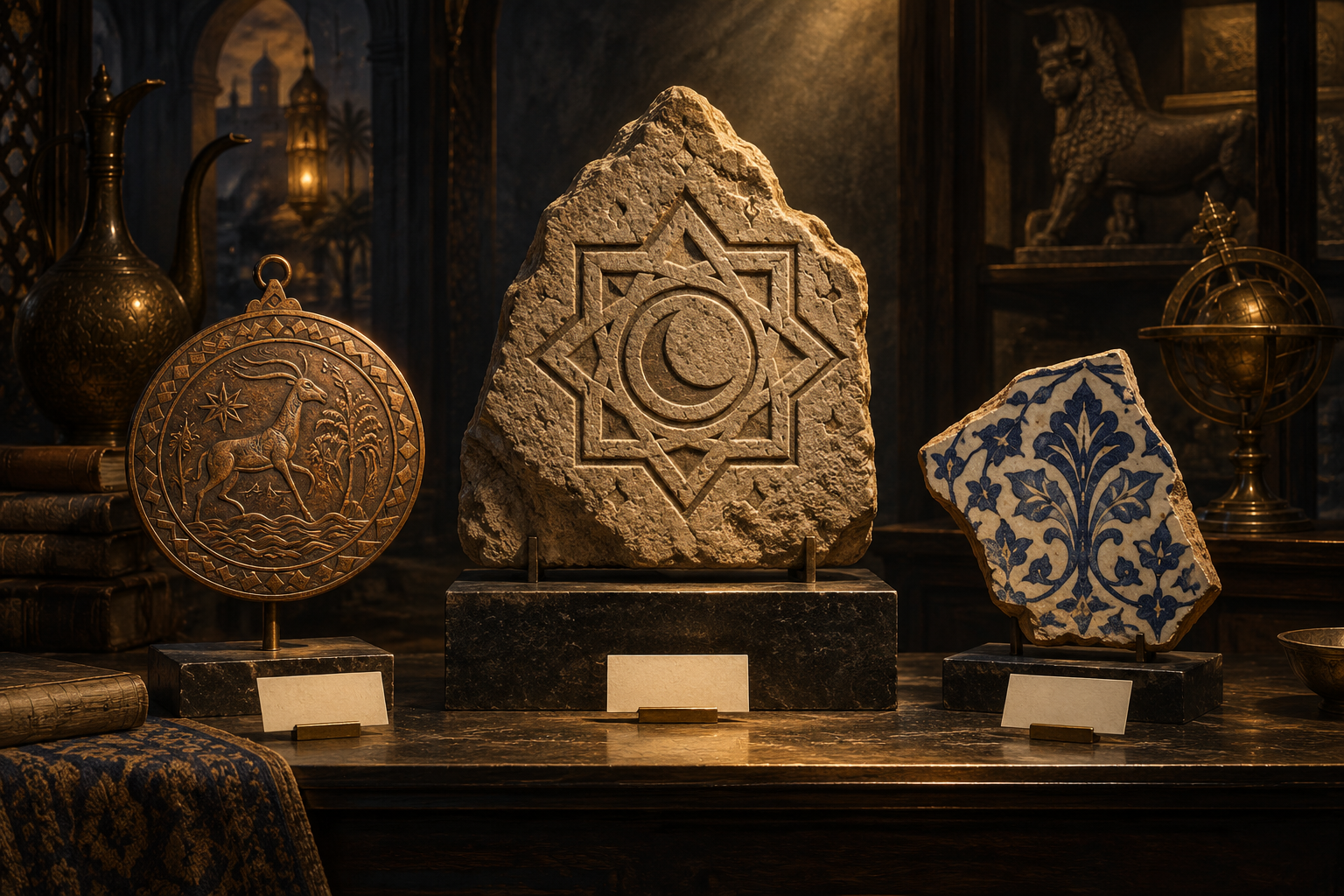
Occult symbols and meanings explained in context: pentagram, hexagram, Seal of Solomon, sigils, planetary signs and the Eye of Horus, with real history.
Quick answer: Occult symbols and meanings depend on the object, the tradition and the century. The same six-pointed star can be a Jewish emblem, a Solomonic seal or an alchemical sign; a pentagram can mean protection, the five wounds of Christ or, after the nineteenth century, a deliberately inverted emblem. This guide walks through the most searched occult symbols, what historical sources actually say about them, and how to tell a genuine traditional meaning from a modern invention.
Related guides: history of the Seal of Solomon, what a sigil actually is, Seal of Solomon vs Star of David, amulets and talismans in history, Goetia names and sigils, Hermeticism and its symbols.
| Symbol | Traditional meaning | Where it appears | Common modern misreading |
|---|---|---|---|
| Pentagram (five-pointed star) | Protection, the five elements or senses, the five wounds of Christ | Greek Pythagorean lore, medieval Christian art, Renaissance magic | Any pentagram is 'satanic' |
| Hexagram (six-pointed star) | Seal of Solomon, union of opposites, fire and water triangles | Islamic and Jewish amulets, alchemy, Ethiopian scrolls | Only ever a Jewish national symbol |
| Sigil | The graphic signature of a spirit, planet or name | Goetia seals, planetary kameas, Agrippa | A random doodle with 'power' |
| Ouroboros | Cyclical time, unity, the alchemical work completing itself | Egyptian funerary texts, Greek alchemy, Gnostic gems | A symbol of evil or infinity only |
| Eye of Horus (wedjat) | Healing, wholeness, royal protection | Egyptian amulets and tomb art | The 'Illuminati eye' |
| Planetary glyphs | Shorthand for the seven classical planets and their metals | Astrology, alchemy, Picatrix-style talismans | Secret codes with hidden intent |
| Ankh | Life, breath, divine gift | Egyptian royal and temple iconography | Generic 'pagan' emblem |
| Caduceus and Rod of Asclepius | Hermes' herald staff; healing serpent staff | Greek myth, Hermetic imagery, medicine | Both are the same symbol |
Key Takeaways
The phrase occult symbols and meanings suggests a dictionary where each shape has one definition. That dictionary does not exist, and most of the ones sold online are modern compilations that flatten centuries of change into a single line. The word occult comes from Latin occultus, meaning hidden, and in its older sense it described knowledge that was concealed or not obvious, such as the hidden properties of stones and plants. Only in the nineteenth century did occult become a label for a whole field of magic, spiritualism and secret societies.
An occult or esoteric symbol is therefore any sign used within those traditions to stand for something larger: a planet, a spirit, a principle of nature, a divine name or a stage in a process. The same visual form can carry very different meanings depending on who drew it. A six-pointed star on a medieval Islamic bowl, a Renaissance alchemical plate and a synagogue wall was understood three different ways by three different audiences.
The practical consequence is simple. To understand an occult symbol you need the context of the object it appears on. This guide follows that rule throughout: each symbol is described with its documented historical uses, and the modern meanings that have grown around it are kept separate. For the general background on charms and inscribed objects, see the article on amulets and talismans in history.
Most of the symbols people now call occult have ordinary origins in older religion, science and craft. Egyptian amulets such as the ankh, the scarab and the wedjat eye were part of mainstream funerary belief, not secret lore. Greek philosophers associated with Pythagoras treated the pentagram as a sign of health and mathematical harmony. The seven planetary glyphs were simply the notation that astronomers and astrologers used before the two fields separated.
The medieval and Renaissance periods are when these signs were gathered into a shared magical vocabulary. Arabic works such as the Ghāyat al-Ḥakīm, known in Latin as the Picatrix, systematized talismans built around planetary images. Heinrich Cornelius Agrippa’s Three Books of Occult Philosophy, printed in 1533, collected planetary squares, seals and alphabets from earlier sources and became the main reference for later writers. Solomonic manuals circulated seals attributed to the king, and the Lesser Key of Solomon assigned a distinct sigil to each of its seventy-two spirits.
The nineteenth century rewrote much of this. Éliphas Lévi in France, and later the Hermetic Order of the Golden Dawn in Britain, assigned new and often polemical meanings to old forms. Lévi’s image of Baphomet with an upright and an inverted pentagram is the single most influential source for the modern association of the inverted star with evil. Many meanings quoted as ancient actually date from this period or from twentieth-century popular occultism.
Does this touch your own situation? Many readers come to these pages because something in their home, dreams or family feels unexplained. Reading history helps, but it cannot look at your specific case.
Consult the Sheikh Private, confidential, and free to ask.
Star shapes are the most searched occult symbols, and the most misunderstood.
A five-pointed star drawn with one continuous line appears on Mesopotamian pottery, in Greek mathematics and in medieval Christian art, where it could stand for the five wounds of Christ. In the fourteenth-century poem Sir Gawain and the Green Knight it is painted on Gawain’s shield as a sign of virtue. Renaissance magicians used it as a protective figure. The inverted pentagram was not widely read as a sign of evil before Lévi’s writings in the 1850s, and the goat-headed version familiar today was adopted by the Church of Satan in 1966.
Two interlaced triangles formed the Seal of Solomon in Islamic, Jewish and Christian sources, where it was associated with Solomon’s authority over spirits. Alchemists read the upward triangle as fire and the downward one as water, so the union of both meant the harmony of opposites. Its role as the Star of David and a specifically Jewish emblem is comparatively late, becoming widespread only from the seventeenth century in Prague and later across Europe. The full story is in Seal of Solomon vs Star of David.
Seven-pointed stars were used to arrange the seven classical planets around a circle, and in modern occultism a seven-pointed form became the Star of Babalon in Thelema. Eight-pointed stars often derive from Islamic geometric art, where they have no magical meaning at all.
A seal in the occult sense is a design claimed to carry authority, usually attached to a name. The Seal of Solomon is the best known example, and its reputation rests on the legend that Solomon received a ring from heaven and used it to command jinn and demons. Islamic sources, the pseudepigraphal Testament of Solomon and later European grimoires all tell versions of this story. The ring’s engraved design varies by source: a hexagram, a pentagram, or a figure with divine names.
A sigil, from Latin sigillum meaning little seal, is a graphic signature. In the Ars Goetia each of the seventy-two spirits has its own sigil, which the text says must be worn or displayed by the operator. In Agrippa’s system, the sigils of planetary spirits were produced by tracing lines across a numbered magic square called a kamea. Later still, the English artist Austin Osman Spare developed a method of combining the letters of a written wish into a single glyph, which is the source of most modern sigil practices online.
These three types are often confused. A Goetic sigil, a planetary kamea sigil and a modern Spare-style sigil have different origins, different construction methods and different claimed functions. The dedicated explainer on what a sigil actually is separates them in detail. This site describes these designs historically and does not provide instructions for using them.
A second large family of esoteric symbols comes from astrology and alchemy, which were respectable sciences for most of their history. The seven classical planets each have a glyph: a circle with a dot for the Sun, a crescent for the Moon, and combinations of circle, cross and crescent for Mercury, Venus, Mars, Jupiter and Saturn. Alchemists assigned the same glyphs to metals, so the sign of the Sun also meant gold, the Moon meant silver, and Mercury meant quicksilver.
Alchemical manuscripts also used triangles for the four elements: an upward triangle for fire, downward for water, and the same shapes crossed by a line for air and earth. A circle enclosing a cross and crescent could represent the philosopher’s stone or the completion of the work. The ouroboros, a serpent eating its tail, was drawn by Greek-Egyptian alchemists to express the unity of matter and the cyclical nature of transformation, and the phrase “the all is one” is written inside one famous early example.
Hermetic tradition, named for the legendary Hermes Trismegistus, supplied further imagery: the caduceus with its paired serpents, the emerald tablet and the formula “as above, so below”. These signs were used by Renaissance philosophers who considered themselves devout Christians, a reminder that esoteric and religious were not opposites in their world.
Several of the most reproduced occult symbols were never secret in their original cultures. The ankh was the Egyptian hieroglyph for life, carried by gods in temple reliefs and offered to the pharaoh’s nose as divine breath. The Eye of Horus, or wedjat, was a healing and protective amulet worn by the living and placed on the dead. The scarab represented the sun’s rebirth each morning. All of these became esoteric only when nineteenth-century Europeans adopted them into new systems after the decipherment of hieroglyphs.
From the Near East comes the hamsa, an open hand with an eye in the palm, used across Jewish, Muslim and Christian communities as protection against the evil eye. Mesopotamian cylinder seals and Jewish incantation bowls carry inscriptions and figures meant to bind harmful spirits. Ethiopian prayer scrolls combine talismanic drawings, including the so-called Net of Solomon, with Christian prayers and the names of angels.
These objects belong to the history of popular religion more than to occultism in the narrow sense, and treating them as sinister misreads their makers’ intentions.
Because occult symbols travel so easily across cultures, some confusions have become almost standard.
Readers who find a strange sign on a ring, a manuscript page or a tattoo design can get much further by asking a few concrete questions than by searching for a universal meaning.
First, what is the object? A printed book plate, a carved stone, a painted scroll and a modern logo belong to different worlds. Second, what language surrounds the symbol? Latin, Hebrew, Arabic, Ge’ez or Greek text points toward a specific tradition and usually toward the symbol’s intended meaning. Third, when was it made? A hexagram from twelfth-century Egypt and one from an 1890s London lodge are different signs that happen to share a shape. Fourth, for whom and why? Protection, healing, decoration, scholarly diagram and group identity are all common purposes.
Finally, check the source that claims to explain it. Modern symbol dictionaries often cite each other rather than historical texts. Where a meaning can be traced to a specific primary source, such as Agrippa, the Picatrix, the Testament of Solomon or a dated amulet, it deserves more weight than an unsourced list. The site’s overview of the history of the Seal of Solomon is a worked example of this approach applied to one famous sign. Done this way, occult symbols stop being a code to crack and become what they really are: a record of how different people, in different centuries, tried to picture the invisible.
Still have a question about your own experience? Describe what you are seeing, feeling or dreaming, and when it started. The Sheikh reads every message personally and replies in private.
Seeing a symbol that feels personal? If a sign or image keeps returning in your dreams or daily life, a Custom Spiritual Session with our partner PuraTarot lets you explore that specific question in a reflective, personal way. Join the free Djinn Guide newsletter and, once you confirm, you will unlock a 50% code for your first reading.
Further reading
As an Amazon Associate we earn from qualifying purchases.
The most common are the pentagram (protection, elements, later inverted as a diabolic sign), the hexagram or Seal of Solomon (authority over spirits, union of opposites), sigils (spirit or planetary signatures), the ouroboros (cyclical renewal), the Eye of Horus (healing and protection), planetary glyphs and the ankh (life). Each meaning depends on the tradition and period.
Not historically. The upright pentagram was a sign of health among Pythagoreans, of the five wounds of Christ in medieval Christianity, and of protection in Renaissance magic. The inverted pentagram gained a diabolic reading only in the nineteenth century through Éliphas Lévi, and the goat-headed version dates from 1966.
A seal is a design that carries authority, often linked to a name, like the Seal of Solomon. A sigil is a graphic signature of a specific spirit, planet or intention. In the Goetia each spirit has its own sigil; in Agrippa, planetary sigils are drawn across magic squares; modern sigils follow Austin Osman Spare's letter-combining method.
Because shapes travel more easily than meanings. The hexagram was used by Muslims, Jews and Christians in the Middle Ages, each attaching their own interpretation. Trade, translation and shared scripture carried symbols across borders, and each community redefined them.
Historically, most were worn for protection, healing or identity, and belief in their effect is a matter of religion and culture rather than evidence. This site describes beliefs about symbols without endorsing them and makes no claims that any symbol produces an effect.
Disclaimer
This article describes occult and esoteric symbols for educational and historical purposes. The meanings discussed are beliefs held by particular communities at particular times, not claims about any real effect, and no ritual instructions are provided.
Did this guide help you understand the subject? Rate it and share your honest opinion to help other readers. Every review is checked by our editors before it appears.
There are no reviews yet. Be the first one to write one.


Sheikh Youssef
Tayeb El Merzouki
For inquiries about personalized spiritual work, private rituals, and traditional talismans, connect directly with Sheikh Youssef Tayeb El Merzouki.
Chat on WhatsApp