Join Djinn Guide: Get 50% Off a Personal Reading
Get new guides to jinn, folklore and occult history. Confirm your subscription to unlock a 50% code for a first personal reading with our partner PuraTarot.
Discover the unseen
King Paimon and Bael are the best-known Ars Goetia kings. Learn what the grimoire says about each, their ranks and legions, and why Paimon is searched now.
Quick answer: King Paimon is the ninth spirit of the Ars Goetia, described as a great king who rides a dromedary, is announced by trumpets, and teaches arts and sciences. Bael is the first spirit of the same list, a king who appears as a cat, a toad, a man, or all three at once. Both belong to a small group of nine kings in the Lesser Key of Solomon, and both descend from older Near Eastern names reshaped by Renaissance demonology.
Related guides: Ars Goetia names, offices and seals, the Goetia rank system explained, full list of the 72 spirits, the five books of the Lemegeton, Belial, the last Goetic king, manuscript and printed Goetia editions.
| Number | Name | Rank | Legions | Direction or notable detail |
|---|---|---|---|---|
| 1 | Bael | King | 66 | East; cat, toad, and man; grants invisibility |
| 9 | Paimon | King | 200 | West; crowned man on a dromedary; teaches arts and sciences |
| 13 | Beleth | King | 85 | Rides a pale horse; arrives with musicians |
| 20 | Purson | King | 22 | Lion-faced; carries a viper; rides a bear |
| 32 | Asmoday | King | 72 | Three heads; teaches geometry and astronomy |
| 45 | Vine | King and Earl | 36 | Lion on a black horse; builds towers |
| 51 | Balam | King | 40 | Three heads; answers of past, present, future |
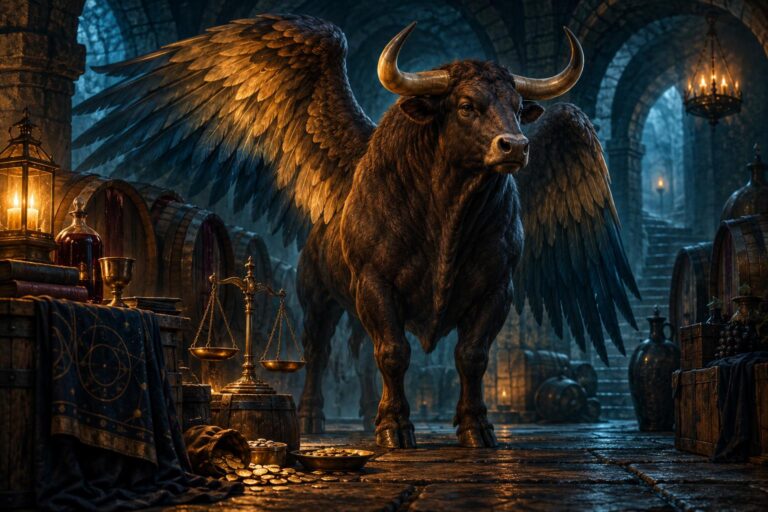
| 61 | Zagan | King and President | 33 | Griffin-winged bull; turns wine to water |
| 68 | Belial | King | 80 | Appears in a chariot of fire; grants dignities |
Key Takeaways
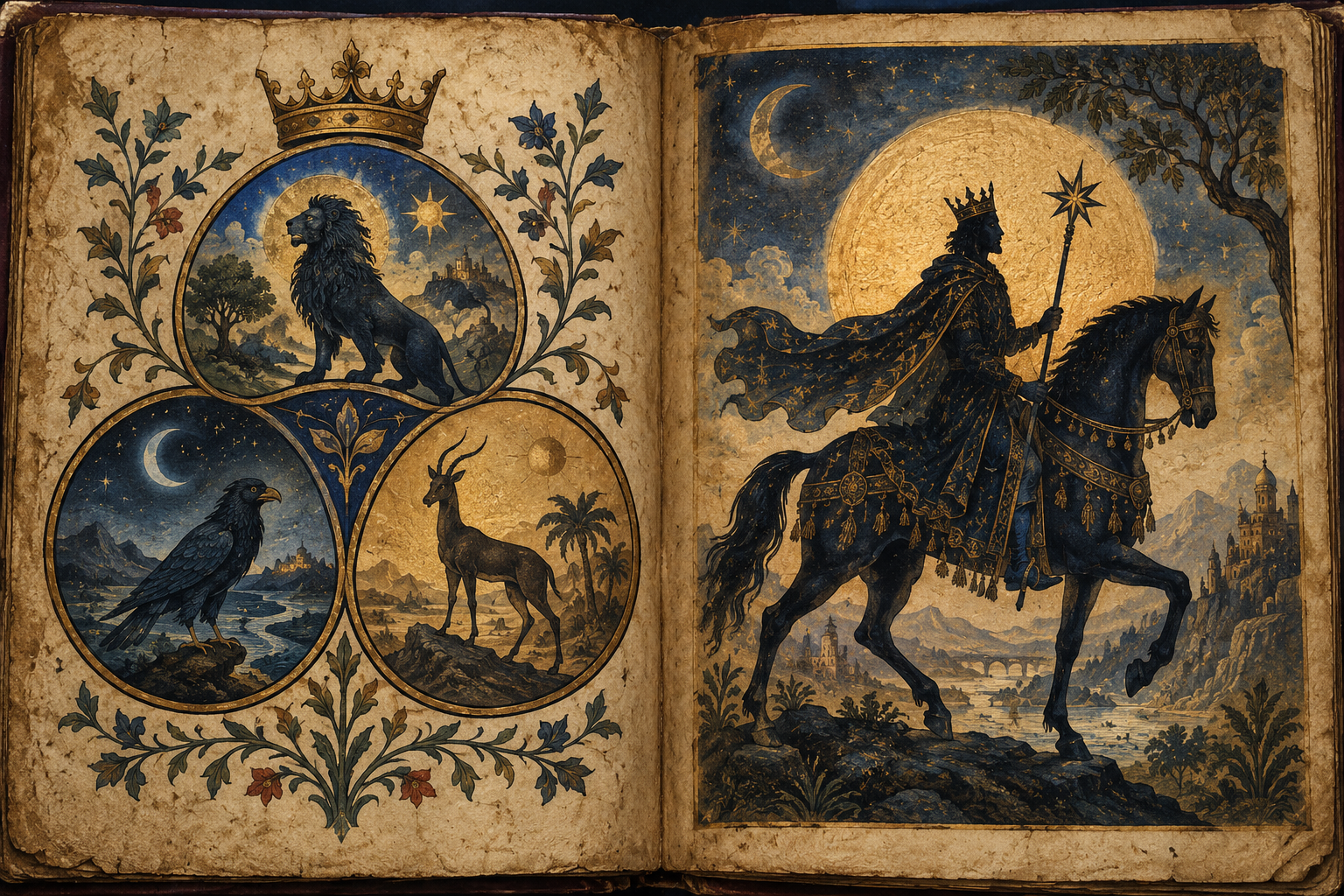
In the Ars Goetia, the first book of the Lesser Key of Solomon, Paimon is listed as the ninth of seventy-two spirits and given the rank of king. The text calls him a great king, obedient to Lucifer, and says he appears as a man with an effeminate face, wearing a glittering crown and riding a dromedary. He is preceded by a host of spirits playing trumpets, cymbals and other instruments, and he speaks with a loud, roaring voice that the magician is supposed to compel into clarity.
The grimoire credits Paimon with teaching all arts, philosophy and sciences, revealing secret things, and giving dignities and familiars. He is said to command two hundred legions, drawn partly from the order of Angels and partly from the order of Potentates. Two further kings, Bebal and Abalam, are described as following him when he is called with offerings. The text instructs that he be observed toward the west, a detail that links him to older systems of directional spirit-rulers.
Everything above is a description of what the book says, not a claim about reality. Djinn Guide does not provide instructions for calling or working with any spirit. Reading these passages closely shows how an early modern compiler imagined a hierarchy of spirits, and how much of that imagery survives in modern depictions of the Paimon demon.
Bael opens the list. The Ars Goetia calls him the first principal spirit, a king ruling in the east, commanding sixty-six legions. His appearance is one of the strangest in the book: he can show himself as a cat, as a toad, as a man, or as all three shapes at once. He speaks hoarsely, and the single power attributed to him is making those who ask invisible.
The name is the most transparent in the whole list. Bael is a spelling of Baal, the Northwest Semitic word for lord or master, used in the Hebrew Bible for Canaanite and Phoenician deities, most famously Baal Hadad, a storm god. By late antiquity Baal had become, in Jewish and Christian writing, a byword for false worship, and medieval and Renaissance demonologists folded the name into their catalogues as a demon. The bael demon of the grimoires is therefore a repurposed title, not a continuous figure from Canaanite religion.
Johann Weyer’s Pseudomonarchia Daemonum of 1577, the printed list on which much of the Goetia depends, also places Bael first. Reginald Scot translated Weyer into English in The Discoverie of Witchcraft in 1584, so English readers already knew a King Bael decades before the Lemegeton manuscripts were compiled.
Does this touch your own situation? Many readers come to these pages because something in their home, dreams or family feels unexplained. Reading history helps, but it cannot look at your specific case.
Consult the Sheikh Private, confidential, and free to ask.
The Goetia assigns each spirit one or more offices borrowed from feudal Europe: king, duke, prince, marquis, count or earl, knight, and president. Kings sit at the top, and most editions count nine of them: Bael (1), Paimon (9), Beleth (13), Purson (20), Asmoday (32), Vine (45), Balam (51), Zagan (61) and Belial (68). Two of these, Vine and Zagan, hold a second office as well. You can see how the whole ladder fits together in our guide to the Goetia rank system.
Rank in the text is tied to planetary and directional ideas that the compiler only half explains. Mathers and Crowley’s 1904 edition adds a scheme in which kings correspond to the Sun, dukes to Venus, princes to Jupiter, and so on, along with the metals and colors a magician was supposed to use for each seal. Those correspondences are not in the earliest manuscripts; they are an editorial layer.
Neither name was invented by the compiler of the Lesser Key. Bael, as noted, is Baal. Paimon is harder. Some writers connect the name to Arabic or Hebrew roots, and a few modern occult authors propose links to a Middle Eastern figure, but no primary source confirms any of this. The earliest clear appearance of a spirit called Paymon is in the same sixteenth-century cluster: Weyer’s Pseudomonarchia Daemonum and Scot’s English rendering, both of which give the dromedary, the crown, the music and the effeminate face.
Behind Weyer stands a lost or partially known manuscript tradition. Weyer himself said he was publishing from a text he called the Liber officiorum spirituum, the Book of the Offices of Spirits, a genre of spirit catalogue that circulated in Latin and vernacular manuscripts from at least the fifteenth century. Surviving fragments show the kings, legions and animal forms being reshuffled long before anyone printed them.
Readers who want to trace these layers should compare the surviving witnesses, which is the subject of our page on manuscript and printed Goetia editions. The short version: the Paimon and Bael you find on the internet today are mostly the Mathers and Crowley text, which is itself a composite of British Library manuscripts copied in the seventeenth century.
The Ars Goetia is only one branch of a much older Solomonic story. In the Greek Testament of Solomon, composed somewhere between the first and fifth centuries CE, Solomon uses a ring to question and bind a series of demons, each of whom confesses a name, a function and the angel who thwarts him. That text has no Bael and no Paimon, but it establishes the pattern of named spirits with offices that the later grimoires elaborate. Readers interested in that earlier layer can start with our article on King Solomon and the jinn.
Islamic and Arabic folk traditions developed their own royal spirits. Popular Arabic occult manuscripts, and later North African and Southeast Asian practice, speak of seven kings of the jinn, each assigned to a day of the week and a planet. These jinn kings share features with the Goetia kings, such as planetary rulership and large retinues, but the names are different and there is no direct textual line between the two systems. Similarities most likely reflect a shared Hellenistic and late antique astrological inheritance.
In Southeast Asian khodam belief, the servant spirit is usually anonymous and tied to an object or lineage rather than catalogued with a rank. Side by side, the Goetia’s bureaucratic flavor of legions, titles and offices stands out as a distinctly European reworking of older material.
The most widespread confusion today comes from the 2018 film Hereditary, which built its plot around a cult devoted to Paimon. The film borrowed the name, the kingship and the idea of a male host, but its version of Paimon as a possessing entity seeking a body has no basis in the grimoire. Viewers searching for the king paimon of the film find a very different figure in the Ars Goetia: a teacher of arts and sciences who is described as a visitor, not an occupant.
A second misunderstanding treats Paimon as gentle or benevolent because the text says he teaches. The Goetia makes no moral judgment about any of its spirits; it is a catalogue of functions. Reading him as either friendly or evil imports modern categories the compiler did not use.
With Bael, the common error is assuming the Goetia’s Bael is the same as the biblical Baal, as if the Canaanite deity simply became a demon. The relationship is one of borrowed name and inherited hostility, not continuous identity. A fourth error is the claim that Paimon or Bael appear in the Quran or in classical Islamic jinn lore. They do not. The jinn of Islamic sources are a separate category, as our beginner page on what jinn are explains.
Search interest in the Paimon demon is driven by a mix of film, games, television and online occult communities. Hereditary is the largest single factor, but Paimon also appears in video games, in demonology-themed anime and manga, and in a long tail of forum posts and social media videos. Bael is searched mostly as a name encountered in games, older literature, or the first entry of the Goetia.
A smaller, steady stream of searches comes from readers interested in the history of magic as an academic subject. Recent scholarly editions of the Lemegeton and studies of Weyer and Scot have made it easier to read the Goetia as a historical document rather than a manual. That is the lens Djinn Guide uses: the kings show how early modern Europeans organized the invisible world.
Finally, the seals themselves draw attention. Paimon’s sigil in particular has become a popular tattoo and design motif, often used by people who know only that it looks striking. Our page on Goetia names, offices and seals explains what the sigils are and how they were drawn in the manuscripts.
When you read any Goetia entry, keep four questions in mind. First, which edition is in front of you? The Mathers and Crowley text, Peterson’s edition based on Sloane manuscripts, and the Weyer and Scot lists all differ in small ways, including legion counts and spelling. Second, which details are old and which are editorial? Directions, planetary attributions and seal colors are largely later additions. Third, what did the compiler mean by a power like invisibility or teaching sciences? These are formulaic phrases shared across many entries. Fourth, where did the name come from, and does that origin actually explain the spirit’s description?
Applied to Bael, those questions reveal a borrowed Semitic title attached to a three-form shapeshifter, placed first probably because Baal was the most famous false god in the Christian imagination. Applied to Paimon, they reveal a court pageant with music, and teaching powers that match the Renaissance ideal of the learned magician. Neither reading requires belief.
For readers continuing from here, the natural next steps are the full list of the 72 spirits and the entries on individual spirits such as Belial, Asmodeus and Astaroth, which show how the royal and ducal offices were distributed across the whole catalogue.
Still have a question about your own experience? Describe what you are seeing, feeling or dreaming, and when it started. The Sheikh reads every message personally and replies in private.
Drawn to these figures for a reason? If your interest in the Goetic kings is tied to a question about your own path, a Full Personal Reading with our partner PuraTarot offers a calm, personal space to reflect on it. Join the free Djinn Guide newsletter and, once you confirm, you will unlock a 50% code for your first reading.
Further reading
As an Amazon Associate we earn from qualifying purchases.
The Ars Goetia describes King Paimon as the ninth spirit, a great king with 200 legions who teaches arts, sciences and philosophy, reveals hidden things and grants dignities. He is said to appear crowned on a dromedary, preceded by musicians, and to be observed toward the west.
Not exactly. Bael's name comes from Baal, a Semitic title meaning lord that the Hebrew Bible applies to Canaanite gods. Later Christian demonology reused the name for a demon. The Goetia's Bael, a king who appears as a cat, toad and man, is a Renaissance figure wearing an ancient name.
Most editions list nine kings: Bael, Paimon, Beleth, Purson, Asmoday, Vine, Balam, Zagan and Belial. Vine and Zagan also hold a second office. The count can shift slightly between manuscripts, since some copies give a spirit a different rank or drop a title.
The film borrowed the name, the title of king and the idea of a cult, but its possession plot is not in the grimoire. The Ars Goetia presents Paimon as a spirit that appears when called, teaches and departs. The film's version is an original dramatic creation that reused historical vocabulary.
The earliest clear printed source is Johann Weyer's Pseudomonarchia Daemonum of 1577, translated into English by Reginald Scot in 1584. Weyer drew on a manuscript catalogue called the Book of the Offices of Spirits. The Lemegeton manuscripts that contain the Ars Goetia date from the seventeenth century.
Disclaimer
This article describes historical texts and beliefs about spirits for educational and cultural purposes. The descriptions of King Paimon, Bael and other Goetic spirits summarize what early modern grimoires say; Djinn Guide does not endorse these beliefs, make any claims about results, or provide ritual instructions.
Did this guide help you understand the subject? Rate it and share your honest opinion to help other readers. Every review is checked by our editors before it appears.
There are no reviews yet. Be the first one to write one.


Sheikh Youssef
Tayeb El Merzouki
For inquiries about personalized spiritual work, private rituals, and traditional talismans, connect directly with Sheikh Youssef Tayeb El Merzouki.
Chat on WhatsApp