





Join Djinn Guide: Get 50% Off a Personal Reading
Get new guides to jinn, folklore and occult history. Confirm your subscription to unlock a 50% code for a first personal reading with our partner PuraTarot.
Discover the unseen
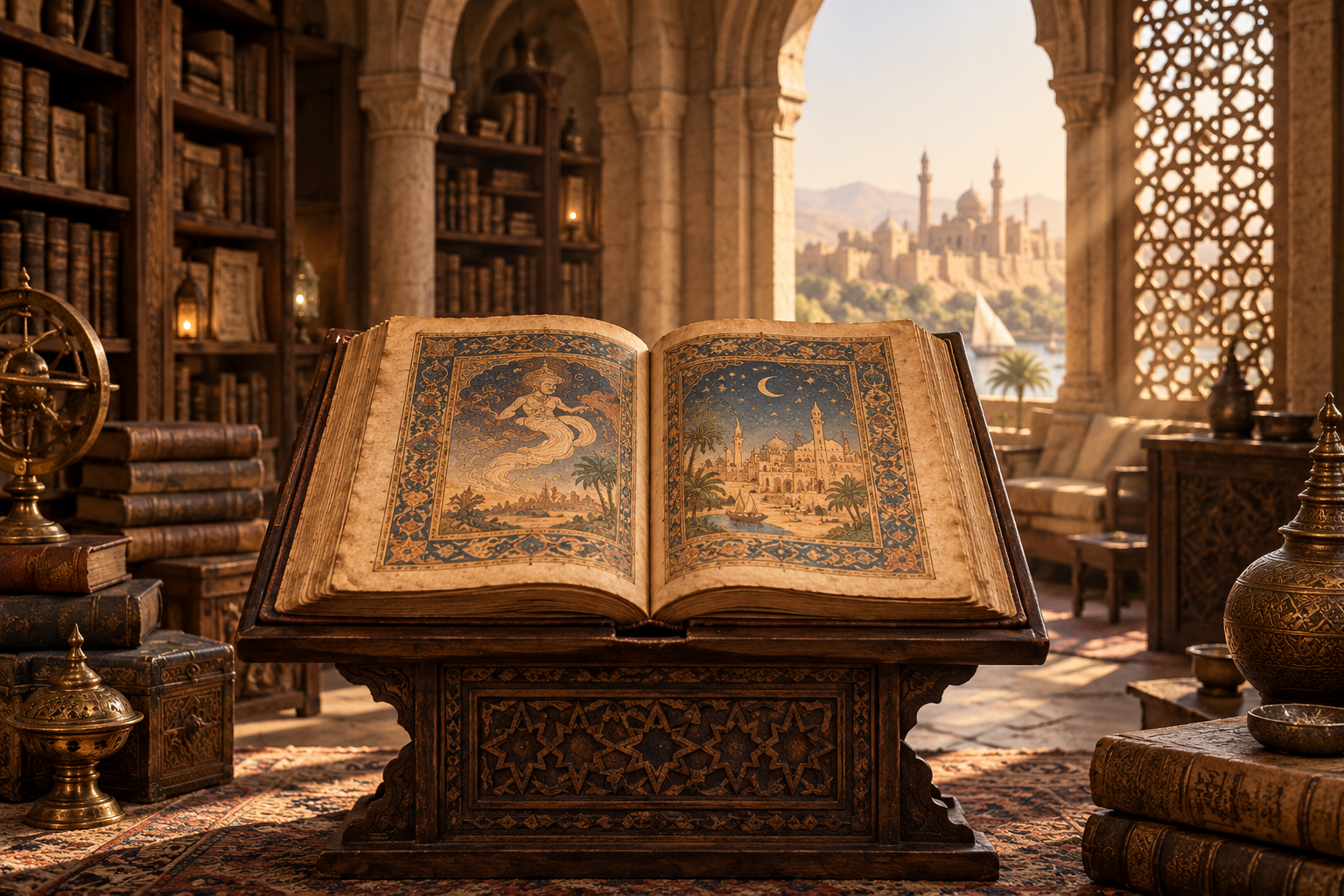
Jinn mythology began in pre-Islamic Arabia and spread with Islam to Persia, Turkey, Morocco, India, East Africa and Java. See how each culture retold jinn.
Quick answer: Jinn mythology is the body of belief and story about the jinn, unseen beings that pre-Islamic Arabs thought lived in deserts, ruins and wild places and that the Qur'an later described as a created species with free will. As Islam spread, that core idea traveled to Persia, Turkey, North Africa, South Asia, the Swahili coast and Southeast Asia, where it blended with local spirits. The Arabian Nights and, much later, European translations turned some of these jinn into the genie of popular culture.
Related guides: what jinn are, for beginners, the different types of jinn, jinn in the Arabian Nights, the Moroccan legend of Aisha Kandisha, shedim in Jewish tradition, jinn in Islamic teaching.
| Region | Local names | Typical setting in folklore | Distinctive feature |
|---|---|---|---|
| Pre-Islamic Arabia | jinn, jann, ghul, si'lat | Deserts, ruins, wells, the valley of Abqar | Jinn as inspirers of poets and as nature spirits |
| Islamic scripture | jinn, shaytan, ifrit, qarin | Created from smokeless fire; share the world with humans | Moral agency: believing and unbelieving jinn |
| Persia and Iran | jinn, div (dev), pari | Mountains, abandoned bathhouses | Overlap with older Persian demons and fairies |
| Turkey and the Balkans | cin, in-cin, peri | Crossroads, ruins, hammams at night | Euphemisms used to avoid saying the word |
| Morocco and the Maghreb | jnun, mluk, Aisha Kandisha | Rivers, drains, hammams, marketplaces | Named jinn tied to places; Gnawa and healing music |
| South Asia | jinn, jinnat, bhoot overlap | Old trees, graveyards, Mughal-era buildings | Jinn stories alongside Hindu and local ghost lore |
| Swahili coast | majini, pepo, jini | The sea, coral islands, mangroves | Sea jinn and spirit possession traditions |
| Indonesia and Malaysia | jin, khodam, hantu | Forests, heirlooms, villages | Servant-spirit belief and the keris tradition |
Key Takeaways
Jinn mythology is the wide field of belief, story and custom surrounding the jinn, beings that Arabic-speaking peoples have described for well over fourteen centuries as living alongside humans but normally hidden from them. The Arabic root j-n-n carries the sense of concealment, and related words cover anything veiled from sight. The jinn are, in the plainest sense, the hidden ones. The spelling djinn comes through French, and the English word genie comes from the Latin genius, which Galland used when translating the Arabian Nights.
The mythology has two layers that are easy to confuse. The first is scripture: the Qur’an describes jinn as created from smokeless fire, possessing free will and capable of belief or disbelief, and Surah 72, Al-Jinn, is named for them. The second is folklore: the enormous body of local stories about jinn in wells, ruins, bathhouses and forests, told in Arabic, Persian, Turkish, Urdu, Swahili, Malay and dozens of other languages. Scripture gives the jinn their nature; folklore gives them their personalities, haunts and names.
This article follows the folklore layer across the regions where it took root. For the scriptural side, start with what jinn are, explained for beginners, and for the classifications that folklore added, see the different types of jinn.
Before Islam, the tribes of the Arabian Peninsula already told stories about jinn. Classical Arabic poetry and later Muslim writers who recorded pre-Islamic customs describe jinn as spirits of the wild: of deserts, abandoned campsites, dark valleys and the hours between dusk and dawn. Travelers were said to seek the protection of the lord of a valley before sleeping there. The ghul, a shape-shifting creature that lured travelers off the road, and the si’lat, a female jinn of unusual cunning, belong to this layer.
One of the most striking pre-Islamic ideas is that jinn inspired poets. Each great poet was thought to have a jinn companion who supplied his verses, and tradition names a valley called Abqar as the home of these poetic jinn. Later Arabic kept the memory in the word abqari, meaning a genius, which is a neat parallel to the Latin genius behind the English genie. Some tribes are reported to have sacrificed to jinn or to have regarded them as kin of the gods, a practice that the Qur’an explicitly criticizes.
Historians treat these accounts carefully, because most were written down after Islam by Muslim scholars. Even so, the picture of jinn as nature spirits tied to places is consistent across sources and survives in rural folklore today.
Does this touch your own situation? Many readers come to these pages because something in their home, dreams or family feels unexplained. Reading history helps, but it cannot look at your specific case.
Consult the Sheikh Private, confidential, and free to ask.
The Qur’an did not invent the jinn, but it redefined them. Instead of local nature spirits, the jinn became a species created by God, parallel to humans, with the same obligation to believe and the same prospect of judgment. Surah Al-Jinn describes a group of jinn who hear the Qur’an recited and accept it. Surah An-Naml (27:38-40) describes an ifrit of the jinn offering to bring the Queen of Sheba’s throne to Solomon, which fixed the image of jinn in service to a prophet-king. Iblis, who refused to bow to Adam, is identified in Surah Al-Kahf (18:50) as one of the jinn.
Hadith literature and later scholarship filled in details: that jinn eat, marry and die; that some are Muslims and some are not; that they can take animal forms; that each person has a companion jinn, the qarin. These teachings gave folklore across the Muslim world a shared vocabulary. A storyteller in Fez, Istanbul, Lahore or Zanzibar could assume that listeners knew the jinn were real, hidden, morally mixed and sometimes dangerous, and could build local tales on that foundation.
The framework also set limits. Because scripture treats jinn as creatures, not gods, folklore that veered into worship was pushed to the margins, surviving in healing cults and possession rituals rather than in mainstream religion.
As Islam spread, the jinn met older spirit worlds and absorbed them. The results differ region by region.
Persian tradition already had the div, a demonic giant of the Shahnameh, and the pari, a beautiful winged spirit. Jinn stories in Iran often sit beside these older figures, and bathhouses, which were believed to be jinn haunts, appear again and again in Persian folk tales.
In Turkish the jinn became the cin, and people often avoided the word, using phrases such as the three-lettered ones or the good ones instead. Ottoman folklore placed cin at crossroads, in ruins and in empty hammams after dark, and the peri, borrowed from Persian, became a gentler counterpart.
North African folklore is unusually rich in named jinn. Aisha Kandisha, a female jinn associated with rivers and drains, is the most famous, and the Gnawa musical tradition addresses a whole court of spirits called mluk through color-coded songs. Hammams, slaughterhouses and markets are typical haunts, and healing ceremonies involving jinn remain part of regional culture.
In India, Pakistan and Bangladesh, jinn stories share space with Hindu and local ghost lore. Jinn are said to live in old trees and Mughal-era buildings, and the Feroz Shah Kotla fort in Delhi is known for letters left to the jinn believed to dwell there.
Along the East African coast, majini are often sea spirits, and possession traditions address them by name. In Indonesia and Malaysia, jin joined a crowded world of hantu and ancestral spirits, producing the khodam or servant-spirit belief and the lore of the keris dagger.
Folklore gave the jinn their haunts; literature gave them their fame. The One Thousand and One Nights, a collection assembled over centuries from Persian, Indian and Arabic sources, is full of jinn: the jinni released from a brass bottle by a fisherman, the jinn who carry sleeping lovers across the world, the jinn who guard treasures and the jinn who are tricked, bound or married. These stories draw on the folklore but shape it for entertainment, giving jinn personalities, speeches and plots.
The Nights reached Europe through Antoine Galland’s French translation of 1704-1717, and Galland added tales he had heard from a Syrian storyteller, Hanna Diyab, including Aladdin and Ali Baba. Aladdin’s two genies, one in a ring and one in a lamp, were not in the Arabic manuscripts Galland worked from, yet they became the most famous jinn in the world. Through Galland, English translators and eventually film, the jinn of folklore became the wish-granting genie, a figure that owes as much to European fantasy as to Arabian belief.
That transformation is why jinn mythology and genie mythology feel so different. One is a living belief about hidden neighbors; the other is a literary device. The site’s survey of jinn in the Arabian Nights traces the stories, and Aladdin’s ring and lamp genies follows the genie’s path into popular culture.
The first misunderstanding is that jinn are simply Islamic demons. In both scripture and folklore, jinn are morally varied: some are faithful, some are hostile, many are indifferent. The hostile ones are called shayatin, and the word shaitan describes a role rather than a species. Treating all jinn as evil flattens a tradition that is far more interesting in its range.
The second is that jinn mythology is one unified thing. A Moroccan story about Aisha Kandisha, a Turkish warning about cin in a hammam and a Javanese account of a khodam attached to a keris share a word and a scriptural backbone, but they belong to different cultures with different older spirit beliefs. The third is that the genie of the lamp represents jinn folklore. It represents one tale, added to the Nights in 18th-century Paris, and filtered through three centuries of European retelling.
A fourth misunderstanding is that jinn lore is a thing of the past. Across the Muslim world, jinn remain part of everyday speech, religious teaching and local custom. Stories are still told, precautions are still taken, and new tales appear online. Folklore is not a museum; it is an ongoing conversation.
Interest in jinn has grown well beyond the regions where the belief is traditional. Horror films from Turkey, Indonesia, Pakistan and the Gulf have made jinn a global genre figure, and Western films and series have borrowed them as an alternative to vampires and ghosts. Video games and fantasy novels have introduced ifrits, marids and jinn courts to readers who never met the folklore directly.
Social media added another layer. Short videos about jinn sightings, jinn-haunted places and jinn-related customs circulate widely, as do the Indonesian cek khodam trend and similar games. Many searchers want to know whether the beliefs are taken seriously. They are, by hundreds of millions of people as a matter of religion, while also serving as entertainment, metaphor and cultural memory.
There is also a scholarly and personal interest. Students of comparative religion compare jinn with the shedim of Jewish tradition, with Greek daimones and with the fairies of European folklore; readers with roots in these cultures look for the stories their grandparents told.
A few questions help make sense of any jinn story. Where was it told, and in what language? A story from the Moroccan Rif and a story from Java use the same word for very different beings. When was it recorded, and by whom? Medieval scholars, colonial-era folklorists and modern video creators all have their own reasons for telling a tale. What genre is it? Scripture, hadith, a literary collection like the Nights, a local legend and a horror film are different kinds of speech and should not be weighed alike.
It also helps to separate the shared backbone from the local flesh. The backbone, drawn from the Qur’an and hadith, is remarkably stable: hidden beings, created from fire, with free will, living in a parallel society. The flesh changes with every region: the haunts, the names, the warnings, the cures. Noticing which part of a story is which is the single most useful skill in reading jinn folklore.
Finally, read with respect. For many people these are not stories but facts of faith, and for many others they are cherished heritage. This site describes jinn mythology as belief and literature without endorsing or dismissing it, and it does not provide any instructions for dealing with jinn. The goal is understanding, and the stories reward it.
Still have a question about your own experience? Describe what you are seeing, feeling or dreaming, and when it started. The Sheikh reads every message personally and replies in private.
Drawn to these stories for a reason? If one of these traditions speaks to something in your own life, a Full Personal Reading with our partner PuraTarot offers a quiet, personal way to reflect on it. Join the free Djinn Guide newsletter and, once you confirm, you will unlock a 50% code for your first reading.
Further reading
As an Amazon Associate we earn from qualifying purchases.
Jinn mythology is the body of belief and folklore about the jinn, hidden beings described in pre-Islamic Arabian tradition and in the Qur'an as a created species with free will. It includes scripture, hadith, the stories of the Arabian Nights and the local legends of every region where Islam spread.
Yes. Pre-Islamic Arabs described jinn as spirits of deserts, ruins and valleys, and believed poets were inspired by jinn companions from a valley called Abqar. The Qur'an later redefined jinn as a created species accountable to God, but the older folklore of places and haunts survived alongside the scriptural view.
Jinn are beings of Islamic scripture and Middle Eastern folklore, morally varied and normally hidden. The genie is a European literary figure, named from the Latin genius, that emerged from translations of the Arabian Nights, especially the Aladdin tale added by Galland in the early 1700s. Wish-granting is a feature of the genie, not of folk jinn.
Arabian, Persian, Turkish, Kurdish, North African, South Asian, Swahili and Southeast Asian cultures all have jinn traditions, each blended with older local spirit beliefs. Morocco is known for named jinn such as Aisha Kandisha, Turkey for euphemisms about cin, and Indonesia and Malaysia for the khodam servant-spirit belief.
Not as a whole. Islamic sources describe believing and unbelieving jinn, and folklore includes helpful, hostile and indifferent ones. The hostile jinn are called shayatin. Some stories feature frightening jinn such as the ghul, but the tradition as a whole presents jinn as a varied society rather than a class of demons.
Disclaimer
This article surveys jinn mythology as folklore and religious belief for educational purposes. Beliefs are described, not endorsed or dismissed, and nothing here is offered as practical guidance for dealing with spirits.
Did this guide help you understand the subject? Rate it and share your honest opinion to help other readers. Every review is checked by our editors before it appears.
There are no reviews yet. Be the first one to write one.


Sheikh Youssef
Tayeb El Merzouki
For inquiries about personalized spiritual work, private rituals, and traditional talismans, connect directly with Sheikh Youssef Tayeb El Merzouki.
Chat on WhatsApp