







Join Djinn Guide: Get 50% Off a Personal Reading
Get new guides to jinn, folklore and occult history. Confirm your subscription to unlock a 50% code for a first personal reading with our partner PuraTarot.
Discover the unseen
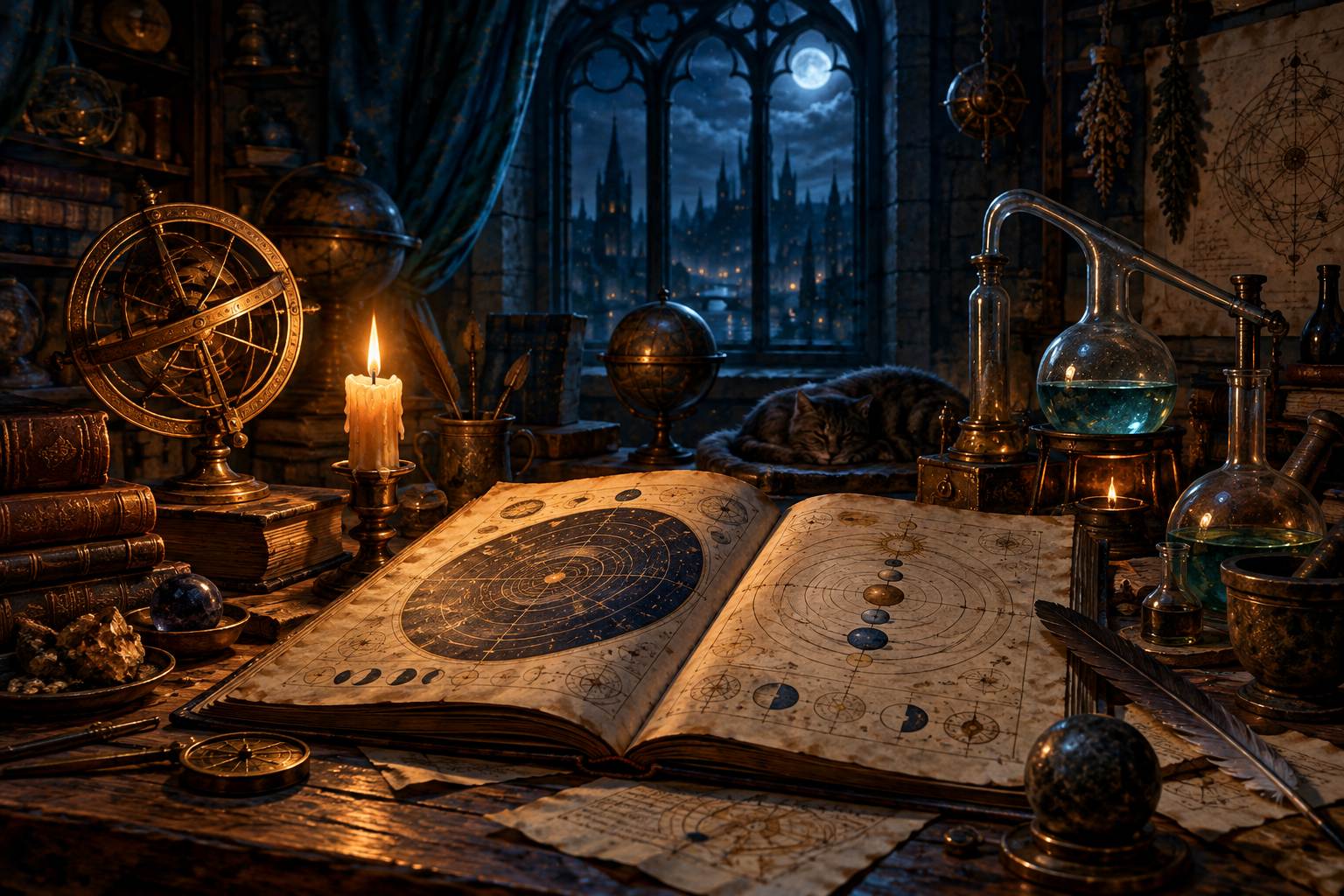
Occult meaning explained: what the occult is, where the word came from, the occult sciences of astrology, alchemy and magic, and how occultism began.
Quick answer: The occult meaning, in its simplest form, is hidden knowledge. The word comes from the Latin occultus, meaning concealed or secret, and the occult refers to beliefs and practices that claim access to hidden forces or truths beyond ordinary perception: astrology, alchemy, ritual magic, divination, spirit communication and related arts. Historically these were called the occult sciences; since the mid-nineteenth century the organized study and practice of them has been known as occultism.
Related guides: demonology as a field of study, grimoire meaning and the famous grimoires, Hermeticism and the Hermetic texts, Agrippa's Three Books of Occult Philosophy, the Picatrix and Arabic occult science, what Kabbalah is and how occultists used it.
| Period | Term in use | What it covered | Representative text |
|---|---|---|---|
| Classical antiquity | Hidden properties (occultae qualitates) | Unexplained powers of stones, plants, magnets | Pliny, Natural History |
| Islamic Golden Age | Hidden sciences (al-ulum al-khafiyya) | Astrology, talismans, letter magic, alchemy | Picatrix (Ghayat al-Hakim) |
| Renaissance | Occult philosophy, occult sciences | Natural, celestial and ceremonial magic; Kabbalah | Agrippa, De occulta philosophia (1533) |
| 19th century | Occultism (occultisme) | Revived magic, Tarot, mesmerism, spiritualism | Eliphas Levi, Dogme et Rituel (1854–56) |
| Late 19th to 20th century | The occult, esotericism | Initiatory orders, Theosophy, Thelema, Wicca | Golden Dawn papers; Crowley |
| Today | Occult, esoteric, Western esotericism | Academic field plus popular and online practice | University programs and surveys |
Key Takeaways
The occult meaning begins with a Latin verb, occulere, to cover over or conceal. Its past participle occultus meant hidden, and medieval scholars used it for properties of things that could not be explained by their visible qualities. Why does a magnet attract iron? Why does a certain herb affect the body? These were called occult qualities, hidden powers known by their effects rather than their causes. The term was neutral and scientific in intent.
From this root grew the phrase occult sciences, which by the sixteenth century named three main disciplines: astrology, the study of celestial influence; alchemy, the transformation of matter and of the self; and magic, understood as the art of working with hidden correspondences between the heavens, the natural world and the human being. Divination, numerology and the Kabbalah were often added. In this older sense, the occult was a body of knowledge, not a cult or a creed.
The modern noun, the occult, is more recent and vaguer. It emerged in the nineteenth century as a collective label for all practices that claim contact with hidden forces, spirits or truths, and it absorbed newer movements like spiritualism and ceremonial magic revival. Today the dictionary definition still reads hidden or secret knowledge, but the everyday connotation leans toward the supernatural and, in some contexts, the sinister.
Hidden knowledge is older than the word. Ancient Mesopotamia produced omen collections, astrological records and exorcism texts; Egypt produced spells, amulets and temple lore; Greece added philosophical frameworks, especially the Platonic idea that the visible world reflects an invisible one. In late antiquity these strands mixed in Alexandria into the Hermetic writings, texts attributed to Hermes Trismegistus that teach the kinship of the cosmos and the soul. Those writings are examined in Hermeticism and the Hermetic texts.
Jewish tradition contributed angelology, the power of divine names and, later, the Kabbalah. Christian writers debated whether natural magic could be lawful while condemning demonic magic. The Greek magical papyri of Egypt, dating from the second century BCE to the fifth century CE, show how practical these ideas became, with recipes mixing Greek, Egyptian and Jewish divine names. They are the ancestors of the medieval grimoires described in grimoire meaning and the famous grimoires.
None of these cultures had a single word matching the occult. What they shared was the conviction that some knowledge was reserved, either because it was dangerous, because it was sacred, or because only the trained could understand it. That conviction, more than any specific practice, is what the later term tried to capture.
Does this touch your own situation? Many readers come to these pages because something in their home, dreams or family feels unexplained. Reading history helps, but it cannot look at your specific case.
Consult the Sheikh Private, confidential, and free to ask.
Between the eighth and twelfth centuries, scholars writing in Arabic produced the most systematic treatment of hidden sciences in the medieval world. Astrology flourished at the Abbasid court; alchemy developed through the writings attributed to Jabir ibn Hayyan; and talismanic magic reached a high point in the Ghayat al-Hakim, known in Latin as the Picatrix, composed in Spain in the eleventh century. Arabic authors distinguished the hidden or strange sciences from the religious ones and argued at length about which were permissible.
These works crossed into Latin Europe through translation centers in Toledo and Sicily. The Picatrix was translated for King Alfonso X of Castile in the 1250s. Latin scholars such as Albertus Magnus discussed occult qualities, and universities taught astrology as part of medicine. Alongside this learned tradition ran a less respectable literature of ritual magic, the Solomonic texts and the Ars Notoria among them, which promised power over spirits or miraculous learning and were repeatedly condemned by church authorities.
The medieval occult was therefore two things at once: an accepted branch of natural philosophy and an underground of forbidden books. The same person might practice astrology openly and copy a conjuration in secret. Understanding this double life explains why the word occult later came to mean both scholarly and sinister.
The Renaissance gave the occult its classic shape. Three figures stand out:
The Florentine philosopher translated Plato and the Hermetic texts into Latin and defended a natural, astrological magic that drew down celestial influences through music, scents and images.
Pico combined magic with the Jewish Kabbalah, arguing that Hebrew letters and divine names confirmed Christian truth. His Christian Kabbalah became a lasting component of Western occultism.
Agrippa’s De occulta philosophia libri tres, printed in 1533, organized the field into natural, celestial and ceremonial magic, covering stones, herbs, numbers, planetary squares, angels and the names of God. It became the standard reference for centuries, as described in Agrippa’s Three Books of Occult Philosophy.
The Swiss physician tied alchemy to medicine and insisted that nature’s hidden virtues could be learned by experiment, bridging occult tradition and early science.
For these men, occult philosophy was a respectable, even pious, pursuit. The same century, however, saw the rise of witch trials and Protestant and Catholic campaigns against magic, so that by 1600 the occult philosopher was increasingly suspect.
The Enlightenment pushed the occult sciences out of the universities, but it did not kill them. Freemasonry, Rosicrucian legends and mesmerism kept hidden knowledge alive in a new, club-like form. Then, in 1854 to 1856, the French writer Alphonse Louis Constant, writing as Eliphas Levi, published Dogme et Rituel de la Haute Magie. Levi fused Agrippa, Kabbalah, the Tarot and his own imagination into a system, and the term occultisme spread from his circle into English as occultism by the 1870s.
Organized occultism followed quickly. The Theosophical Society was founded in New York in 1875, promising ancient wisdom from Eastern masters. The Hermetic Order of the Golden Dawn, founded in London in 1888, built a graded curriculum of Kabbalah, astrology, Tarot, Enochian and ceremonial magic that still underlies much modern practice. Aleister Crowley, a former member, published the Lemegeton’s Goetia with Mathers in 1904 and founded Thelema. Later currents, from Gerald Gardner’s Wicca to chaos magic, continued the pattern of new systems built from old books.
This is the occult most people picture: robed initiates, sigils, Tarot and secret societies. It is a Victorian and twentieth-century creation, drawing on older material but organized in a distinctly modern way, with lodges, degrees, published rituals and an appeal to science as much as to tradition.
The first misunderstanding equates the occult with Satanism or devil worship. Historically, most occult practitioners were Christians, Jews or Muslims who believed they were working within, not against, their faith. Satanism as an organized movement dates from the twentieth century and represents a small fraction of the field. The second confusion equates occult with evil. The word simply means hidden; a secret recipe or a buried treasure is occult in the original sense.
A third error treats the occult as one unified system. In reality it is a loose family of traditions that often contradict each other: an astrologer, an alchemist, a Goetic magician and a spiritualist medium share little beyond the idea of hidden forces. A fourth error assumes continuity. Modern practices frequently claim ancient pedigrees, but many were assembled in the last two hundred years. Claims of unbroken secret lineages should be read with care.
Finally, the occult is sometimes confused with demonology, the study of demons, or with the paranormal, the investigation of ghosts and psychic phenomena. They overlap, but demonology is a sub-field with its own history, outlined in demonology as a field of study, and the paranormal is a largely modern, investigative category.
Interest in the occult rises in periods of uncertainty and whenever popular culture rediscovers it. Television series, films and games built around grimoires, demons and witchcraft have introduced millions of people to names like Agrippa, the Goetia and the Key of Solomon. Social media has turned Tarot, astrology and sigil-making into mainstream hobbies, often stripped of their historical context. At the same time, universities have made Western esotericism a recognized field, with chairs in Amsterdam, Paris and elsewhere and a growing body of serious scholarship.
Searches for occult meaning, occult definition and what is the occult therefore come from very different people: students writing papers, readers of fiction, practitioners looking for sources and believers worried about what the term implies. A good answer has to serve all of them by separating three questions: what the word means, what the traditions historically taught, and what anyone today believes about them.
This site approaches the occult as cultural and intellectual history. We explain texts, symbols and practices as they appear in the sources, we treat beliefs as beliefs, and we do not provide ritual instructions or claim that any practice produces results.
Because the field is full of pseudonymous texts and invented histories, a few habits help. Ask when a text was actually written, not when it claims to have been written; the Key of Solomon, for instance, is a medieval and Renaissance work, not a product of ancient Israel. Ask who edited the version you are reading and what they changed; the 1904 Mathers and Crowley Goetia differs from the manuscripts in several places. Ask whether a correspondence, such as a planet assigned to a demon, comes from the original source or from a later commentator.
It also helps to distinguish primary sources, such as grimoires, treatises and letters, from secondary ones, such as encyclopedias and modern handbooks, and to notice when a secondary source quietly becomes a primary one, as happened with the Dictionnaire Infernal and its engravings. Symbols deserve the same scrutiny, since their meanings shift with time and context.
Read this way, the occult stops being a single mysterious thing and becomes what it always was: a long, layered conversation about hidden order in the world, carried on by philosophers, physicians, poets, charlatans and believers across many centuries.
Still have a question about your own experience? Describe what you are seeing, feeling or dreaming, and when it started. The Sheikh reads every message personally and replies in private.
Have a question of your own? The occult began as a search for hidden meaning, and many readers bring that same curiosity to their own lives. A Custom Spiritual Session with our partner PuraTarot offers a personal, reflective look at a specific question, sign or decision. Join the free Djinn Guide newsletter and, once you confirm, you will unlock a 50% code for your first reading.
Further reading
As an Amazon Associate we earn from qualifying purchases.
Occult means hidden or secret, from the Latin occultus. In common usage the occult refers to beliefs and practices concerning hidden forces or knowledge, such as astrology, alchemy, magic, divination and spirit communication. The word itself carries no judgment about good or evil; that connotation was added later.
Esoteric means intended for an inner circle, from the Greek esoterikos, and refers to knowledge reserved for initiates. Occult means hidden and historically referred to concealed natural powers and the sciences that studied them. Scholars now use Western esotericism as the academic name for the whole field, while occultism names the practice-oriented movements since the 1850s.
No. The occult is a broad family of traditions, most of whose historical practitioners were Christians, Jews or Muslims. Satanism is a specific modern movement, organized only in the twentieth century. Some Satanist groups use occult methods, but the great majority of occult material, from astrology to the grimoires, has nothing to do with Satan worship.
The traditional occult sciences are astrology, alchemy and magic, often joined by divination, numerology and Kabbalah. Medieval and Renaissance scholars treated them as branches of natural philosophy that studied hidden properties and correspondences. Agrippa's Three Books of Occult Philosophy (1533) gave them their classic organization into natural, celestial and ceremonial magic.
Occultism as a named movement began in the 1850s with Eliphas Levi's writings in France, and the English word occultism appears by the 1870s. Organized groups followed: the Theosophical Society in 1875 and the Golden Dawn in 1888. The underlying material, however, draws on ancient, medieval and Renaissance sources going back more than two thousand years.
Disclaimer
This article explains the history and meaning of the occult for educational purposes. The beliefs and practices discussed are described as historical and cultural phenomena, not endorsed, and nothing here is offered as instruction or as a claim that any practice produces results.
Did this guide help you understand the subject? Rate it and share your honest opinion to help other readers. Every review is checked by our editors before it appears.
There are no reviews yet. Be the first one to write one.


Sheikh Youssef
Tayeb El Merzouki
For inquiries about personalized spiritual work, private rituals, and traditional talismans, connect directly with Sheikh Youssef Tayeb El Merzouki.
Chat on WhatsApp


