






Join Djinn Guide: Get 50% Off a Personal Reading
Get new guides to jinn, folklore and occult history. Confirm your subscription to unlock a 50% code for a first personal reading with our partner PuraTarot.
Discover the unseen
Occult manuscripts explained: how to read a grimoire in context, what scribes changed, how editions differ, and how to judge a PDF or printed copy.
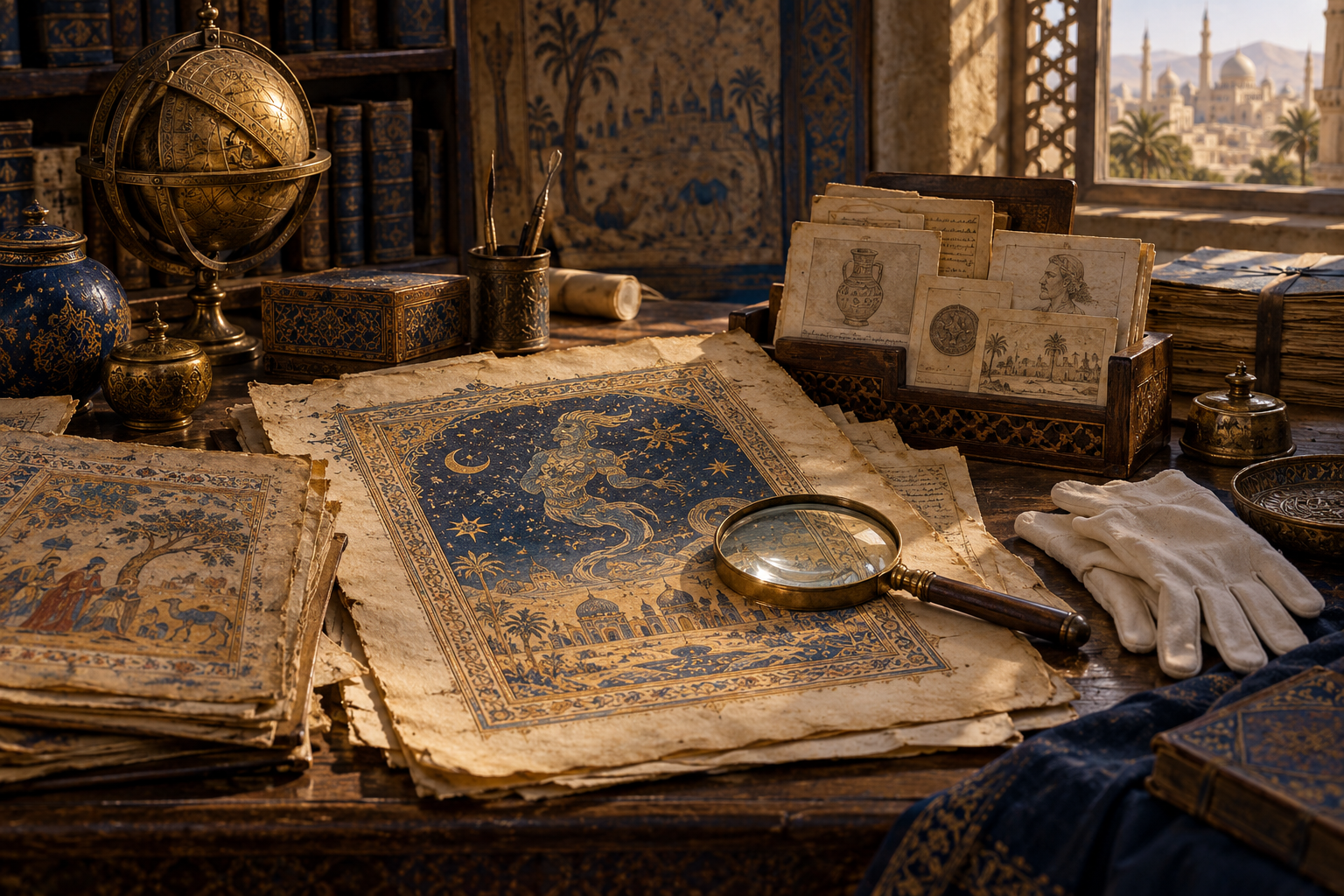
Quick answer: Occult manuscripts are handwritten books of magic, astrology, spirit lore and talismans copied before and alongside the age of print, and reading one well means reading it as a historical document rather than a manual. Every grimoire manuscript carries the fingerprints of its scribe, its century and its sources. This guide explains how to read a grimoire in context: who wrote it, how copies changed, why printed editions differ, and how to judge the PDFs and reprints that circulate today.
Related guides: grimoire meaning and famous grimoires, manuscript versus printed Goetia editions, the five books of the Lesser Key, the Greater Key of Solomon, the Picatrix and its history, the Testament of Solomon explained.
| Text | Earliest witnesses | Original language | What a reader should know |
|---|---|---|---|
| Testament of Solomon | Greek manuscripts; text dated roughly 1st to 5th century CE | Greek | Pseudepigraphal narrative, not a working manual; demon catalog attached to Solomon's ring |
| Picatrix (Ghāyat al-Ḥakīm) | Arabic, 10th to 11th century; Latin version 13th century | Arabic, then Castilian and Latin | Astrological talisman compendium; Latin text abridges and rearranges the Arabic |
| Key of Solomon (Clavicula Salomonis) | Latin and Italian copies from the 15th century; Greek version earlier | Probably Greek or Latin | Dozens of divergent manuscripts; Mathers's 1889 edition merges several |
| Lesser Key of Solomon (Lemegeton) | English manuscripts of the 17th century | English, from earlier Latin material | Five books compiled from older sources; Goetia spirit list derives from Weyer |
| Book of Abramelin | German manuscripts from the 17th century; French copy used by Mathers | German | French copy omits material; Dehn's edition restores the fuller text |
| Sworn Book of Honorius | Latin manuscripts, 14th century | Latin | One of the earliest ritual manuals; survives in few copies |
Key Takeaways
Occult manuscripts are handwritten books concerned with magic, astrology, the invocation of spirits, talismans and hidden natural properties. The word grimoire, from French grammaire, originally meant any book written in Latin that an ordinary person could not read, and it came to mean a book of spells and spirit lists. Most grimoires survive as manuscripts because the material was rarely printed before the nineteenth century, and copying by hand was the only way it traveled.
Reading an occult manuscript is not like reading a modern book with a single fixed text. A grimoire manuscript records one moment in a long chain of copying. The scribe worked from an exemplar that was itself a copy, might have understood the language imperfectly, and often felt free to improve, abridge or combine sources. Two copies of the Key of Solomon can differ in the order of chapters, the names of spirits and the designs of seals.
This is why context is the first question. Who copied this, when, from what, and for whom? A fifteenth-century Italian copy made for a learned physician, a seventeenth-century English copy made by a cunning-man, and a nineteenth-century lodge transcription are three different objects even when they share a title. For the definition and the standard list of famous texts, see the companion article on grimoire meaning and famous grimoires; this guide focuses on how to read them.
The oldest layer of European occult literature is Greek and Jewish. The Testament of Solomon, a Greek narrative of uncertain date between the first and fifth centuries CE, presents Solomon interrogating demons with the help of a ring and is the ancestor of the Solomonic tradition. Greek magical papyri from Egypt preserve spells and divine names that later resurface in medieval books. The Sefer ha-Razim and other Hebrew works contributed angel names and the idea of a book revealed to a patriarch.
The second layer is Arabic. In the tenth and eleventh centuries, scholars in al-Andalus and the Islamic East compiled astrological magic from Greek, Indian, Persian and Sabian sources. The Ghāyat al-Ḥakīm, translated into Castilian and then Latin in the thirteenth century as the Picatrix, became the main channel through which planetary talisman theory reached Europe. The article on the Picatrix and its history traces that journey.
The third layer is Latin and vernacular. From the thirteenth century onward, works attributed to Solomon, Honorius, Albertus Magnus and others circulated among clerics and physicians who could read Latin. By the sixteenth and seventeenth centuries the material was being copied in Italian, German, French and English, which is when the Key of Solomon, the Lemegeton and the Book of Abramelin take the forms known today. Agrippa’s printed Three Books of Occult Philosophy (1533) then fed back into the manuscripts, as scribes copied his tables and seals into their own books.
Does this touch your own situation? Many readers come to these pages because something in their home, dreams or family feels unexplained. Reading history helps, but it cannot look at your specific case.
Consult the Sheikh Private, confidential, and free to ask.
Scholars of magic use a fairly consistent procedure when they open an unfamiliar occult manuscript. It works just as well for readers approaching a facsimile or a scholarly edition.
Note the library and shelfmark if the manuscript is catalogued, the material (paper or parchment), the language, the script and any dates written by the scribe. Paper watermarks and handwriting styles can date a copy to within a few decades even when no date is given.
Compare the opening lines, chapter order and spirit names against known versions. A Key of Solomon that begins with the preparation of the operator belongs to a different family from one that begins with astrological hours. Catalogs and critical editions list these families.
Look for signs that material was added: a change of hand, a change of ink, marginal notes, or sections that interrupt the logic of the text. Many manuscripts are compilations in which an older core is wrapped in later additions.
Prefaces, attributions to Solomon or other ancient figures, and warnings to the reader tell you how the scribe wanted the book to be understood. These frames are often more revealing than the recipes.
Spirit names drift through copying. Tracing a name back to Weyer, Agrippa or an Arabic original shows where the scribe’s text came from and how far it moved.
The most important thing to understand about reading old grimoires is that scribes were not neutral. Some errors are mechanical: skipping a line between two similar words, misreading an abbreviation, or garbling a foreign name. The famous confusion of spirit names across Goetia manuscripts, where one copy’s Purson is another’s Curson, comes largely from this kind of slip.
Other changes were intentional. Scribes added spirits to round out a list, inserted prayers to make the text more pious, removed sections they thought dangerous, or translated Hebrew and Greek words into their own language with mixed success. A copyist who could not draw well might simplify a complex seal; one who was an artist might embellish it. Comparing seals across manuscripts shows that the designs were far less fixed than modern reproductions suggest.
Attribution was also a scribal choice. Attaching the name of Solomon, Honorius or the Egyptian sage Abramelin was a way of claiming authority for a compilation, not a claim of literal authorship. Reading a title page that says “by King Solomon” as a historical statement misunderstands the convention. The manuscripts of the Lesser Key, examined in the five books of the Lesser Key, show how a seventeenth-century English compiler stitched five earlier works into one book and gave the whole a Solomonic frame.
When occult manuscripts began to be printed in the late nineteenth and early twentieth centuries, editors made decisions that still shape how people read these books. Samuel Liddell MacGregor Mathers published The Key of Solomon the King in 1889 by combining readings from several British Library manuscripts and omitting passages he considered black magic. His Book of the Sacred Magic of Abra-Melin (1898) was translated from a single French copy that lacked material found in older German manuscripts, a gap later filled by Georg Dehn’s edition.
The Goetia printed in 1904 under Aleister Crowley’s name used Mathers’s translation and added Crowley’s own preliminary invocation and commentary. Arthur Edward Waite’s Book of Ceremonial Magic (1911) summarized many grimoires but treated them with open skepticism and sometimes paraphrased loosely. Each of these editions circulated far more widely than any manuscript, so their choices became the default text for most readers.
Modern scholarly editions reverse this process. Joseph Peterson’s Lemegeton and Clavicula editions report manuscript variants and identify the sources of each section. Academic series on medieval magic publish Latin texts with critical apparatus. A reader who wants to know what a grimoire actually said in its own period should prefer these editions to Victorian ones, and the comparison in manuscript versus printed Goetia editions gives a concrete case.
Several assumptions trip up new readers of occult manuscripts.
Reading with these cautions in mind turns a grimoire from a mysterious artifact into an intelligible historical source. The site presents these texts for study only and does not supply ritual instructions.
Interest in grimoire manuscripts has grown with digitization. Major libraries have put high-resolution scans of Solomonic, Hermetic and astrological manuscripts online, and the British Library, the Wellcome Collection and the Bibliothèque nationale de France all hold catalogued examples. Fantasy fiction, games and television have also sent readers back to the originals behind names like Goetia, Lemegeton and Picatrix.
A practical reading path starts with a reliable modern edition rather than a manuscript scan. Read a scholarly introduction first to learn the text’s families and sources, then look at a facsimile to see how the manuscript actually presents the material. When encountering a PDF online, check which edition it reproduces: a scan of Mathers is a Victorian reconstruction, a scan of Peterson is a critical edition, and an anonymous typed file may be neither.
Keep a few questions in view throughout. What century is this copy? What language and script? Which earlier texts does it borrow from? What did the scribe add or omit? Which printed edition, if any, standardized the version being read? Answering those turns reading old grimoires from guesswork into a disciplined activity, and it is the same method used in the site’s guides to the Greater Key of Solomon and the Testament of Solomon. Occult manuscripts reward patience, and they reward it most when the reader respects them as the layered historical documents they are.
Still have a question about your own experience? Describe what you are seeing, feeling or dreaming, and when it started. The Sheikh reads every message personally and replies in private.
Have a question of your own? If working through these old texts has stirred a question about your own path, a Full Personal Reading with our partner PuraTarot offers a quiet, personal way to reflect on it. Join the free Djinn Guide newsletter and, once you confirm, you will unlock a 50% code for your first reading.
Further reading
As an Amazon Associate we earn from qualifying purchases.
Start with a scholarly edition that explains the manuscript's date, language, families and sources, then compare it to a digitized facsimile. Read the preface and attributions as historical framing, trace spirit names and seals to earlier texts, and treat variations between copies as evidence of transmission rather than errors.
Among European texts, the Greek magical papyri from Egypt (roughly 2nd century BCE to 5th century CE) and the Greek Testament of Solomon are the oldest witnesses. The earliest Latin ritual manuals, such as the Sworn Book of Honorius, survive in fourteenth-century copies. Most famous grimoires survive only in copies from the fifteenth century or later.
Because each edition is built from different manuscripts and editorial choices. Mathers merged several Key of Solomon copies and cut sections; Crowley added his own material to the Goetia; modern editors like Peterson report variants instead. The underlying manuscripts already differed, and editors added further differences.
No. Attribution to Solomon was a medieval convention for claiming ancient authority. The Key of Solomon's surviving manuscripts date from the fifteenth century onward, with a Greek version somewhat earlier, and their content draws on medieval Jewish, Arabic and Latin sources rather than on any text from Solomon's era.
Only as accurate as the edition they copy. Scans of library manuscripts and of critical editions are reliable records of those sources; anonymous typed files often descend from Victorian editions with added errors. Always identify the base text and editor before trusting a digital copy.
Disclaimer
This article treats grimoires and occult manuscripts as historical documents for educational purposes. Beliefs recorded in these texts are described, not endorsed, and no ritual or practical instructions are given or implied.
Did this guide help you understand the subject? Rate it and share your honest opinion to help other readers. Every review is checked by our editors before it appears.
There are no reviews yet. Be the first one to write one.


Sheikh Youssef
Tayeb El Merzouki
For inquiries about personalized spiritual work, private rituals, and traditional talismans, connect directly with Sheikh Youssef Tayeb El Merzouki.
Chat on WhatsApp


