





Join Djinn Guide: Get 50% Off a Personal Reading
Get new guides to jinn, folklore and occult history. Confirm your subscription to unlock a 50% code for a first personal reading with our partner PuraTarot.
Discover the unseen
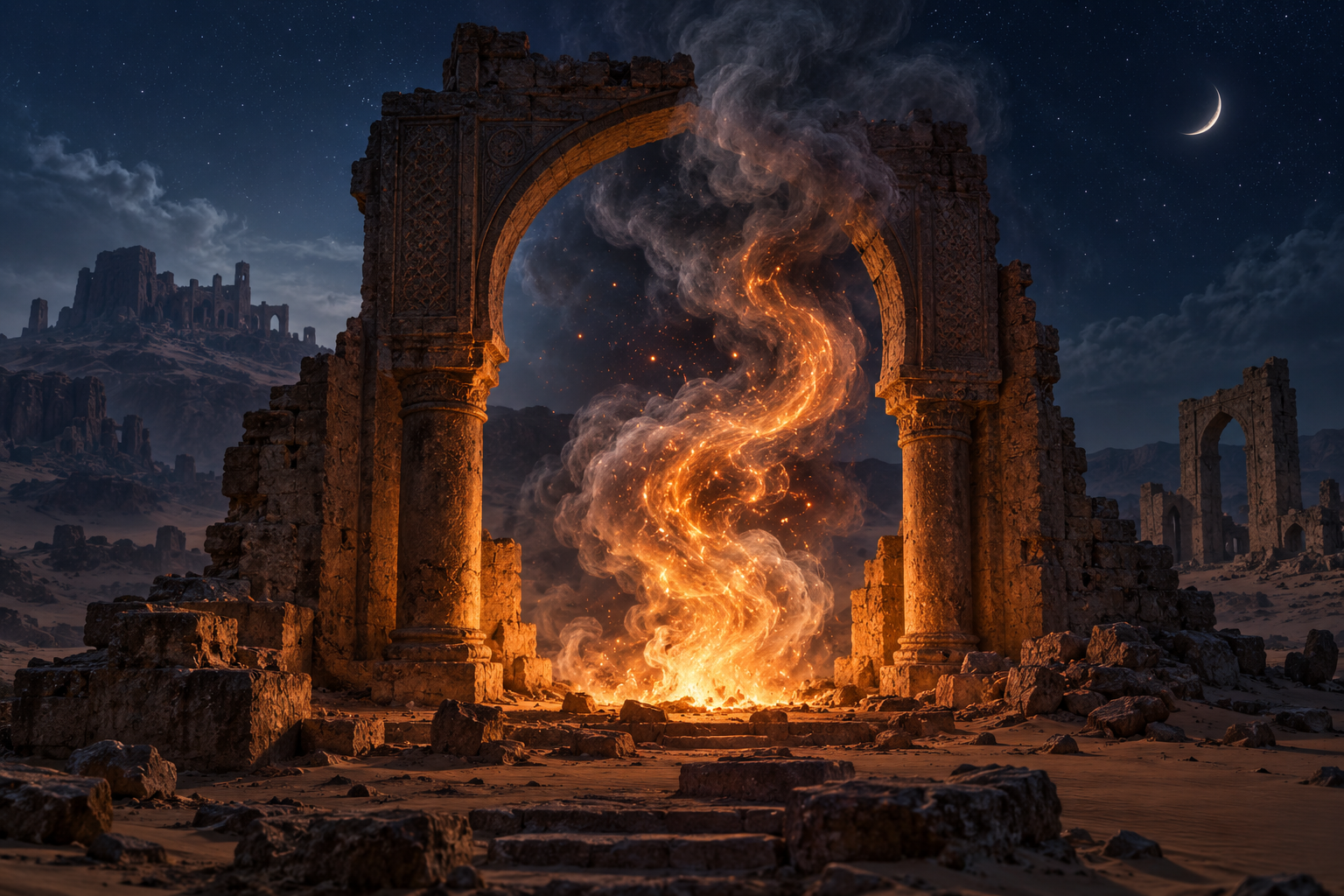
Ifrit meaning explained: what an ifrit is in Arabic, the one Quranic ifrit in Solomon's court, the afreet of Egyptian folklore, and how fiction changed it.
Quick answer: Ifrit meaning, in its original Arabic sense, is a powerful, cunning, and rebellious being, and in religious and folk usage it names a strong class of jinn. The word appears once in the Quran, in Surah An-Naml 27:39, where an ifrit of the jinn offers to bring the Queen of Sheba's throne to Solomon and describes himself as strong and trustworthy. Later Arabic folklore, the Arabian Nights, and modern games expanded the ifrit into a giant, often fiery, spirit.
Related guides: what an ifrit looks like, ifrit vs marid compared, the main types of jinn, Solomon and the Queen of Sheba, the Fisherman and the Jinni, jinn in Islamic teaching.
| Source or context | What ifrit means there | Notes |
|---|---|---|
| Classical Arabic dictionaries | A strong, crafty, insolent or rebellious person or jinn | Applied to humans as well as spirits; plural afarit |
| Quran, Surah An-Naml 27:39 | A powerful jinn in Solomon's assembly | Only occurrence; he calls himself strong and trustworthy |
| Hadith (Bukhari, Muslim) | A jinn who tried to disturb the Prophet's prayer | The Prophet recalls Solomon's special authority over jinn |
| Arabian Nights | A giant, often terrifying jinni, sometimes rebellious, sometimes helpful | Used loosely alongside jinni and marid |
| Egyptian folk belief | The spirit of a person who died violently, rising from the blood | Spelled afreet or afrit in English travel writing |
| Modern games and fantasy | A fire elemental or fire genie | Final Fantasy, Dungeons and Dragons; not the traditional sense |
Key Takeaways
The Arabic word ʿifrīt (plural ʿafārīt) is an intensive form that classical dictionaries gloss as a being who is strong, sly, and insolent, one who overpowers and gets the better of others. The lexicographers connect it to a root meaning to roll in the dust or to overcome, and some note that it could describe a wily, hard-to-handle man as easily as a spirit. In everyday Arabic to this day, calling a mischievous child an ifrit is a joke rather than a theological statement.
When the word is applied to jinn, it marks the upper end of power and willfulness. Many Muslim scholars treated ifrit as a description rather than a species, meaning an especially strong or rebellious jinn, in the way that a giant is a very large person rather than a different kind of creature. Others, especially later folklorists and storytellers, used it as a category name, with ifrit ranked among marid, ghul, sila, and jann. Both usages are old and both are still current.
So the simplest answer to what is an ifrit is this: a jinn of unusual strength and cunning, described in the Quran, named in hadith, and elaborated enormously in folklore. English spellings include ifrit, afrit, afreet, and efreet, all of which transliterate the same Arabic word.
The ifrit in the Quran appears in one scene only. In Surah An-Naml, Solomon has learned of the Queen of Sheba from the hoopoe and knows she is on her way. He turns to his assembly and asks which of them will bring him her throne before her people arrive in submission. The first to answer is an ifrit of the jinn. He says he will bring it before Solomon rises from his place, and he adds, in the Quran’s words, that he is strong and trustworthy for the task (qawiyyun amīn).
Then a second speaker, described only as one who had knowledge from the Book, says he will bring the throne before Solomon’s glance returns to him. The throne appears, and Solomon attributes it to the grace of his Lord, a test of whether he will be grateful. The story continues with the altered throne and the glass floor, which we discuss in our article on Solomon and the Queen of Sheba.
Two things about this short passage shape all later discussion of ifrit meaning. First, the ifrit is a member of Solomon’s assembly and speaks respectfully; he is not a rebel here. Second, his self-description combines strength with trustworthiness, which contradicts the modern assumption that ifrit simply means evil fire demon. The Quran does not say what he looked like, where he came from, or what became of him. Commentators supplied names and details, but the text is spare.
Does this touch your own situation? Many readers come to these pages because something in their home, dreams or family feels unexplained. Reading history helps, but it cannot look at your specific case.
Consult the Sheikh Private, confidential, and free to ask.
The word also appears in a well-known hadith recorded by al-Bukhari and Muslim. The Prophet Muhammad is reported to have said that an ifrit from the jinn came to him during his night prayer to disrupt it, that God gave him power over the jinn, and that he intended to tie it to a pillar of the mosque so the people could see it in the morning. He then remembered the prayer of his brother Solomon, who had asked for a kingdom that would belong to no one after him, and let the jinn go.
This report matters for ifrit meaning in two ways. It confirms that in early Islamic usage an ifrit could be hostile, and it links the ifrit once more to Solomon’s unique authority over jinn, which Muslims understand as a gift the Quran describes in Surah Sad 38:35–38. The hadith also reinforces the general Islamic teaching that jinn are created beings, made from smokeless fire according to Surah Ar-Rahman 55:15, who have free will and may be believers or unbelievers.
Classical commentators such as al-Tabari and Ibn Kathir discussed the ifrit of Surah An-Naml at length. Some gave him a name, such as Kawzan or Dhakwan, on the authority of earlier reports, and some debated whether the one with knowledge of the Book was Asaf ibn Barakhya, Solomon’s scribe, or Solomon himself. These identifications are tradition, not Quranic text, and careful readers keep that distinction clear.
Folklore and later Arabic literature sorted jinn into loose classes. The boundaries are blurry, but a few contrasts are useful.
Jinn is the broad term for the whole category of unseen beings. An ifrit is a jinn described by its power and willfulness. Every ifrit is a jinn; most jinn are not called ifrit.
Marid, from a root meaning rebellious, is used in the Quran for a rebellious devil (Surah As-Saffat 37:7). In folklore the marid became the giant, often water-linked jinni of the Arabian Nights. Storytellers used ifrit and marid almost interchangeably for huge, dangerous spirits, though some later writers ranked marid above ifrit. See our comparison of ifrit and marid.
The ghul is a desert shape-shifter associated with graveyards and with luring travelers. It is lower, more animal, and more clearly malicious than an ifrit, which is powerful and clever rather than ghoulish.
Shaitan names a devil, a jinn who has chosen rebellion against God, and Iblis is their chief. An ifrit may be a shaitan if hostile, but the word itself describes strength, not allegiance. The Quranic ifrit is in Solomon’s service.
Readers who want the full picture can start with our overview of the types of jinn, which covers these classes and several more.
The One Thousand and One Nights gave the ifrit its reputation as a monster of enormous size. In the Fisherman and the Jinni, the spirit released from the brass bottle, sealed with Solomon’s seal, is called an ifrit or marid depending on the manuscript and translation, and it threatens to kill its liberator before being tricked back into the jar. In the Second Kalandar’s tale, an ifrit keeps a kidnapped bride in an underground palace and transforms the narrator into an ape. In the story of the Porter and the Three Ladies, afarit serve, punish, and transform.
These stories are entertainment, composed and compiled over centuries, and they mix the Quranic word with Persian, Indian, and Egyptian story material. They established the image of the ifrit as a towering, smoke-wreathed, quick-tempered spirit that could be both deadly and, if handled cleverly, useful. Our analysis of the Fisherman and the Jinni explores how wit, not strength, wins that encounter.
In Egyptian popular belief, recorded by nineteenth-century writers such as Edward Lane, an afreet is something different again: the spirit of a person who died violently, said to rise from the place where the blood was spilled and to haunt it. This is closer to a ghost than to a Quranic jinn, and it shows how a single Arabic word could carry different meanings in different regions. Much Western use of afreet in travel writing and fiction draws on this Egyptian sense.
Several ideas about the ifrit circulate so widely that readers often assume they come from scripture. They do not.
For a full treatment of how texts and artists imagined the ifrit’s shape, see what an ifrit looks like.
Most people who look up ifrit meaning in English have met the word in a game or a story. Final Fantasy made Ifrit a recurring fire summon; Dungeons and Dragons gave its efreeti a City of Brass on the Plane of Fire; novels, comics, and television series have used ifrit as a stock jinn villain or antihero. Each borrowing keeps the name and a vague sense of power while reinventing everything else. That is a normal part of how folklore travels, but it leaves readers unsure what the original word meant.
The best way to find out is to read the primary passages yourself. Surah An-Naml 27:38–40 takes a minute to read in translation. The hadith about the ifrit at prayer is short and widely available in the collections of al-Bukhari and Muslim. For the folklore, any complete translation of the Arabian Nights will show how storytellers used the word. For the Egyptian ghost sense, Lane’s Manners and Customs of the Modern Egyptians, first published in 1836, is the classic description.
When you compare these, keep three layers separate: the scriptural ifrit, who is strong and trustworthy and serves Solomon; the folkloric afarit, who are giants of story; and the modern fire-spirit, which is a creative reinterpretation. Understanding the layers lets you enjoy the games and the stories without mistaking them for religious teaching, and lets you read the religious texts without importing the monster movie. This site describes these beliefs and traditions; it does not offer any instructions for contacting or commanding spirits.
Still have a question about your own experience? Describe what you are seeing, feeling or dreaming, and when it started. The Sheikh reads every message personally and replies in private.
Have a question of your own? The ifrit’s story turns on strength and trust, two things we all weigh in our own choices. A Full Personal Reading with our partner PuraTarot is a personal way to reflect on where you stand. Join the free Djinn Guide newsletter and, once you confirm, you will unlock a 50% code for your first reading.
Further reading
As an Amazon Associate we earn from qualifying purchases.
Ifrit (ʿifrīt, plural ʿafārīt) describes a being that is strong, cunning, and rebellious or insolent. Classical dictionaries apply it to overpowering, crafty people as well as to jinn. When used of jinn it marks an especially powerful spirit, and in later folklore it became a category name for giant, formidable jinn.
Only once, in Surah An-Naml 27:39. When Solomon asks who can bring the Queen of Sheba's throne, an ifrit of the jinn offers to do it before Solomon rises from his seat, calling himself strong and trustworthy. Someone with knowledge of the Book then brings it even faster.
Not in the traditional sources. The Quran says jinn as a whole were created from smokeless fire, but the word ifrit refers to power and craftiness, not fire. The image of the ifrit as a fire elemental comes from modern fantasy games such as Final Fantasy and Dungeons and Dragons.
Both words describe powerful jinn. Marid comes from a root meaning rebellious and appears in the Quran for a rebellious devil; ifrit stresses strength and cunning. In the Arabian Nights the two are used almost interchangeably for giant spirits, and some later writers rank marid above ifrit, though the Quran gives no ranking.
In Egyptian popular belief, documented by Edward Lane in the 1830s, an afreet is the spirit of a person who died by violence, said to rise from the spot where the blood fell and haunt it. This ghost-like meaning differs from the Quranic ifrit and from the giant jinn of the Arabian Nights.
Disclaimer
This article explains religious texts, commentary, and folklore about the ifrit for educational and cultural purposes. Beliefs are described as the traditions hold them, not endorsed as fact, and the site does not provide instructions for any spiritual practice.
Did this guide help you understand the subject? Rate it and share your honest opinion to help other readers. Every review is checked by our editors before it appears.
There are no reviews yet. Be the first one to write one.


Sheikh Youssef
Tayeb El Merzouki
For inquiries about personalized spiritual work, private rituals, and traditional talismans, connect directly with Sheikh Youssef Tayeb El Merzouki.
Chat on WhatsApp