





Join Djinn Guide: Get 50% Off a Personal Reading
Get new guides to jinn, folklore and occult history. Confirm your subscription to unlock a 50% code for a first personal reading with our partner PuraTarot.
Discover the unseen
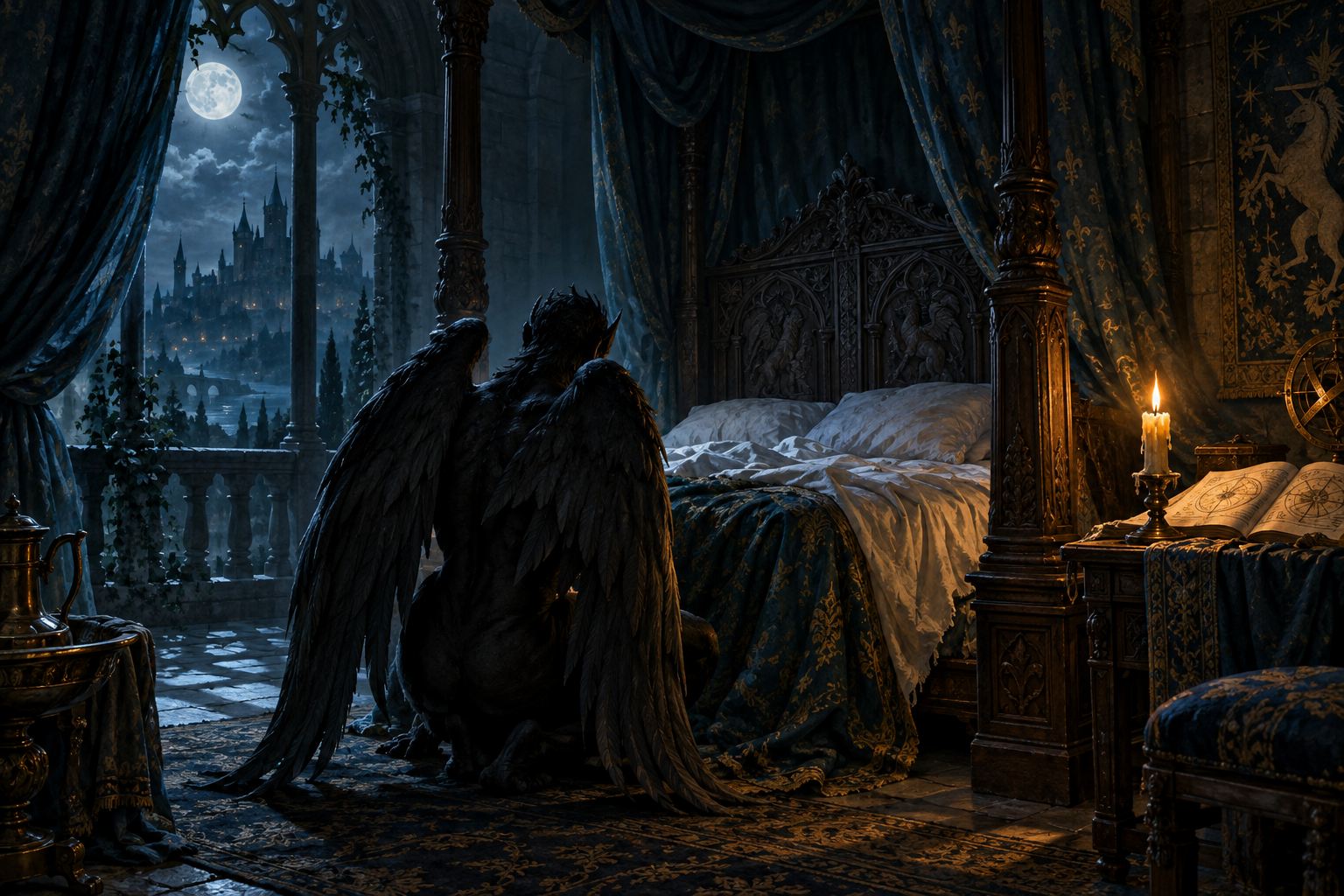
Incubus demon and succubus explained: the Latin names, what medieval, Jewish and Mesopotamian sources said, and how sleep science reads the legend.
Quick answer: An incubus demon is a night spirit of European folklore said to press upon or visit people while they sleep; the succubus is its female counterpart. The words come from Latin incubare, to lie upon, and succubare, to lie beneath. Medieval theologians treated them as demons that troubled sleepers, folklore across the world describes similar night visitors, and modern sleep research links the experience to sleep paralysis, in which a person wakes unable to move and senses a presence in the room.
Related guides: Lilith in Jewish legend and later occultism, shedim, the spirits of Jewish tradition, what demonology is and how it developed, jinn and human relationships in folklore, jinn compared with ghosts and demons, demon names from scripture and folklore.
| Name | Culture and period | How the sources describe it | Common modern reading |
|---|---|---|---|
| Incubus and succubus | Latin Christian Europe, 5th to 17th century | Demons that visit and press upon sleepers; debated by Augustine, Aquinas and the Malleus Maleficarum | Sleep paralysis, dream experience, moral explanation of scandal |
| Lilu, lilitu, ardat-lili | Mesopotamia, 2nd and 1st millennium BCE | Wind-and-night spirits that trouble the young and childless, named in incantation texts | Early ancestors of the Lilith legend |
| Lilith and the lilin | Jewish tradition, Talmud to medieval lore | A night demon with long hair and wings; later the first wife of Adam in the Alphabet of Ben Sira | Folklore figure, later reclaimed in modern writing |
| Mare or mara | Germanic and Slavic folklore | A being that sits on the chest of a sleeper and causes bad dreams; source of the word nightmare | Sleep paralysis with chest pressure |
| Old Hag | Newfoundland and Atlantic Canada | A presence that holds the sleeper down, studied by folklorist David Hufford | Textbook case of sleep paralysis |
| Kanashibari | Japan | Being bound as if by metal while asleep, often with a felt presence | Sleep paralysis; the Japanese term is used in clinical literature |
Key Takeaways
In the folklore and theology of medieval and early modern Europe, an incubus was a demon believed to visit people in their sleep, pressing on them, troubling their dreams and, in the fuller versions of the belief, taking the form of a human lover. The succubus was the same kind of spirit in female form. The two words describe one idea seen from two directions, and many writers used incubus for both.
The belief was never only about dreams. Medieval theologians used incubi to explain unusual births, to account for the confessions produced in witch trials, and to argue about whether demons could have bodies. Village folklore, meanwhile, was less interested in theology and more interested in the frightening experience of waking at night unable to move while something seemed to sit on the chest. That experience, now called sleep paralysis, is the thread that runs from the Latin incubus back to Mesopotamian night spirits and forward to the Old Hag of Newfoundland.
This article treats the incubus demon as a subject of history and folklore. It describes what sources said, where the words came from and why people today still search for them, without endorsing the belief and without the explicit material that some modern retellings add. The history itself is rich enough.
The Latin verb incubare means to lie upon, and in classical Latin the noun incubo meant a nightmare or the spirit thought to cause one. Roman writers also used incubo for a goblin that guarded buried treasure, which is why some late authors connected the night demon with hidden gold. Succubus is formed from succubare, to lie beneath, and the word is attested later, mostly in medieval Latin church writing, as a deliberate counterpart to incubus.
Greek had its own word for the same experience. Ephialtes, literally one who leaps upon, was the name both of the nightmare and of a demon believed to cause it, and Greek medical writers already in antiquity argued that the pressure on the chest was a physical disorder rather than a spirit. That medical reading never fully replaced the folk one; the two coexisted for two thousand years.
In the Germanic languages the equivalent being was the mare or mara, which survives in the English word nightmare and in German Nachtmahr. A mare was not originally a horse but a crushing night presence, and the shift of meaning in English toward bad dreams in general is relatively recent. When readers ask what incubus means today, the honest answer is that it has meant three things at once since antiquity: a bad dream, the felt presence that accompanies it, and a demon that theologians tried to fit into a system.
Does this touch your own situation? Many readers come to these pages because something in their home, dreams or family feels unexplained. Reading history helps, but it cannot look at your specific case.
Consult the Sheikh Private, confidential, and free to ask.
The oldest written relatives of the incubus come from Mesopotamia. Akkadian incantation texts name a family of night and wind spirits, the lilu, the lilitu and the ardat-lili, who were blamed for troubling the sleep of young people and for illness and childlessness. These were not gods but hostile spirits to be warded off with amulets and spoken formulas, and they belong to the same broad world as the lamashtu who threatened mothers and infants.
In Jewish tradition the name Lilith appears once in the Hebrew Bible, in Isaiah 34:14, as a creature of the wilderness, and the Babylonian Talmud mentions her in a few places as a night demon with long hair and wings. The medieval Alphabet of Ben Sira, usually dated between the eighth and tenth centuries, told the story that made her famous: Lilith as the first wife of Adam who refused to submit, left Eden and became a demon who threatened newborns. Later Kabbalistic literature paired her with the demon Samael and treated the lilin, her offspring, as night spirits of the incubus and succubus type. The article on Lilith in Jewish legend and occultism follows that story in more detail.
Jewish tradition also knows a broader class of spirits, the shedim, who resemble the jinn of Islamic sources in being created beings that live alongside humans and can be helpful or harmful. The incubus idea in Europe drew on both strands: the specific Lilith legend and the general belief in spirits who could take human form.
Christian theologians inherited the night demon from late antiquity and spent centuries deciding what to do with it. Four texts mark the main stages.
In Book 15, chapter 23, Augustine reports that many people claimed to have been troubled by silvans and fauns, whom the common people called incubi, and he declines to deny it outright while refusing to build doctrine on it. His cautious wording became the standard citation for every later writer.
Geoffrey made the prophet Merlin the son of a nun and an incubus, drawing on Augustine’s passage to explain how a child could have a spirit for a father. The story passed into the Arthurian romances and gave the incubus its most famous literary role.
Aquinas argued that demons have no bodies of their own but can assume them, and he worked out a theory in which a demon might act as succubus and incubus in turn. His purpose was philosophical consistency, not storytelling, but his conclusion was repeated for three hundred years.
The witch-hunting manual of Heinrich Kramer leaned on Aquinas to make incubi a routine part of witchcraft accusations. From this point the incubus belief moved from learned speculation into the machinery of trials, with real consequences for the accused. The broader context of this development is covered in the overview of what demonology is.
Islamic sources do not use the words incubus or succubus, but the jinn fill a similar space in popular belief. The Quran describes jinn as beings created from smokeless fire who live unseen alongside humans, and later folklore across the Middle East, North Africa and South Asia tells of jinn who fall in love with humans, who appear in dreams, or who are blamed for a sleeper’s sense of being pressed down at night. In Morocco the figure of Aisha Kandisha, a female jinn who appears to men near water, is one well-known local version of the night-visitor idea.
Scholars of Islamic law debated whether marriage between humans and jinn was possible, and folktales from the Arabian Nights onward include jinn husbands and wives. Those stories are usually about loyalty, trickery and the cost of crossing between worlds rather than about the physical details that fascinated European witch-hunters. The folklore is summarized in the article on jinn and human relationships.
The comparison is useful because it shows what is specific to the European incubus. Jinn in folklore are a whole society with their own faiths and families; the incubus is a single-purpose demon defined by one kind of nighttime encounter. When modern writers describe jinn as Islamic incubi, they flatten a much larger tradition into a narrow Latin category.
Sleep paralysis is a recognized state in which a person wakes, or is falling asleep, while the muscle paralysis of REM sleep is still active. The result is a minute or two of being conscious but unable to move, often with a sense of pressure on the chest, difficulty breathing and a strong impression that someone or something is in the room. Studies across many countries find that a large share of adults experience it at least once, and that the accompanying images tend to follow the culture of the sleeper.
The folklorist David Hufford documented this pattern in Newfoundland, where the experience is called the Old Hag and is described as a presence that holds the sleeper down. His 1982 book The Terror That Comes in the Night argued that the experience is real and consistent across cultures, while the interpretation, whether hag, demon, ghost or alien, is supplied by local belief. In Japan the same state is called kanashibari, being bound as if by metal, and in Brazil it is the pisadeira, the woman who treads on the chest.
Henry Fuseli’s 1781 painting The Nightmare, with a squat demon crouched on a sleeping woman’s chest and a horse’s head looking through the curtains, is the image most people associate with the incubus today. It is also, by accident, a nearly perfect illustration of sleep paralysis as clinicians describe it. The painting does not prove that medieval incubus stories were all sleep paralysis, but it shows how the experience, the folklore and the art reinforced one another.
Readers who want to go further should keep three questions in mind. First, is the source describing an experience, a belief or a doctrine? Hufford’s Newfoundland informants describe an experience; the Alphabet of Ben Sira records a belief; Aquinas builds a doctrine. The three kinds of text answer different questions and should not be quoted as if they were interchangeable.
Second, when was the text written and for whom? Augustine wrote in a world where pagan fauns were still part of popular religion; Kramer wrote to justify prosecutions. A single sentence about incubi carries very different weight in each setting. Third, what has been added since? Many modern websites present detailed classifications of incubi and succubi, with ranks, colors and personalities, that have no basis in any pre-modern source. Comparing them with the demon names found in scripture and folklore shows how recent most of that material is. Modern fantasy games and shows, which have turned the succubus into a stock winged temptress, are the main source of that drift.
This site describes the night-demon tradition as history, folklore and, where relevant, sleep science. It does not provide ritual instructions and does not claim that any spirit, prayer or object produces a result. Anyone troubled by repeated sleep paralysis should speak with a medical professional; the condition is common, well understood and usually harmless.
Still have a question about your own experience? Describe what you are seeing, feeling or dreaming, and when it started. The Sheikh reads every message personally and replies in private.
Is a relationship question on your mind? Stories of night visitors have always carried very human longings about intimacy, desire and closeness, and many readers come to them with questions about their own love life. If that is what brought you here, our partner PuraTarot offers a Relationship Harmony Ritual, a personal reading to help you reflect on your relationship and what you hope for it. Join the free Djinn Guide newsletter and, once you confirm, you will unlock a 50% code for your first reading.
Further reading
As an Amazon Associate we earn from qualifying purchases.
An incubus is a demon of European folklore and medieval theology believed to visit people while they sleep, pressing on them and troubling their dreams. The succubus is the female counterpart. The name comes from Latin incubare, to lie upon, and in classical Latin incubo simply meant a nightmare.
The difference is only one of form. Incubus describes the night demon in male shape and succubus in female shape; the words come from the Latin verbs for lying upon and lying beneath. Medieval writers such as Aquinas argued that a single demon could take either role, so the two names describe one belief.
Not the same, but closely related. Sleep paralysis is a documented state in which a waking person cannot move and often senses a presence and pressure on the chest. Folklorists such as David Hufford argue that this experience lies behind incubus, Old Hag and kanashibari stories, while the demon interpretation comes from culture.
The words incubus and succubus do not appear in the Bible. The nearest related passages are Genesis 6:1 to 4, about the sons of God and the daughters of men, and Isaiah 34:14, which names Lilith. Later Christian writers, starting with Augustine, used these texts when discussing incubi.
Merlin. In Geoffrey of Monmouth's History of the Kings of Britain, written around 1136, the prophet Merlin is the son of a nun and an incubus. Geoffrey cited Augustine's remark about incubi to make the story credible, and the detail passed into later Arthurian romances.
Disclaimer
This article presents the incubus and succubus as subjects of folklore, religious history and sleep research. Beliefs are described, not endorsed, and nothing here is medical or spiritual advice or a promise of any outcome.
Did this guide help you understand the subject? Rate it and share your honest opinion to help other readers. Every review is checked by our editors before it appears.
There are no reviews yet. Be the first one to write one.


Sheikh Youssef
Tayeb El Merzouki
For inquiries about personalized spiritual work, private rituals, and traditional talismans, connect directly with Sheikh Youssef Tayeb El Merzouki.
Chat on WhatsApp


