





Join Djinn Guide: Get 50% Off a Personal Reading
Get new guides to jinn, folklore and occult history. Confirm your subscription to unlock a 50% code for a first personal reading with our partner PuraTarot.
Discover the unseen
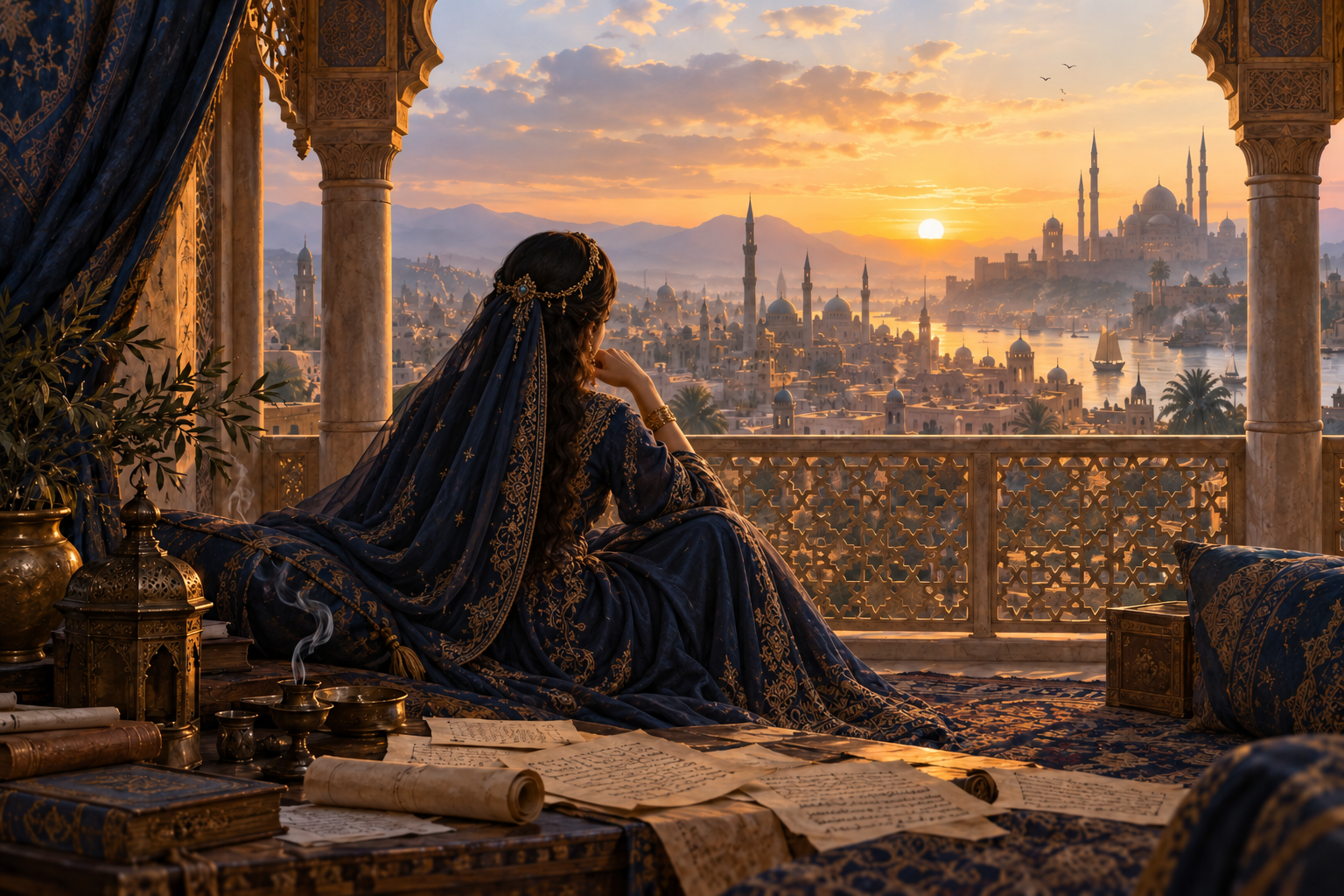
Scheherazade explained: who she is in One Thousand and One Nights, how the frame story works, why she tells tales for 1,001 nights, and how it ends.
Quick answer: Scheherazade is the storyteller of One Thousand and One Nights, the collection known in English as the Arabian Nights. In the frame story, King Shahryar marries a new bride each day and has her executed the next morning. Scheherazade, the vizier's daughter, volunteers to marry him and tells a tale every night, stopping at a cliffhanger so the king spares her to hear the ending. The jinn stories, Sindbad, and later Aladdin all sit inside her nightly storytelling.
Related guides: jinn in the Arabian Nights, the Fisherman and the Jinni, Aladdin's ring and lamp genies, Solomon's seal in the fisherman tale, jinn folklore across cultures, jinn, djinn and genie words.
| Character | Role in the frame | What they represent |
|---|---|---|
| Scheherazade (Shahrazad) | Vizier's daughter who marries the king and tells the tales | Learning, memory, patience and the power of narrative |
| Shahryar | King who executes a bride each morning after his wife's betrayal | Wounded authority, suspicion, and eventual healing |
| Shah Zaman | Shahryar's brother, betrayed first, who shares the discovery | The trigger that sets the king's cruelty in motion |
| Dunyazad (Dinarzade) | Scheherazade's younger sister who asks for a story each night | The audience inside the story; the prompt that keeps tales going |
| The vizier | Scheherazade's father, forced to find brides and then to offer his daughter | Fear, loyalty and the cost of serving a tyrant |
| The jinni of the glass casket | Spirit whose captive wife deceives him in the prologue | Early proof that no watch can prevent betrayal |
Key Takeaways
Scheherazade, spelled Shahrazad in most scholarly transliterations, is the heroine and narrator of One Thousand and One Nights. She is not the author of the collection, and she is not a historical person. She is a character in the frame story, the outer tale that explains why hundreds of smaller tales are being told at all. Everything a reader meets inside the book, from jinn trapped in bottles to merchants, caliphs and talking animals, is presented as something Scheherazade says aloud to her husband in the hours before dawn.
The frame introduces her as the elder daughter of the king’s vizier. The Arabic text describes her as widely read: she has studied histories, poetry, the sayings of wise men and the records of earlier kings, and she has memorized a vast number of stories. This learning is the whole point of her character. She is not saved by beauty or by luck, but by knowledge and by the discipline to use it one night at a time.
Her name is Persian, which is one of several clues that the frame story predates the Arabic collection. Shahryar, the king, also carries a Persian name. Readers searching for a scheherazade story are usually looking for either the frame itself or for a summary of how the device works, and both are explained below.
The frame story opens with two royal brothers, Shahryar and Shah Zaman. Shah Zaman discovers his wife’s infidelity, and on visiting his brother he finds that Shahryar’s queen is unfaithful too. The brothers leave the palace in despair and meet a jinni carrying a glass casket. Inside is a woman the jinni abducted on her wedding night, and she deceives him under his very nose while he sleeps. The lesson the brothers draw is bleak: no man, not even a spirit, can guarantee a wife’s loyalty.
Shahryar returns home, executes his queen, and adopts a terrible rule. Each evening he marries a virgin, and each morning he has her killed. The vizier is ordered to supply the brides. After three years the city is nearly empty of marriageable daughters and the vizier has nowhere left to turn. Scheherazade asks to be married to the king, over her father’s protests, saying she will either save the daughters of the kingdom or die like the others.
On the wedding night she asks that her sister Dunyazad be allowed to stay with her. Before dawn, Dunyazad asks for one of Scheherazade’s stories. The king listens, and the tale breaks off at the most tense moment just as the sun rises. Shahryar, wanting to know the ending, decides she can live until the next night. The pattern repeats for one thousand and one nights.
Does this touch your own situation? Many readers come to these pages because something in their home, dreams or family feels unexplained. Reading history helps, but it cannot look at your specific case.
Consult the Sheikh Private, confidential, and free to ask.
The collection did not appear all at once. Scholars generally trace the frame story back to a lost Persian book called Hazar Afsan, meaning A Thousand Tales, which is mentioned by tenth-century Arabic writers such as the bookseller Ibn al-Nadim in his catalog, the Fihrist. He describes a king who married a woman each night and killed her, until a clever bride told him stories to delay her death. That outline is recognizably the Scheherazade frame.
Behind the Persian book, many researchers see Indian influence, since the technique of nesting tales inside tales is a hallmark of Sanskrit story collections. The device of a story that interrupts a sentence of death also has Indian parallels. By the time the material reached Baghdad, Cairo and Damascus, it was being translated into Arabic and expanded with local stories about caliphs, merchants and jinn.
The surviving Arabic manuscripts are later than the earliest references. A Syrian manuscript now in Paris, dated by most scholars to the fourteenth or fifteenth century, is the oldest substantial witness and was the base text of Galland’s French translation. Later Egyptian recensions grew much longer in order to reach a literal count of 1,001 nights. The number itself was probably never meant to be precise; in Arabic and Persian usage, “a thousand” often just means a great many.
The genius of the Scheherazade frame is that the mechanism and the message are the same. Narrative suspense is literally what keeps her alive. Each dawn the text pauses with a formula noting that morning overtook Scheherazade and she fell silent. Then the next night begins with Dunyazad’s request to continue, and the king’s agreement. Readers of translations sometimes find this repetitive; in the original setting, it is the heartbeat of the book.
The nesting goes deeper than a single layer. Scheherazade tells of a merchant who meets a jinni; the merchant is then joined by three sheikhs who each tell their own tale to persuade the jinni to spare the merchant’s life. So a story about buying mercy with stories is itself told to buy mercy with a story. The same move appears in the Fisherman and the Jinni, where a fisherman tells cautionary tales to a spirit who wants to kill him.
Scheherazade does not work alone, and the frame is more interesting when the supporting cast is taken seriously.
Shahryar is often read simply as a monster, but the text presents him as a man broken by betrayal who turns private grief into public terror. His slow change over the nights, from a listener who grants one more day to a husband who comes to love the woman speaking to him, is the real arc of the book. The stories are the therapy; he is the patient.
Dunyazad, spelled Dinarzade in older English versions, has a small but essential job. Scheherazade cannot simply start talking to the king; that would look like a trick. Her sister’s innocent request creates the occasion, and her presence turns a private bedroom into a storytelling circle. She is the reader’s stand-in, voicing the question every listener has: and then what happened?
The vizier has already carried out the king’s orders for years. When his own daughter volunteers, he tries to dissuade her with a fable of his own, the tale of the ox and the donkey, which is the first nested story in the entire collection. His fear is the realistic counterweight to her confidence.
The jinni in the prologue establishes the supernatural register early. He is powerful and jealous, yet still outwitted, which foreshadows the many captured, tricked or persuaded spirits in the nights that follow.
Not every version of the Nights ends the same way, and some early manuscripts do not reach a conclusion at all; they simply stop when the scribe’s source ran out. The familiar ending comes from the longer Egyptian recension printed in the nineteenth century in Bulaq, near Cairo, and in Calcutta. There, after the final tale, Scheherazade presents the king with the three sons she has borne him during the nights and asks for her life for their sake. Shahryar replies that he had already pardoned her, long before, because of her goodness and wisdom. The two sisters are married to the two brothers, the vizier is honored, and the stories are written down and preserved.
Antoine Galland, whose French translation of 1704 to 1717 introduced the book to Europe, shaped the ending to suit his readers and added tales such as Aladdin and Ali Baba that are not in any Arabic manuscript older than his own work. Those stories came to him orally from a Syrian storyteller named Hanna Diyab, as Galland’s diaries record. The genie of the lamp, discussed in the article on Aladdin’s ring and lamp genies, is therefore a later addition to Scheherazade’s repertoire.
Several ideas about Scheherazade circulate widely but do not match the text.
The image of a veiled woman whispering tales of magic to a cruel king comes largely from European art, ballet and film, including Rimsky-Korsakov’s 1888 orchestral suite. Those works are interpretations, not sources.
Scheherazade has become a shorthand for storytelling itself: the idea that a narrative can hold off death, change a tyrant and preserve a culture. Writers from Edgar Allan Poe to John Barth and Salman Rushdie have reworked her, and the name appears in music, film, perfume and software. People search for her because the frame is one of the most memorable plot devices in world literature, and because the tales nested inside it, with their jinn, flying horses and enchanted cities, remain among the most retold stories on earth.
For readers who want the real thing rather than the retellings, the choice of translation matters. Husain Haddawy’s English version of the fourteenth-century Syrian manuscript, based on Muhsin Mahdi’s critical edition, gives the shortest and arguably earliest form of the frame. Malcolm Lyons’s three-volume translation of the Calcutta II text gives the full 1,001 nights with the complete ending. Burton’s Victorian translation is colorful but heavily padded with his own notes and prejudices.
A practical way to read the frame is to pay attention to who is speaking at each level, and to notice when a character inside a story starts telling a story of their own. Keeping that map in mind turns a sprawling anthology into a single, coherent act of survival. Readers interested in the spirits she describes can continue with jinn folklore across cultures, or with the famous episode of Solomon’s seal in the fisherman tale.
Still have a question about your own experience? Describe what you are seeing, feeling or dreaming, and when it started. The Sheikh reads every message personally and replies in private.
Thinking about trust in your own relationship? Scheherazade’s tale is, at its heart, about rebuilding trust within a marriage. If that theme resonates, the Relationship Harmony Ritual with our partner PuraTarot is a gentle way to reflect on your own bond. Join the free Djinn Guide newsletter and, once you confirm, you will unlock a 50% code for your first reading.
Further reading
As an Amazon Associate we earn from qualifying purchases.
Scheherazade marries King Shahryar, who has been executing a new bride each morning. To survive, she tells him a story every night and stops at a cliffhanger before dawn, so he spares her to hear the rest. After one thousand and one nights, in the longer versions, the king pardons her, and the stories she told form the Arabian Nights.
No. Scheherazade is a fictional character from a Persian story tradition that was later expanded in Arabic. Her name is Persian, and tenth-century Arabic writers already described her frame story as part of a book called Hazar Afsan. No historical queen of that name is recorded.
The frame covers 1,001 nights in the longest editions, but the number of separate tales is lower, usually estimated at between roughly 200 and 300 depending on the manuscript. Many stories stretch over several nights, and some tales contain further tales inside them.
Dunyazad, sometimes spelled Dinarzade, is Scheherazade's younger sister. She stays in the royal bedchamber and asks for a story before dawn each night, giving Scheherazade a reason to begin. In the longer endings she marries Shah Zaman, the king's brother.
Not in the surviving Arabic manuscripts that predate the eighteenth century. Aladdin was added by Antoine Galland to his French translation, published between 1704 and 1717, after he heard it from the Syrian storyteller Hanna Diyab. It was later translated back into Arabic.
Disclaimer
This article discusses One Thousand and One Nights as literature and folklore. The jinn and magic in Scheherazade's tales are described as story elements and traditional beliefs, not as claims about the world. No ritual or practical guidance is offered.
Did this guide help you understand the subject? Rate it and share your honest opinion to help other readers. Every review is checked by our editors before it appears.
There are no reviews yet. Be the first one to write one.


Sheikh Youssef
Tayeb El Merzouki
For inquiries about personalized spiritual work, private rituals, and traditional talismans, connect directly with Sheikh Youssef Tayeb El Merzouki.
Chat on WhatsApp