






Join Djinn Guide: Get 50% Off a Personal Reading
Get new guides to jinn, folklore and occult history. Confirm your subscription to unlock a 50% code for a first personal reading with our partner PuraTarot.
Discover the unseen
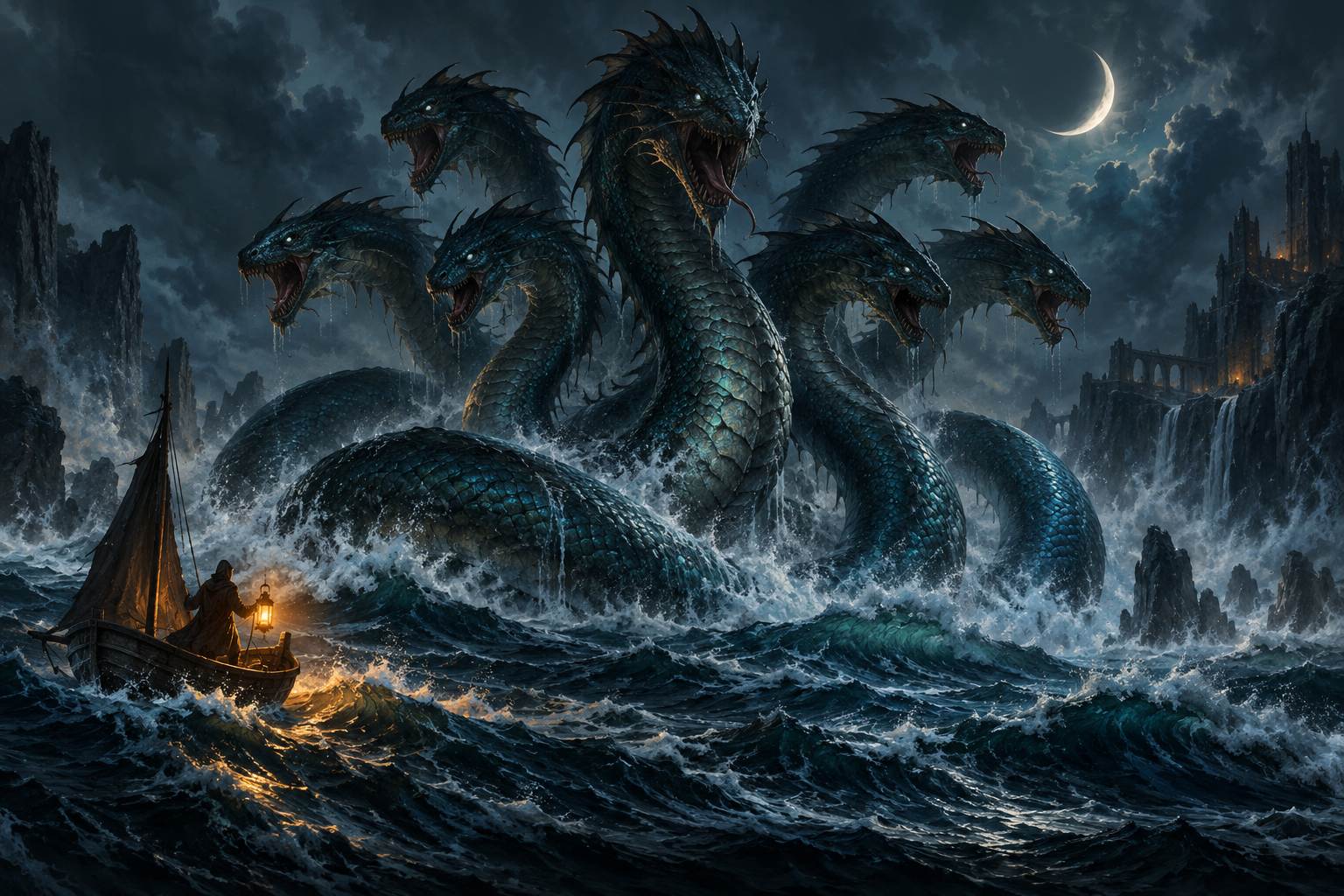
Leviathan demon explained: the sea monster of Job and Isaiah, the Canaanite Lotan, the rabbinic banquet, the sin of envy and the modern prince of hell.
Quick answer: The Leviathan demon is a later development of the biblical Leviathan, a vast sea monster described in Job, Psalms and Isaiah as a creature only God can tame. Medieval and early modern demonologists turned the sea serpent into a named devil: Peter Binsfeld assigned Leviathan to the sin of envy in 1589, French exorcists listed him among possessing spirits, and twentieth-century occultism made him a crown prince of hell ruling the element of water.
Related guides: Beelzebub, lord of the flies, Mammon and the sin of greed, what demonology actually studies, a full list of demon names, angels and demons compared, Belial, the worthless one.
| Source | Date | What Leviathan is | Role |
|---|---|---|---|
| Ugaritic Baal Cycle (Lotan) | c. 14th–12th century BCE | Seven-headed twisting serpent | Chaos monster defeated by the storm god Baal |
| Job 41; Psalm 74; Psalm 104; Isaiah 27 | 1st millennium BCE | Untameable sea creature, dragon in the sea | Proof of God's power; enemy to be slain at the end of days |
| Talmud, Bava Batra 74b–75a | c. 3rd–6th century CE | Primordial sea beast paired with Behemoth | Future banquet for the righteous; skin becomes a shelter |
| Binsfeld, Classification of Demons | 1589 | Devil of one deadly sin | Prince of envy |
| Aix and Loudun possession cases | 1611 and 1634 | Possessing spirit named by exorcists | Tempter to heresy and unbelief |
| Dictionnaire Infernal (de Plancy) | 1818/1863 | Demon of the sea, admiral of hell in some lists | Rules the waters and tempts to doubt |
| Satanic Bible (LaVey) | 1969 | Crown prince of hell | Element of water, direction west |
Key Takeaways
The Leviathan demon is the name later tradition gave to a creature the Hebrew Bible never calls a demon at all. In scripture, Leviathan (Hebrew livyatan, probably from a root meaning “to twist” or “coil”) is a monstrous sea creature, sometimes a serpent, sometimes a dragon, sometimes simply the largest thing in the ocean. The word appears six times in the Hebrew text, and in every case the point is the same: this is a being so powerful that only God can master it.
The transformation from sea monster to devil happened slowly. Early Christian writers read the serpent and dragon imagery alongside Revelation 12, where Satan is “the great dragon,” and Leviathan became a convenient symbol for the devil himself. By the late Middle Ages the symbol had hardened into a personality. Demonologists who tried to sort hell into ranks and offices needed names, and Leviathan was one of the oldest and most frightening available.
Today the phrase “Leviathan demon” usually points to one of three things: the sea beast of Job, the prince of envy in seven-deadly-sins lists, or the crown prince of the west in modern occult literature. This article follows the name through all three, with the sources named so you can check them yourself.
The longest biblical description is Job 41, a full chapter in which God challenges Job to catch Leviathan with a hook, put a cord through its nose, or make it a pet for his daughters. The creature has a back of shields, breath that sets coals ablaze, and a heart “as hard as a millstone.” Iron is like straw to it, and “upon earth there is not its like.” Some scholars read the passage as a poetic crocodile; others see a mythic dragon. The text itself is deliberately larger than life.
Psalm 74:14 recalls that God “crushed the heads of Leviathan,” a plural that matches the multi-headed serpent of older Canaanite myth. Psalm 104:26, by contrast, is almost playful: Leviathan is a creature God formed “to play in” the sea, one animal among many that look to their maker for food. Job 3:8 mentions people skilled at rousing Leviathan, likely a reference to professional cursers.
Isaiah 27:1 looks forward rather than back. On a coming day the Lord “will punish Leviathan the fleeing serpent, Leviathan the twisting serpent, and he will slay the dragon that is in the sea.” This verse, more than any other, fed the later idea of Leviathan as an enemy of God awaiting final defeat, which is a short step from calling it a demon.
Does this touch your own situation? Many readers come to these pages because something in their home, dreams or family feels unexplained. Reading history helps, but it cannot look at your specific case.
Consult the Sheikh Private, confidential, and free to ask.
The biblical writers did not invent Leviathan from nothing. Clay tablets found at Ugarit, on the Syrian coast, preserve a Bronze Age poem in which the storm god Baal defeats a sea serpent called Lotan, described with the same two epithets Isaiah uses: the fleeing serpent and the twisting serpent, with seven heads. The names are cognate, and most scholars treat Leviathan as the Israelite inheritor of this Canaanite chaos monster.
Farther east, the Babylonian creation epic Enuma Elish tells how Marduk kills the sea goddess Tiamat and builds the world from her body. The pattern, a divine warrior subduing a watery chaos being, is sometimes called the Chaoskampf motif, and it runs through Near Eastern religion. The Bible reuses the imagery but changes the theology: Leviathan is a creature, not a rival god, and the fight is already won.
This background matters for the demon question. When Christian and Jewish readers later identified Leviathan with Satan, they were partly recovering an ancient idea that the sea serpent stood for everything hostile to divine order. The demonologists of the sixteenth century simply gave that hostility a job title.
Rabbinic literature keeps Leviathan a beast rather than a devil, but a very large and very strange one. The Talmud, in tractate Bava Batra 74b–75a, collects sailors’ tales and exegetical traditions: God created a male and female Leviathan, killed the female so the pair could not multiply and destroy the world, and salted her flesh for the righteous. At the end of days the righteous will feast on Leviathan, and God will make a shelter from its skin.
Leviathan is regularly paired with Behemoth, the land monster of Job 40, and with the giant bird Ziz, so that the three represent sea, land and air. Jewish liturgy still echoes this: a blessing recited when leaving the sukkah at the end of Sukkot expresses the hope to sit next year in the sukkah made of Leviathan’s hide. This is a very different Leviathan from the demon of later Christian lists.
None of these sources present Leviathan as a tempter or a fallen angel. The demonic reading belongs almost entirely to Christian Europe.
The church fathers set the stage. Writers from Origen onward used Leviathan as a figure for the devil, drawing on Isaiah’s “dragon in the sea” and Revelation’s “old serpent.” In medieval art the mouth of hell is often drawn as the gaping jaws of a sea beast, and the Leviathan of Job supplied the picture. Thomas Aquinas, discussing the sin of envy, quoted Job 41 and the opinion that “Leviathan” there signifies the devil.
The decisive step came from the German theologian Peter Binsfeld. In his 1589 treatise on witches’ confessions he matched seven demons to the seven deadly sins: Lucifer with pride, Mammon with greed, Asmodeus with lust, Leviathan with envy, Beelzebub with gluttony, Satan with wrath and Belphegor with sloth. The list spread widely, and it remains the main reason Leviathan shows up in “seven deadly sins demons” searches today.
Note what is missing. Leviathan is not one of the 72 demons of the Goetia, and he has no seal, legions or office in the Lemegeton. His demonic career runs through sermons, exorcism records and sin lists rather than the Solomonic grimoires. Readers who want the ranked spirit catalog should see the Goetia ranks and hierarchy instead.
Because Leviathan sits in several overlapping systems, it is easy to confuse with other great names of hell. Beelzebub, the “lord of the flies” of 2 Kings and the Gospels, is Binsfeld’s demon of gluttony and a prince in almost every hierarchy; our profile of Beelzebub traces that history. Belial, from the Hebrew word for worthlessness, appears in the Dead Sea Scrolls as the leader of the sons of darkness and later as a Goetia king. Behemoth is Leviathan’s land-dwelling twin in Job and in rabbinic lore, and almost never a demon in its own right.
The clearest way to tell them apart is by origin and element. Leviathan is the sea; Behemoth is the earth; Beelzebub is the air, as the flies suggest; Belial is a moral quality turned into a person. Modern occult writers formalized this. Anton LaVey’s Satanic Bible (1969) names Satan, Lucifer, Belial and Leviathan as the four crown princes of hell, assigning Leviathan to water and the west.
Among the seven-sin demons, Leviathan’s partner is Mammon, the personification of greed. Envy and greed are neighbors in the medieval moral map, and sermons often described the envious as drowning in bitterness, which fits a water monster well enough that the pairing stuck.
Milton’s Paradise Lost compares the fallen Satan, stretched on the burning lake, to Leviathan, the sea beast so huge that sailors mistake it for an island and anchor to its side. That image, drawn from medieval bestiaries, gave English literature its default picture of the creature. Herman Melville’s Moby-Dick uses “Leviathan” as a plain synonym for whale, and the word still carries that meaning in everyday English.
Film and television have gone further. The series Supernatural made the Leviathans a race of ancient monsters older than angels. Video games such as Final Fantasy cast Leviathan as a summonable sea serpent, and the name appears in tabletop games, comics and heavy-metal lyrics as shorthand for an apex monster. Searches for “Leviathan demon” often come from these sources, where the biblical origin is barely remembered.
A second stream comes from popular interest in demonology and the seven deadly sins, where lists circulate online with Leviathan as the demon of envy. A third comes from readers of political philosophy who meet Hobbes’s title and wonder about the monster behind it. The name has had three lives, and all three are still active.
If you want to go deeper, start with the texts in order. Read Job 40 and 41 in a modern translation, then Psalm 74, Psalm 104 and Isaiah 27, noticing how differently each passage treats the creature. A translation of the Ugaritic Baal Cycle, available in most Near Eastern mythology anthologies, will show you Lotan with its seven heads and its two epithets. Bava Batra 74b–75a is available in English and is a short, strange and rewarding read.
For the demonic Leviathan, Binsfeld’s 1589 treatise is the key document, though it is rarely translated in full; summaries in histories of witchcraft reproduce the seven-sin list accurately. The Dictionnaire Infernal entry is brief and reflects nineteenth-century assumptions. Treat modern occult assignments, including the four crown princes, as twentieth-century inventions, which their authors never claimed were ancient.
Finally, keep the categories straight. Scripture presents Leviathan as a creature that displays God’s power. Rabbinic tradition presents a monster destined for a banquet. Christian demonology presents a devil of envy. These are different claims from different centuries, and much online confusion comes from stacking them into a single biography.
Still have a question about your own experience? Describe what you are seeing, feeling or dreaming, and when it started. The Sheikh reads every message personally and replies in private.
Want a personal perspective? Leviathan became the medieval emblem of envy, a feeling almost everyone meets at some point, and our partner PuraTarot offers a Full Personal Reading for readers who would like to reflect calmly on what is stirring in their own life. Join the free Djinn Guide newsletter and, once you confirm, you will unlock a 50% code for your first reading.
Further reading
As an Amazon Associate we earn from qualifying purchases.
Leviathan is a biblical sea monster that later Christian demonology reinterpreted as a devil. In Job, Psalms and Isaiah it is a vast serpent only God can subdue. From the sixteenth century, demonologists such as Peter Binsfeld listed Leviathan as the demon of envy, and modern occult writers made it a crown prince of hell associated with water.
Envy. The pairing comes from Peter Binsfeld's 1589 classification, which assigned Lucifer to pride, Mammon to greed, Asmodeus to lust, Leviathan to envy, Beelzebub to gluttony, Satan to wrath and Belphegor to sloth. The list was influential in later demonologies and is the source of most modern seven-sins demon charts.
No. In the Hebrew Bible Leviathan is a creature, a sea monster described in Job 41 and mentioned in Psalms and Isaiah. It is never called a demon or a fallen angel. The demonic identification developed in Christian interpretation, where the serpent and dragon imagery was linked to Satan, the great dragon of Revelation 12.
Both appear in the Book of Job. Behemoth, in Job 40, is a land animal of immense strength, often read as a hippopotamus or a mythic beast. Leviathan, in Job 41, is a sea creature. Rabbinic tradition pairs them as the great monsters of land and sea, destined to be served at a feast for the righteous.
No. Leviathan does not appear in the Ars Goetia or any book of the Lesser Key of Solomon, and it has no sigil, rank or legions in that system. Its place in demonology comes from biblical interpretation, sin classifications, French exorcism cases and nineteenth-century compilations such as the Dictionnaire Infernal.
Disclaimer
This article describes Leviathan as it appears in scripture, rabbinic literature, Christian demonology and modern culture. It presents beliefs and traditions as historical material, does not endorse them, and provides no ritual instruction.
Did this guide help you understand the subject? Rate it and share your honest opinion to help other readers. Every review is checked by our editors before it appears.
There are no reviews yet. Be the first one to write one.


Sheikh Youssef
Tayeb El Merzouki
For inquiries about personalized spiritual work, private rituals, and traditional talismans, connect directly with Sheikh Youssef Tayeb El Merzouki.
Chat on WhatsApp