







Join Djinn Guide: Get 50% Off a Personal Reading
Get new guides to jinn, folklore and occult history. Confirm your subscription to unlock a 50% code for a first personal reading with our partner PuraTarot.
Discover the unseen
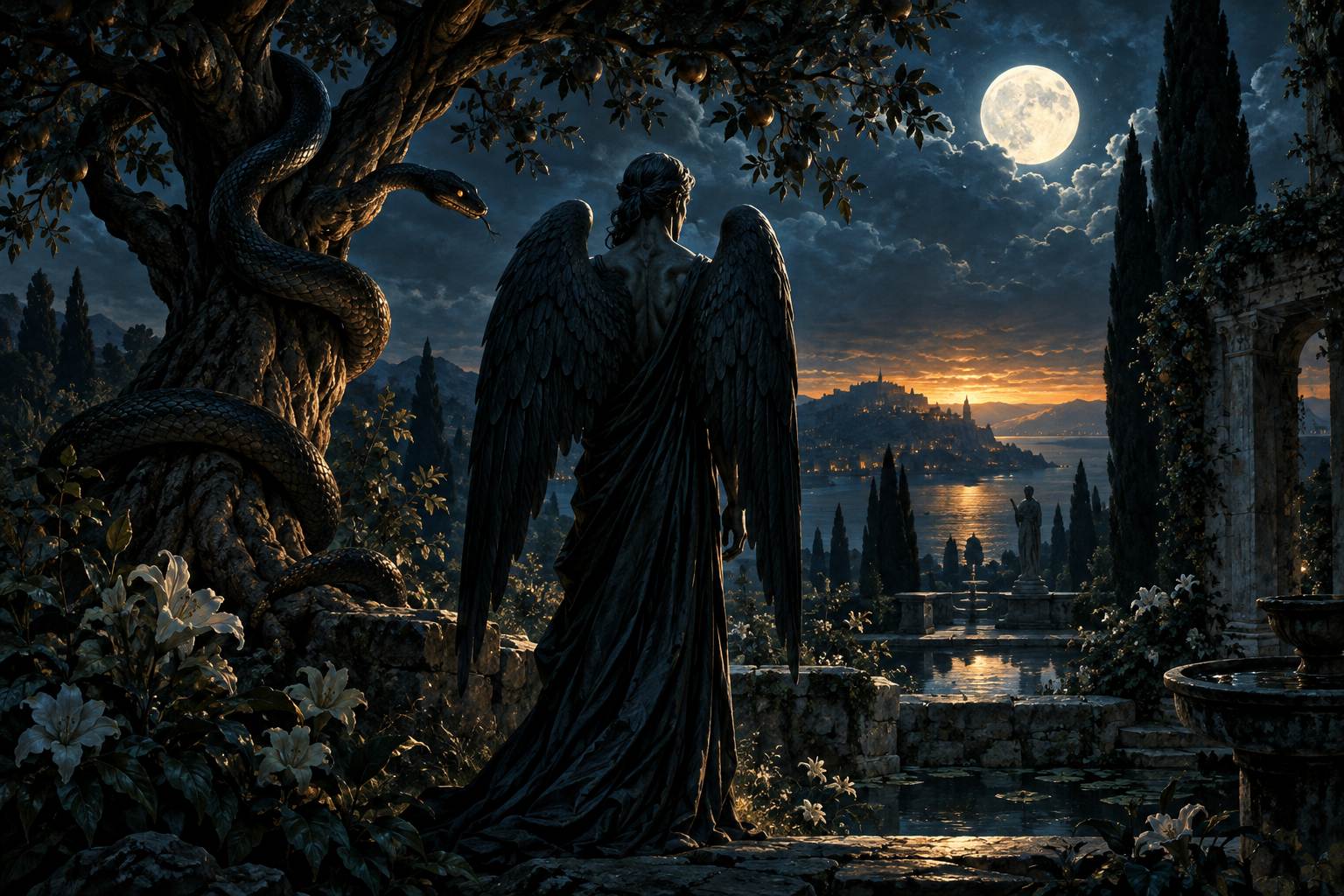
Samael explained: the angel of death and accuser of Jewish tradition, what his name means, his role in midrash, the Zohar and Gnostic texts, and Lilith.
Quick answer: Samael is a figure of Jewish tradition who is both angel and adversary: the accuser, the angel of death, the guardian angel of Rome and Esau, and the rider of the serpent in Eden. His name is usually explained as "poison of God" or, in Gnostic texts, "blind god." He is not named in the Bible or the Babylonian Talmud but appears in midrash, the Hekhalot writings and above all the Zohar, where he is paired with Lilith as the ruler of the Other Side.
Related guides: Lilith in Jewish legend, angels and demons compared, what Kabbalah is, Azazel, the scapegoat angel, who Shaitan is in Islam, shedim, the spirits of Jewish tradition.
| Source | Date (approx.) | Role of Samael | Angel or demon? |
|---|---|---|---|
| Ascension of Isaiah | 1st to 2nd century CE | Ruler of this world, identified with Satan and Beliar | Fallen angel |
| 3 Baruch | 1st to 3rd century CE | Plants the vine that leads Adam astray | Angel who errs |
| Apocryphon of John (Gnostic) | 2nd century CE | Name of the ignorant creator Yaldabaoth, 'blind god' | False god |
| Pirkei de-Rabbi Eliezer | 8th to 9th century CE | Rides the serpent into Eden, tempts Eve | Rebel angel |
| Deuteronomy Rabbah | c. 9th century CE | Angel of death sent for Moses, repelled by him | Angel |
| Zohar | late 13th century CE | Consort of Lilith, head of the Other Side, accuser | Demonic prince |
Key Takeaways
Samael is one of the most layered figures in Jewish tradition, because he was never pinned down to a single role. In different texts he is the accuser who brings charges against Israel in the heavenly court, the angel of death who collects souls, the guardian angel of Esau and therefore of Rome, the angel who rode the serpent into the Garden of Eden, and the husband of Lilith. He is addressed as an angel, and sometimes as a high one, yet his work is almost always hostile. That tension is what makes him interesting: he is the clearest case in Jewish literature of an angel whose function is adversarial without his being simply the Devil.
The figure answers a question that the Hebrew Bible leaves open. Scripture has an angel of death, an adversary or satan, and a serpent, but it does not connect them. From the second century CE onward, Jewish and Christian writers began to give these roles a single name, and Samael was one of the names chosen. Over the following thousand years the name absorbed more and more, until in the Zohar he became the prince of the demonic realm. Readers who want the Islamic parallel will find it in our article on who Shaitan is, where a similar process gave Iblis his story.
Two etymologies compete, and the sources themselves disagree. The most common Jewish explanation divides the name into Hebrew sam, meaning poison or drug, and El, meaning God, giving “poison of God” or “venom of God.” This fits his role as angel of death, and medieval writers linked it to the tradition that the angel of death kills with a drop of poison from his sword. It is a plausible folk etymology but not a demonstrated one.
The Gnostic texts of the second and third centuries give a different reading. The Hypostasis of the Archons, found among the Nag Hammadi manuscripts, says that the creator god Yaldabaoth is also called Samael, “which means god of the blind,” and the Apocryphon of John lists Samael as one of his three names alongside Saklas, “fool.” This derives the name from Aramaic sami, blind, and expresses the Gnostic view that the creator of the material world was ignorant of the true God above him.
Modern scholars generally treat both as interpretations rather than origins. The name may originally have belonged to an angel with no particular meaning attached, as many angelic names in the apocrypha do, with the explanations added later to fit the roles he had acquired. What is clear is that by late antiquity the name was already associated with death, hostility and blindness, which is the combination later tradition developed.
Does this touch your own situation? Many readers come to these pages because something in their home, dreams or family feels unexplained. Reading history helps, but it cannot look at your specific case.
Consult the Sheikh Private, confidential, and free to ask.
Searches for “Samael Talmud” usually expect to find him there, but the Babylonian Talmud does not use the name. What the Talmud does say, in Bava Batra 16a, is that Satan, the evil inclination and the angel of death are one and the same, a statement that later writers used to justify giving all three roles to Samael. The name itself appears in texts on either side of the Talmud.
The Ascension of Isaiah, a Jewish-Christian work of the first or second century, calls the ruler of this world Sammael and treats the name as equivalent to Satan and Beliar. The Greek Apocalypse of Baruch (3 Baruch) makes Samael the angel who planted the vine in Eden, whose fruit led Adam astray.
In 3 Enoch, a mystical text of the fifth to seventh centuries, Samael is named as prince of the accusers and as the angel of Rome, standing in the heavenly court against Israel while Michael and Gabriel defend it.
This eighth or ninth century midrash gives the fullest early narrative. Samael, the greatest prince in heaven, with twelve wings to the seraphim’s six, descends with his host, chooses the serpent as his mount and uses it to tempt Eve. Some manuscripts add that Cain was born of Samael rather than Adam, a tradition the Zohar later repeats.
In Deuteronomy Rabbah 11, God sends Samael as angel of death to take Moses’s soul, and Moses drives him off with his staff and the radiance of his face, until God himself takes the soul with a kiss. The story shows Samael as a legitimate officer of heaven whose work the righteous may resist.
The pairing that most people know comes from medieval Kabbalah. The first explicit statement is in the Treatise on the Left Emanation by Rabbi Isaac ha-Kohen of Castile, written around 1260 to 1280, which describes a demonic counterpart to the divine structure of the sefirot. In it Samael and Lilith are a couple, born together, ruling the realm of impurity, and Isaac adds the detail that God castrated Samael to prevent the pair from multiplying demons without limit. The idea of a mirror-image hierarchy of evil is the foundation of later Kabbalistic demonology.
The Zohar, composed in Spain in the late thirteenth century, developed the picture. Samael is the head of the Sitra Achra, the Other Side, the system of husks or qelipot that feed on holiness. He is the serpent’s rider, the accuser, and the force behind Esau and Rome. Lilith is his consort, and together they are said to tempt, to harm infants and to cause nocturnal impurity. The Zohar also preserves the tradition that Samael is a blind figure, which brings the two etymologies together. For the structure he mirrors, see our introduction to what Kabbalah is, and for his partner, the page on Lilith in Jewish legend.
Later Kabbalists, including the sixteenth-century school of Safed, refined these ideas, and nineteenth-century occultists in the Golden Dawn borrowed the Other Side wholesale, placing Samael as the shell corresponding to the sefirah Hod. That attribution is a modern occult reading rather than a Jewish one and should be labeled as such.
Outside Judaism, Samael took two quite different paths. The Gnostic Christians of the second and third centuries, as noted above, used the name for the ignorant creator of the material world. In the Hypostasis of the Archons he boasts that he is the only god and is rebuked by a voice from above, which calls him Samael, god of the blind. This figure is a cosmic villain of a kind the rabbis never imagined, and the shared name is mostly a coincidence of vocabulary: both traditions needed a name for a hostile heavenly power, and this one was available.
Mainstream Christianity largely ignored him. He appears in a few lists of fallen angels and in some medieval Latin texts that drew on Jewish lore, but Satan, Lucifer and Beelzebub filled the role in Christian imagination, and Samael never became a standard demon. He is not among the seventy-two spirits of the Goetia and is absent from most of the grimoires. The one place he surfaces regularly is in angelology: a few Renaissance and later writers, following the rabbinic view that he was a prince of angels, list him among the archangels or as the angel of Mars, which is why he sometimes appears on lists of angels and demons alike. Our comparison of angels and demons explains why such double membership was possible.
In modern occultism he is mostly a Kabbalistic figure, discussed in connection with the qelipot and with Lilith, and treated as a symbol of severity, judgment and the destructive side of divine power.
Several claims circulate that the sources do not support, and they are worth sorting out.
None of this makes Samael less significant. It means that his biography is a medieval construction built from older pieces, which is true of most of the great figures of demonology.
Much of the current interest in Samael comes from fiction. The series Lucifer made the name familiar to millions as the Devil’s original angelic name. Video games including the Darksiders series, the Silent Hill series and the Shin Megami Tensei games use him as a boss, a hidden power or a summonable demon. Metal bands have taken the name, and he appears in comics, anime and fantasy novels as a dark angel, often with little connection to any source. The attraction is obvious: an angel who is also an adversary offers a more ambiguous character than a plain devil.
A second group of searchers comes from religious and academic interest. Students of Kabbalah meet him in the Zohar; readers of Gnostic texts meet the blind god; anyone studying Jewish angelology or the development of Satan runs into him sooner or later. The questions they ask, whether he is an angel or a demon, what his name means, and how he came to be paired with Lilith, are the questions this article has tried to answer.
For further reading, the order that makes most sense is chronological: the Ascension of Isaiah and 3 Baruch, then the Nag Hammadi texts, then Pirkei de-Rabbi Eliezer and the midrashim, then the Treatise on the Left Emanation and the Zohar. Read that way, Samael’s story is a case study in how a tradition gives a name to its fears and then keeps revising what the name means.
Still have a question about your own experience? Describe what you are seeing, feeling or dreaming, and when it started. The Sheikh reads every message personally and replies in private.
Want a personal perspective? Samael’s story turns on testing and accusation, themes that often resonate with readers who are going through their own season of doubt or difficult choices. If you would like to reflect on that privately, our partner PuraTarot offers a Full Personal Reading centered on your own circumstances and questions. Join the free Djinn Guide newsletter and, once you confirm, you will unlock a 50% code for your first reading.
Further reading
As an Amazon Associate we earn from qualifying purchases.
Samael is an angel of Jewish tradition who acts as accuser, angel of death, prince of Rome and Esau, and tempter in Eden. He is not named in the Bible or the Talmud but appears in apocrypha, midrash and the Zohar, where he rules the demonic Other Side together with Lilith.
Both, depending on the source. Rabbinic texts call him an angel, even a great prince, whose duties are hostile to humans. The Zohar makes him head of the demonic realm. Gnostic texts use the name for the ignorant creator god. He is best described as an angel of adversarial function who later became a demonic prince.
The usual Jewish explanation is 'poison of God', from Hebrew sam, poison, and El, God, fitting his role as angel of death. Gnostic texts explain it as 'blind god', from Aramaic sami, blind. Scholars regard both as interpretations attached to the name after the fact rather than its proven origin.
In medieval Kabbalah, beginning with Isaac ha-Kohen's Treatise on the Left Emanation in the thirteenth century and continuing in the Zohar, Samael and Lilith are a couple who rule the Other Side, the realm of impurity that mirrors the holy sefirot. Earlier sources do not pair them.
The Babylonian Talmud does not use the name. It states in Bava Batra 16a that Satan, the evil inclination and the angel of death are one, and later writers applied that identity to Samael. His stories come from midrashim such as Pirkei de-Rabbi Eliezer and Deuteronomy Rabbah, and from the Zohar.
Disclaimer
This article describes Samael as he appears in Jewish, Gnostic and later occult literature for educational purposes. The beliefs of those traditions are reported, not endorsed, and nothing here is offered as ritual guidance or as a claim about the existence or power of any spirit.
Did this guide help you understand the subject? Rate it and share your honest opinion to help other readers. Every review is checked by our editors before it appears.
There are no reviews yet. Be the first one to write one.


Sheikh Youssef
Tayeb El Merzouki
For inquiries about personalized spiritual work, private rituals, and traditional talismans, connect directly with Sheikh Youssef Tayeb El Merzouki.
Chat on WhatsApp


