




Join Djinn Guide: Get 50% Off a Personal Reading
Get new guides to jinn, folklore and occult history. Confirm your subscription to unlock a 50% code for a first personal reading with our partner PuraTarot.
Discover the unseen

Jinn in Islam explained: what the Quran and hadith say about the jinn, their creation from smokeless fire, Iblis, Solomon's jinn, and common beliefs.
Quick answer: In Islam, jinn are intelligent beings created by God from smokeless fire, unseen by humans in their natural state, and morally accountable like people. The Quran mentions them in many chapters, devotes Surah 72 (Al-Jinn) to them, and describes some jinn accepting Islam and others rejecting it. Hadith literature adds details about their food, their habits, and the companion jinn assigned to each person. Jinn are not angels and not mere folklore within Islamic theology; they are part of the unseen world Muslims are asked to believe in.
Related guides: Surah Al-Jinn explained verse by verse, the qareen companion jinn, who Shaitan is in Islam, the main types of jinn, are jinn evil or good, are jinn real.
| Feature | Angels | Jinn | Humans |
|---|---|---|---|
| Created from | Light (Sahih Muslim) | Smokeless fire (Quran 55:15) | Clay (Quran 55:14) |
| Free will | No; obey by nature | Yes; believers and rejecters exist | Yes |
| Normally visible to humans | No | No | Yes |
| Eat, marry, reproduce, die | No | Yes, per hadith and scholars | Yes |
| Judged on the Last Day | Not accountable in the same way | Yes (Quran 6:128) | Yes |
| Knowledge of the unseen | Only what God reveals | None (Quran 34:14) | None |
Key Takeaways
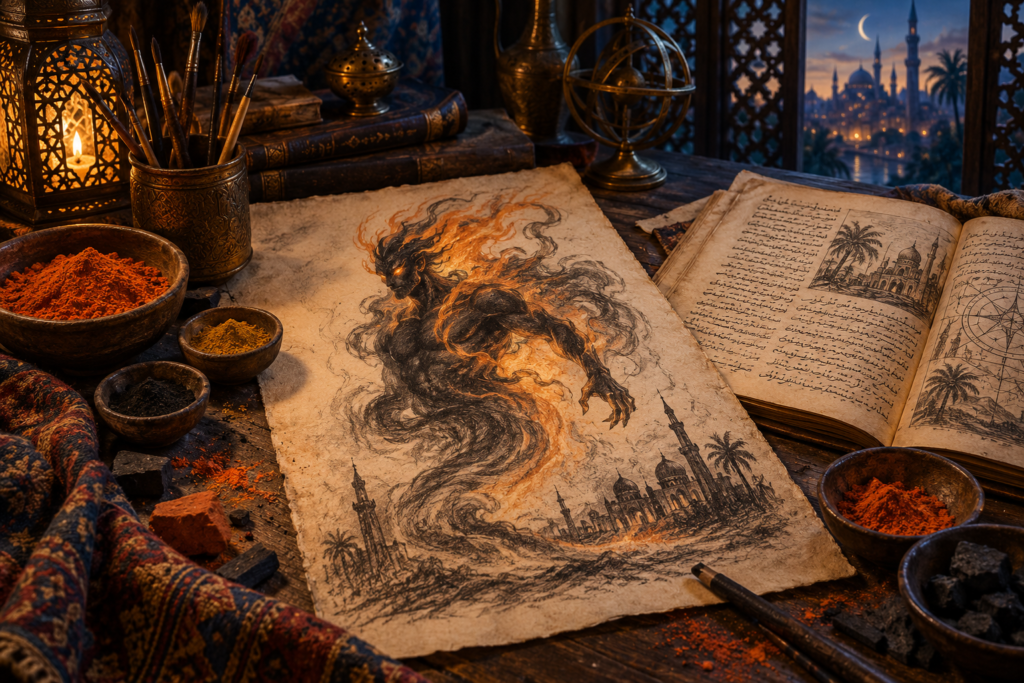
The word jinn comes from an Arabic root meaning to hide or conceal, and that is the simplest definition of jinn in Islam: a created order of beings hidden from ordinary human sight. The Quran states that God created the jinn from a smokeless flame of fire (Surah Ar-Rahman 55:15) while humans were formed from clay. This contrast matters. Jinn are not ghosts, not the souls of the dead, and not fallen angels. They are a separate species with their own origin, their own communities, and their own moral responsibility before God.
Islamic theology treats jinn as real but as part of al-ghayb, the unseen. A Muslim is asked to believe in them because scripture affirms them, not because anyone has measured them. The Quran addresses jinn and humans together as the two weighty groups (Surah Ar-Rahman 55:31) and says both were created to worship God (Surah Adh-Dhariyat 51:56). That shared purpose is the heart of the idea: jinn are moral agents who can choose faith or rejection, just as humans can.
For readers new to the subject, the beginner guide to what jinn are covers the basics across cultures. This article focuses on the specifically Islamic picture, drawn from the Quran, the hadith, and the classical scholars who commented on them. Where later folklore adds color, we flag it as folklore rather than doctrine.
The Quran names jinn in dozens of verses, and one whole chapter, Surah Al-Jinn (72), takes its title from them. In that chapter a group of jinn overhear the Quran being recited and respond with astonishment, saying they heard a wonderful recitation that guides to the right way and so believed in it (72:1-2). The chapter then presents the jinn speaking in their own voice, admitting that among them are the righteous and among them are those who are otherwise (72:11). It is the clearest scriptural statement that jinn are morally diverse.
Surah Al-Ahqaf (46:29-32) tells a related episode: jinn listen to the Prophet, then return to their people as warners. Surah Al-An’am (6:130) says messengers were sent to the company of jinn and mankind, and the final chapter of the Quran, Surah An-Nas (114), ends by seeking refuge from whisperers from among jinn and mankind. Together these passages establish that jinn hear revelation, are answerable for it, and can act as both believers and tempters.
The Quran also records the jinn of Solomon, who built and dived for him under God’s authority (Surah Saba 34:12-13; Surah Al-Anbiya 21:82), and the ifrit who offered to fetch the Queen of Sheba’s throne (Surah An-Naml 27:38-40). Finally, Surah Al-Kahf (18:50) states plainly that Iblis was of the jinn, a verse that shapes the whole Islamic understanding of Satan. For a verse-by-verse reading of the key chapter, see our explanation of Surah Al-Jinn.
Does this touch your own situation? Many readers come to these pages because something in their home, dreams or family feels unexplained. Reading history helps, but it cannot look at your specific case.
Consult the Sheikh Private, confidential, and free to ask.
Hadith, the recorded sayings and actions of the Prophet Muhammad, fill in details the Quran leaves open. Scholars grade each report for reliability, and the examples below come mainly from the two most trusted collections, Sahih Muslim and Sahih al-Bukhari. They are the main source of what Muslims traditionally say about jinn habits.
A hadith in Sahih Muslim, narrated by Aisha, states that the angels were created from light, the jinn from smokeless fire, and Adam from what the Quran describes, meaning clay. This single report is the reason Islamic writers so consistently separate jinn from angels, and why the idea of a fallen angel does not fit Islamic categories at all.
A report preserved in collections such as al-Tabarani describes three categories: jinn with wings that fly through the air, jinn in the form of snakes and dogs, and jinn that settle in one place and travel about like people. Classical scholars quote it often, although it is less strongly graded than the Sahih reports and should be read as tradition rather than firm doctrine.
Sahih Muslim preserves a tradition in which the Prophet tells a delegation of jinn that bones over which God’s name was mentioned become food for them, and that animal dung becomes fodder for their mounts. It is the origin of the custom, still observed by some Muslims, of not using bones or dung for cleaning, since they are described as provision for the jinn.
Also in Sahih Muslim, the Prophet says every person has been assigned a companion, a qarin, from among the jinn. Asked whether this included him, he replied that God had helped him against his companion, so it only urged him to good. The idea has a long afterlife in folk belief, which we trace in the article on the qareen companion jinn.
Ibn Mas’ud relates that the Prophet went out one night to recite the Quran to a gathering of jinn and afterward showed his companions the traces of their fires. Together with Surah 72 and Surah 46, this report is the hadith basis for the belief that jinn received the Islamic message directly rather than only through humans.
Because jinn can choose, Islamic sources divide them first by faith, not by species. Muslim jinn are those who accept God’s message; the jinn of Surah 72 describe themselves this way. Unbelieving jinn reject it. A third label, shaitan (plural shayatin), is a role rather than a lineage: any jinn who devotes itself to tempting and harming is a shaitan, and the Quran even speaks of devils from among mankind and jinn (Surah Al-An’am 6:112), so a human can be called one too.
Iblis is the first and chief shaitan. According to Surah Al-Kahf 18:50, he was of the jinn, which is why he could disobey the command to bow to Adam; angels in Islamic belief cannot disobey. His followers are the shayatin of later tradition. Our article on who Shaitan is separates these overlapping terms carefully.
Beyond faith, tradition recognizes named types that are closer to folklore than doctrine: the ifrit (named once in the Quran at 27:39 as a powerful jinn), the marid, the ghul, the sila, and others. These labels describe strength or behavior, not theological rank. The guide to the types of jinn lays them out with their sources and shows which have scriptural backing and which do not.
Popular media mixes the Islamic jinn with the genie of the Arabian Nights and Hollywood, and the resulting confusion is worth clearing. The Islamic sources never describe wish granting, lamps, or three wishes; those belong to literary tradition, which we cover in the article on jinn in the Arabian Nights. These points are the ones most often misunderstood by readers meeting the topic for the first time.
Scholars from Ibn Taymiyyah in the fourteenth century to modern commentators have warned against both extremes: denying jinn entirely and blaming every misfortune on them. The classical compendium Akam al-Marjan by al-Shibli, also from the fourteenth century, remains a standard collection of what hadith and jurists said, and it already warns against popular superstition.
Searches for jinn in Islam rise for several reasons. Converts and students want to know what belief in jinn actually requires. Readers of horror fiction and viewers of films that borrow the word djinn look for the original meaning behind the monster. And many people in Muslim-majority communities meet jinn language in daily life, from reciting Ayat al-Kursi before sleep to explanations offered for illness or bad luck.
The internet also hosts a large market of ruqyah services, amulet sellers, and self-styled healers. Some operate within recognized religious frameworks; others sell fear. Knowing what the primary sources say is the best protection against being misled. The Quran gives real attention to jinn but none to formulas for controlling them, and the Islamic tradition treats attempts at that kind of control, along with seeking their help in magic, as forbidden rather than merely risky.
Jinn also appear in the long history of Solomonic magic and the European grimoires, where Arabic ideas mingled with Jewish and Greek ones, and in the Southeast Asian khodam tradition, where servant spirits are described in Islamic vocabulary. Those later systems are worth studying on their own terms, but they should not be read back into the Quran, which never presents jinn as servants available for hire.
Start with the Quran in a reliable translation that includes commentary, and read the verses in context rather than as isolated proof texts. Surah 72 is the natural first stop, followed by the Solomon passages in Surah 27, Surah 34, and Surah 21, and the Iblis narrative in Surah 18 and Surah 7. Notice how often the text pairs jinn with humans; that pairing tells you more about the Islamic concept than any single dramatic verse does.
Hadith come with gradings, and those gradings matter. A report in Sahih Muslim or Sahih al-Bukhari carries far more weight than one found only in a later compilation, and a weak hadith about jinn behavior should not be presented as settled belief. Good modern translations mark the grading. When a website quotes a dramatic saying about jinn without naming its collection, treat the quotation with caution until you can trace it.
Finally, keep three layers apart: scripture, scholarly interpretation, and folklore. The Quran says jinn exist and are accountable. Scholars such as al-Shibli and Ibn Taymiyyah worked out the details. Folklore added the ghul, the lamp, the seven kings, and the local stories every region tells. All three are worth reading, but only the first is binding for Muslims, and every good question about jinn starts there.
Still have a question about your own experience? Describe what you are seeing, feeling or dreaming, and when it started. The Sheikh reads every message personally and replies in private.
Have a question of your own? Learning what the Quran and hadith say about the jinn often stirs quieter, more personal questions about one’s own life and direction. If you would like space to think those through, our partner PuraTarot offers a Full Personal Reading, a calm reading focused on your own situation. Join the free Djinn Guide newsletter and, once you confirm, you will unlock a 50% code for your first reading.
Further reading
As an Amazon Associate we earn from qualifying purchases.
Yes, many times. The Quran mentions jinn in dozens of verses and devotes an entire chapter, Surah Al-Jinn (72), to them. Other key passages include Surah Ar-Rahman 55:15 on their creation from fire, Surah An-Naml 27:39 on the ifrit in Solomon's court, and Surah Al-Kahf 18:50, which states that Iblis was of the jinn.
The Quran says jinn were created from a smokeless flame of fire (Surah 55:15 and Surah 15:27). A hadith in Sahih Muslim adds the comparison: angels from light, jinn from smokeless fire, and Adam from clay. Scholars read fire as the original substance, not as a description of how jinn look or behave now.
Yes. Surah Al-Jinn describes a group of jinn who heard the Quran and believed, and Surah Al-Ahqaf 46:29-32 shows jinn returning to warn their people. Hadith report that the Prophet recited to jinn directly. Islamic tradition therefore speaks of Muslim jinn and unbelieving jinn, judged on the same basis as humans.
Iblis is a jinn. Surah Al-Kahf 18:50 says he was of the jinn and so departed from his Lord's command. Because angels in Islam cannot disobey, Iblis could only refuse to bow to Adam if he had free will, which jinn possess. This is why Islam does not describe Satan as a fallen angel.
No. Nothing in the Quran or hadith describes jinn granting wishes, living in lamps, or being bound by a rubbed ring. Those motifs come from the Arabian Nights and later European retellings. Islamic sources describe jinn as beings with limited power, no knowledge of the unseen, and no obligation to serve humans.
Disclaimer
This article describes Islamic scripture, hadith, scholarly commentary, and folklore for educational purposes. Beliefs are presented as the tradition holds them, not as claims endorsed by this site, and nothing here promises any spiritual outcome or provides ritual instruction.
Did this guide help you understand the subject? Rate it and share your honest opinion to help other readers. Every review is checked by our editors before it appears.
There are no reviews yet. Be the first one to write one.


Sheikh Youssef
Tayeb El Merzouki
For inquiries about personalized spiritual work, private rituals, and traditional talismans, connect directly with Sheikh Youssef Tayeb El Merzouki.
Chat on WhatsApp