







Join Djinn Guide: Get 50% Off a Personal Reading
Get new guides to jinn, folklore and occult history. Confirm your subscription to unlock a 50% code for a first personal reading with our partner PuraTarot.
Discover the unseen
Jinn kings explained: the seven kings of the jinn, the weekday and planet tied to each, where the tradition comes from, and how it compares to the Goetia.
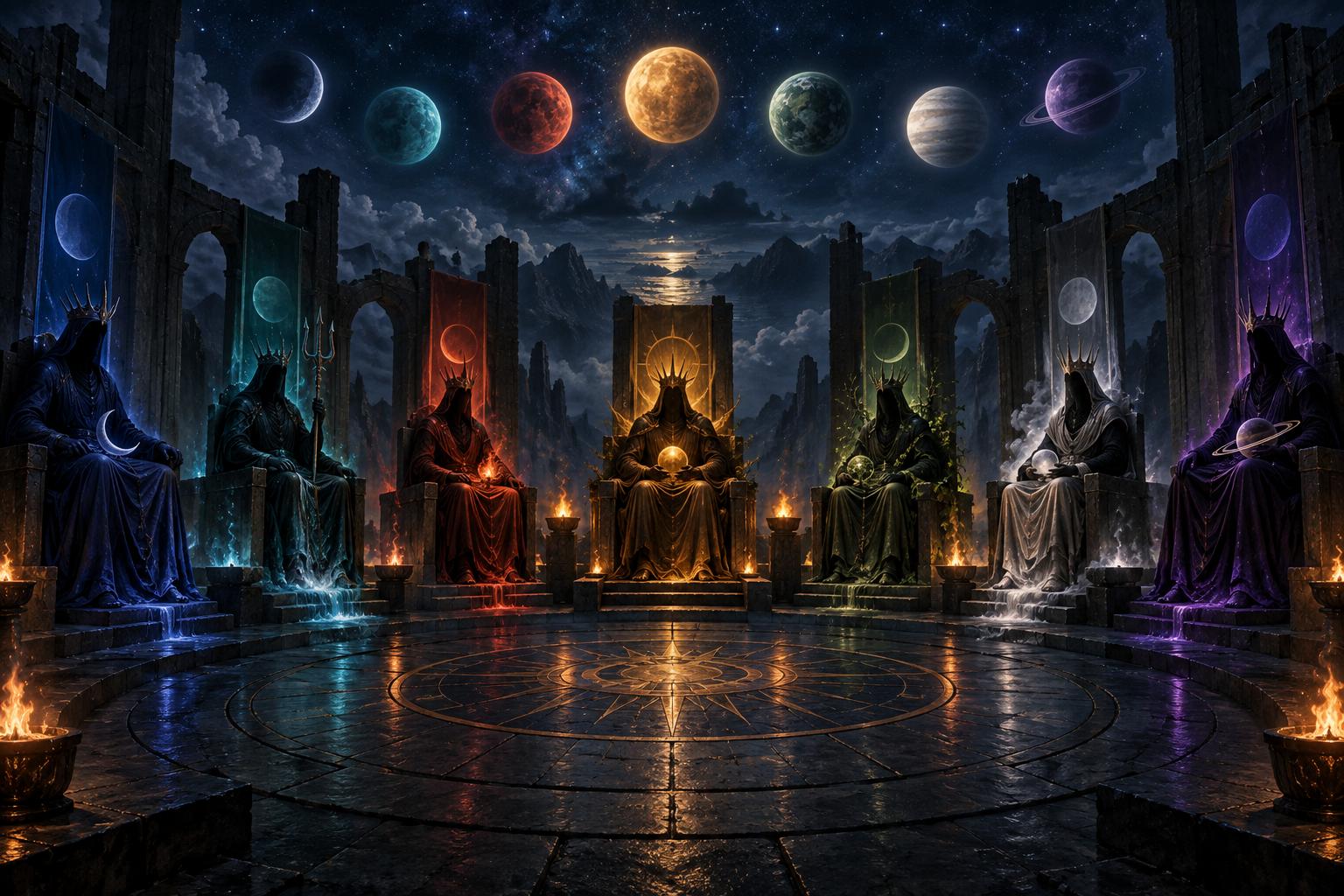
Quick answer: The jinn kings are seven rulers of the jinn named in medieval Arabic occult literature and later folk tradition, each assigned to a day of the week and its planet: al-Mudhhib (Sunday), al-Abyad (Monday), al-Ahmar (Tuesday), Burqan (Wednesday), Shamhurish (Thursday), Zawba'ah (Friday) and Maymun (Saturday). The list does not come from the Quran or hadith; it belongs to the literature of letter magic and to folklore from Morocco to the Gulf, where the kings are said to rule tribes of jinn.
Related guides: the main types of jinn, who Shaitan and Iblis are, Aisha Kandisha in Moroccan legend, Bael and Paimon, the Goetia kings, King Solomon and the jinn, demon hierarchy in the Goetia.
| Day | Jinn king (common spelling) | Planet in the tradition | Notes found in later sources |
|---|---|---|---|
| Sunday | Al-Mudhhib (al-Mudhdhib, "the Gilded") | Sun | Often described in gold or yellow; linked to kingship |
| Monday | Al-Abyad ("the White"), sometimes Murrah al-Abyad | Moon | Associated with pale or white forms and water |
| Tuesday | Al-Ahmar ("the Red") | Mars | The warlike king; feared in Moroccan folk accounts |
| Wednesday | Burqan (Barqan) | Mercury | Linked to speech, writing and trade |
| Thursday | Shamhurish | Jupiter | Called the judge (qadi) of the jinn; said in folklore to have embraced Islam |
| Friday | Zawba'ah ("Whirlwind") | Venus | Named after the dust devil; linked to winds |
| Saturday | Maymun (Maimun Abu Nuh) | Saturn | The dark or black king; linked to Saturn's heavy character |
Key Takeaways
In the Arabic occult literature that grew up from roughly the twelfth century onward, the jinn are imagined as organized into tribes, each tribe answering to a king. The best-known scheme names seven kings of the jinn and assigns one to each day of the week. The usual order runs from Sunday to Saturday: al-Mudhhib, al-Abyad, al-Ahmar, Burqan, Shamhurish, Zawba’ah and Maymun. Spellings vary widely because the names passed through many hands, and some lists swap two of the kings or add alternative names such as Murrah for the Monday king.
Several of the names are descriptive rather than personal. Al-Ahmar simply means “the Red,” al-Abyad “the White,” and al-Mudhhib “the Gilded.” Zawba’ah is the ordinary Arabic word for a whirlwind or dust devil, which in Arabian folklore was often said to be a jinn passing by. Maymun means “fortunate” or “blessed,” a common name that may have been chosen for its auspicious sound. Shamhurish and Burqan are harder to explain and appear only in this context.
Each king is paired with a planet. Sunday belongs to the Sun, Monday to the Moon, Tuesday to Mars, and so on through Saturn. This pairing is the key to understanding the whole system: the seven jinn kings are the Islamic-world form of the much older idea that the seven classical planets rule the seven days and that each has spirits attached to it. For the wider species these kings are said to govern, our overview of the types of jinn is the natural starting point.
The jinn kings do not appear in the Quran, and no sound hadith names them. The Quran speaks of Iblis, of shayatin, of jinn who served Solomon, and of jinn who listened to the Prophet, but it never lists a royal court. The kings belong instead to a later body of writing often grouped under the heading ilm al-huruf, the “science of letters,” which combined Quranic verses, divine names, magic squares and astrology. The most famous work in that stream is the Shams al-Ma’arif attributed to Ahmad al-Buni, who died in the thirteenth century, although the text as it circulates today grew well beyond anything he wrote.
Works of this type routinely organize spirits by planet and weekday, and they often pair each jinn king with an angel of the same day, so that the angel commands the king and the king commands his tribes. Angel names such as Ruqya’il, Jibra’il, Sama’il, Mika’il, Sarfya’il, Anya’il and Kasfya’il appear in such lists, though the spellings and pairings differ from manuscript to manuscript. The structure is clearly borrowed from older Greek and Hellenistic astral magic, and it resembles the planetary system of the Arabic Picatrix.
A second channel is oral folklore. Ethnographers working in Morocco in the early twentieth century recorded the same seven names among ordinary people, healers and musicians, which shows that the list had left the manuscripts and entered daily belief long before modern print. The kings became a shared vocabulary for talking about illness, luck and the unseen, far from any grimoire.
Does this touch your own situation? Many readers come to these pages because something in their home, dreams or family feels unexplained. Reading history helps, but it cannot look at your specific case.
Consult the Sheikh Private, confidential, and free to ask.
Later sources give each king a personality, a color and a sphere of influence that follows his planet. The descriptions below summarize what tradition says; they are beliefs reported, not claims.
The gilded king is linked to gold, authority and the brightness of the Sun. He is often placed first in the lists and treated as a kind of senior ruler, though no source makes him the single king over the others.
The white king shares the Moon’s associations with water, change and pale light. Some lists call him Murrah al-Abyad, and some medieval writers connected Murrah with Iblis’s own lineage.
The red king is the most feared of the seven in Moroccan accounts, where he is associated with blood, fever and sudden anger. His Martian character explains the reputation.
Burqan takes the Mercurial qualities of speech, writing and quick movement, and later texts attach him to scribes and merchants.
Shamhurish is the best known. Jupiter’s connection with judges and law made him the qadi of the jinn, and Moroccan folklore holds that he became a Muslim and that one of his dwellings lies in the Atlas Mountains. His name is still invoked in trance-music traditions.
Zawba’ah, the whirlwind, carries Venus’s day but a stormy nature. Maymun, under Saturn, is the dark king, sometimes called Maymun Abu Nuh, and is linked to melancholy and the deep earth, Saturn’s traditional domain.
| Feature | Seven jinn kings | Goetia kings |
|---|---|---|
| Number of kings | Seven, one per weekday | Nine among 72 spirits (Bael, Paimon, Beleth, Purson, Asmoday, Vine, Balam, Zagan, Belial) |
| Main organizing principle | Day of the week and its planet | Rank, number in the list, direction and legions |
| Earliest textual home | Arabic letter-magic manuals, 12th-13th century onward | Latin and English manuscripts, Weyer 1577 to the Lemegeton, 17th century |
| Relation to Solomon | Loose; rooted in Quranic jinn under Solomon | Explicit; spirits said to be bound by Solomon in a brass vessel |
| Status in religion | Folklore and occult literature, not doctrine | Condemned by churches; a grimoire tradition |
Although the seven-king scheme is post-Quranic, the idea of a king of jinn has deep roots. The Quran describes jinn and shayatin working under Solomon’s command (Surah 21:82, 34:12-13, 38:37-38), and later commentators and storytellers built a whole court around that image, with named jinn chiefs who built the Temple, dived for pearls or rebelled. The most famous is Sakhr, the jinn who, in Islamic legend, stole Solomon’s ring and ruled in his place for forty days. The article on King Solomon and the jinn gathers these stories.
The Arabian Nights continues the theme. Its jinn have kings and queens, armies and tribes; a jinn princess may fall in love with a human, and a marid may be imprisoned by Solomon’s seal for centuries. The stories do not use the seven-day list, but they share its assumption that the jinn form a society with rulers, laws and rivalries. In the tale of Hasan of Basra, for example, a jinn king’s daughters live on an island of their own under their father’s rule.
In Jewish tradition the parallel figure is Ashmedai, king of the demons, whom the Talmud and later legend pit against Solomon. In Persian lore the divs have kings as well, and in South Asia the jinn of Islamic belief merged with local spirit-kings. The theme is so widespread that the seven Arabic kings look less like an invention and more like a tidy, planetary version of a very old idea.
Western readers who know the Lesser Key of Solomon will notice the parallel at once. The Ars Goetia lists 72 spirits with ranks of king, duke, prince, marquis, count or earl, knight and president, and nine of them hold the title of king: Bael, Paimon, Beleth, Purson, Asmoday, Vine, Balam, Zagan and Belial. Like the jinn kings, the Goetic kings command legions, and the text assigns each a direction, a planet or a time of day for operations.
There are real differences. The Goetia’s spirits have individual names, appearances and offices, drawn from Weyer’s Pseudomonarchia Daemonum and earlier Latin sources; the jinn kings are defined chiefly by their weekday and color. The Goetia frames its spirits as demons bound by Solomon, while the jinn-king tradition treats its rulers as leaders of a created species that may be hostile, neutral or even Muslim. And the Islamic lists always sit under angels and divine names, whereas the Goetia’s angelic layer appears mostly in its seals and conjurations.
Both systems, however, grow from the same soil: the Solomon legend and planetary astrology shared by Greek, Arabic, Jewish and Latin writers. Readers who want the European side in detail can turn to our guide to Bael and Paimon, the Goetia kings, and then compare the two tables side by side.
The most common error is to treat the seven kings as Islamic doctrine. They are not mentioned in the Quran or in authenticated hadith, and many Muslim scholars reject the literature that names them. A believer can accept the existence of jinn as scripture describes them while regarding the royal lists as folklore or as later occult speculation, and most do.
A second confusion is between the kings and Iblis. Iblis, discussed in our article on who Shaitan is, is the first and chief of the shayatin in the Quran. He is not one of the seven weekday kings, and the lists generally do not place him above or among them; they belong to different genres that were never fully reconciled.
A third mistake is assuming that a single, stable list exists. Manuscripts differ on names, spellings and even the day assignments; Monday’s king may be Murrah, al-Abyad or both; the angel pairings shift. Modern websites often present one version as “the” list, which flattens a messy tradition. Finally, the kings are sometimes presented as beings to contact or command. This site describes the tradition historically and does not provide instructions of that kind.
Searches for jinn kings come from several directions. Readers of Moroccan or Gulf background hear the names in family stories, in healing ceremonies or in trance music and want the written background. Students of comparative religion meet the seven-day scheme and recognize it from the Picatrix or the Goetia. Fantasy and game writers borrow the kings for world-building. And some people arrive from occult forums where the names circulate without context.
Whatever the route, a few habits make the material easier to judge. Separate the three layers: Quran and hadith, which know no seven kings; medieval letter-magic texts, which invented or recorded the lists; and modern folklore, which keeps them alive in new forms. Treat every list as one version among many, and notice which day-planet pairings it uses. And remember that a name like al-Ahmar is a description, so two sources may be talking about the same figure under different labels.
Read this way, the jinn kings are a window onto how Islamic-world writers absorbed planetary astrology, organized the unseen into a court, and passed that court into the songs and stories of ordinary people. The figures that rule a single day of the week turn out to carry a thousand years of cultural history.
Still have a question about your own experience? Describe what you are seeing, feeling or dreaming, and when it started. The Sheikh reads every message personally and replies in private.
Drawn to these stories for a reason? The idea of seven jinn kings tied to the days of the week reflects an old wish to find order in the unseen. If you are looking for some clarity in your own questions, a Full Personal Reading with our partner PuraTarot offers grounded, personal reflection. Join the free Djinn Guide newsletter and, once you confirm, you will unlock a 50% code for your first reading.
Further reading
As an Amazon Associate we earn from qualifying purchases.
The seven jinn kings in the traditional lists are al-Mudhhib (Sunday), al-Abyad (Monday), al-Ahmar (Tuesday), Burqan (Wednesday), Shamhurish (Thursday), Zawba'ah (Friday) and Maymun (Saturday). Each is paired with the planet that rules his day. Spellings and some pairings vary between manuscripts and between regional folk traditions.
No. The Quran mentions Iblis, the shayatin, and jinn who worked under Solomon, but it names no kings of the jinn and gives no weekday system. The seven kings come from later Arabic occult literature, especially the letter-magic tradition associated with al-Buni, and from folklore in Morocco, Egypt and the Gulf.
Tradition gives no single agreed answer. The Quran presents Iblis as chief of the shayatin, but not as king of all jinn. In the seven-king lists, al-Mudhhib is often placed first, and in Moroccan folklore Shamhurish is the most prominent as judge of the jinn. Legend also names Sakhr as a powerful jinn chief in Solomon's time.
Shamhurish is the jinn king assigned to Thursday and the planet Jupiter in the traditional lists. Because Jupiter is linked to law and judges, he is called the qadi, or judge, of the jinn. Moroccan folklore holds that he converted to Islam, and his name appears in local healing and trance-music traditions, where he is treated with respect rather than fear.
They are separate traditions with a shared background. The Goetia's nine kings, such as Bael and Paimon, come from Latin and English grimoires and are framed as demons bound by Solomon. The seven jinn kings come from Arabic occult texts and folklore and are framed as rulers of a created species. Both systems rely on planetary astrology and the Solomon legend.
Disclaimer
This article describes the jinn kings as they appear in medieval Arabic occult literature and in later folklore. These figures are not part of Islamic scripture, and the beliefs surrounding them are reported for cultural and historical understanding, not endorsed. The site does not provide ritual or contact instructions.
Did this guide help you understand the subject? Rate it and share your honest opinion to help other readers. Every review is checked by our editors before it appears.
There are no reviews yet. Be the first one to write one.


Sheikh Youssef
Tayeb El Merzouki
For inquiries about personalized spiritual work, private rituals, and traditional talismans, connect directly with Sheikh Youssef Tayeb El Merzouki.
Chat on WhatsApp