







Join Djinn Guide: Get 50% Off a Personal Reading
Get new guides to jinn, folklore and occult history. Confirm your subscription to unlock a 50% code for a first personal reading with our partner PuraTarot.
Discover the unseen
Mephistopheles demon explained: where the name comes from, the 1587 Faust book, Marlowe, Goethe, the Faustian grimoires and why Mephisto still matters.
Quick answer: The Mephistopheles demon is the devil-figure of the Faust legend: the spirit who serves the scholar Johann Faust for a fixed term in exchange for his soul. Unlike Goetia spirits or biblical demons, Mephistopheles has no ancient pedigree. He first appears in a German chapbook printed in 1587, then passes through Christopher Marlowe, a family of Faustian grimoires, and Goethe's two-part drama, which turned him into literature's most famous tempter.
Related guides: what demonology actually studies, a wider list of demon names, famous grimoires and how to read them, the Grand Grimoire and Lucifuge Rofocale, Samael, accuser and angel of death, how angels and demons are classified.
| Source | Date | Spelling used | How Mephistopheles is portrayed |
|---|---|---|---|
| Historia von D. Johann Fausten (Spies chapbook) | 1587 | Mephostophiles | A servant spirit under Lucifer; grim, bound by a 24-year pact; Faust is damned |
| Christopher Marlowe, Doctor Faustus | c. 1592 (printed 1604) | Mephistophilis | A tormented fallen angel who warns Faustus about hell yet still secures his soul |
| Praxis Magia Faustiana and Faust's Höllenzwang texts | 18th century (claim earlier dates) | Mephistophiel / Mephistophilis | One of several named hell-princes with a seal; treated as a grimoire spirit |
| Goethe, Faust Part One and Two | 1808 / 1832 | Mephistopheles | A witty, cynical 'spirit that negates'; loses the wager when Faust's soul is saved |
| Gounod, Faust (opera) | 1859 | Méphistophélès | A suave bass role in red; the version most people picture on stage |
| Thomas Mann, Doktor Faustus | 1947 | unnamed devil | A shape-shifting visitor who offers a composer genius at a terrible price |
Key Takeaways
Mephistopheles is the demon of the Faust legend. In the story, a learned and restless German scholar named Johann Faust summons a spirit, bargains with it for knowledge, pleasure and power, and signs a pact with his own blood. The spirit who serves him for the agreed term, usually twenty-four years, is Mephistopheles. When the term ends, the pact is collected. That bare outline has carried through more than four centuries of retellings, even as the demon’s personality changed from grim servant to sardonic philosopher.
What sets this figure apart from most names a reader meets in demonology is his age. Spirits such as Asmodeus, Beelzebub or Astaroth can be traced through scripture, apocrypha and medieval catalogs. Mephistopheles cannot. He is absent from the Bible, from the Testament of Solomon, from Weyer’s Pseudomonarchia Daemonum of 1577 and from the Ars Goetia. His first known appearance in writing is a popular German book printed at Frankfurt in 1587, which makes him a product of the Reformation era rather than antiquity.
The honest answer is that nobody knows. The 1587 chapbook spells the name Mephostophiles, and early manuscripts of the legend vary between Mephostophiles, Mephistophiles and Mephistophilis before Goethe fixed the modern form. Scholars have offered several explanations, and it is worth treating them as proposals rather than facts.
The Faust legend itself grew around a real person. A Johann Georg Faust, born around 1480 and dead by about 1540, is recorded in German town documents as a wandering astrologer, alchemist and self-proclaimed magician. Contemporaries such as the abbot Trithemius and the reformer Philipp Melanchthon mention him with contempt. The demon’s name, however, has no trace in the historical Faust’s life; it belongs to the storytellers who took over after his death.
Does this touch your own situation? Many readers come to these pages because something in their home, dreams or family feels unexplained. Reading history helps, but it cannot look at your specific case.
Consult the Sheikh Private, confidential, and free to ask.
The Historia von D. Johann Fausten, published by Johann Spies in Frankfurt in 1587, is the first full telling. It is a Lutheran cautionary tale. Faust conjures in a forest near Wittenberg, and a spirit appears who identifies himself as a servant of Lucifer. He is bound to Faust by a written pact, answers questions about hell and the cosmos, performs tricks at courts, and at the end of the term Faust is torn apart in the night. Mephostophiles here is dour and dutiful, a jailer in the shape of a friar, and the book repeatedly reminds readers that curiosity without faith leads to damnation.
An English translation reached London within a few years, and Christopher Marlowe turned it into The Tragical History of Doctor Faustus, written around 1592 and printed in 1604. Marlowe’s Mephistophilis is a different creature. He is a fallen angel who remembers heaven and suffers for its loss. When Faustus asks how he can be out of hell, the demon answers that hell is wherever he is. He even advises Faustus to abandon the pact. This mixture of menace and melancholy is Marlowe’s invention, and it gave the character an inner life that the chapbook never attempted.
Readers who want to compare this with the formal catalog tradition can look at how the Ars Goetia describes its seventy-two spirits in the full list of Solomon’s demons. Those entries give rank, legions and offices; the Faust texts give motive, dialogue and doubt. Both are early modern, but they belong to different genres.
Once the legend was famous, magic books began to claim Faust as their author. A family of German texts known collectively as Faust’s Höllenzwang (‘coercion of hell’) circulated in manuscript and cheap print from the eighteenth century, often carrying false dates such as 1501 or 1527 to look ancient. The best known is the Praxis Magia Faustiana, supposedly printed at Passau in 1527 but in reality a later production. Another, the Magia naturalis et innaturalis, is sometimes called the ‘Black Raven’.
In these books Mephistopheles, usually spelled Mephistophiel or Mephistophilis, is one of seven or so hell-princes alongside names such as Aziel, Marbuel, Ariel, Anifel and Barbuel. Each is given a seal and a specialty: treasure, invisibility, knowledge of hidden things. The seals are usually dense, irregular diagrams with small crosses, loops and lettering, in the general manner of continental grimoire sigils but with no connection to the sigils of the Lemegeton. Anyone reading them should know that the grimoire tradition frequently borrowed celebrity names to sell manuscripts, and the Faust books are a textbook case.
The Grand Grimoire offers a useful parallel. It centers on a pact with Lucifuge Rofocalé, Lucifer’s prime minister, and its structure of bargaining, promise and collection mirrors the Faust story closely. Historians generally read both as products of the same early modern market for forbidden books rather than as records of any older practice. This site does not provide ritual instructions from any of these texts.
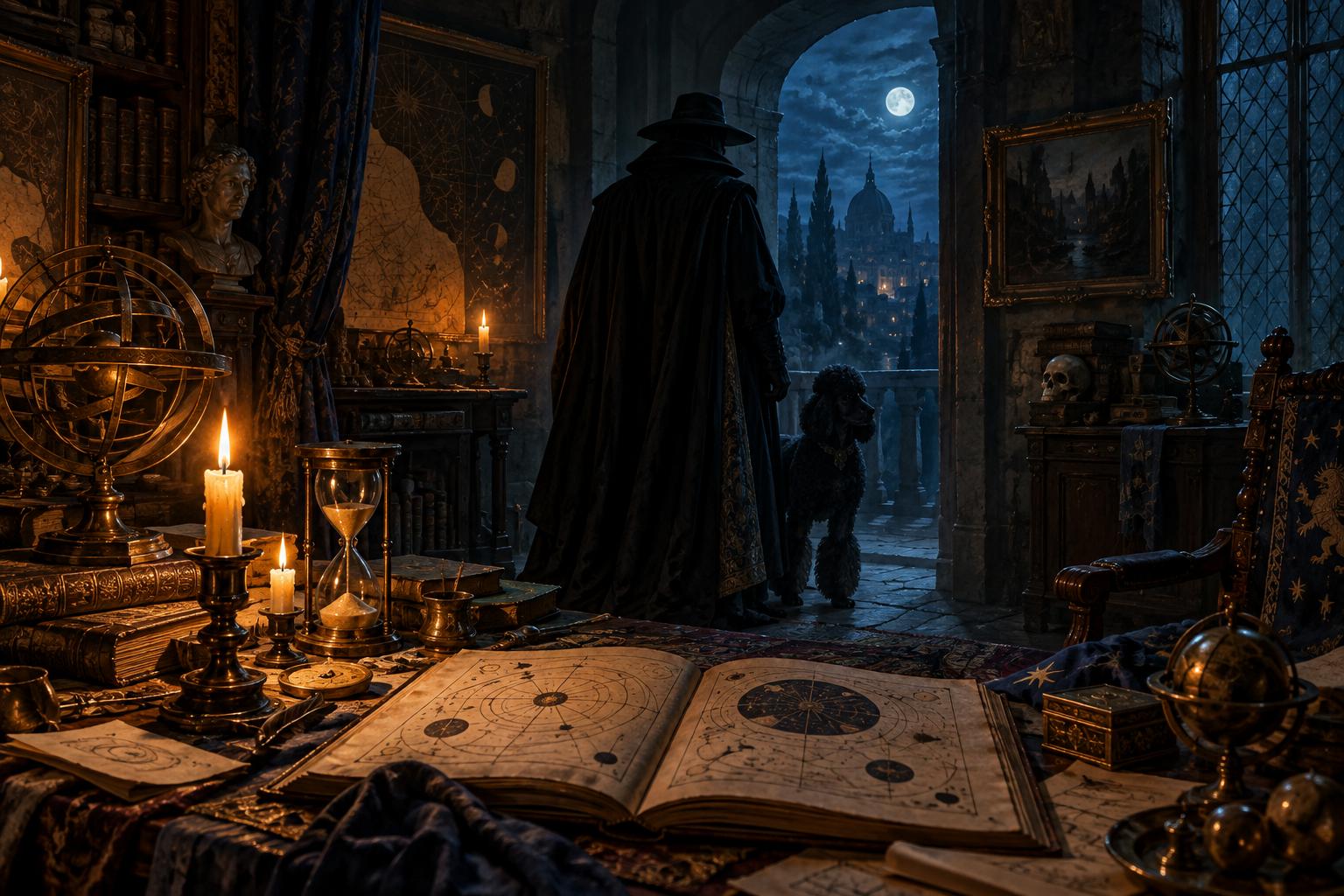
Johann Wolfgang von Goethe worked on Faust for most of his life. Part One appeared in 1808 and Part Two in 1832, the year of his death. His Mephistopheles is the version that shaped modern usage of the word. He first enters Faust’s study in the form of a black poodle before taking human shape, and introduces himself as ‘the spirit that negates’, a force of denial and mockery that, by opposing, ends up serving creation.
Goethe changed the terms of the deal. Instead of a fixed-term pact, Faust wagers that Mephistopheles can never give him a moment so satisfying that he would wish it to last. The demon then leads him through tavern scenes, the witch’s kitchen, the tragic romance with Gretchen and, in Part Two, the imperial court, classical Greece and a land-reclamation project. At the end, Faust’s striving earns him grace, angels carry his soul away, and Mephistopheles loses the wager while complaining bitterly about the unfairness of it all.
Three things in Goethe’s portrait proved durable. First, Mephistopheles is funny; his lines about professors, courtiers and lovers are satirical rather than horrifying. Second, he is small-scale by choice, describing himself as a part of a part, a limited spirit rather than the great adversary. Third, he is a reasoner who argues that life is pointless and is answered not by debate but by Faust’s refusal to stop acting. Later writers who wanted a sophisticated devil, from Dostoevsky to Bulgakov, were writing in Goethe’s shadow.
Because Mephistopheles is so famous, readers often assume he must hold a high office in some demonic hierarchy. He does not, and the contrast with catalog demons makes his nature clearer.
In the Faust texts Mephistopheles is explicitly a subordinate. The 1587 book has him seek Lucifer’s permission before binding Faust, and Goethe’s character calls himself a lesser spirit. He is a negotiator and agent, never the ruler of hell. In that sense he resembles Lucifuge Rofocalé of the Grand Grimoire, a minister who handles pacts on his master’s behalf, more than Satan himself.
The seventy-two spirits of the Ars Goetia come with ranks, legions, animal forms and specific offices, as described in the article on Goetia ranks and orders. Mephistopheles has none of this in the Lemegeton tradition because he is not in it. The Faustian grimoires gave him a seal later, in imitation of that tradition.
Jewish tradition’s Samael, the accuser and angel of death, shares one trait with Mephistopheles: a role within a divinely permitted system rather than open rebellion. Goethe’s ‘Prologue in Heaven’ borrows the Book of Job’s scene of a satan asking permission to test a man, which is the same literary ancestry.
Marvel’s Mephisto, introduced in 1968, is a ruler of a hell-dimension who collects souls through bargains. He takes the name and the pact motif, but not the subordinate rank or the wit. Pop-culture Mephistos are generally closer to Satan with a nickname.
The term ‘Faustian bargain’ has entered ordinary English for any deal that trades long-term ruin for short-term gain, and Mephistopheles is the name attached to the other side of the table. Students meet him in Marlowe and Goethe in school and university courses, and opera audiences meet him in Gounod’s Faust, Boito’s Mefistofele and Berlioz’s La damnation de Faust. Thomas Mann’s 1947 novel Doktor Faustus reworked the legend as an allegory of Germany’s descent into Nazism.
Comics, games and animation keep the name circulating. Marvel’s Mephisto has appeared for decades, and characters called Mephisto or Mephistopheles turn up in Japanese role-playing games, horror films and metal lyrics. Search interest also comes from readers trying to settle a definition: is Mephistopheles the same as Satan, is he a real demon from scripture, and what does the name mean? The short answers are no, no and uncertain, which is why this article exists.
Three habits help anyone studying this demon. First, keep the genres separate. The 1587 chapbook is moral fiction, Marlowe and Goethe are drama, the Faustian grimoires are commercial magic books, and modern comics are entertainment. Each uses the name for its own purposes, and claims from one do not transfer to another. A seal printed in an eighteenth-century Höllenzwang tells you about eighteenth-century book sellers, not about Goethe’s character or about any demon in scripture.
Second, check dates and spellings. A text that gives Mephistopheles a long-standing place in medieval demonology is wrong, and a ‘grimoire of 1501’ that mentions him is almost certainly later than it claims. The spelling shift from Mephostophiles to Mephistopheles is a rough clock: the Goethe spelling signals the nineteenth century or later.
Third, compare him with figures that do have deep roots. Reading about Samael in Jewish sources, or about the formally catalogued spirits of the Goetia, shows how differently a tradition behaves when it has centuries of layered commentary behind it. Mephistopheles has only four centuries, and almost all of them are literary. That is not a weakness; it is simply what he is, and it makes him one of the clearest windows into how Europeans imagined temptation after the Reformation.
Still have a question about your own experience? Describe what you are seeing, feeling or dreaming, and when it started. The Sheikh reads every message personally and replies in private.
Facing a crossroads of your own? Every version of the Faust story turns on a single choice and what it costs, which is why it still speaks to anyone weighing a major decision. If you have a specific question like that, our partner PuraTarot offers a Custom Spiritual Session, a personal reading built around the decision you bring. Join the free Djinn Guide newsletter and, once you confirm, you will unlock a 50% code for your first reading.
Further reading
As an Amazon Associate we earn from qualifying purchases.
Mephistopheles is the demon of the Faust legend, the spirit who serves the scholar Faust in exchange for his soul. He first appears in a German chapbook of 1587 and was developed by Marlowe and Goethe. He is not found in the Bible, the Testament of Solomon or the Ars Goetia.
No. In every major Faust text he is a subordinate spirit. The 1587 book has him answer to Lucifer, and Goethe's Mephistopheles calls himself a lesser spirit, a part of a part. Later comics and films often blur him with Satan, but that is a modern simplification.
The meaning is uncertain. Proposed etymologies include Hebrew words for 'destroyer' and 'liar', a Greek phrase meaning 'not loving light', and Latin mephitis for foul vapor. Many scholars think the author of the 1587 Faust book simply invented an impressive-sounding name.
No. The seventy-two spirits of the Ars Goetia do not include him. He entered magic books only through the Faustian Höllenzwang grimoires of the eighteenth century, which gave him a seal and ranked him among invented hell-princes such as Aziel and Marbuel.
Marlowe's Mephistophilis is a mournful fallen angel who suffers the loss of heaven and warns Faustus. Goethe's Mephistopheles is witty and cynical, the 'spirit that negates', and he loses the wager when Faust's soul is saved. Both versions shaped how later writers imagine a sophisticated devil.
Disclaimer
This article discusses Mephistopheles as a figure in literature, folklore and the history of grimoires. Beliefs and stories are described for educational purposes, not endorsed, and no ritual instructions or outcomes are offered.
Did this guide help you understand the subject? Rate it and share your honest opinion to help other readers. Every review is checked by our editors before it appears.
There are no reviews yet. Be the first one to write one.


Sheikh Youssef
Tayeb El Merzouki
For inquiries about personalized spiritual work, private rituals, and traditional talismans, connect directly with Sheikh Youssef Tayeb El Merzouki.
Chat on WhatsApp


