







Join Djinn Guide: Get 50% Off a Personal Reading
Get new guides to jinn, folklore and occult history. Confirm your subscription to unlock a 50% code for a first personal reading with our partner PuraTarot.
Discover the unseen
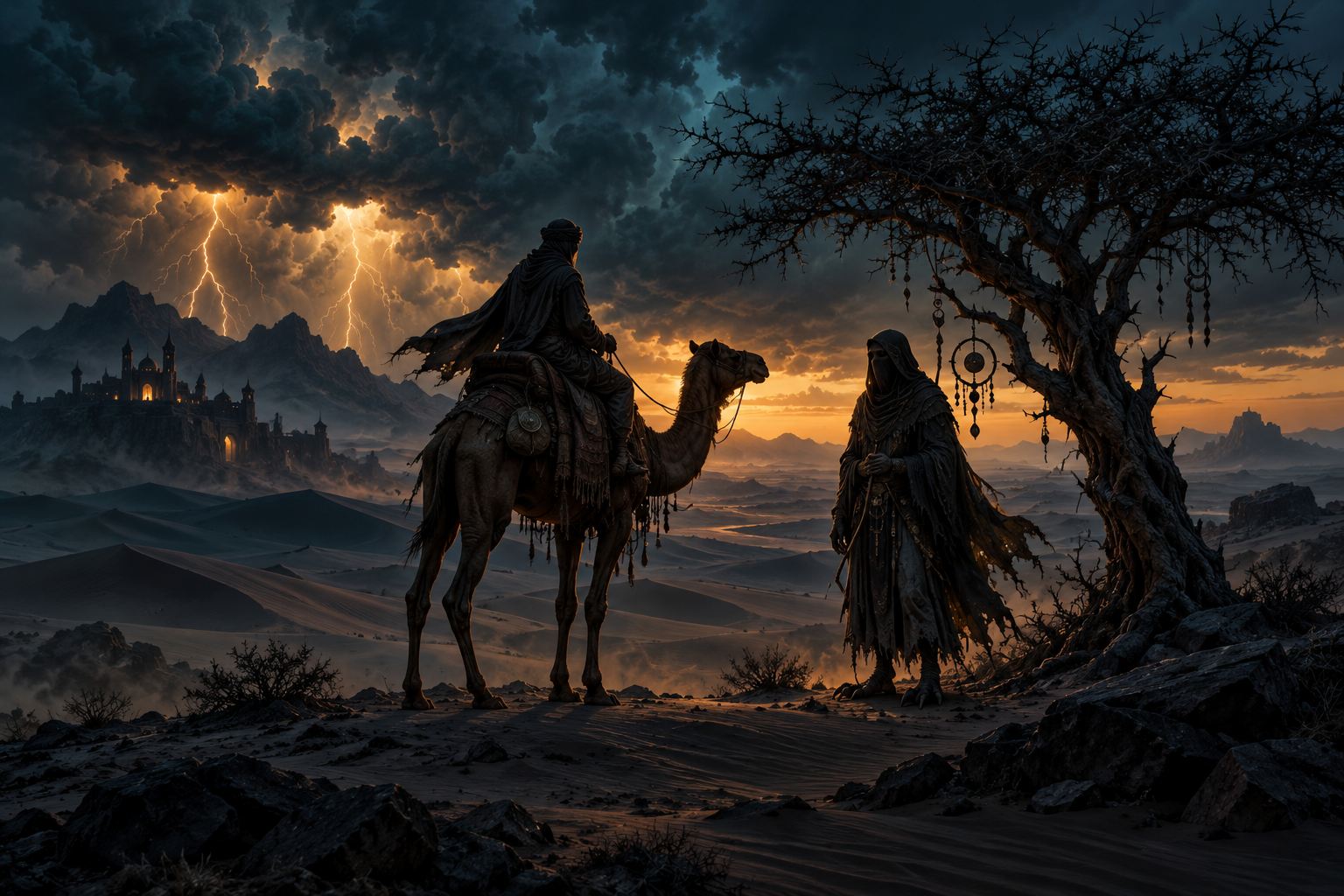
Sila jinn, jann, hinn and shiqq explained: what Arabic sources say about these lesser-known types of jinn and how they differ from the ghul and ifrit.
Quick answer: The sila jinn (Arabic si'la, plural sa'ali) is a shape-shifting female spirit of Arabian folklore, usually grouped with the ghul and remembered as the cleverest and most deceptive of the jinn. Alongside it, classical Arabic writers describe the jann, a word the Quran uses for the jinn's fiery ancestor; the hinn, a weaker order said to appear as dogs; and the shiqq, a half-bodied creature of the desert. These lesser-known types of jinn come from medieval encyclopedias and tribal lore, not from scripture.
Related guides: the main types of jinn, the ghul of Arabic folklore, the half-human nasnas, every Quran verse about jinn, jinn and human marriage in folklore, ifrit versus marid.
| Type | Main sources | Typical description | Known for |
|---|---|---|---|
| Si'la (sila jinn) | Al-Jahiz, al-Qazwini, al-Damiri, tribal lore | Female shape-shifter, often beautiful, true form hidden | Cunning; luring travelers; marrying into human tribes in legend |
| Jann | Quran 15:27 and 55:15; lexicons | Ancestor of the jinn or a plain, weaker jinn; also a snake | Created from smokeless fire before humankind |
| Hinn | Al-Jahiz and later compilers | Weak jinn resembling dogs; sometimes a pre-Adamic race | Lowest tier of jinn in folk ranking |
| Shiqq | Pre-Islamic poetry, al-Jahiz, al-Qazwini | Half a body: one eye, one arm, one leg | Attacking lone travelers in the desert |
| Ghul | Nights, al-Jahiz, folklore | Desert shape-shifter, grave-haunting in later lore | Deceiving and devouring travelers |
| Ifrit | Quran 27:39; Nights | Powerful, rebellious, often huge | Strength and cunning |
| Marid | Nights; later lexicons | Rebellious, strongest class in folk ranking | Sea and giant forms in the Nights |
Key Takeaways
The sila jinn, written in Arabic as si’la or si’lat with the plural sa’ali, is a female spirit of the desert that can take almost any shape. Medieval Arabic writers usually file her with the ghul, the better-known shape-shifter of the sands, and sometimes treat the two as the same creature under different names. Where they distinguish them, the si’la is the more intelligent of the pair: a ghul deceives by instinct, a si’la by craft.
The ninth-century scholar al-Jahiz, in his Kitab al-Hayawan (Book of Animals), records the beliefs of the Bedouin about the sa’ali while keeping a skeptic’s distance from them. Later encyclopedists such as al-Qazwini in the thirteenth century and al-Damiri in the fourteenth repeat the descriptions: a creature that appears to travelers in attractive human form, that cannot fully hide some animal feature, and that is most dangerous when alone with its victim.
The word itself is old. Lexicographers connect it with ideas of malice and mischief, and pre-Islamic poets used “si’la” as an insult for a shrewish or dangerous woman. That double use, a real creature in one line and a figure of speech in the next, is typical of how the lesser-known types of jinn survive in the record.
The most famous si’la story is a genealogy. Several medieval sources repeat the claim that a man of the Banu Tamim, ‘Amr ibn Yarbu’, married a si’la who had taken human form, and that she bore him children who became ancestors of a clan. The tale ends when she sees lightning, hears the thunder of her own kind, and vanishes back into the desert, leaving the children behind. The clan was known afterward as the “sons of the si’la.”
Stories like this belong to a wider pattern of jinn marrying humans, discussed in our article on jinn and human marriage in folklore. The si’la version stresses two things: the spirit’s ability to pass as a woman for years, and the fragility of the arrangement. One thunderclap undoes it.
Other anecdotes are less domestic. In desert tales the si’la lures a rider off the road by calling his name or by appearing as a woman in distress, then reveals herself when he is lost. Some versions say she can be defeated by a single blow but that a second blow revives her, a motif the si’la shares with the ghul of Arabic folklore and with ogres in many cultures.
Does this touch your own situation? Many readers come to these pages because something in their home, dreams or family feels unexplained. Reading history helps, but it cannot look at your specific case.
Consult the Sheikh Private, confidential, and free to ask.
Jann is the one name in this group with a scriptural pedigree. Surah Al-Hijr 15:27 states that “the jann We created before, from scorching fire,” and Surah Ar-Rahman 55:15 says the jann was created “from a smokeless flame of fire.” Classical commentators read “al-jann” in these verses in two ways: as the father of the jinn, a counterpart to Adam, or as a collective noun for the whole race. Both readings make jann the origin point rather than a species.
The same root produces another meaning. In Surah An-Naml 27:10 and Surah Al-Qasas 28:31, Moses throws down his staff and sees it move “as if it were a jann,” which translators render as a snake. The link between jinn and serpents runs through later folklore, where snakes in a house are sometimes assumed to be jinn in disguise and are addressed before being harmed.
Medieval writers extended the term further. Al-Jahiz and others use jann for an ordinary jinn with no special rank, the baseline against which the stronger marid and ifrit are measured. Modern dictionaries often give “jann” as a plain synonym for jinn. Our verse-by-verse guide to every Quran verse about jinn shows the term in its full scriptural context.
Two more names fill out the lower reaches of the jinn world. Neither appears in the Quran, and both depend on a thin line of medieval transmission, which is why descriptions vary from book to book.
The hinn are described as a feeble order of jinn, often said to appear in the form of dogs. Some compilers rank them below the ordinary jinn and above nothing at all. A separate strand of lore, found in commentaries on the creation of Adam, names the “hinn and binn” as races that lived on earth before humans and before, or alongside, the jinn. The two ideas sit uneasily together, and most writers simply report both.
The shiqq, whose name means “half” or “split,” is pictured as half of a human figure: one eye, one arm, one leg, moving by hopping. Pre-Islamic verses and later anecdotes say a shiqq killed the traveler ‘Alqama ibn Safwan, and the creature became a standard explanation for deaths on lonely roads. Some sources make the shiqq the parent of the nasnas, the half-human creature of Yemen and Hadramawt.
Arabic scholars never agreed on a single taxonomy. One scheme, quoted in later works and traced to a report of the Prophet transmitted by Abu Tha’laba al-Khushani, divides jinn into three kinds: those with wings that fly, those that are snakes and dogs, and those that travel and settle like humans. This scheme sorts by form and habit, not by strength.
A second scheme sorts by power and is the ancestor of most modern “types of jinn” lists. In it, the plain jinn or jann are the base; a jinn that lives with people is an ‘amir; one that appears to children is an arwah; one that turns malicious is a shaytan; a stronger one is a marid; and the strongest of all is an ifrit. The si’la, hinn and shiqq do not sit cleanly on this ladder, which is one reason they are the lesser-known types of jinn: the popular ranking has no slot for them.
For the full roster, including marid, ifrit, qareen and others, see the main types of jinn. The present article covers the names that list leaves in the margins, where tribal storytelling rather than theology preserved them.
The sila jinn has close cousins in neighboring traditions. Persian folklore knows the pari and the div, and the shape-shifting female spirit who marries a man and then vanishes appears in Persian and Turkic tales as well; our survey of jinn in Persian mythology traces that overlap. In the Maghreb the figure of Aisha Kandisha, a beautiful spirit with animal feet who haunts riverbanks, matches the si’la pattern almost point for point.
The jann as a primeval fire-being has parallels in the way Islamic commentators describe Iblis, who was “of the jinn” according to Surah Al-Kahf 18:50 and who was made of fire. Later Sufi and philosophical writers speculated about the jann as the first of the fiery creation, much as Adam was the first of the earthly.
The hinn and shiqq traveled less well. They remain mostly in Arabic encyclopedias and in regional folklore of the Arabian Peninsula, Iraq and Yemen. Southeast Asian khodam traditions, which borrowed Arabic jinn vocabulary, generally did not borrow these minor names, though stories of half-bodied forest spirits exist independently across the Malay world.
The first confusion is treating these names as a fixed hierarchy. Online charts often rank jann, hinn, si’la and shiqq in neat tiers beneath the marid and ifrit, as if a single source laid them out. No medieval author did. Al-Jahiz was collecting what Bedouin said; al-Qazwini was compiling wonders; neither was writing a field guide.
The second is assuming the si’la is Quranic. The Quran mentions jinn, jann, shaytan and ifrit, but never the si’la, ghul, hinn or shiqq. Those words belong to Arabic culture broadly, not to scripture, and a believer can accept jinn as real without accepting any of the folk categories. Our article on jinn in the Quran keeps the two layers separate.
The third is gender. The si’la is consistently female in the sources; the ghul is usually female but sometimes male; the shiqq and hinn have no fixed gender. Modern games and novels that make the si’la a male warrior or the ghul a cemetery zombie are drawing on later European reinterpretations, not on the Arabic material.
Anyone who wants to check these claims can follow a short path. Begin with the Quran verses: 15:27 and 55:15 for the jann, 27:10 and 28:31 for the snake sense, and 18:50 for Iblis as a jinn. These are the only scriptural anchors, and they say nothing about si’la, hinn or shiqq.
Next come the encyclopedias. Al-Jahiz’s Kitab al-Hayawan survives in Arabic and in partial translations, and its passages on the jinn, ghul and sa’ali are frequently excerpted in academic studies of Arabian folklore. Al-Qazwini’s ‘Aja’ib al-Makhluqat (Wonders of Creation) and al-Damiri’s Hayat al-Hayawan repeat and expand the material. Modern scholarly surveys of jinn belief summarize all three.
Finally, read the stories as stories. The genealogy of the si’la’s children is a tribal boast; the shiqq’s victims are cautionary tales for travelers; the dog-like hinn explain strange animals at the edge of camp. Treated that way, the lesser-known types of jinn are a window into how pre-modern Arabs mapped the dangers of the desert, which is a more interesting subject than any ranking chart.
Still have a question about your own experience? Describe what you are seeing, feeling or dreaming, and when it started. The Sheikh reads every message personally and replies in private.
Drawn to jinn lore for a personal reason? If these old classifications have stirred questions about your own path rather than about the jinn themselves, our partner PuraTarot offers a Full Personal Reading as a calm space for personal reflection. Join the free Djinn Guide newsletter and, once you confirm, you will unlock a 50% code for your first reading.
Further reading
As an Amazon Associate we earn from qualifying purchases.
A sila (si'la, plural sa'ali) is a female shape-shifting jinn of Arabian folklore, usually classed with the ghul. Medieval Arabic writers such as al-Jahiz and al-Qazwini describe her as the most cunning of the jinn, able to pass as a human woman for long periods and known in legend for marrying into human tribes.
In the Quran (15:27, 55:15), "al-jann" names the fiery being created before humans, read by commentators either as the ancestor of the jinn or as the race itself. Later Arabic writers used jann for an ordinary, lower-ranking jinn, and the same word can also mean a snake, as in the story of Moses' staff.
The hinn are a weak order of jinn described in medieval Arabic sources, often said to appear as dogs. A separate tradition names the hinn and binn as races that lived on earth before humankind. The name is absent from the Quran and survives mainly in encyclopedias and folklore of the Arabian Peninsula.
The shiqq is a half-bodied creature with one eye, one arm and one leg, said to haunt desert roads and attack lone travelers. Pre-Islamic verses and later compilers mention it, and some sources make it the parent of the nasnas. It is folklore rather than scripture and is rarely included in modern jinn lists.
No. The Quran mentions jinn, jann, shaytan and ifrit, but not the sila, ghul, hinn or shiqq. Those names come from Arabic culture, poetry and medieval encyclopedias. Scholars treat them as folklore that grew up alongside religious belief in jinn rather than as part of that belief.
Disclaimer
This article presents the sila, jann, hinn and shiqq as they appear in Arabic literature and folklore. Beliefs are described, not endorsed, and nothing here is advice or a claim about real spirits.
Did this guide help you understand the subject? Rate it and share your honest opinion to help other readers. Every review is checked by our editors before it appears.
There are no reviews yet. Be the first one to write one.


Sheikh Youssef
Tayeb El Merzouki
For inquiries about personalized spiritual work, private rituals, and traditional talismans, connect directly with Sheikh Youssef Tayeb El Merzouki.
Chat on WhatsApp