




Join Djinn Guide: Get 50% Off a Personal Reading
Get new guides to jinn, folklore and occult history. Confirm your subscription to unlock a 50% code for a first personal reading with our partner PuraTarot.
Discover the unseen

Jinn in the Quran explained verse by verse: creation from fire (55:15, 15:27), purpose (51:56), Solomon's jinn (27, 34), the listening jinn (46, 72), 114.
Quick answer: Jinn in the Quran are a created species, made from smokeless fire before humans (55:15, 15:27), with free will and the same purpose as people: to worship God (51:56). The Quran mentions jinn by name in about thirty verses across more than a dozen chapters. They can be righteous or wicked, they will be judged, some served the prophet Solomon (27:17, 34:12–14), a group of them accepted the Quran after hearing it (46:29–32, 72:1–15), and the final chapter asks protection from evil among jinn and humans (114:6).
Related guides: Surah Al-Jinn (72) explained, jinn in Islamic belief and practice, King Solomon and the jinn, who Iblis is in the Quran, are jinn evil or morally mixed, how Solomon's death exposed the jinn.
| Theme | Key verses | What the Quran states |
|---|---|---|
| Creation | 55:15; 15:27 | Jinn made from smokeless fire, created before Adam |
| Purpose and accountability | 51:56; 6:130; 7:179; 55:33–39 | Created to worship God; messengers reached them; judged with humans |
| Iblis and the devils | 18:50; 2:102; 6:112 | Iblis was a jinn; devils among jinn and humans deceive and teach magic |
| Solomon | 27:17–40; 34:12–14; 21:82; 38:37–38 | Jinn served Solomon by God's permission; an ifrit; his death revealed their limits |
| Jinn who believed | 46:29–32; 72:1–15 | A group heard the Quran and returned to their people as warners |
| Limits of jinn | 34:14; 72:8–10; 37:158 | Jinn do not know the unseen; the sky is guarded; no kinship with God |
| Protection | 114:1–6 | Seek refuge from the whisperer, from among jinn and humans |
Key Takeaways
The Quran treats jinn as a real but unseen species, parallel to humans in moral responsibility and distinct from angels. The Arabic word jinn comes from a root meaning concealed or hidden, and the Quran uses it, together with the collective jann, about thirty times. Jinn are addressed alongside humans as the two accountable creations, the thaqalan, and both will be questioned on the Day of Judgment (55:31). Some jinn are believers, others are rebels, and the devils (shayatin) include members of both species.
Unlike angels, who are described as obedient by nature, jinn choose. Iblis could refuse to bow to Adam because he was a jinn with free will (18:50), and a group of jinn could listen to the Quran and accept it (46:29). Jinn have communities and foolish members (72:4), they lived before humans, and some worked for the prophet Solomon under God’s command.
The Quran also sets limits. Jinn do not know the unseen (34:14), they cannot eavesdrop on heaven as they once did (72:8–9), and claims of kinship between God and the jinn are rejected (37:158). For the broader picture of how these verses shaped Muslim practice and law, see jinn in Islamic belief and practice. The sections below go through the verses themselves.
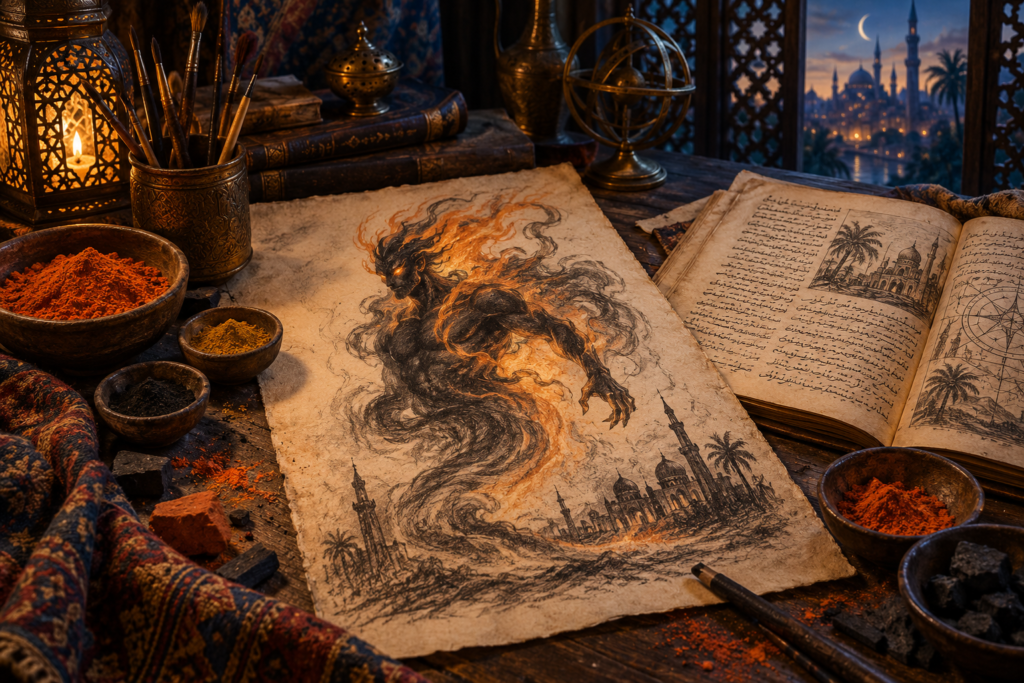
Surah Ar-Rahman 55:15 states that God created the jinn from a smokeless flame of fire, marij min nar, immediately after saying that humans were created from clay like pottery (55:14). The pairing is deliberate: two species, two materials, one Creator. Commentators understood marij as fire without smoke, the purest and most mobile part of a flame.
Surah Al-Hijr 15:26–27 gives the sequence. Humans were created from sounding clay of altered mud, and the jann, the jinn as a kind, were created before that from the fire of a scorching wind, nar al-samum. The samum is the hot desert wind, so the jinn’s origin is tied to heat and air rather than to earth. From this verse comes the traditional teaching that jinn inhabited the world before Adam.
Surah Adh-Dhariyat 51:56 supplies the purpose: God did not create jinn and humans except to worship Him. It is the clearest statement that jinn are not mere forces but creatures with the same religious obligation as people. Scholars draw from it the conclusion that prophets were sent to the jinn, a point made explicit in 6:130, where both communities are asked whether messengers came to them from among themselves.
Does this touch your own situation? Many readers come to these pages because something in their home, dreams or family feels unexplained. Reading history helps, but it cannot look at your specific case.
Consult the Sheikh Private, confidential, and free to ask.
Surah Al-Kahf 18:50 is the verse that settles Iblis’s nature. When the angels were commanded to prostrate to Adam, all did except Iblis, who was of the jinn and departed from his Lord’s command. The verse answers a question earlier chapters leave open, since in 2:34 and 7:11 Iblis is mentioned among the angels. Islamic scholars reconcile this by saying he was a jinn who worshipped among the angels. His story is examined in who Iblis is in the Quran.
Surah Al-An’am 6:100 condemns those who made the jinn partners with God, although God created them, and who invented sons and daughters for Him. Pre-Islamic Arabs offered worship to jinn and sought their protection in the wilderness; the Quran treats this as idolatry. Surah Al-Jinn 72:6 adds that men used to seek refuge with men among the jinn, which only increased the jinn’s arrogance.
Surah Al-Baqarah 2:102 concerns the devils who taught people magic in Babylon and who falsely attributed it to Solomon’s reign. The Quran says Solomon did not disbelieve, but the devils did. Together with 6:112, which speaks of devils among humans and jinn inspiring one another with deceptive speech, the verse shows that shaytan in the Quran is a description of behavior, not a separate species. A devil may be a jinn or a human.
| Chapter and verse | Subject |
|---|---|
| 2:102 | Devils taught magic; Solomon did not disbelieve |
| 6:100, 6:112, 6:128, 6:130 | Jinn as false partners; devils among jinn and humans; messengers to jinn |
| 7:38, 7:179 | Jinn and humans in the Fire |
| 15:27 | Jinn created before humans from scorching fire |
| 17:88 | Jinn and humans cannot imitate the Quran |
| 18:50 | Iblis was of the jinn |
| 21:82; 38:37–38 | Devils who dived and built for Solomon |
| 27:17, 27:39–40 | Solomon's jinn army; the ifrit and the throne |
| 32:13; 11:119 | Hell filled from jinn and humans |
| 34:12–14 | Jinn labor for Solomon; his death; jinn do not know the unseen |
| 37:158 | No kinship between God and the jinn |
| 41:29 | The misleaders among jinn and humans |
| 46:29–32 | Jinn hear the Quran and warn their people |
| 51:56 | Jinn and humans created to worship |
| 55:15, 55:33, 55:39, 55:56, 55:74 | Creation from smokeless fire; jinn and humans judged and rewarded |
| 72:1–28 | Surah Al-Jinn: the jinn's testimony and the guarded heaven |
| 114:6 | Refuge from the whisperer among jinn and humans |
The longest narrative about jinn in the Quran concerns Solomon (Sulayman). The verses fall into a few groups.
Solomon’s hosts of jinn, humans and birds are gathered in ranks and marched in order. Passing a valley of ants, he hears an ant warn its colony and smiles, thanking God for his gifts.
Solomon asks his assembly who can bring him the Queen of Sheba’s throne before her delegation arrives. An ifrit from among the jinn offers to bring it before Solomon rises from his seat, calling himself strong and trustworthy. But one who has knowledge of the Book brings it before Solomon’s glance returns to him. The passage is the Quran’s only use of the word ifrit, and it ranks knowledge above raw jinn strength.
The wind was made to serve Solomon, a fountain of molten copper flowed for him, and among the jinn were those who worked before him by his Lord’s permission. Any who turned from the command would taste the punishment of the blaze. The jinn made for him whatever he wished: elevated chambers, statues, basins like reservoirs and fixed cauldrons.
When Solomon died, nothing showed the jinn his death except a creature of the earth eating his staff. When he fell, the jinn realized that had they known the unseen, they would not have remained in humiliating labor. The verse is a direct denial that jinn possess hidden knowledge.
Related verses, 21:82 and 38:37–38, add devils who dived and built for Solomon; see King Solomon and the jinn.
Surah Al-Ahqaf 46:29–32 describes a group of jinn whom God directed to the Prophet Muhammad as he recited the Quran. They told one another to listen, and when the recitation ended they returned to their people as warners, announcing that they had heard a book revealed after Moses, confirming what came before it, and urging their people to answer the caller of God. Jinn, then, can hear revelation, understand it and preach it to their own kind.
Surah Al-Jinn 72, the seventy-second chapter, is built on the same event and is the only chapter named for the jinn. Its first fifteen verses report the jinn’s own words: they heard a wonderful recitation and believed; they will never associate anyone with their Lord; some among them are righteous and some are otherwise, following divergent paths; they used to sit in the heavens to listen but now find it filled with guards and flaming darts; among them are Muslims and among them are the unjust. The rest of the chapter addresses the Prophet about the limits of his own knowledge.
That chapter has its own treatment in Surah Al-Jinn (72) explained. The point here is that 46 and 72 together establish the moral variety of jinn: belief and unbelief run through their community just as through the human one.
Surah Ar-Rahman addresses jinn and humans together throughout. In 55:33 both communities are challenged to pass beyond the regions of the heavens and the earth, which they cannot do without authority. In 55:39 neither humans nor jinn will need to be asked about their sins, because the record is known. In 55:56 and 55:74 the companions of paradise are described as untouched by humans or jinn, implying that righteous jinn also enter paradise.
Verses of warning are equally shared. 7:38 describes nations of jinn and humans entering the Fire together, 7:179 says many of both were created for Hell because they refuse to understand, and 11:119 and 32:13 repeat that Hell will be filled from both. 41:29 shows the condemned asking to see the jinn and humans who misled them. 37:158 rejects any kinship between God and the jinn. 17:88 declares that humans and jinn combined could not produce the like of the Quran.
Surah An-Nas 114, the final chapter, closes the theme. The believer seeks refuge in the Lord of humankind from the retreating whisperer who whispers in people’s breasts, from among the jinn and humankind (114:6). The chapter names no spirit, only a source of whispering that may come from either species, and it is recited daily for protection.
The first misunderstanding is that the Quran describes jinn’s shapes, ranks, kings and tribes. It does not. The elaborate classifications of marid, ghul, sila and the seven jinn kings come from hadith, folklore and later literature. The Quran gives origin, moral status, a few narratives and the limits of jinn knowledge, and little else.
The second is that jinn and devils are the same word. Shaytan is used for rebellious beings of both species, while jinn is a species name that includes believers. A third misunderstanding treats the ifrit of 27:39 as a type or rank; in the Quran ifrit is a description, a powerful one among the jinn, and later tradition made it a category. A fourth is that the Quran says jinn possess people; the Quran does not use that vocabulary, and the doctrine of possession rests on hadith and scholarly opinion.
Finally, readers sometimes assume that the Quran endorses the Solomonic magic of the grimoires. Surah 2:102 says the opposite: Solomon’s authority over jinn was a gift by God’s permission, and the devils who taught magic in his name disbelieved.
A useful method is to group the verses by what they are doing. Some are doctrinal (55:15, 15:27, 51:56). Some are narrative, telling of Iblis, Solomon and the listening jinn (18:50, 27, 34, 46, 72). Some are polemical, correcting Arabian beliefs about jinn as partners or relatives of God (6:100, 37:158, 72:6). Some are eschatological (55, 7:38, 7:179). And one is devotional, the daily prayer of 114. Reading a verse without knowing its group is the usual cause of confusion.
It also helps to read with a classical commentary at hand, since words like marij, samum, ifrit and qarin carry nuances that translations flatten. Commentators from al-Tabari to Ibn Kathir sometimes disagree about details such as whether Iblis was ever an angel or what creature ate Solomon’s staff.
This site presents the Quranic material as scripture studied for its content and history. We describe what Muslims believe about jinn on the basis of these verses and offer no practices or rituals connected with jinn.
Still have a question about your own experience? Describe what you are seeing, feeling or dreaming, and when it started. The Sheikh reads every message personally and replies in private.
Want a personal perspective? Studying what the Quran says about jinn often raises questions that are personal as well as textual. A Full Personal Reading with our partner PuraTarot offers a calm space for personal reflection. Join the free Djinn Guide newsletter and, once you confirm, you will unlock a 50% code for your first reading.
Further reading
As an Amazon Associate we earn from qualifying purchases.
The Quran says jinn are a species created from smokeless fire before humans (55:15, 15:27), that they exist to worship God (51:56), that they have free will and include believers and unbelievers (72:11, 72:14), that some served Solomon (27:17, 34:12), and that they will be judged with humans. It also says jinn do not know the unseen (34:14).
The word jinn and the related form jann occur about thirty times in the Quran, in roughly fifteen chapters. Surah Al-Jinn (72) is named for them and devotes its first fifteen verses to their words. Other dense passages are Surah An-Naml 27, Surah Saba 34, Surah Al-Ahqaf 46 and Surah Ar-Rahman 55.
Surah An-Naml (27:17–40) describes Solomon's army of jinn, humans and birds, the hoopoe, the Queen of Sheba and the ifrit who offered to fetch her throne. Surah Saba (34:12–14) describes the jinn building for Solomon and learning of his death only when a creature ate his staff. Surah Al-Anbiya 21:82 and Surah Sad 38:37–38 add the devils who dived and built for him.
Surah Al-Kahf 18:50 states plainly that Iblis was of the jinn and so disobeyed when the angels were commanded to prostrate to Adam. Because earlier verses mention him among the angels, classical scholars explain that he was a jinn who lived and worshipped among them. The majority view in Islamic scholarship is that he was a jinn.
No. The Quran describes jinn as morally mixed. Surah Al-Jinn 72:11 has the jinn say that some among them are righteous and some are otherwise, and 72:14 that some are Muslims and some unjust. Surah Al-Ahqaf 46:29–32 praises jinn who believed and warned their people. Only the rebellious among jinn and humans are called shayatin, devils.
Disclaimer
This article summarizes Quranic verses about jinn and classical Muslim interpretations for educational purposes. Islamic beliefs are described respectfully as beliefs, not endorsed or disputed, and nothing here is offered as religious ruling, ritual guidance or a claim about the activity of unseen beings.
Did this guide help you understand the subject? Rate it and share your honest opinion to help other readers. Every review is checked by our editors before it appears.
There are no reviews yet. Be the first one to write one.


Sheikh Youssef
Tayeb El Merzouki
For inquiries about personalized spiritual work, private rituals, and traditional talismans, connect directly with Sheikh Youssef Tayeb El Merzouki.
Chat on WhatsApp