




Join Djinn Guide: Get 50% Off a Personal Reading
Get new guides to jinn, folklore and occult history. Confirm your subscription to unlock a 50% code for a first personal reading with our partner PuraTarot.
Discover the unseen
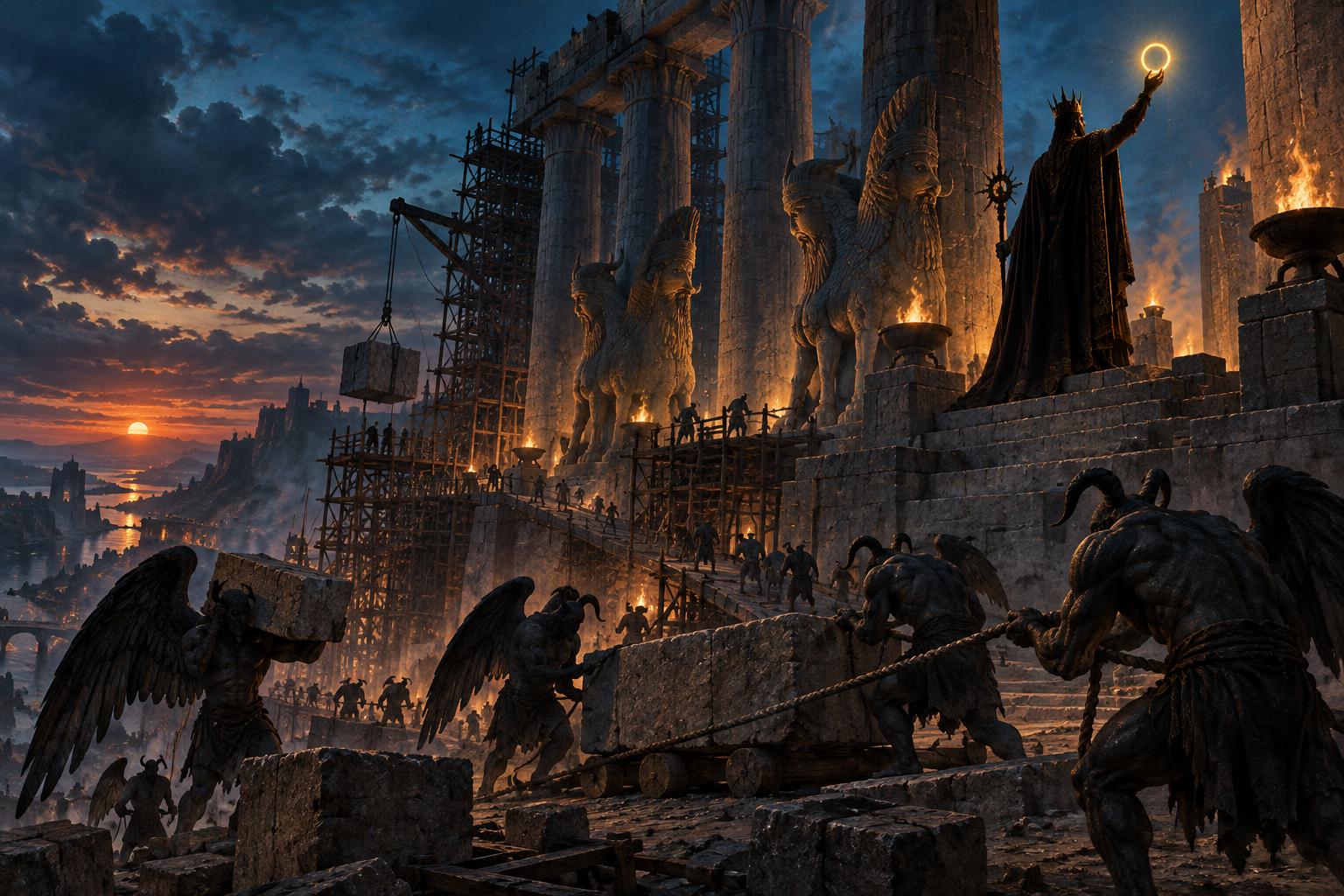
The Testament of Solomon explained: what this ancient Greek text is, a full summary, its demons from Ornias to Asmodeus, the ring, and its later influence.
Quick answer: The Testament of Solomon is a pseudepigraphal Greek text, written sometime between the first and fifth centuries CE, in which King Solomon describes how he received a ring from the archangel Michael and used its seal to command demons while building the Temple in Jerusalem. The text is a mix of Jewish, Christian and Greco-Egyptian ideas, and it is the earliest full narrative of Solomon as a master of spirits, a theme later taken up by Islamic tradition, the Arabian Nights and the Goetia.
Related guides: the ring of Solomon in the Testament, Seal of Solomon history and meaning, Asmodeus, the demon of Tobit, King Solomon and the jinn, the 72 demons of the Goetia, Beelzebul, prince of demons.
| Demon | Description in the text | Thwarted by (according to the text) |
|---|---|---|
| Ornias | First demon bound; drains the life of a boy working on the Temple; shape-shifter | The archangel Ouriel |
| Beelzebul | Prince of demons; claims to have been the highest angel | The holy name of God, called Emmanuel |
| Onoskelis | Female demon with the legs of a mule; lives in caves and ravines | The name of God and the seal |
| Asmodeus | Demon of lust and discord; breaks marriages; born of a human mother and an angel | The angel Raphael and the smoke of a fish's liver and gall |
| Lix Tetrax | Demon of the wind; causes fires and divisions | The archangel Azael |
| The seven heavenly bodies | Seven spirits of deception, strife, fate and error, tied to the stars | Various angels named in the text |
| Obyzouth | Female demon who strangles newborn children at night | The angel Afarof |
| Enepsigos | Three-formed female demon linked to the Moon; prophesies the Temple's destruction | The angel Rathanael |
| Kunopegos | Sea demon in the shape of a horse and fish; drowns sailors | The angel Iameth |
| Ephippas | Arabian wind demon captured in a flask; lifts the cornerstone of the Temple | Bound by Solomon's seal |
Key Takeaways
The Testament of Solomon is an ancient text, written in Greek and presented as Solomon’s own account of how he built the Temple in Jerusalem with the help of demons he had bound. It belongs to the pseudepigrapha, writings attributed to a famous biblical figure who did not actually write them. Scholars date it anywhere from the first to the fifth century CE, with many placing its core in the early centuries of the Common Era and its final form somewhat later.
The text is not scripture for any religious community. It survived because Byzantine copyists valued it as a story and as a reference on demons and the angels who oppose them. In structure it is part narrative, part catalog: Solomon summons demon after demon, asks each its name, its powers and its thwarting angel, then assigns it a task on the Temple.
What makes the Testament important is its place in the history of ideas. It is the earliest surviving work to tell at length the legend that Solomon ruled over spirits by means of a ring and a seal. That legend later flowed into Jewish folklore, into the Quran’s account of Solomon’s jinn, into the Arabian Nights with its brass bottles stamped by Solomon’s seal, and eventually into the Lesser Key of Solomon, whose seventy-two demons claim the same royal pedigree.
The Testament survives in a number of Greek manuscripts, the earliest of which are medieval, though fragments and related material suggest a much older origin. The scholar Chester Charlton McCown produced the standard critical edition in 1922, grouping the manuscripts into recensions and arguing for a core text from around the third century CE. Earlier, in 1898, F. C. Conybeare published an English translation that is still widely reproduced online. A more recent translation by D. C. Duling appeared in James H. Charlesworth’s collection The Old Testament Pseudepigrapha (1983) and is the version most scholars cite.
The language and content point to a Greek-speaking environment where Jewish, Christian and pagan ideas mixed freely. The demons bear Greek and Semitic names; the thwarting angels are drawn from Jewish angelology; several passages refer to Christ and the cross, which shows Christian editing. The astrological material, with its seven heavenly bodies and thirty-six decans, reflects Greco-Egyptian learning of the kind found in the magical papyri. Many researchers think the Testament was composed or expanded in Egypt or Syria-Palestine.
Because the manuscripts differ, there is no single Testament of Solomon. Some recensions are longer, some add demons, some reorder the episodes, so a web translation and a scholarly edition will not always agree on names and details.
Does this touch your own situation? Many readers come to these pages because something in their home, dreams or family feels unexplained. Reading history helps, but it cannot look at your specific case.
Consult the Sheikh Private, confidential, and free to ask.
The narrative can be summarized in a few movements. The details vary between manuscripts, but the shape is consistent.
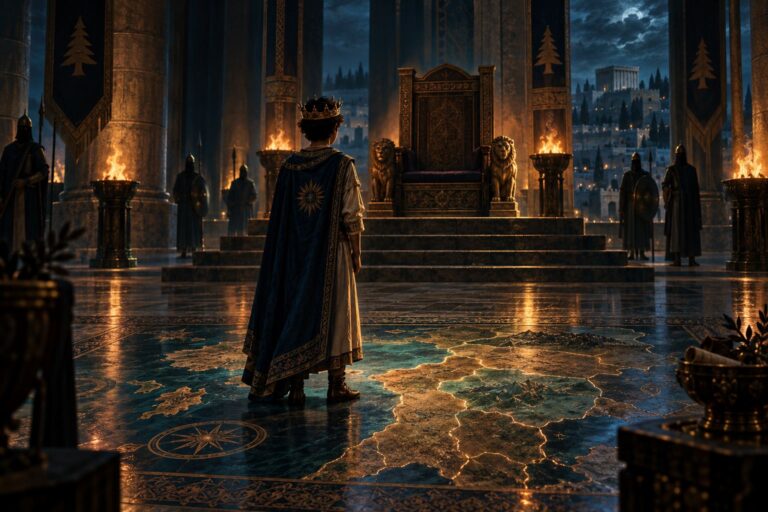
The Temple is under construction, and Solomon favors the son of a master craftsman. The boy grows thin and pale; a demon named Ornias comes each evening, takes half his wages and food, and sucks life from his thumb. Solomon prays in the Temple for authority over the demon.
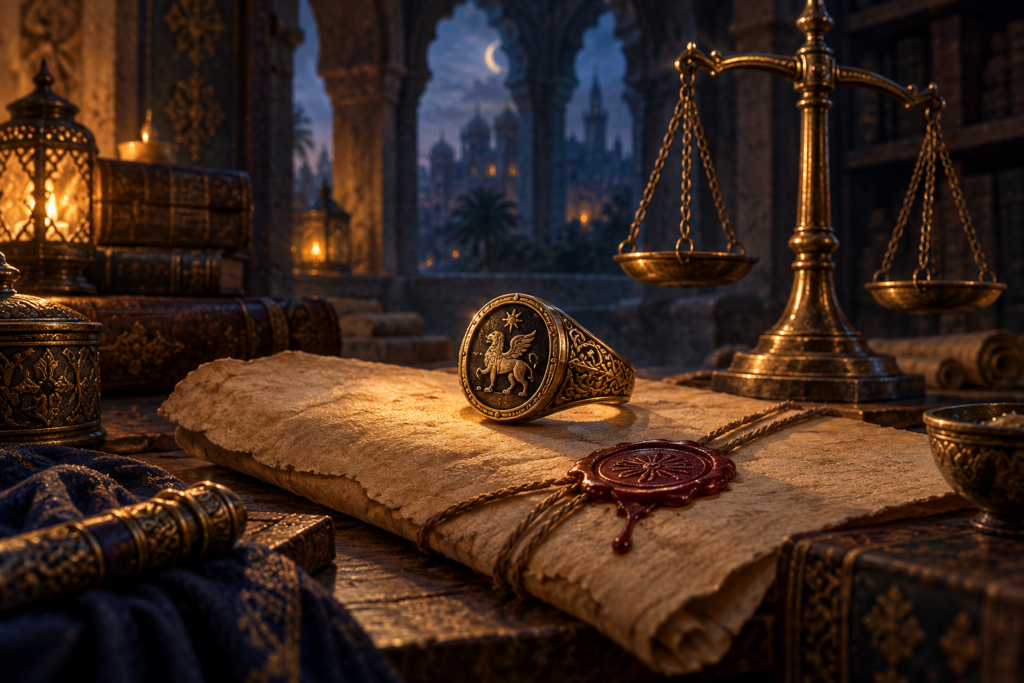
In answer, the archangel Michael brings Solomon a ring bearing an engraved seal, telling him that with it he will bind all demons, male and female, and build Jerusalem. Solomon gives the ring to the boy, who throws it at Ornias’s chest and compels him to come before the king.
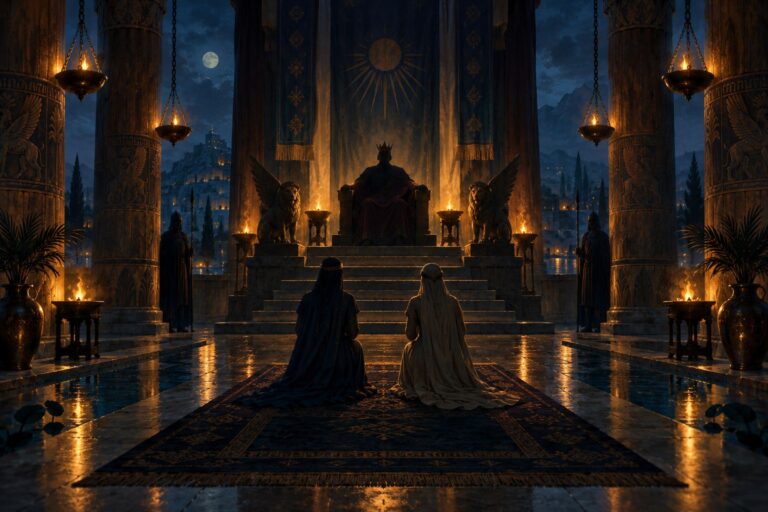
Ornias is made to fetch Beelzebul, the prince of demons, who in turn summons others. One by one, Solomon interrogates them: Onoskelis, Asmodeus, the wind demon Lix Tetrax, the seven heavenly bodies, the headless demon, the hound-shaped Rabdos, the lion-shaped demon, the three-headed dragon, Obyzouth, the winged dragon, Enepsigos, Kunopegos and more. Each confesses its name, its zodiac sign, its mischief and the angel that thwarts it.
Each bound demon is set to work: cutting stone, carrying water, spinning hemp, heating the furnace. The wind demon Ephippas, captured in a leather flask by Solomon’s servant in Arabia, and a demon from the Red Sea together lift the enormous cornerstone into place.
The Testament ends soberly. Solomon falls in love with a foreign woman and, pressed by her priests, sacrifices to the idols Moloch and Raphan. His wisdom departs, the spirit of God leaves him, and he writes his testament as a warning. The demon-master loses everything through his own weakness.
The most distinctive feature of the Testament is its pairing of each demon with an angel. This reflects a widespread ancient belief that every harmful spirit has a specific counter-power, and that knowing a demon’s name and its opposing angel gives protection. The table in this article lists the major pairings as the text gives them.
Several demons deserve comment. Ornias is a shape-shifter who appears as a lion, a winged creature and a beautiful woman; he is tied to the sign of Aquarius and is thwarted by Ouriel. Beelzebul claims to have been the first angel of the first heaven and now rules the demons; he reveals that his name is defeated by the holy name of God, called Emmanuel by the text. Asmodeus is the demon who, in the Book of Tobit, killed Sarah’s seven bridegrooms; the Testament has him confess that the smoke of a fish’s liver and gall drives him away, exactly as in Tobit, and names Raphael as his angel.
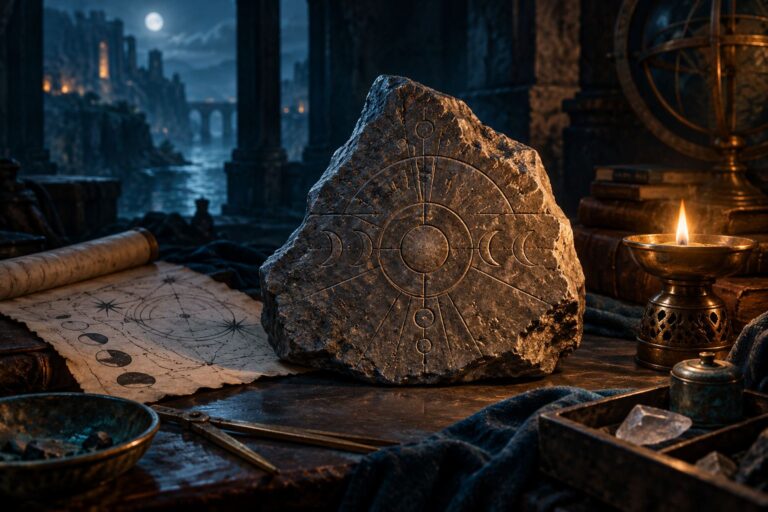
Obyzouth is a female demon with disheveled hair who strangles newborns and causes stillbirths, a figure related to Lilith and to the child-killing demons of Near Eastern folklore. Enepsigos is three-formed and linked to the Moon; she prophesies that the Temple will be destroyed and the demons set free, which is the text’s explanation for why demons are still at large. The seven heavenly bodies, who introduce themselves as Deception, Strife, Fate, Distress, Error, Power and “the Worst,” show the Testament’s astrological side, in which demons are tied to stars and signs.
The ring is the hinge of the whole story. The Testament describes it as given by God through Michael, with a seal engraved on a precious stone. Some manuscripts describe the device as a pentalpha, a five-pointed star, while later tradition associated Solomon’s seal with the six-pointed hexagram. The text does not describe a hexagram, and the identification of the Seal of Solomon with the Star of David came much later, in medieval and Islamic contexts.
In the narrative, the ring works by contact and authority rather than by spoken formula. Thrown at a demon, it compels obedience; shown to a demon, it extracts confession. Solomon lends it to others, including the boy and the servant who captures Ephippas in Arabia, which suggests that the power belongs to the seal rather than to the king personally. This idea, that a sealed object can hold a spirit, is the ancestor of the sealed bottles and jars of the Arabian Nights and of the brass vessel in the Goetia’s legend.
The article on the ring of Solomon in the Testament examines these passages in detail. The key point is that the Testament gives the ring its first full literary life and sets the pattern that later Solomonic texts follow.
The Testament does not appear by name in later traditions, but its central idea traveled far. In the Quran, Solomon commands the jinn, who build for him and dive for him (Surah Saba 34:12 to 13), and an ifrit offers to fetch the Queen of Sheba’s throne (Surah An-Naml 27:39). The Quran gives no ring, but Islamic commentary and folklore supplied one, and the tale of Solomon briefly losing his ring and kingdom echoes the Testament’s humbled king.
The Arabian Nights inherited both the seal and the sealing. In the tale of the Fisherman and the Jinni, a marid is imprisoned in a brass bottle stoppered with lead and stamped with Solomon’s seal. In the City of Brass, jinn remain sealed in vessels on a distant shore. These stories assume the reader knows that Solomon bound spirits, the very legend the Testament first told at length.
The Goetia, compiled in seventeenth-century England, claims that Solomon shut seventy-two spirits in a brass vessel and that each can be compelled by its seal. The names mostly differ from the Testament’s, but Asmodeus appears in both, and the structure of interrogation, confession and assignment is the same. The 72 demons of the Goetia are, in a real sense, descendants of Ornias and his companions.
The first is that the Testament is in the Bible. It is not; Kings and Chronicles describe Solomon’s wisdom and his Temple but say nothing about binding demons. The second is that Solomon wrote it; the text is centuries younger than the king and written in Greek.
The third misunderstanding is to confuse the Testament with the Key of Solomon or the Lesser Key. Those are medieval and early modern grimoires with different content, different demons and a very different purpose. The Testament is a story with a catalog inside it, not a manual.
Historians of religion value the Testament as a window into popular belief in the early Common Era, when Jews, Christians and pagans shared a vocabulary of demons, angels, stars and seals. Students of the Bible read it to see how Solomon’s reputation for wisdom became a reputation for magic. Fans of fantasy and games meet its names through the Goetia and trace them back.
For anyone reading the text, a few guidelines help. Use a scholarly translation, such as Duling’s, rather than an anonymous web copy, because the recensions differ and web versions often mix them. Treat the angel-demon pairings as evidence of ancient belief, not as instructions. And read the ending. Its lasting message is not that a wise king can command spirits, but that even he could not command himself. This site describes these traditions for educational purposes only.
Still have a question about your own experience? Describe what you are seeing, feeling or dreaming, and when it started. The Sheikh reads every message personally and replies in private.
Drawn to these stories for a reason? The Testament of Solomon is a story about wisdom, responsibility and the limits of power. A Full Personal Reading with our partner PuraTarot is a reflective way to bring those themes to your own question. Join the free Djinn Guide newsletter and, once you confirm, you will unlock a 50% code for your first reading.
Further reading
As an Amazon Associate we earn from qualifying purchases.
It is a Greek pseudepigraphal text in which Solomon tells how he received a sealed ring from the archangel Michael, bound a series of demons, learned their names and the angels that thwart them, and set them to work building the Temple. It ends with Solomon losing his power after being drawn into idolatry.
Scholars date it between the first and fifth centuries CE, with a core probably from around the third century and later Christian editing. The surviving manuscripts are medieval. It was likely composed in a Greek-speaking setting such as Egypt or Syria-Palestine where Jewish, Christian and pagan ideas mixed.
No. It has never been part of any Jewish or Christian canon. The biblical accounts of Solomon in Kings and Chronicles mention his wisdom and the Temple but not demons or a magic ring. The Testament belongs to the pseudepigrapha, writings attributed to biblical figures who did not write them.
Ornias is the first demon Solomon binds. He torments a boy working on the Temple by taking his wages and draining his life. After the boy throws Solomon's ring at him, Ornias is compelled to serve, fetches Beelzebul, and is later put to work cutting stone. The text says the archangel Ouriel thwarts him.
Mostly not. The Testament names demons such as Ornias, Beelzebul, Onoskelis, Obyzouth and Ephippas, which do not appear in the Goetia. Asmodeus is the main shared figure. What the two texts share is the idea that Solomon bound spirits with a seal and compelled them to confess their names and powers.
Disclaimer
This article describes the Testament of Solomon as a historical and literary text for educational purposes. The beliefs it records are described, not endorsed, and nothing here provides ritual instruction or promises any outcome.
Did this guide help you understand the subject? Rate it and share your honest opinion to help other readers. Every review is checked by our editors before it appears.
There are no reviews yet. Be the first one to write one.


Sheikh Youssef
Tayeb El Merzouki
For inquiries about personalized spiritual work, private rituals, and traditional talismans, connect directly with Sheikh Youssef Tayeb El Merzouki.
Chat on WhatsApp