




Join Djinn Guide: Get 50% Off a Personal Reading
Get new guides to jinn, folklore and occult history. Confirm your subscription to unlock a 50% code for a first personal reading with our partner PuraTarot.
Discover the unseen
Amon demon profile: seventh spirit of the Ars Goetia, a marquis with 40 legions. Appearance, offices, sigil, Weyer and de Plancy versions, Amun link.
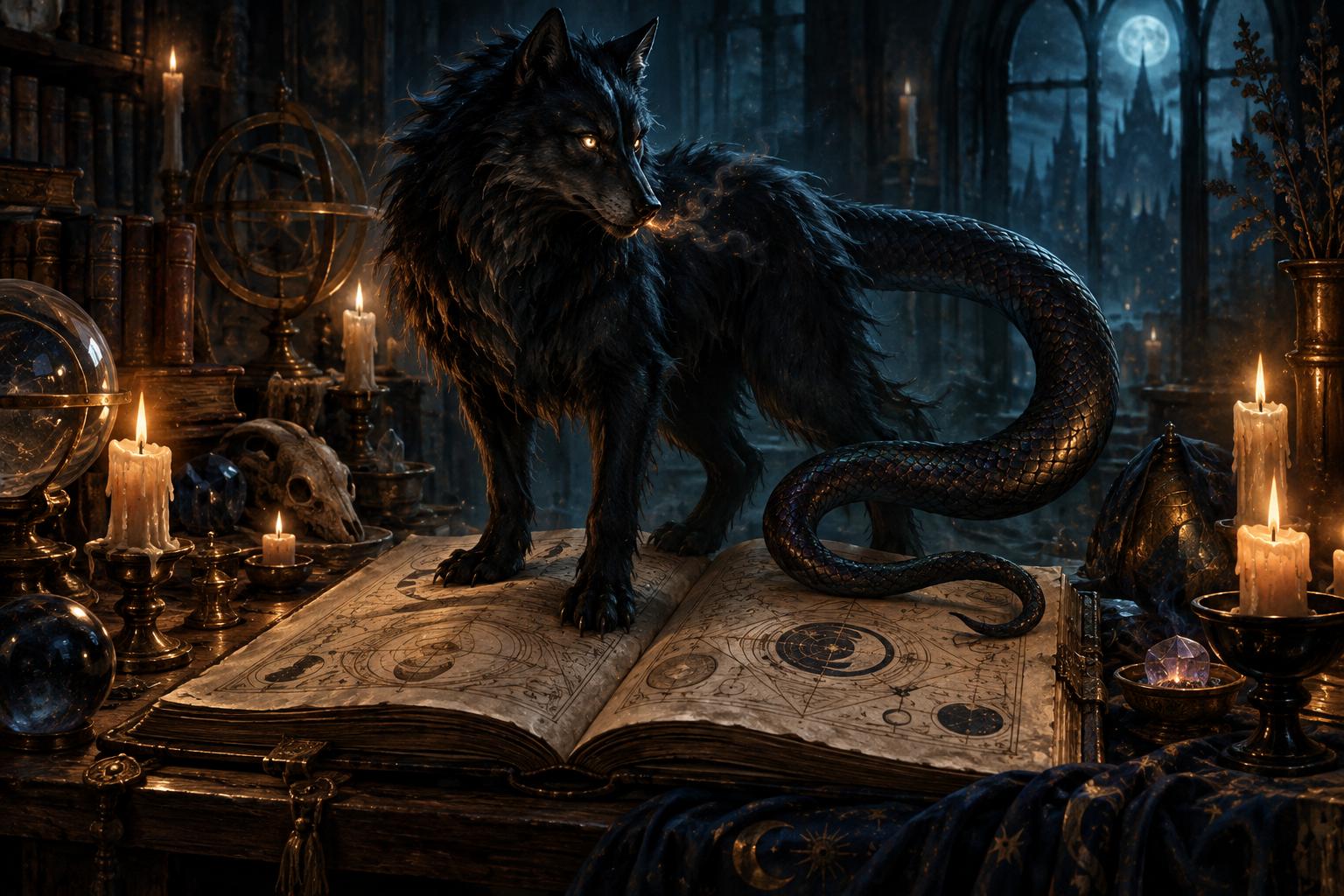
Quick answer: The Amon demon (also spelled Aamon) is the seventh spirit listed in the Ars Goetia, the first book of the Lesser Key of Solomon. He is ranked as a marquis commanding forty legions, and the text describes him first as a wolf with a serpent's tail breathing flames, then as a man with dog's teeth and a raven-like head. His offices are knowledge of past and future, settling quarrels between friends, and arranging goodwill. The name resembles the Egyptian god Amun, but the two figures come from different worlds.
Related guides: Ars Goetia names, offices and seals, full list of the 72 demons, Goetia ranks and demon hierarchy, Barbatos, the eighth Goetia spirit, Marbas, the fifth spirit, what a sigil actually is.
| Spirit | Number and rank | Legions | First form in the Lemegeton | Main offices |
|---|---|---|---|---|
| Amon (Aamon) | 7, Marquis | 40 | Wolf with serpent's tail, breathing fire | Past and future, reconciling friends, procuring goodwill |
| Marbas | 5, President | 36 | Great lion | Hidden things, diseases, mechanical arts, shape-changing |
| Barbatos | 8, Duke | 30 | Hunter with four kings and their companies | Hidden treasure, animal speech, reconciling friends |
| Naberius | 24, Marquis | 19 | Black crane with a hoarse voice | Rhetoric, arts and sciences, restoring lost honors |
Key Takeaways
In the Ars Goetia, the first of the five books that make up the Lemegeton or Lesser Key of Solomon, Amon is the seventh of the seventy-two spirits. The 1904 Mathers and Crowley edition lists him as “a Great and Mighty Marquis” who governs forty legions of spirits. His entry is short, as most of them are, but it has unusually vivid imagery. He is said to appear first as a wolf with a serpent’s tail, vomiting flames of fire, and then, at the command of the operator, to take the shape of a man with dog’s teeth set in a head like that of a raven, or simply a man with a raven’s head.
The offices assigned to him are gentle compared with the warlike spirits elsewhere in the list. Amon “telleth all things Past and to Come,” settles disputes and “procureth feuds and reconcileth controversies between friends,” and “procureth love.” In the vocabulary of the grimoires, that last phrase usually means goodwill or favor rather than romance, though later readers often took it literally. The catalogue of spirits also records that the seal or sigil of Amon must be worn by the operator, as with every spirit in the list. You can see how this entry fits into the whole in our guide to Ars Goetia names, offices and seals.
The spelling varies: Weyer writes Aamon, most manuscripts Amon. The doubled vowel is probably a copyist’s habit, but it has encouraged speculation about Egyptian origins, discussed below.
The standard Goetia profile can be broken into a few fixed elements, and it helps to lay Amon’s out one by one.
Amon is the seventh spirit. His rank is marquis, which in the Goetia’s internal logic belongs to the planetary and elemental scheme that later editors, especially the Golden Dawn circle, attached to the ranks. Marquises are usually said to be “of the order of the Moon” and best approached in the hours between three in the afternoon and dusk. Those correspondences are not in the earliest manuscripts; they belong to the layer of commentary that grew around the text.
Forty legions is a middling number. Bael, Paimon and the other kings command far more; minor spirits command fewer. The legion count was a way for the compilers to express relative importance, not a literal census.
The wolf-and-serpent image is the one most illustrators choose. The second form, a man with a raven’s head and canine teeth, is less often drawn but more interesting, because hybrid bird-headed figures have a long history in Near Eastern and Egyptian art, which is partly why the name invites comparison with Amun.
Amon’s seal in the Mathers edition is built around a horizontal bar with curved, horn-like strokes rising from it and small circular terminals at the tips, with a short vertical element below. Copies differ in small details; the general effect is of a crowned or antlered line. These figures were treated as a spirit’s signature rather than a picture of it.
Does this touch your own situation? Many readers come to these pages because something in their home, dreams or family feels unexplained. Reading history helps, but it cannot look at your specific case.
Consult the Sheikh Private, confidential, and free to ask.
Grimoire spirits are defined by their offices, the services the text claims they perform. Amon has three. The first is knowledge of past and future, which he shares with dozens of other spirits; prophecy was the most common Goetia office, reflecting how much of early modern magic was concerned with divination. The second is reconciliation. The Lemegeton says he reconciles controversies between friends, and the Weyer text extends this to friends and foes alike. The third is procuring love or favor, a phrase that in the sixteenth century covered the goodwill of patrons, judges and employers as readily as it covered courtship.
There is a curious tension in the Lemegeton wording, which says Amon “procureth feuds” as well as reconciling them. Most commentators read this as a copying slip or as a sign that the spirit was thought able to work in both directions, stirring up and calming disputes. Weyer’s Latin is clearer and speaks only of reconciling.
This site describes these claims as historical material only. We do not provide ritual instructions, and nothing in the grimoire tradition has been shown to produce the results it promises.
The Goetia did not invent Amon. His entry comes almost word for word from the Pseudomonarchia Daemonum, the catalogue of spirits that Johann Weyer printed in 1577 as an appendix to his De praestigiis daemonum. Weyer, a physician and critic of the witch trials, left out the conjurations on purpose. In his text Aamon is “a great and mighty marquis” who comes in the likeness of a wolf with a serpent’s tail, vomiting flames; in human shape he shows dog’s teeth and “a great head like to a mighty raven.” Weyer adds that he is “the strongest prince of all other,” a phrase the Goetia dropped, and gives him the same forty legions.
Reginald Scot translated Weyer’s list into English in The Discoverie of Witchcraft (1584), which is how the wording reached English readers and, eventually, the compilers of the Lemegeton. The Goetia reorders Weyer’s spirits and adds a handful, but Amon keeps his place near the top.
Jacques Collin de Plancy’s Dictionnaire Infernal, first published in 1818, repeats Weyer’s description in French. The 1863 edition added the engravings by Louis Le Breton that fixed the popular image of many Goetia spirits. Le Breton’s Amon is a wolf-bodied creature with an owl-like head, a serpent’s tail and a small flame at the mouth, which blends the two forms of the text into one. Most modern pictures of Amon descend from that engraving rather than from any manuscript.
Readers often arrive at the Goetia Amon from the Egyptian god Amun (also written Amon or Ammon), the hidden god of Thebes who became the chief deity of the New Kingdom and was identified by the Greeks with Zeus. The names look identical, and a popular theory holds that the grimoire demon is the old god demoted, in the way that Baal became Bael and Astarte became Astaroth. The pattern is real for those two spirits, where the biblical polemic against Canaanite gods did the demoting. For Amon the evidence is thinner.
Amun does appear in the Bible. Jeremiah 46:25 names “Amon of No,” that is, Amun of Thebes, among the Egyptian powers to be judged, and Nahum 3:8 speaks of “No-Amon.” So a medieval or early modern scholar leafing through scripture could have met the name and placed it in a demon catalogue. But the Goetia’s description, a wolf with a serpent’s tail and a raven-headed man, has nothing to do with Amun’s iconography, which is a ram or a crowned man with two tall plumes.
The honest position is that the connection is possible but unproven. The names may be a coincidence, a half-remembered biblical reference, or a scribe’s choice.
Because Amon is one of the more memorable spirits in the list, he has collected a fair amount of folklore of his own. A few points are worth clearing up.
These corrections simply separate the sixteenth-century text from the layers that gathered around it later.
Most searches for the Amon demon are driven by fiction and games rather than by occult practice. The Japanese manga Devilman (1972) made Amon the demon who merges with its protagonist, and that version has been adapted repeatedly, most recently in the 2018 animated series. The Shin Megami Tensei and Persona games include Amon among their recruitable demons, usually drawn with elements from the Le Breton engraving.
A second stream of interest comes from readers of the Bible and of Egyptian history who find the name in Jeremiah or in a museum and then discover that a grimoire has a demon called the same thing. A third comes from the general revival of interest in the Lesser Key of Solomon, which is available in cheap reprints and free online transcriptions and has become a kind of shared character sheet for modern pop demonology. For a wider view of why these lists fascinate people, see our introduction to what demonology is.
The Goetia’s compilers would not have recognized any of this. For them Amon was one line in a working catalogue, not a character.
If you want to go beyond summaries, there are three texts to read and a few habits worth keeping. Read Weyer first, in Scot’s English or in the Latin, because that is the earliest layer. Then read the Goetia entry in the Mathers and Crowley edition, and note where the wording changes. Finally look at de Plancy, mainly to see how the illustrations shaped later imagination.
Ask which details are in all three sources and which appear in only one. For Amon the answers are clear: the wolf, the serpent’s tail, the fire, the raven head and the forty legions are stable from Weyer onward; the owl, the lunar attribution and the Egyptian connection are later additions of varying reliability.
Finally, treat the spirits as literature and history. The Goetia belongs to the same world as the Testament of Solomon and the medieval Solomonic legends, in which the king was said to command spirits by a ring and a seal; our page on King Solomon and the jinn explains that background. Amon makes most sense as one small entry in that long story of imagined authority over the unseen.
Still have a question about your own experience? Describe what you are seeing, feeling or dreaming, and when it started. The Sheikh reads every message personally and replies in private.
Drawn to these stories for a reason? Readers often come to Amon because the old lists say he tells of things past and to come, and that kind of question is usually about our own lives more than the grimoire. If that is true for you, our partner PuraTarot offers a Full Personal Reading as a calm space for personal reflection on what you are facing now. Join the free Djinn Guide newsletter and, once you confirm, you will unlock a 50% code for your first reading.
Further reading
As an Amazon Associate we earn from qualifying purchases.
Amon is the seventh spirit of the Ars Goetia, a marquis who commands forty legions. The text describes him as a wolf with a serpent's tail breathing fire, able to take the form of a man with dog's teeth and a raven's head. His offices are knowledge of past and future, reconciling disputes between friends, and winning goodwill.
Probably not, though the question is open. The names match, and Amun is mentioned in the Bible in Jeremiah 46:25, but the Goetia's description of a wolf and a raven-headed man has nothing in common with Amun's ram or plumed-man imagery. The link is a modern guess rather than something the sources state.
Amon holds the rank of marquis. In the later planetary scheme attached to the Goetia, marquises are associated with the Moon. Weyer's 1577 text also calls him "the strongest prince of all," but that phrase is not in the Lemegeton, and his formal title remains marquis in every edition.
In the Mathers and Crowley edition the seal of Amon is a horizontal bar with curved, horn-like strokes rising from it, small circles at the tips, and a short element below, giving a crowned or antlered appearance. Copies vary in detail. Like all Goetia seals it is a symbolic signature, not a portrait.
The best-known appearance is in the manga and anime Devilman, where Amon is the demon fused with the hero. He is also a recruitable demon in the Shin Megami Tensei and Persona games and turns up in card games, mobile games and horror media that borrow names from the Lesser Key of Solomon.
Disclaimer
This article describes the Amon demon as he appears in historical grimoires and later popular culture for educational purposes. The beliefs and claims of those texts are reported, not endorsed, and the site provides no ritual instructions or promises of any outcome.
Did this guide help you understand the subject? Rate it and share your honest opinion to help other readers. Every review is checked by our editors before it appears.
There are no reviews yet. Be the first one to write one.


Sheikh Youssef
Tayeb El Merzouki
For inquiries about personalized spiritual work, private rituals, and traditional talismans, connect directly with Sheikh Youssef Tayeb El Merzouki.
Chat on WhatsApp