





Join Djinn Guide: Get 50% Off a Personal Reading
Get new guides to jinn, folklore and occult history. Confirm your subscription to unlock a 50% code for a first personal reading with our partner PuraTarot.
Discover the unseen
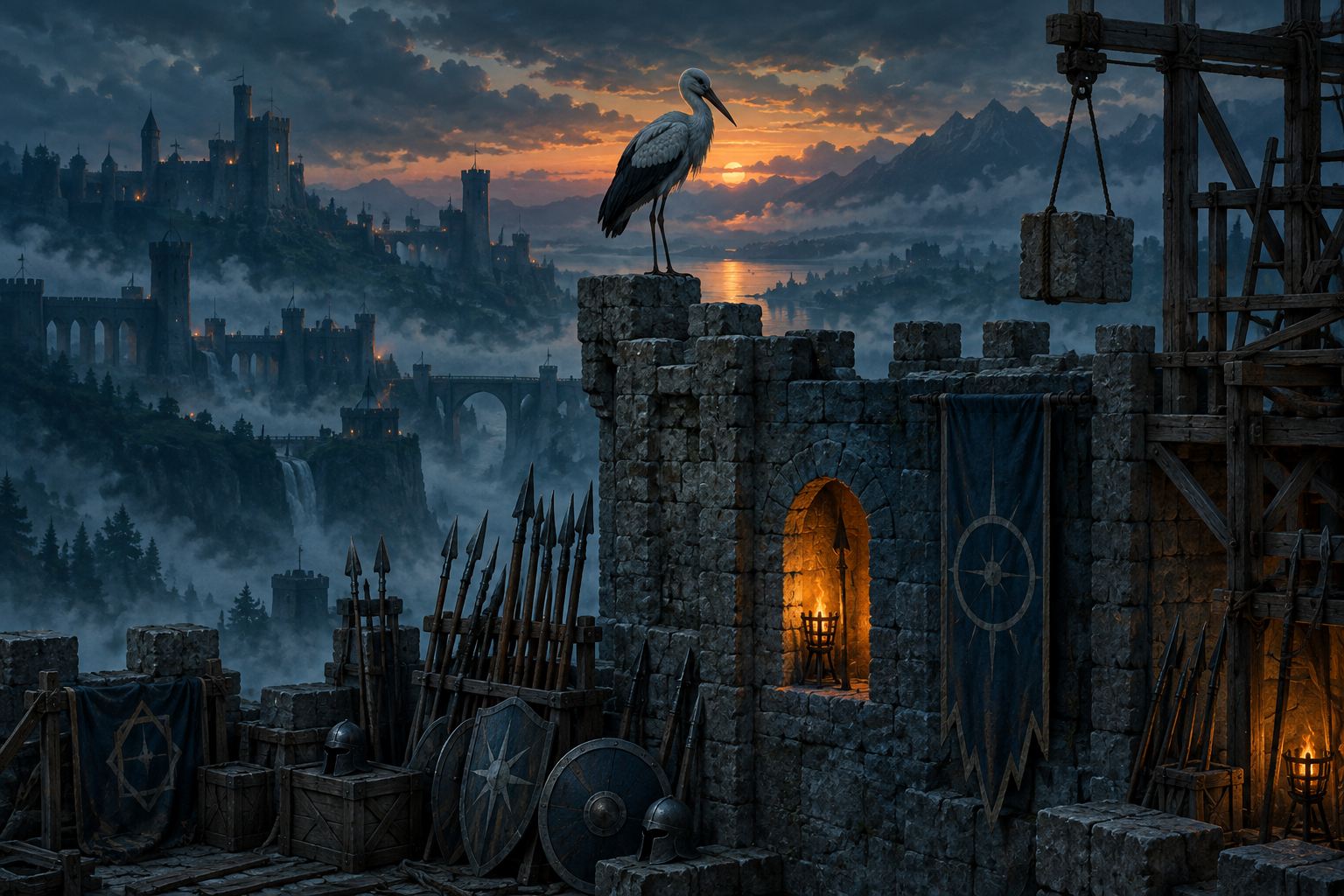
Halphas demon explained: the 38th spirit of the Ars Goetia, an earl who appears as a stork, builds towers and rules 26 legions. Sigil, sources and lore.
Quick answer: The Halphas demon is the thirty-eighth spirit of the Ars Goetia, the first book of the Lesser Key of Solomon. Described as a Great Earl who appears in the form of a stork (or, in the 1904 Mathers edition, a stock-dove) and speaks with a hoarse voice, Halphas is said to build towers, stock them with weapons and send soldiers to appointed places. He rules 26 legions of spirits and is also called Malthus or Malthas.
Related guides: the full list of 72 Goetia demons, Goetia ranks from king to president, how Goetia names, offices and seals work, Malphas, the crow president who builds houses, Raum, the crow earl of the Goetia, what a sigil actually is.
| Spirit | Number and rank | Form in the Lemegeton | Offices | Legions |
|---|---|---|---|---|
| Halphas (Malthus) | 38, Earl | Stork or stock-dove, hoarse voice | Builds towers, supplies weapons, sends soldiers | 26 |
| Malphas | 39, President | Crow, then a man with a hoarse voice | Builds houses and towers, reveals enemies' thoughts | 40 |
| Raum | 40, Earl | Crow, then a man | Steals treasure, destroys cities, causes love | 30 |
| Stolas | 36, Prince | Raven or crowned night-raven | Teaches astronomy and herbs | 26 |
Key Takeaways
Halphas is one of the 72 spirits cataloged in the Ars Goetia, the opening book of the Lemegeton or Lesser Key of Solomon, a seventeenth-century English compilation of older material. He holds position 38 and the rank of Great Earl. The Mathers and Crowley edition of 1904, the version most reprints follow, describes him as appearing in the form of a stock-dove, speaking with a hoarse voice, and ruling 26 legions of spirits. His alternative names, Malthous, Malthus or Malthas, come from the earlier Latin catalog on which the Goetia is based.
His offices are unusually specific. Halphas is said to build up towers and to furnish them with ammunition and weapons, and to send men of war to places appointed. In the vocabulary of the grimoires, this makes him a spirit of fortification and military logistics rather than of knowledge, treasure or love. The emphasis on supplying rather than fighting distinguishes him from war spirits like Andras or Leraje, who are described as sowing discord and causing wounds.
As with every Goetia entry, Halphas is presented as a spirit that King Solomon bound and commanded. The text also assigns him a seal, which the operator was supposed to wear. This article describes those traditions as they appear in the sources; it does not provide instructions for evocation. For how the catalog as a whole is organized, see how Goetia names, offices and seals work.
The Goetia did not invent Halphas. He appears in the Pseudomonarchia Daemonum, the catalog of 69 demons that the Dutch physician Johann Weyer published in 1577 as an appendix to his book De praestigiis daemonum. Weyer lists him under the name Malthus, with Halphas given as an alias, and describes him as a great earl who comes forth like a stork, speaks with a hoarse voice, builds towns full of munitions and weapons, sends soldiers to appointed places and commands 26 legions. The English translation of this passage was printed by Reginald Scot in The Discoverie of Witchcraft in 1584.
Comparing the three texts shows how the entry drifted. Weyer and Scot write stork; the Goetia manuscripts and the Mathers edition write stock-dove. Most commentators think stock-dove is a corruption or misreading, since the rest of the description is identical and a stork fits the martial, tower-raising character better than a small wild pigeon. Weyer also speaks of towns, where the Goetia says towers; either reading is defensible, since Latin and early English vocabulary overlapped.
These differences matter because they reveal the catalog’s history. The Goetia compiler reordered Weyer’s spirits, added four that Weyer lacked, attached seals and ranks and reduced each entry to a formula. Halphas is a good example of a spirit whose essential description survived this process almost unchanged, while small details such as the bird species wobbled between copies.
Does this touch your own situation? Many readers come to these pages because something in their home, dreams or family feels unexplained. Reading history helps, but it cannot look at your specific case.
Consult the Sheikh Private, confidential, and free to ask.
Every Goetia spirit has a seal, usually called a sigil in modern usage, that the Lemegeton presents as the sign Solomon used to bind it. The seal of Halphas, as printed in the Mathers edition and copied across the internet, is a compact geometric figure. In the common version it is built around a horizontal bar from which short vertical strokes and curved hooks descend, with small circles terminating several of the lines and a pair of inward-curling arcs that give the figure a roughly symmetrical, crown-like outline.
Readers should know that the seals vary between manuscripts. The copies of the Lemegeton in the British Library do not always agree with one another, and the Mathers plates were redrawn by hand, so no single version can claim to be the original. The symbols also carry no attested meaning beyond their function in the text; attempts to read letters or astrological glyphs into them are modern speculation.
Thomas Rudd’s seventeenth-century version of the Goetia, edited by Stephen Skinner and David Rankine in 2007, pairs each demon with one of the 72 angels of the Shem HaMephorash as a controlling counterpart. In that system Halphas, as the 38th spirit, is matched with the 38th angel, Haamiah. This pairing is a feature of the Rudd manuscript and not of the standard Lemegeton.
Jacques Collin de Plancy’s Dictionnaire Infernal, first published in 1818, gathered demons from Weyer, the grimoires and folklore into an encyclopedia. The 1863 edition added engravings by Louis Le Breton, and these pictures did more than any text to fix the modern image of the Goetic spirits. Halphas appears among them as a stork, drawn naturalistically, standing in profile with no human features at all. The plainness of the image is striking next to the monstrous neighbors on surrounding pages, and it is the reason he is often labeled the stork demon online.
De Plancy’s text follows Weyer closely, calling Halphas a grand count of the infernal empire who appears as a stork, speaks hoarsely, builds towns and towers and arms them, and commands 26 legions. He does not add legends or anecdotes about Halphas, and no independent folklore about this spirit is known. Unlike Asmodeus, Astaroth or Belial, Halphas has no biblical or Near Eastern ancestor; his name and character exist only within the grimoire catalog tradition.
Scholars have tried to find an etymology. Suggestions range from a corrupted Hebrew or Arabic word to a scribal error, but none is secure. The safest statement is that Halphas, like Malphas beside him, is a name born inside the late medieval demon lists rather than inherited from an ancient religion.
The Goetia arranges a small cluster of bird-form spirits together, and reading Halphas alongside them clarifies his character.
A Great Prince who appears as a raven or a crowned night-raven and teaches astronomy and the virtues of herbs and stones. A spirit of learning, not war.
The stork or stock-dove earl, hoarse-voiced, who raises towers, stocks them with weapons and dispatches soldiers. A spirit of fortification.
A Great President who first appears as a crow and then takes human shape, also with a hoarse voice. He builds houses and high towers, brings artificers together and can reveal enemies’ desires. He is warned to be deceptive about sacrifices. See Malphas, the crow president who builds houses.
A Great Earl appearing as a crow, who steals treasure from kings’ houses, destroys cities and dignities and can reconcile friends and foes.
The pattern is clear: three consecutive spirits with bird forms, hoarse voices and powers concerned with buildings. Halphas and Malphas are sometimes confused because their names, voices and tower-building offices nearly match. The distinction in the text is that Halphas supplies and garrisons, while Malphas constructs and spies. Whether the compiler intended a deliberate sequence or simply copied Weyer’s order is unknown, but the grouping makes Halphas easier to remember.
The most common error is the bird. Because the Mathers edition dominates reprints, many websites state flatly that Halphas is a dove, and some draw conclusions about peace or gentleness from that. The older sources say stork, and even the stock-dove reading describes the wild wood pigeon, not the white dove of religious art. A second error is to describe him as a demon of war in the sense of battle. His text is about building and provisioning fortresses; he equips armies rather than leading them.
A third confusion concerns rank. Halphas is an Earl, which in the Goetia’s internal scheme is a middle rank, below kings, dukes and princes and above presidents, marquises and knights. Sources that call him a duke or a president have mixed him up with his neighbors. The table of ranks in Goetia ranks from king to president explains these titles and the planetary and metal attributions that later authors attached to them.
Finally, there is a tendency to invent personality. Modern occult blogs assign Halphas colors, enns, incense and day-of-the-week correspondences. None of these appear in the Lemegeton, Weyer, Scot or de Plancy. They are twentieth- and twenty-first-century additions and should be labeled as such.
Halphas is a minor spirit by any measure, so most of his modern visibility comes from media that use the full Goetia roster. He appears as a recruitable demon in the Shin Megami Tensei and Persona video game series, as a character in several manga and mobile games built on the 72 spirits, and in occult-themed card and role-playing games. These portrayals usually keep the stork and the fortress motifs but add dramatic personalities absent from the sources. He also surfaces in the long tail of searches for Goetia sigils, where his seal is sold on pendants and prints.
Among readers of the grimoire tradition, interest in Halphas tends to be scholarly rather than practical: he is one of the spirits that illustrates how Weyer’s Latin catalog became the English Goetia, how bird imagery clusters in the list and how small textual errors propagate for centuries. The entire roster can be browsed in the full list of 72 Goetia demons.
This site treats Halphas as a figure of occult literary history. We describe what the texts say and how illustrators imagined him, and we do not present evocation, seals or offerings as practices that produce any result.
Still have a question about your own experience? Describe what you are seeing, feeling or dreaming, and when it started. The Sheikh reads every message personally and replies in private.
Want a personal perspective? Studying a minor spirit like Halphas is an exercise in reading sources closely. If you have a personal question you would like to look at just as carefully, a Full Personal Reading with our partner PuraTarot offers a calm, reflective perspective. Join the free Djinn Guide newsletter and, once you confirm, you will unlock a 50% code for your first reading.
Further reading
As an Amazon Associate we earn from qualifying purchases.
Halphas is the 38th spirit of the Ars Goetia, ranked as a Great Earl. The Lemegeton describes him appearing as a stork or stock-dove with a hoarse voice, building towers, supplying them with weapons and sending soldiers to appointed places. He commands 26 legions and is also called Malthus or Malthas in earlier sources.
Johann Weyer (1577) and Reginald Scot (1584) say Halphas appears as a stork. The Mathers edition of the Goetia (1904) says stock-dove, which most readers consider a misreading of the same word. The 1863 Dictionnaire Infernal illustrates him as a plain stork in profile, with no human or monstrous features.
The Halphas sigil is the seal assigned to him in the Lesser Key of Solomon, drawn as a symmetrical figure of a horizontal bar with hooks, short strokes and small terminal circles. Versions differ between manuscripts, and the symbol has no documented meaning beyond its role in the text. It is widely reproduced on jewelry and art today.
Halphas is a Great Earl, sometimes translated as count. In the Goetia's hierarchy earls sit below kings, dukes and princes and above presidents, marquises and knights. Earls are traditionally associated with Mars in later commentaries, which fits Halphas's military offices of fortifying towers and dispatching troops.
No. They are adjacent spirits with similar names and overlapping themes. Halphas (38) is an earl who appears as a stork and supplies towers with weapons and soldiers. Malphas (39) is a president who appears as a crow, builds houses and towers and reveals enemies' thoughts. The resemblance is probably why their names are so often confused.
Disclaimer
This article describes Halphas as he appears in historical grimoires, demonological catalogs and modern media for educational purposes. The beliefs and practices described are presented as cultural history, not endorsed, and no ritual instructions are provided or implied to produce any effect.
Did this guide help you understand the subject? Rate it and share your honest opinion to help other readers. Every review is checked by our editors before it appears.
There are no reviews yet. Be the first one to write one.


Sheikh Youssef
Tayeb El Merzouki
For inquiries about personalized spiritual work, private rituals, and traditional talismans, connect directly with Sheikh Youssef Tayeb El Merzouki.
Chat on WhatsApp