





Join Djinn Guide: Get 50% Off a Personal Reading
Get new guides to jinn, folklore and occult history. Confirm your subscription to unlock a 50% code for a first personal reading with our partner PuraTarot.
Discover the unseen
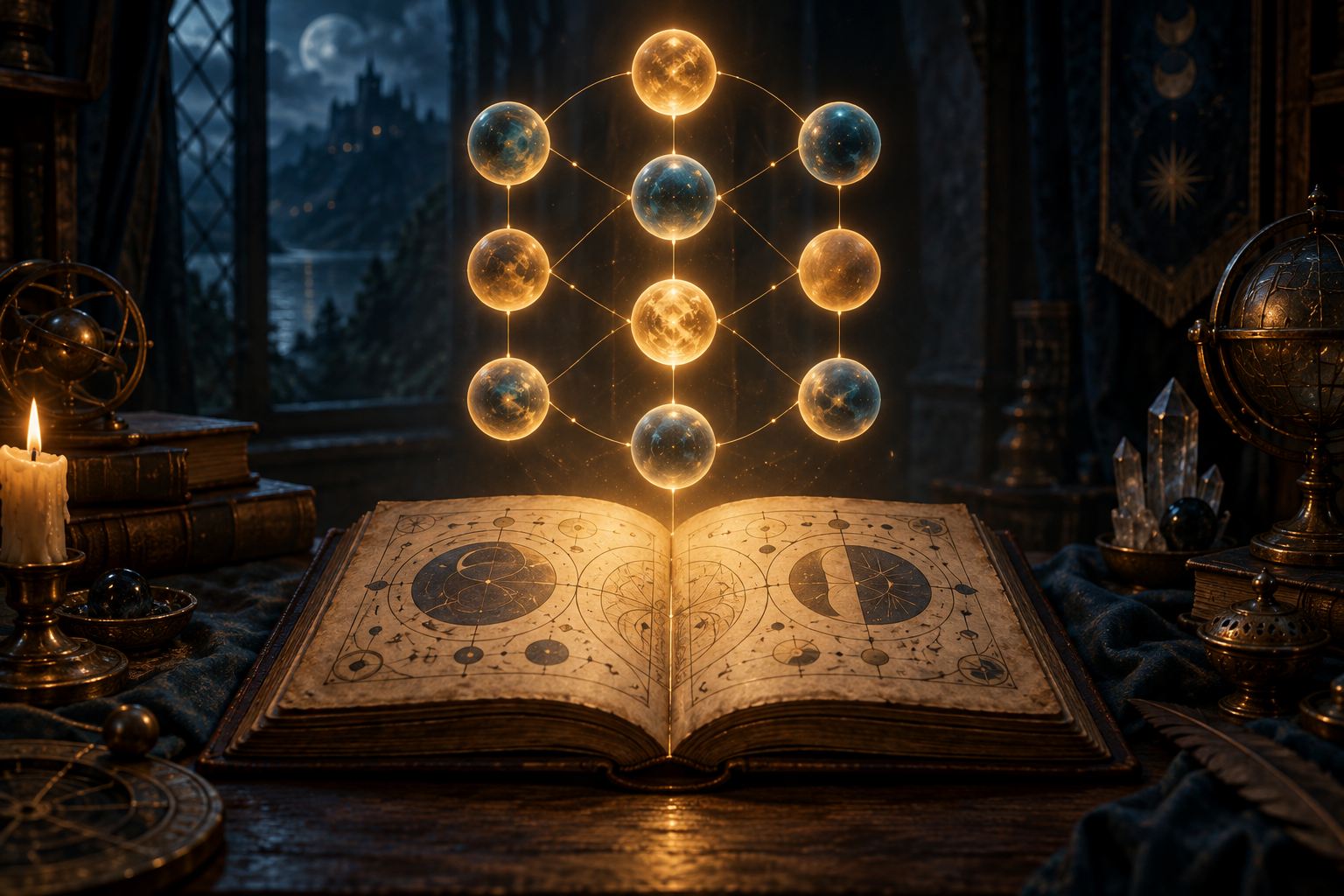
Kabbalah Tree of Life explained: the ten sephirot, 22 paths, three pillars and four worlds, where the diagram came from, and how occultists changed it.
Quick answer: The Kabbalah Tree of Life is a diagram of ten sephirot, or divine emanations, connected by twenty-two paths, used in Jewish mysticism to describe how the infinite God relates to creation and how a person may ascend toward the divine. The ten spheres run from Keter (crown) at the top to Malkhut (kingdom) at the bottom, arranged in three pillars. The diagram was first printed in 1516 and was later adopted by Christian and Hermetic occultists.
Related guides: what Kabbalah is and where it came from, Hermeticism and the Hermetic Qabalah, what the occult actually means, the 72 angels of the Shem HaMephorash, Agrippa's Three Books of Occult Philosophy, demonology as a field of study.
| Source | Date and place | Contribution to the Tree of Life |
|---|---|---|
| Sefer Yetzirah (Book of Formation) | c. 3rd–6th century CE, Hebrew | First use of the term 'ten sefirot' alongside the 22 Hebrew letters; no diagram yet |
| Sefer ha-Bahir | Late 12th century, Provence | Describes the sefirot as divine attributes and uses tree imagery for the structure of emanation |
| Zohar | Late 13th century, Castile (Moses de León) | Gives the sefirot their classic names, personalities and relationships; the core text of Kabbalah |
| Sha'arei Orah by Joseph Gikatilla | c. 1290, Castile | A systematic guide to the ten sefirot and the divine names attached to each |
| Portae Lucis (Latin Gikatilla) by Paulus Ricius | 1516, Augsburg | Frontispiece shows the first printed Tree of Life diagram, held by a seated man |
| Pardes Rimonim by Moses Cordovero | 1548, Safed | Rationalizes the system; fixes the pillar and path arrangement later readers use |
| Oedipus Aegyptiacus by Athanasius Kircher | 1652, Rome | Christian Kabbalist version of the diagram with 22 paths that the Golden Dawn adopted |
| Golden Dawn papers | 1888 onward, London | Attaches planets, archangels, tarot trumps and colors to every sephirah and path |
Key Takeaways
The Tree of Life, in Hebrew Etz Chaim, is the central diagram of Kabbalah, the Jewish mystical tradition that took shape in medieval Spain and Provence. It depicts ten sephirot (singular sephirah), usually translated as emanations, attributes or vessels, through which the infinite and unknowable God, called Ein Sof (‘without end’), becomes present in creation. The ten spheres are joined by twenty-two lines, the paths, which correspond to the twenty-two letters of the Hebrew alphabet. Together the ten and the twenty-two make the ‘thirty-two paths of wisdom’ mentioned at the opening of the Sefer Yetzirah.
The diagram reads from top to bottom as a description of how divine energy flows into the world, and from bottom to top as a map for the soul’s return. At the summit stands Keter, the crown, closest to the unknowable source; at the base is Malkhut, the kingdom, which Kabbalists identify with the physical world and with the Shekhinah, the indwelling divine presence. Between them the sephirot are arranged in three vertical columns, and the whole figure is often drawn inside the outline of a human body, since the Zohar teaches that the human form reflects the structure of the divine.
For the broader setting of the tradition, including its texts, schools and modern revival, the article on what Kabbalah is provides the background. This article concentrates on the diagram itself.
Kabbalistic authors describe the sephirot in several registers at once: as stages of emanation, as divine attributes, as parts of a cosmic body, and as qualities a person may cultivate. The names below are the standard ones from the Zohar and Cordovero, with the alternative names in parentheses.
Keter (crown) is pure will, the first stirring of the divine toward creation. Chokhmah (wisdom) is the flash of undifferentiated insight, traditionally called the father. Binah (understanding) receives that flash and gives it form, and is called the mother or the supernal palace. These three are considered beyond ordinary human reach.
Chesed (loving-kindness, also Gedulah, greatness) is expansive giving. Gevurah (strength, also Din, judgment) is restraint and limitation. Tiferet (beauty, also Rachamim, compassion) harmonizes them and sits at the center of the Tree; it is linked with the patriarch Jacob and with the written Torah.
Netzach (victory, endurance) and Hod (splendor, majesty) are paired forces of drive and submission, often associated with prophecy. Yesod (foundation) channels everything above into the final sphere and is tied to the covenant and to the righteous person, the tzaddik.
Malkhut (kingdom) has no light of its own and receives from all the others, like the moon receiving the sun. It is the Shekhinah, the community of Israel, and the world of action.
Some diagrams show an eleventh circle, Da’at (knowledge), between Chokhmah and Binah. It is not counted among the ten; it marks the place where the upper three unite and is sometimes drawn with a dotted line or omitted entirely.
Does this touch your own situation? Many readers come to these pages because something in their home, dreams or family feels unexplained. Reading history helps, but it cannot look at your specific case.
Consult the Sheikh Private, confidential, and free to ask.
Three structural ideas organize the Tree beyond the list of spheres. The first is the three pillars. The right column (Chokhmah, Chesed, Netzach) is the pillar of mercy or expansion; the left column (Binah, Gevurah, Hod) is the pillar of severity or restriction; the middle column (Keter, Tiferet, Yesod, Malkhut) is the pillar of balance. Kabbalists teach that creation requires both giving and limiting, and that the healthy soul, like the healthy cosmos, keeps the two sides in equilibrium through the center.
The second idea is the twenty-two paths. Each connects two sephirot and is assigned a Hebrew letter. The Sefer Yetzirah sorts the letters into three ‘mothers’ (aleph, mem, shin), seven ‘doubles’ (which have two pronunciations) and twelve ‘simples’, and links them to elements, planets and zodiac signs. Different manuscripts draw the paths differently; the arrangement most people know today, with exactly twenty-two lines, was standardized by Cordovero and then by Kircher’s 1652 engraving.
The third idea is the four worlds: Atzilut (emanation), Beriah (creation), Yetzirah (formation) and Assiah (action). Some Kabbalists place a complete Tree in each world, so that Malkhut of one becomes Keter of the next, producing a ladder of forty sephirot. Others map the four worlds onto a single Tree. Either way, the four worlds give the diagram depth, turning a flat chart into a model of descending levels of reality. The same four-world scheme underlies the angelic and divine-name tables that occultists later attached to the 72 angels of the Shem HaMephorash.
| Sephirah | Hebrew meaning | Pillar | Planet (Golden Dawn) | Archangel (Golden Dawn) |
|---|---|---|---|---|
| Keter | Crown | Middle | Primum Mobile (first motion) | Metatron |
| Chokhmah | Wisdom | Right (mercy) | Zodiac / sphere of fixed stars | Raziel |
| Binah | Understanding | Left (severity) | Saturn | Tzaphkiel |
| Chesed (Gedulah) | Loving-kindness / greatness | Right (mercy) | Jupiter | Tzadkiel |
| Gevurah (Din) | Strength / judgment | Left (severity) | Mars | Khamael |
| Tiferet | Beauty | Middle | Sun | Raphael (some lists: Michael) |
| Netzach | Victory / endurance | Right (mercy) | Venus | Haniel |
| Hod | Splendor | Left (severity) | Mercury | Michael (some lists: Raphael) |
| Yesod | Foundation | Middle | Moon | Gabriel |
| Malkhut | Kingdom | Middle | Earth / the four elements | Sandalphon |
The ideas behind the Tree are older than the picture. The Sefer Yetzirah, written somewhere between the third and sixth centuries CE, speaks of ‘ten sefirot of nothingness’ but uses the word in the sense of numbers or countings, not emanations, and contains no drawing. The Bahir, which surfaced in Provence in the late twelfth century, reinterprets the ten as divine attributes and compares them to a tree whose roots are above. The Zohar, composed in Castile in the 1280s and attributed by its author Moses de León to the second-century sage Shimon bar Yochai, gives the sephirot their names, genders, colors and dramatic relationships.
Drawing the system came later. Manuscript sketches survive from the fourteenth century, but the earliest printed Tree of Life appears on the frontispiece of Portae Lucis, Paulus Ricius’s 1516 Latin abridgement of Gikatilla’s Sha’arei Orah, where a bearded man holds a tree of ten linked circles. Moses Cordovero’s Pardes Rimonim (1548) worked out the logic of the paths, and Isaac Luria’s school in Safed added the cosmology of contraction, shattered vessels and repair.
From there the diagram migrated. Christian Kabbalists such as Pico della Mirandola, Johannes Reuchlin and Athanasius Kircher reread it through Neoplatonism and Christian theology. Kircher’s engraving in Oedipus Aegyptiacus (1652), with its twenty-two labeled paths, is the direct ancestor of the version used by the Hermetic Order of the Golden Dawn, and it is Kircher’s layout, not any Jewish manuscript, that most occult books reproduce.
Readers who come to the Tree through tarot, ceremonial magic or popular esoterica meet a version that differs from the Jewish one in important ways. The Hermetic Qabalah, spelled with a Q by many of its practitioners, grew out of Renaissance Christian Kabbalah, Cornelius Agrippa’s Three Books of Occult Philosophy (1533), the French occultist Éliphas Lévi in the 1850s, and the Golden Dawn from 1888. Each of these added correspondences.
Agrippa and Lévi connected the sephirot to the seven classical planets and the paths to the tarot trumps. The Golden Dawn systematized this into tables that assign every sphere a planet, an archangel, an order of angels, a color scale, a divine name and a ‘vice and virtue’. Aleister Crowley’s Liber 777 (1909) printed the tables in full. These attributions are what the second table in this article presents, and it is labeled as Golden Dawn material for a reason: a medieval Kabbalist would recognize the names of the sephirot but not the planets and archangels placed beside them, which belong to a different intellectual tradition described in the article on Hermeticism.
The two systems also differ in purpose. Jewish Kabbalah is a theology and a devotional path bound to Torah, commandments and prayer. Hermetic Qabalah is a classification scheme for ritual magic and meditation that treats the Tree as a universal filing cabinet. Neither is ‘wrong’, but they should not be confused, and a reader who cites the Golden Dawn as an authority on the Zohar, or the Zohar as an authority on tarot, has mixed the two.
Kabbalah also speaks of a shadow side. The qliphoth or kelipot, ‘husks’ or ‘shells’, are described in Lurianic teaching as the fragments left when the vessels of the sephirot shattered under the force of divine light. They trap sparks of holiness in the material world, and the human task of tikkun, repair, is to release those sparks through righteous action. In Jewish sources the husks are a problem to be mended, not a map to be explored.
Later occult writers, beginning with Lévi and intensifying in twentieth-century Left-Hand Path literature, drew an ‘inverted Tree’ with ten demonic spheres opposite the ten sephirot and assigned named demons to them. This ‘Tree of Death’ has no basis in the Zohar or Cordovero. Readers researching demon hierarchies should treat it as a modern invention, distinct from the older catalogs discussed in the article on what demonology is. This site describes such systems historically and offers no instructions for working with them.
These points matter because the Tree is now one of the most reproduced diagrams in popular spirituality, usually shown without any indication of which tradition’s version it is.
A reader who wants to understand the Tree rather than simply recognize it should keep three questions in mind. Which tradition is this source from: Jewish Kabbalah, Christian Kabbalah or Hermetic Qabalah? Which century: the medieval texts, the sixteenth-century Safed systematizers, the Renaissance translators, or the Victorian occultists? And what is the source using the Tree for: theology, devotion, philosophy, or ritual classification? The same ten names mean different things in each setting.
Good starting points exist for each path. Gershom Scholem’s and Moshe Idel’s academic studies cover the Jewish tradition; Joseph Dan’s short introduction is accessible. For the Hermetic version, the Golden Dawn papers edited by Israel Regardie and Crowley’s Liber 777 show the correspondence system in its own words. Reading one from each side makes the differences obvious and shows the Tree as a structure three traditions have argued over for seven hundred years.
Still have a question about your own experience? Describe what you are seeing, feeling or dreaming, and when it started. The Sheikh reads every message personally and replies in private.
Want a personal perspective? The Tree of Life has long served as a map for thinking about balance, growth and where a person stands on their own path. If you would like to reflect on that in your own life, our partner PuraTarot offers a Full Personal Reading focused on your present situation and the questions you bring. Join the free Djinn Guide newsletter and, once you confirm, you will unlock a 50% code for your first reading.
Further reading
As an Amazon Associate we earn from qualifying purchases.
The Kabbalah Tree of Life is a diagram of ten sephirot, or divine emanations, connected by twenty-two paths, used in Jewish mysticism to describe how God relates to creation. It runs from Keter at the top to Malkhut at the bottom and is arranged in three pillars.
From top to bottom: Keter (crown), Chokhmah (wisdom), Binah (understanding), Chesed (loving-kindness), Gevurah (strength), Tiferet (beauty), Netzach (victory), Hod (splendor), Yesod (foundation) and Malkhut (kingdom). Da'at (knowledge) is sometimes drawn as a hidden eleventh point but is not counted.
Each path connects two sephirot and is assigned one of the twenty-two letters of the Hebrew alphabet. The Sefer Yetzirah groups the letters into three mothers, seven doubles and twelve simples, linked to elements, planets and zodiac signs. Ten sephirot plus twenty-two paths make the thirty-two paths of wisdom.
Both, in different forms. It originated in medieval Jewish Kabbalah, especially the Zohar and the Safed school. Renaissance Christian Kabbalists and later the Golden Dawn adapted it, adding planets, archangels and tarot cards. The Hermetic Qabalah version is the one most occult books reproduce.
The right pillar of mercy (Chokhmah, Chesed, Netzach) represents expansion and giving; the left pillar of severity (Binah, Gevurah, Hod) represents restriction and judgment; the middle pillar of balance (Keter, Tiferet, Yesod, Malkhut) harmonizes them. Kabbalists teach that creation requires both sides held in equilibrium.
Disclaimer
This article describes the Tree of Life as it appears in Jewish Kabbalah and in later Christian and Hermetic adaptations, for historical and educational purposes. Religious and esoteric beliefs are presented as beliefs, not endorsed, and no spiritual outcomes are promised.
Did this guide help you understand the subject? Rate it and share your honest opinion to help other readers. Every review is checked by our editors before it appears.
There are no reviews yet. Be the first one to write one.


Sheikh Youssef
Tayeb El Merzouki
For inquiries about personalized spiritual work, private rituals, and traditional talismans, connect directly with Sheikh Youssef Tayeb El Merzouki.
Chat on WhatsApp


