







Join Djinn Guide: Get 50% Off a Personal Reading
Get new guides to jinn, folklore and occult history. Confirm your subscription to unlock a 50% code for a first personal reading with our partner PuraTarot.
Discover the unseen
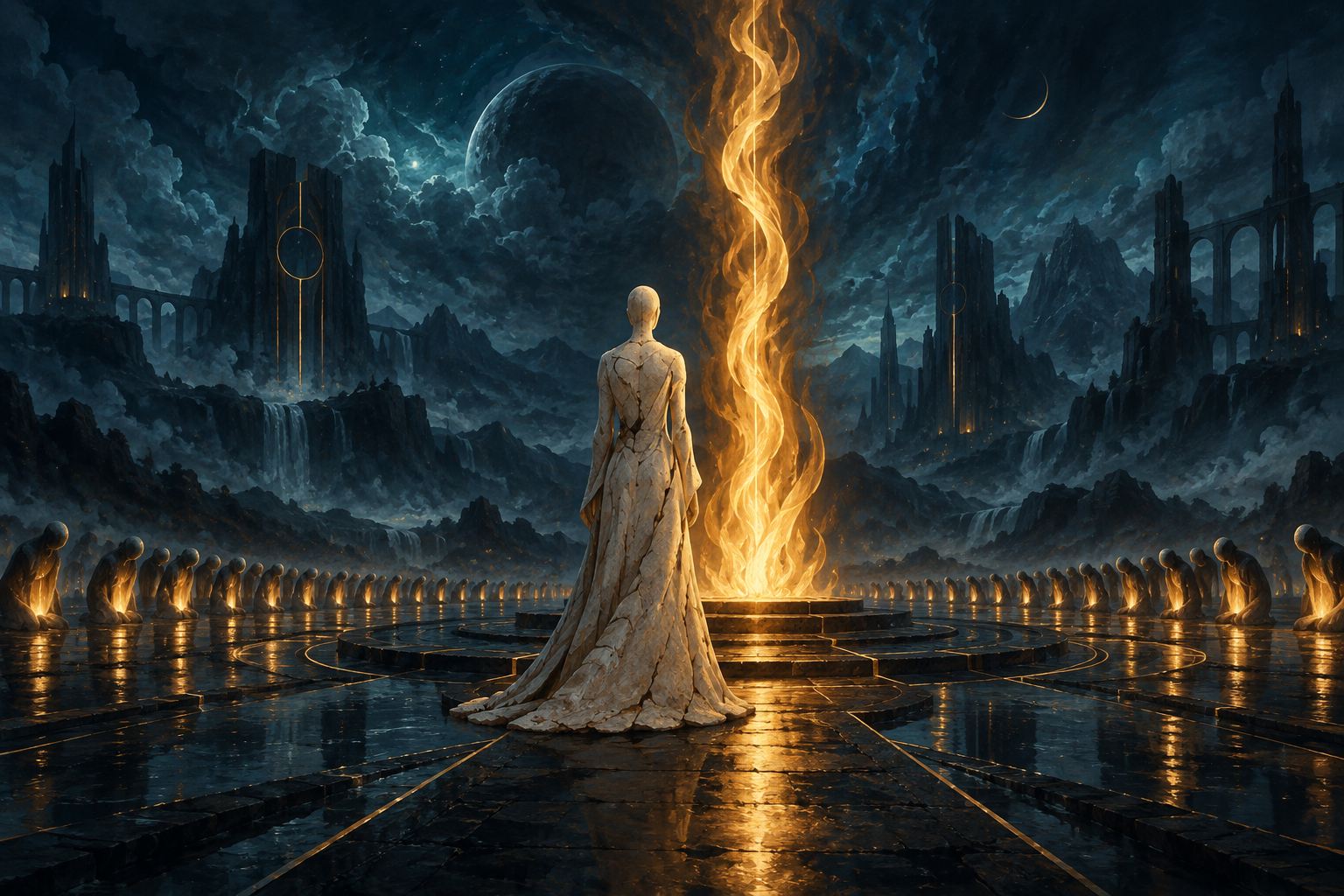
Who is Iblis? His refusal to bow to Adam, the Quran verses that tell it, the jinn-or-angel debate, Iblis vs Shaitan, and his afterlife in Sufi poetry.
Quick answer: Iblis is the proper name of the being who, in the Quran, refused God's command to prostrate before Adam and was expelled from the divine presence. The Quran states that he was 'of the jinn' and was created from fire, that he asked for and received respite until the Day of Resurrection, and that he vowed to lead humanity astray. In Islamic tradition Iblis is the individual figure, while shaitan is the broader role of tempter.
Related guides: Shaitan, Iblis and the jinn compared, jinn in Islamic belief, verse-by-verse guide to jinn in the Quran, the types of jinn, the qareen companion jinn, angels and demons across traditions.
| Passage | What it tells about Iblis | Distinctive detail |
|---|---|---|
| 2:34 | The angels prostrate to Adam; Iblis refuses, is proud and becomes one of the disbelievers | Shortest telling; sets the pattern |
| 7:11–18 | Iblis argues he is better because he is made of fire and Adam of clay; he is cast out and asks for respite | First statement of the fire-versus-clay claim |
| 15:26–43 | Iblis refuses to bow to a being of clay; God grants respite 'until the day of the appointed time' | Iblis says he will adorn evil for humanity, except God's sincere servants |
| 17:61–65 | Iblis asks why he should bow to one made of clay, and promises to seize most of Adam's descendants | Mentions his voice, cavalry and shared wealth and children |
| 18:50 | All prostrate except Iblis, who 'was of the jinn' and departed from his Lord's command | The explicit statement that Iblis is a jinn |
| 20:116–123 | Iblis refuses, then whispers to Adam about a tree of immortality | Links the refusal to the temptation in the garden |
| 38:71–85 | God asks why he did not bow to what God made with His hands; Iblis is cursed until Judgment Day | Iblis swears 'by Your might' to mislead all but the sincere |
Key Takeaways
Iblis is the figure who refused to bow to Adam. The Quran returns to this scene again and again, and each telling adds a detail. In Surah al-Baqarah (2:34) God commands the angels to prostrate before the newly created Adam, and all do so except Iblis, who refuses out of pride and is counted among the disbelievers. In Surah al-A’raf (7:11–18) he gives his reason: ‘I am better than him. You created me from fire and created him from clay.’ God expels him, and Iblis asks for respite until the day humanity is resurrected. The request is granted, and Iblis declares that he will sit in wait on the straight path and come at people from every side.
Surah al-Hijr (15:26–43) and Surah Sad (38:71–85) repeat the dialogue with variations. In Surah Sad, God asks what prevented Iblis from bowing to a being God made with His own hands, and whether he was arrogant or thought himself exalted. Iblis repeats the fire-and-clay argument, is cursed until the Day of Judgment, and swears by God’s might to mislead everyone except God’s sincere servants. Surah al-Kahf (18:50) adds the sentence that settles his nature for most later readers: he ‘was of the jinn, and departed from the command of his Lord.’
Taken together, these passages make Iblis the archetype of refusal. He is not a rival creator or an equal to God; he is a created being who disobeyed one command and then chose to spend his reprieve leading others into the same fault. For a wider picture of how the Quran treats spirits of fire, see the verse-by-verse guide to jinn in the Quran.
The word Iblis occurs eleven times in the Quran, always as a proper name and always in the context of the refusal to bow. Two explanations of its origin compete. Traditional Arabic lexicographers derived it from the root b-l-s, which carries the sense of despairing or being cut off from hope. On this reading Iblis is ‘the one who despaired of God’s mercy’, a name that describes his condition after the expulsion.
Many modern scholars prefer a different route. Greek diabolos, ‘slanderer’ or ‘accuser’, is the source of the English word devil, and it entered Syriac and Arabic Christian usage before the rise of Islam. A borrowing from this word, with the initial syllable dropped, would give something very close to Iblis. The two theories are not mutually exclusive in practice, since Arabic speakers may have heard the foreign word and connected it to a familiar root.
What matters for readers is that Iblis is a name, not a category. Compare the word shaitan, which the Quran uses both for Iblis and for rebellious jinn and humans generally. The difference between the two terms is explained in the article on who Shaitan is; in short, Iblis is the individual who refused to bow, and he becomes al-Shaitan, ‘the Satan’, once he takes up the work of tempting Adam and Eve.
Does this touch your own situation? Many readers come to these pages because something in their home, dreams or family feels unexplained. Reading history helps, but it cannot look at your specific case.
Consult the Sheikh Private, confidential, and free to ask.
The question that generates most searches about Iblis is whether he was an angel. The Quran’s wording creates the puzzle: God commands the angels to bow, Iblis is mentioned as the exception, and yet 18:50 states he was of the jinn. Muslim scholars have handled this in several ways, and the major commentaries record the disagreement openly.
Al-Hasan al-Basri, the influential early scholar of Basra, held that Iblis was never an angel for a single moment. His reasoning rested on 18:50 and on the principle that angels, as the Quran describes them, do not disobey God, while Iblis plainly did. On this view Iblis was a jinn who worshipped alongside the angels and was included in the command by association. Most later theologians, including Ibn Taymiyyah and Ibn Kathir, adopted this position.
Reports attributed to Ibn Abbas and others, collected by al-Tabari in his commentary, describe Iblis as belonging to a tribe of angels called the jinn, named for their guardianship of the garden (janna), or as an angel who was keeper of the lower heavens. On this view ‘of the jinn’ describes an angelic order, and the refusal is a unique fall from angelic rank.
Some commentators combined the views: Iblis was a jinn in substance but had been raised to the company of angels through his devotion, so that the command to the angels covered him. This reading preserves the Quran’s statement about angelic obedience while explaining why Iblis was present at the scene.
The debate matters theologically because it bears on whether angels can sin and on the nature of free will among created beings. It also shapes how the types of jinn are understood, since the jinn view makes Iblis the first and worst of their kind rather than a fallen member of a higher order.
The argument Iblis makes is a claim about material. Fire, he says, is nobler than clay, so the being made of fire should not bow to the being made of earth. Commentators have treated this as the first act of qiyas, analogical reasoning, used against a direct command, and they draw the lesson that a creature cannot overrule its Creator by appeal to its own logic. Some add that Iblis was wrong even on his own terms: clay is humble, stable and nourishing, while fire is restless and consuming.
The fire-and-clay contrast also explains why Iblis belongs to the jinn in the dominant reading. Surah al-Rahman (55:15) says the jinn were created from a smokeless flame of fire, and Surah al-Hijr (15:27) says the jann were created from the fire of scorching wind. Iblis’s self-description matches the jinn’s origin exactly. Angels, by contrast, are described in hadith literature as created from light.
After the expulsion, Iblis’s role shifts from refuser to tempter. In Surah Ta Ha (20:120) he whispers to Adam about a tree of eternity and a kingdom that never decays. The Quran does not name a serpent and does not blame Eve first; both Adam and his wife eat, both repent, and both are forgiven. Iblis, who never repents, remains under the curse. The asymmetry between the forgiven humans and the unforgiven Iblis is one of the central moral lessons later writers draw from the story.
Hadith literature and the commentaries fill in Iblis’s later career. He is said to have his throne on the water and to send out his troops, the most honored of whom are those who sow the most trouble between people. He is described as fleeing or weeping when a believer prostrates in prayer, because the believer does what Iblis refused to do. He is credited with a host of subordinate shaitans, among them the personal tempter assigned to each human, the qareen, which tradition says accompanies every person from birth.
Popular belief in many Muslim societies extends this picture with stories that have no textual basis but circulate widely: that Iblis has named sons responsible for particular vices, that he cannot enter a house where certain verses are recited, or that he was once the most learned of the angels and taught them for thousands of years. Scholars generally distinguish these from the Quranic account, and careful readers should too. The site’s guide to jinn in Islamic belief sets out which ideas rest on scripture and which on folklore.
The most surprising chapter in the history of Iblis is his transformation in some Sufi writing from villain into tragic hero. The tenth-century mystic al-Hallaj, in his Kitab al-Tawasin, portrayed Iblis as the one true monotheist, who refused to bow to anything other than God even when God Himself commanded it, and who accepted eternal separation rather than compromise his devotion. Ahmad Ghazali in the twelfth century reportedly said that whoever does not learn monotheism from Iblis is an unbeliever, a remark preserved precisely because it scandalized his contemporaries. The poets Sana’i and Attar developed the theme of Iblis as a rejected lover who still cherishes the memory of once beholding God.
Mainstream jurists and theologians rejected this reading, and it was never the majority position. But it entered Persian and Urdu poetry permanently. In the twentieth century, Muhammad Iqbal wrote dialogues in which Iblis complains that humans are too easy to seduce and that he longs for an opponent worthy of him, an image that comments on modern complacency as much as on theology.
Outside the Islamic world, Iblis is usually met through comparison with the Christian Satan or the Jewish Samael. The comparison is instructive but imperfect. The Quranic Iblis is never a fallen archangel ruling hell, never a dragon, and never a rival power; he is a jinn who made one catastrophic choice. For a broader comparison of these figures see the article on angels and demons across traditions.
A few errors appear repeatedly in articles and videos about Iblis.
Read that way, the story of Iblis is less a horror tale than a meditation on pride, reasoning and consent. Iblis’s sin is not ignorance; he knows exactly who commanded him and refuses anyway. His punishment is not immediate destruction but time, which he chooses to spend making others repeat his choice.
His power, according to the text that defines him, is only an invitation that humans are free to decline. Those themes are why a figure described in a few dozen verses has held the attention of theologians, mystics and poets for fourteen centuries.
Still have a question about your own experience? Describe what you are seeing, feeling or dreaming, and when it started. The Sheikh reads every message personally and replies in private.
Have a question of your own? At its heart, the story of Iblis is about pride, comparison and the refusal to bow, themes many readers recognize in their own lives. If you would like a calm, personal space to reflect on a question you are carrying, our partner PuraTarot offers a Full Personal Reading centered on your own situation. Join the free Djinn Guide newsletter and, once you confirm, you will unlock a 50% code for your first reading.
Further reading
As an Amazon Associate we earn from qualifying purchases.
Iblis is the being who refused God's command to prostrate before Adam, was expelled, and was given respite until the Day of Judgment to tempt humanity. The Quran says he was of the jinn and created from fire. He is the individual behind the title al-Shaitan, the Satan.
The Quran states in 18:50 that Iblis was of the jinn, and most scholars, following al-Hasan al-Basri, hold he was never an angel. Some early reports describe him as an angel or a jinn raised among the angels. The majority view today is that he is a jinn.
Iblis is a proper name for one being; shaitan is a description meaning rebellious tempter, applied to Iblis, to other rebellious jinn and even to humans. Iblis is therefore the chief shaitan, but the word shaitan is not limited to him.
According to the Quran (7:12 and 38:76), Iblis argued that he was better than Adam because he was created from fire while Adam was created from clay. Commentators treat this as pride and as the first case of a creature using its own reasoning to reject a direct divine command.
No. In Islamic teaching hell is guarded by angels, and Iblis will be punished there along with his followers. The Quran (14:22) has him address his followers on the Day of Judgment, disclaiming any power over them beyond having invited them to disobey.
Disclaimer
This article presents the story of Iblis as found in the Quran, classical commentary and later literature, for educational and cultural understanding. Religious beliefs are described respectfully as beliefs, not evaluated or endorsed, and no claims about spiritual outcomes are made.
Did this guide help you understand the subject? Rate it and share your honest opinion to help other readers. Every review is checked by our editors before it appears.
There are no reviews yet. Be the first one to write one.


Sheikh Youssef
Tayeb El Merzouki
For inquiries about personalized spiritual work, private rituals, and traditional talismans, connect directly with Sheikh Youssef Tayeb El Merzouki.
Chat on WhatsApp