





Join Djinn Guide: Get 50% Off a Personal Reading
Get new guides to jinn, folklore and occult history. Confirm your subscription to unlock a 50% code for a first personal reading with our partner PuraTarot.
Discover the unseen
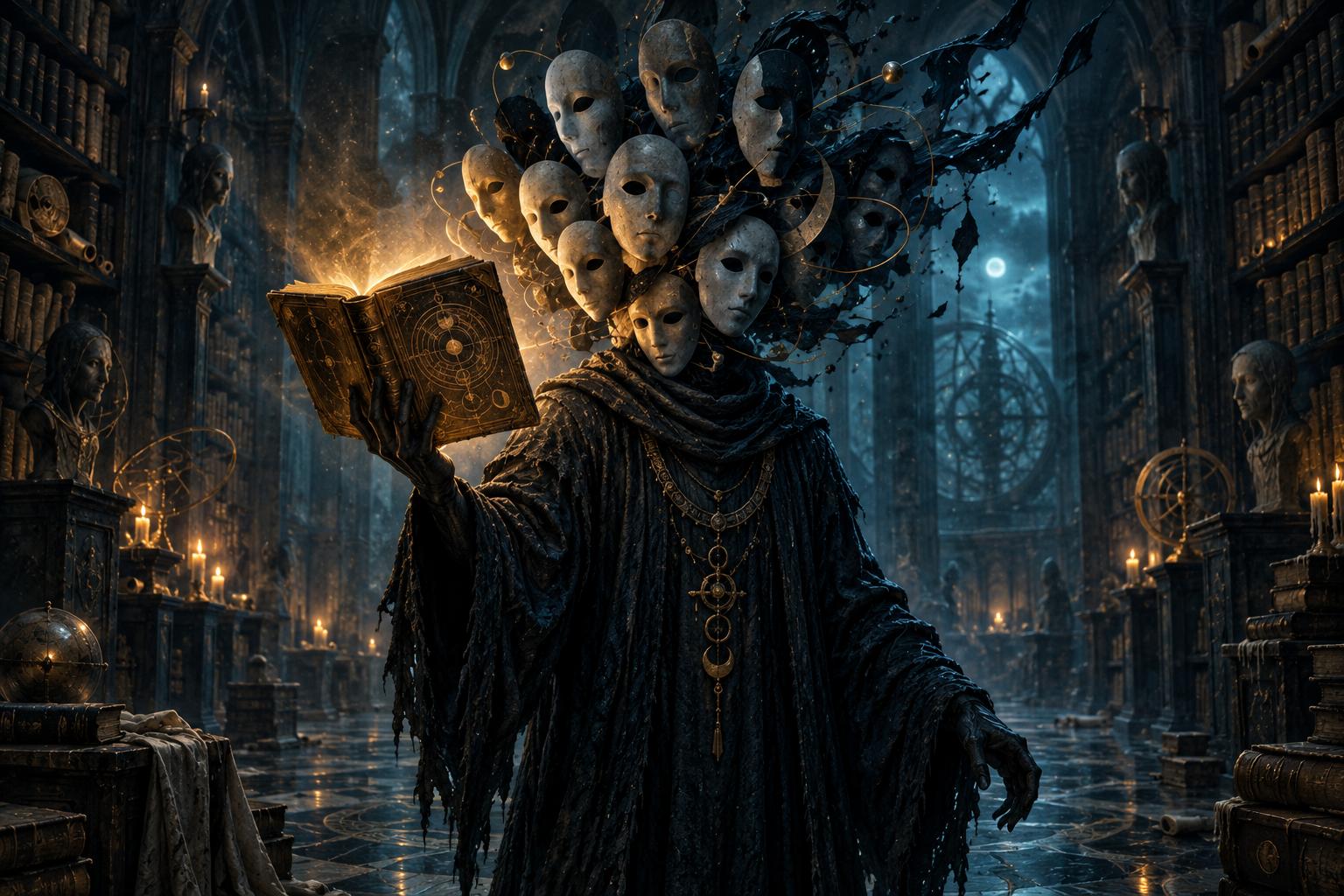
Dantalion demon: the Goetia's 71st spirit, a duke of 36 legions with many faces and a book. His sigil, offices, and why Weyer never listed him.
Quick answer: Dantalion is the seventy-first spirit of the Ars Goetia, a Great and Mighty Duke said to command thirty-six legions. The Lesser Key of Solomon describes the Dantalion demon as a man with many countenances, the faces of men and women, holding a book in his right hand. His offices are teaching all arts and sciences, revealing anyone's secret counsel, knowing and changing thoughts, causing love, and showing the likeness of any person in a vision. He is one of four Goetia spirits missing from Weyer's 1577 catalogue.
Related guides: the complete 72 demons of Solomon, ranks and legions in the Goetia, Vassago, the prince who finds lost things, Sitri, the prince who inflames love, names, offices and seals of the Goetia, how the Goetia manuscripts and editions differ.
| Spirit | Number and rank | Legions | Form in the Lemegeton | Chief offices |
|---|---|---|---|---|
| Dantalion | 71, Great Duke | 36 | A man with many faces of men and women, a book in his right hand | Teaches arts and sciences, reveals secrets, knows and changes thoughts, causes love, shows any person in a vision |
| Vassago | 3, Prince | 26 | Same nature as Agares; no distinct form given | Declares past and future, discovers hidden and lost things |
| Seere | 70, Prince | 26 | A beautiful man on a winged horse | Brings things to pass suddenly, carries things anywhere, reveals thefts and hidden treasure |
| Andromalius | 72, Earl | 36 | A man holding a great serpent | Returns stolen goods, exposes thieves and wickedness, finds hidden treasure |
Key Takeaways
Dantalion is the seventy-first of the seventy-two spirits catalogued in the Ars Goetia, the first book of the Lesser Key of Solomon. The text styles him a Great and Mighty Duke and gives him thirty-six legions of spirits, a large command for a duke; most dukes in the list have between twenty and forty. His position near the end of the catalogue is itself a clue to his history, since the final four spirits appear to have been added by the seventeenth-century compilers to complete the set of seventy-two.
His appearance is among the strangest in the Goetia. He shows himself in the form of a man with many countenances, all men’s and women’s faces, and he carries a book in his right hand. Where other spirits combine animal parts, Dantalion multiplies human ones, and the book marks him as a spirit of knowledge rather than force. No alternative or fairer form is mentioned.
His offices are entirely mental. He teaches all arts and sciences to anyone, declares the secret counsel of any person, knows the thoughts of all men and women and can change them at will, causes love, and shows the likeness of any person in a vision, wherever they are in the world. In a catalogue full of treasure-finders and warriors, Dantalion is the spirit of minds, secrets and persuasion, which is why modern readers often describe him as the Goetia’s psychologist.
The wording most readers know comes from the 1904 edition of the Goetia prepared by S. L. MacGregor Mathers and published by Aleister Crowley. The Dantalion entry is short, and each element deserves a closer look.
The phrase all men’s and women’s faces has been read in two ways: as a single body with many heads, or as a face that shifts continually. Artists have drawn both. The Lemegeton gives no number, so illustrations ranging from three faces to dozens are all equally faithful.
The book in his right hand is unexplained but fits the teaching office. Several Goetia spirits carry objects that signal their function, such as Vapula’s lion form for learning or Marbas’s mechanical skill, and Dantalion’s book places him among the teachers.
The seal printed by Mathers is an open, asymmetrical figure built from a long horizontal stroke with looped and hooked terminals, a pair of small circles, and short branching lines above and below, giving the impression of a cursive signature. As with every seal in the Goetia it is a geometric mark, not a portrait; the guide to Goetia names, offices and seals explains how such marks were understood.
Does this touch your own situation? Many readers come to these pages because something in their home, dreams or family feels unexplained. Reading history helps, but it cannot look at your specific case.
Consult the Sheikh Private, confidential, and free to ask.
Johann Weyer’s Pseudomonarchia Daemonum, printed in 1577 as an appendix to his De Praestigiis Daemonum, is the oldest published version of the spirit catalogue, and it lists sixty-nine spirits, not seventy-two. Dantalion is not among them. Neither are Vassago, Seere and Andromalius. When the Lemegeton took shape in English manuscripts of the mid-seventeenth century, the compilers added these four to reach seventy-two, a number with Solomonic and astrological resonance that matched the seventy-two names of God in Kabbalistic tradition and the seventy-two quinances of the zodiac.
Reginald Scot’s 1584 English translation of Weyer in The Discoverie of Witchcraft therefore has no Dantalion either, and Jacques Collin de Plancy’s Dictionnaire Infernal of 1818, which drew its Goetia material from Weyer, has no entry for him. The 1863 edition with Louis Le Breton’s engravings illustrates many spirits, but Dantalion is not one of them, so there is no nineteenth-century plate to fix his image the way Le Breton’s plates fixed Bune or Buer.
This absence matters for readers tracing the tradition. Every description of Dantalion rests on the Lemegeton manuscripts and the Mathers edition; there is no older layer to compare. Where the four added spirits came from is unknown. Some scholars suspect the compilers drew them from other manuscripts now lost, others that they were composed to fill the gaps. The article on manuscript and printed Goetia texts traces the editions in detail.
The four spirits absent from Weyer make a natural group, and comparing them shows what the seventeenth-century compilers wanted to add. Vassago, placed third in the list, declares past and future and finds lost things. Seere, the seventieth, brings things to pass suddenly and carries goods anywhere. Andromalius, the seventy-second, returns stolen property and exposes thieves. Dantalion, between Seere and Andromalius, handles knowledge, secrets and thought. Together they fill practical needs that the older list covered unevenly: finding, fetching, recovering and persuading.
Within the wider catalogue, Dantalion’s offices overlap with several older spirits. Gusion and Purson tell past, present and future; Sitri and Zepar are said to cause love; Foras and Vapula teach sciences; Dantalion’s claim to show anyone’s likeness in a vision resembles the scrying offices attributed elsewhere. What is distinctive is the concentration. No other single spirit is given quite so complete a command over what people know, think and feel, and no other is described through the image of many faces, an image that seems to picture the many minds he can read.
Students of the Goetia sometimes use the table above to argue that the four late additions share a more polished, literary quality than the older entries. Whether or not that holds, Dantalion’s entry reads as the work of a compiler who understood the list as a system and wanted it to end with spirits of mind and justice rather than with another treasure-finder. The full set is laid out in the complete list of the 72 demons.
Because Dantalion appears only in the late sources, modern writing about him contains more invention than usual. A few points are worth correcting. He has no documented appearance in any grimoire before the seventeenth century, so claims that he is an ancient or Mesopotamian spirit are unfounded. His name has no agreed etymology; suggestions linking it to Greek or Latin roots are guesses, and the Lemegeton itself offers none.
He is not depicted in the Dictionnaire Infernal, so any image presented as the historical portrait of Dantalion is modern. The many faces are not numbered in the text, and the book is not described, which means that the detailed artwork found online represents an artist’s choice rather than the source. Finally, the Goetia does not describe him as a demon of knowledge in any grand sense; it describes a list of services, of which teaching arts and sciences is one.
Readers should also separate the Goetia’s Dantalion from the many personalities attached to the name by twentieth-century and later occult authors, who assigned him colors, planets, days and preferences without textual basis. Those attributions belong to the history of modern occultism, not to the Lesser Key of Solomon.
Dantalion’s striking description has made him unusually popular in Japanese media. He is a lead character in Devils and Realist, a manga by Madoka Takadono and Utako Yukihiro adapted into an anime in 2013, where he appears as a grand duke of Hell competing for the throne. The light novel and anime series The Mystic Archives of Dantalian takes its name from the spirit and turns the book in his hand into a library of forbidden volumes. He also appears as a demon in the Shin Megami Tensei game family, which draws on the full Goetia roster.
Western uses are fewer but growing. The name turns up in role-playing supplements, in occult-themed webcomics and in music, usually as shorthand for a many-faced or mind-reading entity. In almost every case the modern version keeps the many faces and the book and expands the mind-reading office into full telepathy or mind control, which the Lemegeton’s brief phrasing invites but does not quite say.
These appearances explain most searches for the Dantalion demon today. Readers who meet the name in a manga or game want to know whether it has an older source. It does, though the source is younger and thinner than they may expect: a few lines in a seventeenth-century compilation, fixed in print only in 1904.
Dantalion is a useful test case for reading the Goetia critically because his textual history is so short. There is no Weyer entry, no Scot translation, no de Plancy article and no Le Breton plate. The tradition consists of the Lemegeton manuscripts in the British Library and elsewhere, the Mathers and Crowley edition of 1904, and the later editions that depend on it, including Joseph Peterson’s annotated Lemegeton of 2001, which is the best modern scholarly text.
A reader who wants to know what the sources say should therefore go directly to a good edition of the Goetia and read the entry, then compare it with the entries for Vassago, Seere and Andromalius to see the late additions as a group. Anything beyond that, including personality profiles, correspondences and reports of personal experience, is modern commentary and should be labeled as such.
This site describes the Goetia as history and folklore. It does not provide ritual instructions, and it does not claim that any spirit, seal or ceremony produces a result. The historical Dantalion is a figure in a catalogue, interesting for what his entry reveals about how seventeenth-century compilers imagined knowledge, secrecy and the reading of minds, and for the many-faced image that has outlived the books that invented it.
Still have a question about your own experience? Describe what you are seeing, feeling or dreaming, and when it started. The Sheikh reads every message personally and replies in private.
Have a question of your own? Dantalion’s many faces have long stood for the way people read, hide and change their thoughts. If you are turning over a question about your own feelings or choices, a Full Personal Reading with our partner PuraTarot offers thoughtful personal reflection. Join the free Djinn Guide newsletter and, once you confirm, you will unlock a 50% code for your first reading.
Further reading
As an Amazon Associate we earn from qualifying purchases.
Dantalion is the seventy-first spirit of the Ars Goetia, a Great and Mighty Duke who commands thirty-six legions. The Lesser Key of Solomon describes him as a man with many male and female faces holding a book, who teaches arts and sciences, reveals secrets, knows and changes thoughts, causes love, and shows the likeness of any person in a vision.
The seal in the 1904 Mathers edition is an open, asymmetrical figure made of a long horizontal stroke with looped and hooked ends, two small circles, and short branching lines above and below, resembling a cursive signature. It is a geometric mark of the kind used for all seventy-two spirits, not a picture of the demon.
The Lemegeton gives no explanation; it simply says he appears with all men's and women's faces. Readers usually connect the image with his offices of knowing and changing the thoughts of everyone and of showing any person's likeness, so the many faces picture the many minds he is said to read.
No. Weyer's 1577 catalogue lists sixty-nine spirits, and Dantalion, Vassago, Seere and Andromalius are absent. The seventeenth-century Lemegeton manuscripts added these four to reach seventy-two. Because de Plancy's Dictionnaire Infernal relied on Weyer, Dantalion has no entry or illustration there either.
He is a lead character in the manga and anime Devils and Realist, the namesake of the light novel series The Mystic Archives of Dantalian, and a demon in the Shin Megami Tensei games. These works keep his many faces and his book while expanding his mind-reading office into outright telepathy.
Disclaimer
This article describes the Dantalion demon as a figure in the history of European grimoires and modern media. Beliefs about spirits are presented as beliefs, not endorsed, and no ritual instructions or outcomes are offered.
Did this guide help you understand the subject? Rate it and share your honest opinion to help other readers. Every review is checked by our editors before it appears.
There are no reviews yet. Be the first one to write one.


Sheikh Youssef
Tayeb El Merzouki
For inquiries about personalized spiritual work, private rituals, and traditional talismans, connect directly with Sheikh Youssef Tayeb El Merzouki.
Chat on WhatsApp