







Join Djinn Guide: Get 50% Off a Personal Reading
Get new guides to jinn, folklore and occult history. Confirm your subscription to unlock a 50% code for a first personal reading with our partner PuraTarot.
Discover the unseen
What is Kabbalah? Its meaning, core beliefs, key texts like the Zohar, its history from Provence to Safed, and how it differs from Hermetic Qabalah.
Quick answer: Kabbalah is the Jewish mystical tradition that developed in medieval Provence and Spain and reached its classic form in the Zohar of the late thirteenth century. The word is Hebrew for received tradition. Its central teaching is that the hidden, infinite God, the Ein Sof, reveals itself through ten emanations called sefirot, and that the Torah, read symbolically, describes that inner life of the divine. Kabbalah is a dimension of Judaism rather than a separate religion, though Christian and occult adaptations later borrowed its symbols.
Related guides: the Kabbalah Tree of Life and the ten sefirot, Hermeticism and the Hermetic tradition, Agrippa's Three Books of Occult Philosophy, what the occult means, the 72 angels of the Shem HaMephorash, John Dee and Renaissance magic.
| Text | Date and place | Authorship | What it contributes |
|---|---|---|---|
| Sefer Yetzirah (Book of Formation) | Between the 3rd and 6th centuries CE; date debated | Anonymous; later attributed to Abraham | The 22 Hebrew letters and ten sefirot as the tools of creation |
| Sefer ha-Bahir (Book of Brightness) | Late 12th century, Provence | Anonymous; attributed to Rabbi Nehunya ben ha-Kanah | First clear description of the sefirot as divine attributes |
| Zohar (Book of Splendor) | c. 1280 to 1290, Castile | Moses de León; attributed to Rabbi Shimon bar Yochai | The central text: a mystical commentary on the Torah in Aramaic |
| Pardes Rimmonim (Orchard of Pomegranates) | 1548, Safed | Moses Cordovero | Systematic summary of Kabbalah before Luria |
| Etz Chaim (Tree of Life) | Late 16th century, Safed | Chaim Vital, recording the teaching of Isaac Luria | Lurianic Kabbalah: contraction, shattering and repair |
| Tanya | 1796, Belarus | Shneur Zalman of Liadi | Kabbalah adapted for Hasidic daily life and ethics |
Key Takeaways
Kabbalah is the name given to the main stream of Jewish mysticism from the twelfth century onward. It is a body of teaching about the inner life of God, the structure of creation and the hidden meaning of the Torah, transmitted through texts, commentaries and teacher-to-student instruction. The word is Hebrew for something received, and kabbalists understood their doctrine as a tradition handed down from antiquity rather than as a new invention, even though historians can watch it emerge in specific places and decades.
At its center stands a distinction between God as utterly hidden and God as revealed. The hidden aspect is called the Ein Sof, without end, about which nothing can be said. The revealed aspect unfolds through ten sefirot, emanations or attributes such as wisdom, understanding, loving-kindness, judgment and kingship, arranged in a pattern later drawn as a tree. The Torah, on this view, is not only law and history but a coded account of how the sefirot relate to one another, and human action, especially the performance of the commandments, affects the harmony among them.
Kabbalah is therefore not a religion of its own. It is a way of understanding Judaism from the inside, practiced by rabbis and scholars who kept the same laws and prayers as their neighbors while reading them on a deeper level. The occult versions of Kabbalah that appear in Renaissance magic and modern esotericism are adaptations of this Jewish tradition, and the second half of this article explains how they differ.
The Hebrew root q-b-l means to receive, and in early rabbinic literature qabbalah referred simply to tradition. The Mishnah tractate Avot opens by saying that Moses received the Torah at Sinai and handed it on to Joshua, and the books of the Prophets and Writings were sometimes called qabbalah as distinct from the five books of Moses. The word did not mean mysticism at all.
In the thirteenth century, among the circles in Provence and Catalonia that produced the first sefirotic texts, qabbalah became the preferred name for their esoteric teaching. The choice was deliberate. By calling their doctrine received tradition, the early kabbalists claimed that it came from the prophets and sages and had been transmitted quietly ever since. Modern scholars read this as a strategy for legitimacy as much as a historical claim, but it explains why the Zohar was written in Aramaic and attributed to a second-century rabbi.
Jewish tradition also distinguishes the revealed Torah, nigleh, from the hidden Torah, nistar, and Kabbalah belongs to the hidden side. A medieval acronym, PaRDeS, lists four levels of interpretation: peshat (plain meaning), remez (hint), derash (homiletic meaning) and sod (secret). Kabbalah is the study of sod. When people ask what Kabbalah means, the most accurate short answer is this: the received, secret dimension of the Torah.
Does this touch your own situation? Many readers come to these pages because something in their home, dreams or family feels unexplained. Reading history helps, but it cannot look at your specific case.
Consult the Sheikh Private, confidential, and free to ask.
Kabbalah is not a creed with fixed articles, and different schools emphasize different ideas, but a handful of concepts recur in nearly every kabbalistic text.
The infinite, unknowable Godhead beyond all names and attributes. Kabbalists insist that Ein Sof cannot be described, only pointed toward, and that everything said about God in scripture refers to the sefirot rather than to Ein Sof itself.
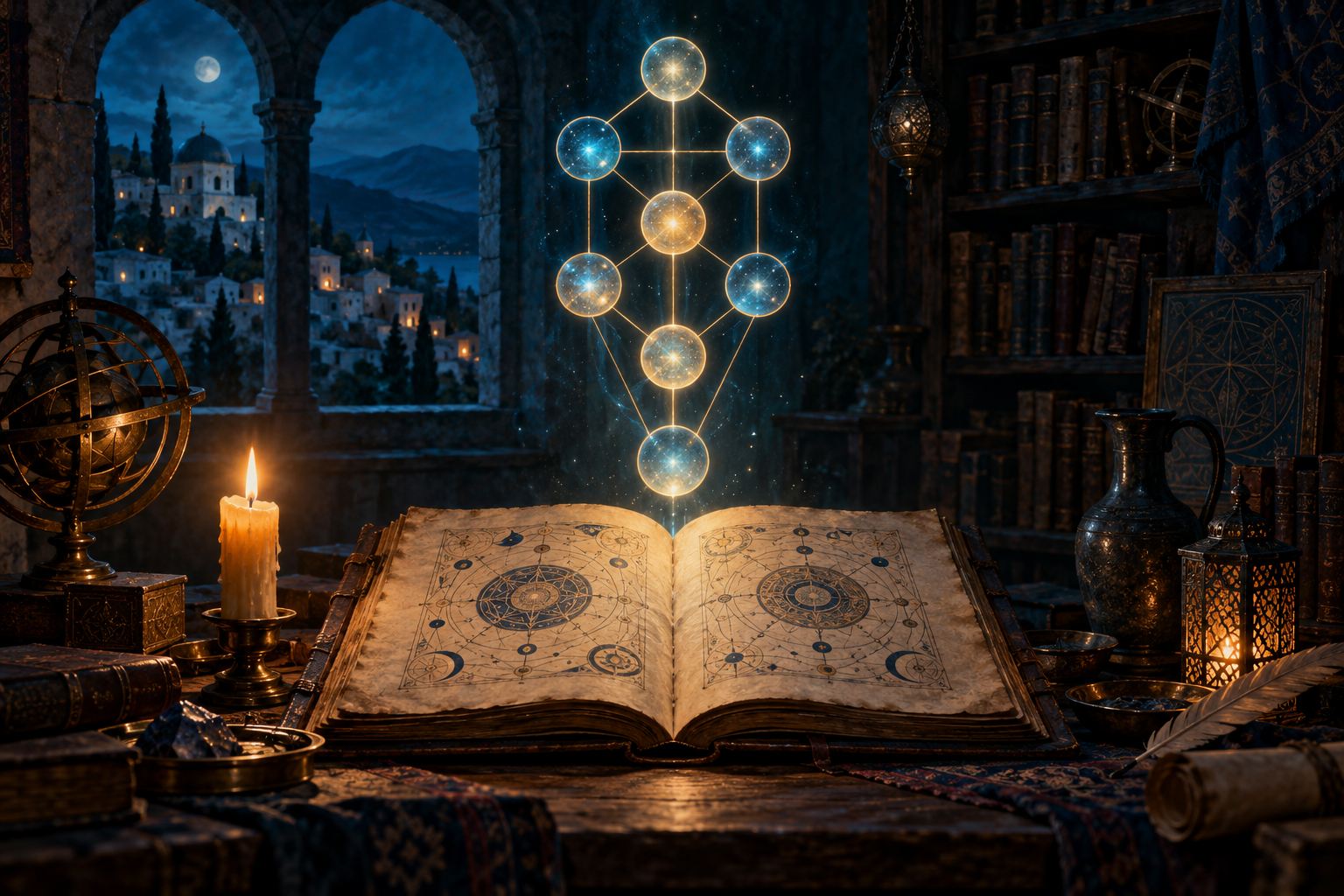
Keter, Chokhmah, Binah, Chesed, Gevurah, Tiferet, Netzach, Hod, Yesod and Malkhut: ten emanations through which the infinite becomes knowable and creation takes shape. Their arrangement as a diagram is the Tree of Life, and their interplay explains everything from divine mercy and judgment to the structure of the human soul.
Later Kabbalah describes four descending levels of reality, Atzilut (emanation), Beriah (creation), Yetzirah (formation) and Assiyah (action), with the full set of sefirot present in each. The scheme lets kabbalists speak of angels, souls and the physical world as stages of a single process.
The tenth sefirah, Malkhut, is identified with the Shekhinah, the divine presence, pictured in feminine terms and said to share the exile of Israel. The reunion of the Shekhinah with the higher sefirot is a central goal of prayer and the commandments.
In the teaching of Isaac Luria, God contracted to make room for creation, the vessels meant to hold the divine light shattered, and sparks of light fell into the world. Human beings repair the damage, tikkun, through sacred action. This myth gave Jewish life after the expulsion from Spain a cosmic meaning and remains the best-known kabbalistic idea.
Jewish mysticism is older than Kabbalah. Late antique Merkavah and Hekhalot texts describe visionary ascents to the divine throne, and the Sefer Yetzirah, composed sometime between the third and sixth centuries, already speaks of ten sefirot, though it means something closer to numbers than to divine attributes. Kabbalah proper begins with the Sefer ha-Bahir, which surfaced in Provence in the late twelfth century and treated the sefirot as aspects of God for the first time. Isaac the Blind in Provence and the circle at Gerona in Catalonia, which included the great commentator Nahmanides, developed these ideas in the early thirteenth century.
The decisive moment came in Castile in the 1280s, when Moses de León circulated the Zohar, a sprawling Aramaic commentary on the Torah presented as the teaching of Rabbi Shimon bar Yochai and his companions in the second century. Scholars since Gershom Scholem have attributed the bulk of the work to de León and his circle. At the same time Abraham Abulafia in Spain and Italy taught a different, meditative Kabbalah based on the permutation of Hebrew letters and divine names.
After the expulsion of the Jews from Spain in 1492, the center of Kabbalah shifted to Safed in Galilee, where Moses Cordovero wrote his systematic works and Isaac Luria, known as the Ari, taught the doctrines of contraction, shattering and repair that his student Chaim Vital recorded. Lurianic Kabbalah spread through the Jewish world, fueled the messianic movement around Sabbatai Zevi in 1665 and 1666, and shaped the Hasidic revival begun by the Baal Shem Tov in the eighteenth century. In the twentieth century Gershom Scholem made Kabbalah an academic field.
The spelling often signals the tradition. Kabbalah with a K usually means the Jewish tradition described above. Cabala with a C often refers to the Christian Cabala of the Renaissance, and Qabalah with a Q to the Hermetic or occult version used by modern magical orders. The distinctions are not rigid, but they are useful.
Christian Cabala began in 1486, when Giovanni Pico della Mirandola included kabbalistic theses among his nine hundred propositions and argued that Kabbalah proved the truth of Christianity. Johann Reuchlin’s De Arte Cabalistica of 1517 made the subject respectable among Christian scholars, and Cornelius Agrippa wove it into the third book of his Three Books of Occult Philosophy, where the sefirot, divine names and angelic orders sit beside planetary magic. The Jesuit Athanasius Kircher printed an influential version of the Tree of Life in 1652. From this point the Tree traveled on its own, detached from Jewish practice.
Hermetic Qabalah is the nineteenth- and twentieth-century development of that detached Tree. Eliphas Levi in the 1850s linked the twenty-two Hebrew letters to the tarot trumps, the Hermetic Order of the Golden Dawn made the Tree the master diagram of its system from 1888, and Aleister Crowley’s book 777 in 1909 tabulated correspondences among sefirot, planets, colors, perfumes and gods. These systems draw on Hermeticism, astrology and ceremonial magic as much as on the Zohar, and they treat the Tree as a universal map of consciousness rather than as a reading of the Torah. Jewish kabbalists generally do not recognize them as Kabbalah, and the practical magic they encourage is something traditional Kabbalah mostly warned against.
Several ideas about Kabbalah circulate widely without much support in the sources. Kabbalah is not a separate religion that one can join; it is studied within Judaism, and the modern organizations that market it to a general public are recent and controversial within the Jewish world. Red string bracelets, celebrity endorsements and bottled water are products of the past few decades, not of the Zohar.
Kabbalah is also not primarily magic. There is a strand called practical Kabbalah, kabbalah ma’asit, concerned with amulets, divine names and the summoning of angels, and it has a real history, including an influence on the Solomonic grimoires described in the guide to grimoires and their meaning. But the main tradition, speculative Kabbalah, is about understanding God and sanctifying ordinary religious life, and its leading teachers repeatedly cautioned against the practical kind.
Finally, the Zohar was not written in the second century, the sefirot are not gods, and the Tree of Life diagram is a late visual aid rather than an ancient relic. These corrections replace legends about Kabbalah with its actual history, which is better documented and more interesting.
Begin with a reliable overview rather than with the Zohar itself. Gershom Scholem’s Major Trends in Jewish Mysticism, first published in 1941, remains the standard introduction, and Moshe Idel’s Kabbalah: New Perspectives offers the main scholarly alternative. For the Zohar, the Pritzker edition translated by Daniel Matt and colleagues is the first complete, annotated English version and is the text to use for serious reading.
When reading older or occult material, check the lineage. A nineteenth-century book that calls itself Kabbalah may be drawing on Kircher, Levi or the Golden Dawn rather than on any Jewish source, and its attributions of planets, colors and tarot cards to the sefirot are Hermetic inventions. Those inventions have their own history and value, but they should be labeled correctly. The same caution applies to websites that present Lurianic myth, Hasidic ethics and occult correspondences as a single seamless teaching.
This site treats Kabbalah as a subject of religious history and comparative study. It describes beliefs as beliefs, it does not offer practical or magical instruction, and it makes no claims about what any practice achieves. Read with that framing, the question what is Kabbalah opens onto eight centuries of texts, debates and images that remain among the richest in the history of religion.
Still have a question about your own experience? Describe what you are seeing, feeling or dreaming, and when it started. The Sheikh reads every message personally and replies in private.
Curious how this applies to your own life? Kabbalah has always been about the search for meaning beneath what we can see. If that search feels personal for you right now, a Full Personal Reading with our partner PuraTarot offers a quiet space to reflect on your own questions. Join the free Djinn Guide newsletter and, once you confirm, you will unlock a 50% code for your first reading.
Further reading
As an Amazon Associate we earn from qualifying purchases.
Kabbalah is the mystical tradition within Judaism. It teaches that the infinite, hidden God, called Ein Sof, is revealed through ten emanations called sefirot, and that the Torah, read symbolically, describes this divine structure. The word means received tradition in Hebrew, and its central text is the Zohar.
No. Kabbalah is a dimension of Judaism, studied by people who keep Jewish law and prayer, not a separate faith. Modern organizations that present Kabbalah as a standalone spiritual path for anyone are recent and are not recognized as traditional Kabbalah by most Jewish authorities.
The unknowable Ein Sof; the ten sefirot through which God is revealed; the four worlds of emanation, creation, formation and action; the Shekhinah as the divine presence in exile; and, in Lurianic Kabbalah, the story of contraction, the shattering of the vessels and tikkun, the repair of the world through sacred action.
Kabbalah is the Jewish tradition based on the Torah and the Zohar. Hermetic Qabalah is a modern occult system, developed by Eliphas Levi, the Golden Dawn and Aleister Crowley, that uses the Tree of Life as a universal map and links it to tarot, astrology and ceremonial magic. Jewish kabbalists do not regard the occult version as Kabbalah.
The Zohar presents itself as the teaching of Rabbi Shimon bar Yochai in the second century, but scholars since Gershom Scholem attribute most of it to Moses de León, who circulated it in Castile in the 1280s. Traditional Jewish readers continue to accept the older attribution; the text is central either way.
Disclaimer
This article describes Kabbalah and its Christian and Hermetic adaptations as subjects of religious and intellectual history. Beliefs are presented as the traditions hold them, not endorsed, and no practical or magical instruction is given.
Did this guide help you understand the subject? Rate it and share your honest opinion to help other readers. Every review is checked by our editors before it appears.
There are no reviews yet. Be the first one to write one.


Sheikh Youssef
Tayeb El Merzouki
For inquiries about personalized spiritual work, private rituals, and traditional talismans, connect directly with Sheikh Youssef Tayeb El Merzouki.
Chat on WhatsApp


