





Join Djinn Guide: Get 50% Off a Personal Reading
Get new guides to jinn, folklore and occult history. Confirm your subscription to unlock a 50% code for a first personal reading with our partner PuraTarot.
Discover the unseen
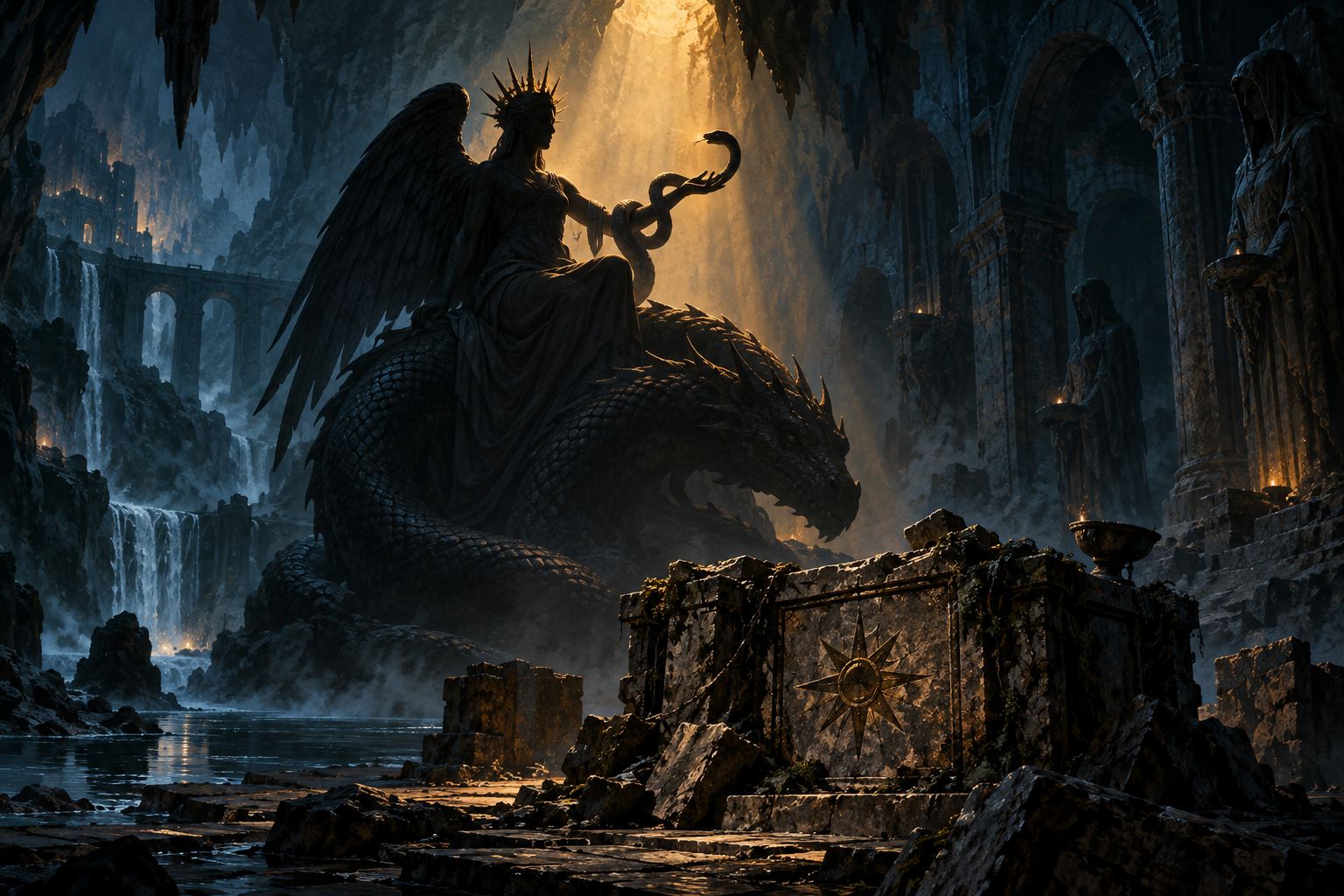
Astaroth demon explained: the great duke of the Ars Goetia, his description and sigil, the link to the goddess Astarte, and his role in later grimoires.
Quick answer: The Astaroth demon is the twenty-ninth spirit of the Ars Goetia, described as a great duke who appears as a hurtful angel riding an infernal dragon, carrying a viper, and commanding 40 legions. The text says he answers questions about past, present, and future, teaches the liberal sciences, and explains the fall of the spirits. His name descends from Ashtoreth, the Hebrew Bible's form of the Near Eastern goddess Astarte, whom medieval demonology transformed into a male devil.
Related guides: Ars Goetia names, offices, and seals, the full list of 72 demons, Goetia ranks and demon hierarchy, what a sigil is, Asmodeus, king of the Goetia, Beelzebub in the Bible and grimoires.
| Source | Date | Role or rank | Key details |
|---|---|---|---|
| Hebrew Bible (as Ashtoreth) | 1st millennium BCE | Goddess of the Sidonians | Worship condemned in Judges 2:13 and 1 Kings 11:5; not a demon |
| Book of Abramelin | 15th-17th century mss | One of eight sub-princes | Listed as Astarot beside Magot, Asmodee, Belzebud, Oriens, Paimon, Ariton, Amaimon |
| Pseudomonarchia Daemonum (Weyer) | 1577 | Great duke | Rides a dragon, holds a viper, foul breath; 40 legions |
| Ars Goetia | 17th century | Duke, spirit 29 | Hurtful angel on a dragon; teaches sciences; tells how spirits fell; sigil given |
| Michaelis, Admirable History | 1612 | Prince of accusers | Placed among the Thrones; said to tempt to idleness |
| Grand Grimoire | 18th century | Grand duke | Third of the infernal triad with Lucifer and Beelzebub |
| Dictionnaire Infernal (de Plancy) | 1818; illustrated 1863 | Grand duke and treasurer | Le Breton engraving: winged man with a serpent riding a beast |
Key Takeaways
Astaroth is one of the best-known names in Western demonology, and almost everything said about him comes from a handful of grimoires. In the Ars Goetia, the first book of the Lesser Key of Solomon, he is the twenty-ninth of 72 spirits and holds the rank of duke, which the text often strengthens to great and mighty duke. He is described as appearing in the form of a hurtful angel seated on an infernal beast like a dragon, with a viper in his right hand.
The Goetia gives him a set of offices. He answers truly about things past, present, and to come, reveals secrets, declares how the spirits fell and the reason for his own fall, and makes men knowing in the liberal sciences. He commands 40 legions. The entry also carries a warning: his breath is noxious, and the operator is told to keep him at a distance and hold a ring before the face, a detail borrowed from the Solomonic tradition of the ring of power.
Behind the grimoire figure stands a much older name. Astaroth is a demonized version of Ashtoreth, the Hebrew Bible’s spelling of the goddess Astarte, and the long path from Near Eastern goddess to European duke of hell is the real story of this demon. The sections below follow that path and then return to the Goetia, the sigil, and the later books that gave Astaroth his high rank. For the full catalog, see our guide to the Ars Goetia.
Astarte was a major goddess of the Phoenicians and Canaanites, associated with love, fertility, and war, and related to the Mesopotamian Ishtar. The Hebrew Bible refers to her as Ashtoreth, and the plural Ashtaroth is used for goddesses in general. Judges 2:13 says the Israelites forsook God and served Baal and the Ashtaroth; 1 Kings 11:5 and 11:33 record that Solomon in his old age followed Ashtoreth the goddess of the Sidonians; 1 Samuel 31:10 places Saul’s armor in a temple of Ashtaroth.
Many scholars hold that the Hebrew vowels of Ashtoreth were deliberately altered to echo the word boshet, shame, a way of mocking a foreign deity in the written text. Whatever the mechanism, the biblical passages make Ashtoreth a byword for idolatry. Early Christian writers inherited that judgment and, following the general rule that the gods of the nations were demons, treated the name as belonging to a fallen spirit.
The shift in gender came gradually. Medieval Latin texts, working from the plural form Astaroth, treated the name as a single being and, because demons in that literature were assumed to be male, made him one. By the time the name reached the grimoires of the Renaissance, nothing of the goddess remained except the word itself. The transformation is a textbook case of how demonology absorbed the deities of older religions, and it links Astaroth to the similar careers of Baal and Beelzebub.
Does this touch your own situation? Many readers come to these pages because something in their home, dreams or family feels unexplained. Reading history helps, but it cannot look at your specific case.
Consult the Sheikh Private, confidential, and free to ask.
The Goetia entry is short but dense, and it is worth taking in parts. The description below follows the standard text as printed in the Mathers and Crowley edition of 1904 and in Joseph Peterson’s manuscript-based edition of 2001, which agree on all essentials. Each part of the entry has its own history, and small differences between manuscripts are noted where they matter.
Astaroth appears as a hurtful or foul angel riding an infernal dragon-like beast, with a viper held in the right hand. The image combines the fallen angel of Christian tradition with the dragon of Revelation and the serpent of Genesis, three symbols of evil fused into one figure. Artists from the nineteenth century onward have drawn him this way, usually with wings and a crown.
His offices are those of a teacher. He answers questions about the past, present, and future, discovers secrets, and makes the operator skilled in all the liberal sciences, the medieval curriculum of grammar, logic, rhetoric, arithmetic, geometry, music, and astronomy. Most distinctive is his willingness to explain the fall of the spirits and to claim that he himself was unjustly punished. Weyer’s 1577 version has him say he did not fall of his own will.
He is a great duke with 40 legions, a middling retinue in a book where kings command up to 200. The warning about his breath, found in Weyer and the Goetia alike, is unusual; few other spirits carry a physical hazard. The text tells the operator to hold a magical ring near the face as protection, a detail we describe as part of the historical text, not as instruction. Where dukes sit among the other ranks is explained in our article on the Goetia demon hierarchy.
Every Goetia spirit has a seal, and Astaroth’s is among the most frequently reproduced. In the manuscripts it is a symmetrical figure built from curved lines and small circles, which some viewers compare to a stylized insect or a pair of wings. The Mathers and Crowley edition redrew it cleanly, and that version is the one copied onto posters, pendants, and album covers today. Peterson’s edition reproduces the manuscript forms, which vary in detail from copy to copy.
The Goetia describes the seals as the means by which the spirits are said to be bound and recognized, and instructs that they be worn or displayed during an operation. For the purposes of history, the important point is that the seals are the Goetia’s main contribution to the older list it inherited from Weyer, who gave no seals at all. The sigils made the 72 spirits visually distinct and are the reason the Goetia, rather than the Pseudomonarchia, became the standard reference. How such figures were built is covered in our explainer on what a sigil means.
The Goetia was not the first or the last book to list Astaroth. Johann Weyer’s Pseudomonarchia Daemonum of 1577 contains nearly the same entry, including the dragon, the viper, the breath, and the 40 legions, and Reginald Scot translated it into English in 1584. Weyer is the source of the Goetia’s description, which makes Astaroth one of the spirits whose literary form was fixed before the Lemegeton existed.
The Book of Abramelin, a German text surviving in manuscripts from the fifteenth to the eighteenth century and translated by Mathers in 1898, gives Astaroth a higher place. There he is one of eight sub-princes, listed as Astarot, who serve under four principal spirits and command many servants, often in pairs with Asmodeus. The eighteenth-century French Grand Grimoire raises him higher still, naming Lucifer as emperor, Beelzebub as prince, and Astaroth as grand duke, the three superior spirits of its infernal government.
Church demonology added its own layer. The exorcist Sebastien Michaelis, writing in 1612 after a famous possession case in Aix-en-Provence, placed Astaroth among the order of Thrones as the prince of accusers and inquisitors who tempts people to idleness, opposed by Saint Bartholomew. The result is that Astaroth holds a different rank in nearly every source, from duke to sub-prince to one of three rulers of hell, which is typical of how grimoire hierarchies disagree.
The image most people associate with Astaroth comes from the Dictionnaire Infernal of Jacques Collin de Plancy, first published in 1818 and illustrated in the 1863 edition with engravings by Louis Le Breton. Le Breton’s Astaroth is a crowned, naked man with feathered wings, holding a serpent and riding a wolf-like beast with a dragon’s tail. De Plancy calls him a very powerful grand duke and treasurer of hell, who knows the past and future and teaches the sciences, following the Goetia and Weyer.
Because the engraving is in the public domain, it is reproduced constantly, and it has shaped Astaroth’s appearance in video games, comics, and animation, where the name is used for characters ranging from hulking golems to elegant aristocrats. In games such as the Soulcalibur series, Astaroth is a giant axe-wielding brute, far from the Goetia’s learned duke. Few of these borrowings keep any trace of the goddess, the dragon, or the liberal sciences.
The first misunderstanding is biblical. Astaroth does not appear in the Bible as a demon. The Bible names Ashtoreth, a goddess, and Ashtaroth, a city in Bashan and a plural term for goddesses. The demon is a later construction, and any claim that scripture describes a devil named Astaroth confuses the medieval reading with the text itself.
The second is gender. Some modern writers present Astaroth as a female demon or as the goddess Astarte in disguise, reversing the historical process. The grimoires are uniform in treating Astaroth as male, and the Goetia uses masculine pronouns throughout. Readers who want the goddess should read about Astarte and Ishtar directly rather than through the demon.
The third concerns rank and power. Because the Grand Grimoire makes Astaroth one of three rulers of hell, he is sometimes described as a king of the Goetia. In the Goetia he is a duke, and the nine kings are a separate group. The fourth is the sigil: it is a figure from a seventeenth-century manuscript tradition, not an ancient symbol, and the many versions sold online differ because the manuscripts themselves differ. None of the texts described here are instructions, and this site does not provide any.
Begin with the biblical references to Ashtoreth, which are brief and easy to find, and read them alongside a reference article on Astarte to see what the goddess was before demonology claimed the name. Then read Weyer’s entry in the Pseudomonarchia Daemonum, available in translation, and compare it with the Goetia entry in Peterson’s edition. The two are nearly identical, and seeing that will show you how the grimoire tradition copied rather than invented.
After that, the later sources fall into place. The Grand Grimoire and Michaelis show how a single name could be promoted or reassigned to suit a new system. The Dictionnaire Infernal and Le Breton’s engraving explain the modern image. Keeping these sources in chronological order is the single most useful habit for reading about any Goetic spirit, and the ordered list of the 72 demons of Solomon gives the Goetia layer for all of them.
Still have a question about your own experience? Describe what you are seeing, feeling or dreaming, and when it started. The Sheikh reads every message personally and replies in private.
Drawn to this story for a reason? The long road from the goddess Astarte to a Goetia duke shows how one name can carry many meanings over time. If this history sparks a question about your own life, a Full Personal Reading with our partner PuraTarot offers a calm, personal perspective. Join the free Djinn Guide newsletter and, once you confirm, you will unlock a 50% code for your first reading.
Further reading
As an Amazon Associate we earn from qualifying purchases.
Astaroth is the twenty-ninth spirit of the Ars Goetia, a great duke who commands 40 legions. The text describes him as a hurtful angel riding an infernal dragon with a viper in his hand. He is said to answer questions about the past, present, and future, teach the liberal sciences, and explain how the spirits fell.
Historically the names are linked but the figures are not the same. Astarte was a Phoenician and Canaanite goddess, called Ashtoreth in the Hebrew Bible. Medieval demonology treated the name as that of a male demon, and the grimoires inherited that figure. Astaroth the demon retains nothing of the goddess except the word.
No. The Bible names Ashtoreth, the goddess of the Sidonians, whose worship is condemned in Judges 2:13 and 1 Kings 11:5, and Ashtaroth as a city and a plural for goddesses. It never describes a demon called Astaroth. That figure first appears in medieval and Renaissance demonology and the grimoires.
The Goetia seal of Astaroth is a symmetrical figure of curved lines and small circles that some compare to wings or an insect. The Mathers and Crowley edition of 1904 printed a cleaned-up version that is now widely copied, while manuscript versions reproduced by Joseph Peterson vary in detail from copy to copy.
It depends on the source. The Ars Goetia and Weyer make him a great duke with 40 legions. The Book of Abramelin lists him as one of eight sub-princes. The Grand Grimoire names him grand duke, one of three rulers with Lucifer and Beelzebub. Michaelis places him among the Thrones as prince of accusers.
Disclaimer
This article describes grimoire literature, biblical references, and demonological writings as historical and cultural material. The spirits, ranks, and claims described are reported, not endorsed, and nothing here constitutes ritual instruction or promises any outcome.
Did this guide help you understand the subject? Rate it and share your honest opinion to help other readers. Every review is checked by our editors before it appears.
There are no reviews yet. Be the first one to write one.


Sheikh Youssef
Tayeb El Merzouki
For inquiries about personalized spiritual work, private rituals, and traditional talismans, connect directly with Sheikh Youssef Tayeb El Merzouki.
Chat on WhatsApp