




Join Djinn Guide: Get 50% Off a Personal Reading
Get new guides to jinn, folklore and occult history. Confirm your subscription to unlock a 50% code for a first personal reading with our partner PuraTarot.
Discover the unseen
The Asmodeus demon explained: his role in the Book of Tobit and Sarah's story, the Talmud's Ashmedai, the Testament of Solomon, and his rank in the Goetia.
Quick answer: The Asmodeus demon first appears in the Book of Tobit, a Jewish text of around the third to second century BCE, where he kills the seven husbands of a young woman named Sarah before the angel Raphael drives him away. Jewish legend later made him Ashmedai, king of demons, who clashed with Solomon. The Testament of Solomon and the Goetia both include him; in the Goetia he is Asmoday, the thirty-second spirit, a king who commands seventy-two legions.
Related guides: the Testament of Solomon explained, full list of the 72 Goetia demons, King Solomon and the demons, shedim and Ashmedai in Jewish lore, Goetia ranks and hierarchy, Ars Goetia names and seals.
| Source | Approximate date | How Asmodeus appears |
|---|---|---|
| Book of Tobit | 3rd to 2nd century BCE | Demon who kills Sarah's seven husbands; repelled by burning fish liver and heart; bound in Egypt by Raphael |
| Testament of Solomon | 1st to 5th century CE | Demon of lust and discord, son of a human mother and an angel; thwarted by Raphael and the smoke of a fish's liver and gall |
| Babylonian Talmud (Gittin 68a to 68b) | Compiled c. 500 CE | Ashmedai, king of demons, captured by Benaiah for Solomon; later seizes Solomon's throne |
| Binsfeld's classification | 1589 | Listed as the demon of lust among the seven deadly sins |
| Weyer's Pseudomonarchia Daemonum | 1577 | Sidonay or Asmoday, a great king with three heads, riding a dragon |
| Ars Goetia (Lemegeton) | 17th century; Mathers edition 1904 | Asmoday, 32nd spirit, king, 72 legions; teaches sciences and reveals treasure |
| Le Diable boiteux (Lesage) | 1707 | Comic limping devil who lifts rooftops to reveal secrets |
Key Takeaways
Asmodeus is a demon whose story runs through Jewish, Christian and European occult literature for more than two thousand years. He first appears in the Book of Tobit, a Jewish narrative written in the Hellenistic period and included in the Catholic and Orthodox Old Testament as a deuterocanonical book. There he is a jealous spirit who kills the seven successive husbands of Sarah, the daughter of Raguel, on their wedding nights, until the angel Raphael intervenes.
From that beginning the character grew. Rabbinic legend made him Ashmedai, king of the demons, a figure of great power who was nevertheless outwitted by King Solomon. The Testament of Solomon, a Greek text of the early Common Era, has Solomon interrogate him and extract the secret of his weakness. Medieval and Renaissance demonologists placed him in their hierarchies, and Peter Binsfeld in 1589 assigned him to lust in a scheme matching demons to the seven deadly sins. Finally, the seventeenth-century Ars Goetia catalogued him as Asmoday, a king commanding seventy-two legions.
What holds these versions together is a consistent personality: Asmodeus is tied to desire, marriage and discord, to hidden treasure and knowledge, and to a mixture of menace and courtliness. He is recognizable precisely because so many traditions kept telling stories about him.
The Book of Tobit, probably composed in Aramaic or Hebrew around the third or second century BCE and preserved in Greek, tells of two families in distress. Tobit, a pious Israelite in exile in Nineveh, has gone blind. In Media, his kinsman Raguel has a daughter, Sarah, who has been married seven times, and each husband has died in the bridal chamber, killed by the demon Asmodeus before the marriage could be consummated. Sarah is mocked by her servants and prays for death.
God sends the angel Raphael, disguised as a traveler named Azariah, to accompany Tobit’s son Tobias on a journey. On the way, Tobias catches a large fish, and Raphael tells him to keep its heart, liver and gall. When Tobias marries Sarah, he burns the heart and liver on the embers of incense, and the smoke drives Asmodeus away. The demon flees to the farthest parts of Egypt, where Raphael binds him. The fish’s gall later cures Tobit’s blindness.
This is the only appearance of Asmodeus in any biblical canon, and it is why the phrase “Asmodeus in the Bible” leads here. Readers of Protestant Bibles, which exclude Tobit, will not find him at all. The story is important for later tradition in two ways: it fixed Asmodeus as a demon of marriage and desire, and it supplied the detail of the fish smoke that the Testament of Solomon would repeat centuries later.
Does this touch your own situation? Many readers come to these pages because something in their home, dreams or family feels unexplained. Reading history helps, but it cannot look at your specific case.
Consult the Sheikh Private, confidential, and free to ask.
The most widely accepted etymology connects Asmodeus with Aeshma, the demon of wrath in Zoroastrian tradition. In Avestan, aeshma daeva means “the demon Aeshma” or “demon of wrath,” and the Book of Tobit’s setting in Persian-ruled Media and Nineveh makes a Persian borrowing plausible. The Greek form Asmodaios and the Hebrew and Aramaic Ashmedai both fit this derivation reasonably well.
Some scholars have proposed alternatives. One links the name to the Hebrew root shamad, meaning to destroy, which would make Ashmedai “the destroyer.” Another sees a folk etymology at work in the Talmud, where the name is sometimes explained in Hebrew terms even if its origin was foreign. The question is not settled, but the Persian theory remains the standard one in reference works.
The spellings also vary by tradition. Catholic Bibles use Asmodeus; the Talmud has Ashmedai; Weyer’s Latin catalog gives Sidonay, also called Asmoday; the Goetia uses Asmoday and notes Asmodai as a variant. All refer to the same figure, and modern writers usually treat Asmodeus as the standard form.
The Babylonian Talmud, in tractate Gittin (68a to 68b), preserves the fullest Jewish legend of Asmodeus. Solomon needs the shamir, a creature or substance that can cut stone without iron tools, in order to build the Temple as the law requires. He learns that Ashmedai, king of the demons, knows where it is. Solomon’s commander Benaiah captures the demon by replacing the water in his cistern with wine, then binding him with a chain inscribed with the divine name.
On the way to Jerusalem, Ashmedai behaves strangely, weeping and laughing at things he passes, and each action turns out to reveal a hidden truth about the people he sees. Once in Solomon’s court, he helps obtain the shamir. Later, Solomon asks what makes demons superior to humans. Ashmedai asks for the king’s ring and chain, uses them to hurl Solomon far away, and rules in his place until the deception is discovered.
This story has a close parallel in Islamic tradition, where a jinn named Sakhr steals Solomon’s ring and occupies his throne for forty days. The shared motif suggests that the Ashmedai legend circulated widely in the Near East. It is discussed further in the article on King Solomon and the jinn, and the broader world of Jewish demons is covered under shedim.
In the Testament of Solomon, Asmodeus is one of the first great demons brought before the king. The text gives him a strange genealogy: he claims to be born of a human mother and an angel, a reference to the ancient tradition of the “sons of God” who took human wives in Genesis 6. He describes his work as spreading the wickedness of men through the world, plotting against newlyweds, ruining the beauty of virgins and estranging hearts.
Solomon asks which angel thwarts him, and Asmodeus answers Raphael, and adds that the liver and gall of a fish, burned over coals of tamarisk, drive him away, which the king confirms by testing it. The dependence on Tobit is obvious. The Testament then has Solomon bind Asmodeus in iron, make him carry water, and set him to work with clay for the Temple. In a detail that shows the author’s humor, the demon complains bitterly about the task.
The Testament also records a prophecy from Asmodeus that Solomon’s kingdom will be divided, and a sneering remark that the king’s rule over demons will not last. Both set up the text’s ending, in which Solomon loses his power through idolatry. The Testament thus sits between Tobit and the grimoires, preserving the fish motif from the former and anticipating the binding and interrogation format of the latter.
The Ars Goetia, the first book of the Lesser Key of Solomon, lists Asmodeus as the thirty-second spirit under the name Asmoday. The entry follows the format used for every spirit in the 72 demons of Solomon list, with a title, a description, a set of offices and a seal. The main points, as given in the Mathers and Crowley edition of 1904, are these.
Asmoday is a king, one of nine in the Goetia. He governs seventy-two legions of spirits, the third-largest force in the list after Paimon (200) and Beleth (85).
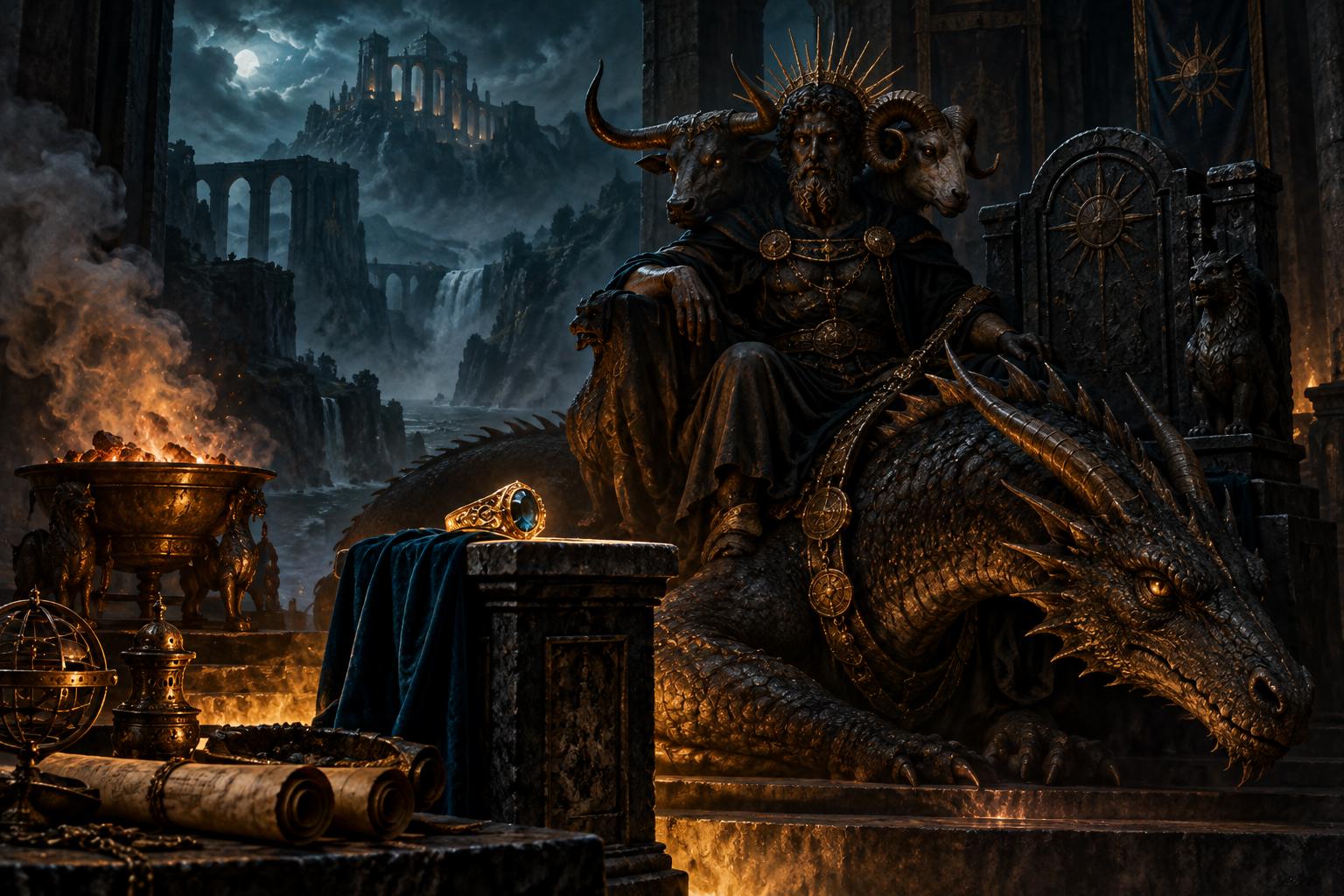
He is described with three heads, those of a bull, a man and a ram, together with a serpent’s tail and the webbed feet of a goose. He breathes fire and rides an infernal dragon, carrying a lance with a banner. This description is inherited almost word for word from Weyer’s 1577 catalog.
The text says he gives the ring of virtues, teaches arithmetic, astronomy, geometry and all handicrafts, answers questions fully and truly, grants invisibility, and reveals the places where treasures lie and guards them. The emphasis on learning and treasure echoes the Talmud’s Ashmedai, who knows hidden things.
The Goetia calls him strong and powerful and places him under the power of Amaymon, one of the four cardinal kings of the Goetic system. Later demonologists, following Binsfeld, kept him as the demon of lust, a role that does not appear in the Goetia’s own text but shapes how he is read today.
The first is that Asmodeus is a major figure in the Christian Bible. He appears only in Tobit, which many Christians do not read, and never in the New Testament. The second is that he is originally a demon of lust. That role comes from Binsfeld’s sixteenth-century scheme and from later popular writing; in Tobit he is a killer of bridegrooms, and in the Talmud and the Goetia his interests are knowledge, power and hidden things.
Third, Asmodeus is often described as the husband or consort of Lilith. This pairing appears in some Kabbalistic texts, where both are associated with demonic sexuality, but it is a later development and not part of the older stories. Fourth, readers sometimes assume the Goetia’s description, with its three heads and dragon, is ancient; it is sixteenth-century Latin material copied into a seventeenth-century English grimoire.
Asmodeus is a favorite of modern storytellers. He is a major archdevil in Dungeons and Dragons, where he rules the Nine Hells; a recurring character in the Shin Megami Tensei games; the lustful prince of the Ars Goetia ring in the animated series Helluva Boss; and a villain in Supernatural, the Bartimaeus novels and many other works. Alain-Rene Lesage’s 1707 novel Le Diable boiteux (The Limping Devil) turned him into a witty companion who lifts the roofs of Madrid to expose human folly, an early sign of how adaptable the character is.
Beyond entertainment, readers interested in biblical studies encounter him in Tobit, students of Judaism meet Ashmedai in the Talmud and in folklore, and anyone studying grimoires finds him among the Goetic kings. Because his story crosses so many boundaries, Asmodeus is a good case study in how a demon’s identity is built from scripture, legend, scholarship and fiction.
For readers who want the sources, follow them in order: Tobit, the Testament of Solomon, Gittin in the Talmud, then Weyer and the Goetia. Reading them in sequence shows which features are ancient and which are inventions. This article describes those texts for educational purposes only.
Still have a question about your own experience? Describe what you are seeing, feeling or dreaming, and when it started. The Sheikh reads every message personally and replies in private.
Is a relationship question on your mind? Asmodeus is remembered above all as the spirit who stood between Sarah and her husbands in the Book of Tobit, so many readers come to his story with questions about love and commitment. If that is what brought you here, our partner PuraTarot offers a Relationship Harmony Ritual, a personal reading to help you reflect on your own relationship and what you hope for it. Join the free Djinn Guide newsletter and, once you confirm, you will unlock a 50% code for your first reading.
Further reading
As an Amazon Associate we earn from qualifying purchases.
Asmodeus appears in the Book of Tobit, a deuterocanonical book in Catholic and Orthodox Bibles. He kills the seven husbands of Sarah on their wedding nights until Tobias, guided by the angel Raphael, drives him away with the smoke of a burning fish's heart and liver. Raphael then binds him in Egypt.
In the Ars Goetia he is Asmoday, the thirty-second spirit, with the rank of king. He commands seventy-two legions, appears with the heads of a bull, a man and a ram, rides a dragon and carries a lance with a banner. The text says he teaches arithmetic, astronomy and geometry and reveals hidden treasure.
The most accepted explanation derives it from the Avestan aeshma daeva, the Zoroastrian demon of wrath, borrowed into Jewish tradition during the Persian period. An alternative connects it to the Hebrew root shamad, to destroy. The Hebrew and Aramaic form is Ashmedai; the Goetia spells it Asmoday.
He is often called that, but the label comes from Peter Binsfeld's 1589 classification of demons by the seven deadly sins. In Tobit he is a jealous killer of bridegrooms; in the Testament of Solomon he disrupts marriages; in the Talmud and the Goetia he is associated with knowledge, treasure and kingship rather than lust specifically.
According to the Talmud (Gittin 68a to 68b), Solomon's officer Benaiah captured Ashmedai by filling his cistern with wine and binding him with a chain bearing the divine name. In the Testament of Solomon, Solomon binds him with the seal of his ring and learns that the angel Raphael and the smoke of a fish's liver thwart him.
Disclaimer
This article describes the Asmodeus demon as he appears in religious texts, legend and grimoires for educational and historical purposes. Beliefs are reported, not endorsed, and the site offers no ritual instructions and makes no claims about any spirit.
Did this guide help you understand the subject? Rate it and share your honest opinion to help other readers. Every review is checked by our editors before it appears.
There are no reviews yet. Be the first one to write one.


Sheikh Youssef
Tayeb El Merzouki
For inquiries about personalized spiritual work, private rituals, and traditional talismans, connect directly with Sheikh Youssef Tayeb El Merzouki.
Chat on WhatsApp