





Join Djinn Guide: Get 50% Off a Personal Reading
Get new guides to jinn, folklore and occult history. Confirm your subscription to unlock a 50% code for a first personal reading with our partner PuraTarot.
Discover the unseen
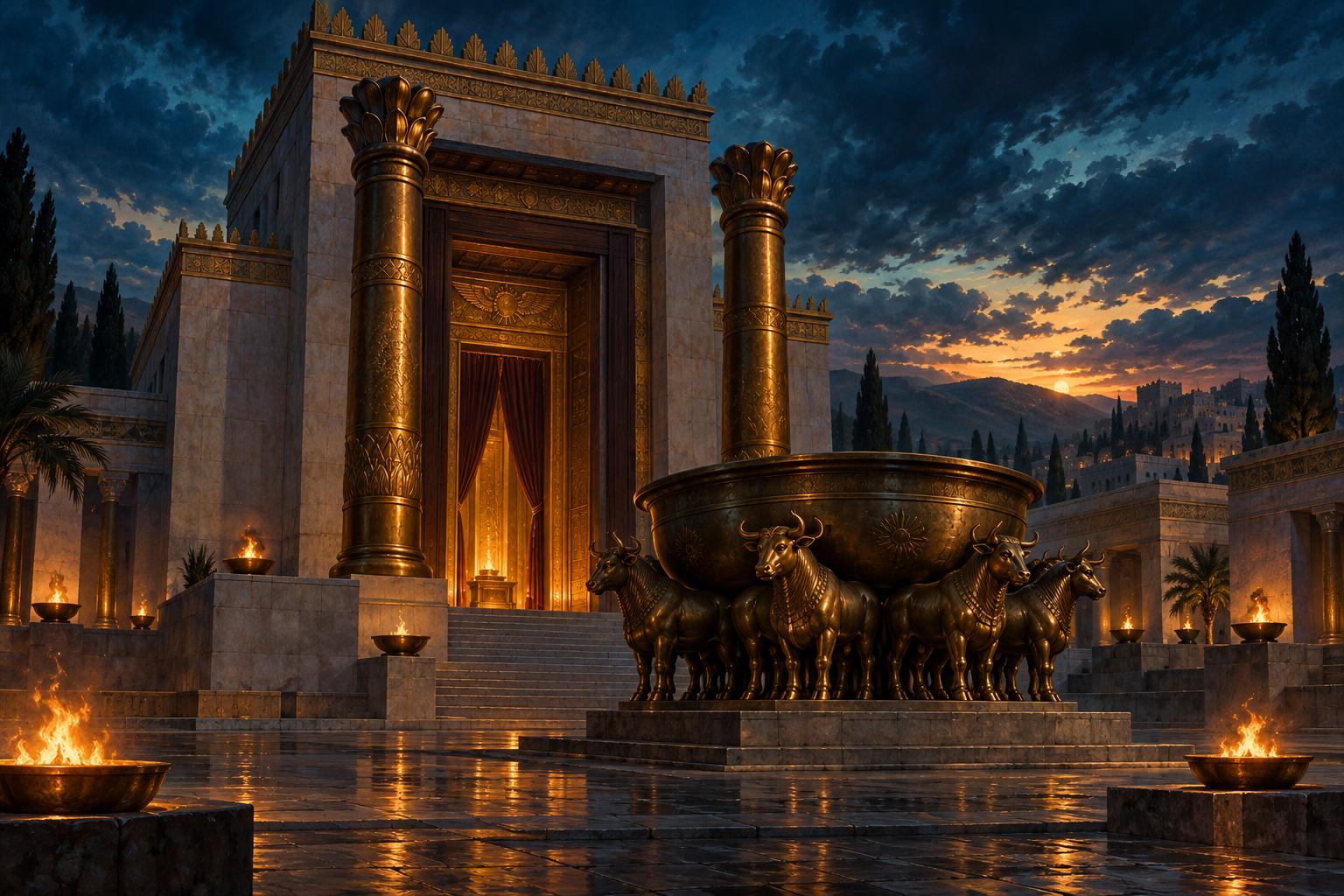
King Solomon temple explained: the First Temple in 1 Kings, what the Quran says about jinn building for Solomon, the legends, and what archaeology shows.
Quick answer: King Solomon's temple, called the First Temple, was the sanctuary that the Bible says Solomon built in Jerusalem in the tenth century BCE to house the Ark of the Covenant. First Kings 6 to 8 and Second Chronicles 2 to 7 describe a cedar-lined stone building about 90 feet long with a golden inner shrine, two bronze pillars and a huge bronze basin. It was destroyed by the Babylonians in 587 or 586 BCE. The Quran adds that jinn labored for Solomon, and later legends say demons helped raise the walls.
Related guides: who King Solomon was, King Solomon and the jinn, the Testament of Solomon explained, was King Solomon a real person, how King Solomon died, the legend of King Solomon's mines.
| Feature | Biblical description | Approximate size | Source |
|---|---|---|---|
| Main hall (hekhal) | Stone building lined with cedar and overlaid with gold | 60 cubits long, 20 wide, 30 high (about 90 x 30 x 45 ft) | 1 Kings 6:2 |
| Inner sanctuary (debir) | Cube-shaped Holy of Holies holding the Ark and two olive-wood cherubim | 20 x 20 x 20 cubits (about 30 ft each way) | 1 Kings 6:16-28 |
| Porch (ulam) | Entrance hall in front of the main hall | 20 cubits wide, 10 deep | 1 Kings 6:3 |
| Jachin and Boaz | Two free-standing bronze pillars at the entrance | 18 cubits high with 5-cubit capitals | 1 Kings 7:15-22 |
| Molten Sea | Round bronze basin on twelve bronze oxen | 10 cubits across, 5 high | 1 Kings 7:23-26 |
| Construction time | Begun in Solomon's fourth year, finished in his eleventh | Seven years | 1 Kings 6:1, 6:38 |
Key Takeaways
The temple of Solomon is the building that the Hebrew Bible presents as Israel’s first permanent sanctuary, replacing the portable tabernacle of the wilderness period. According to 1 Kings 5, David had wanted to build it but was told to leave the task to his son. Solomon began work in the fourth year of his reign, which the text places 480 years after the exodus, and finished seven years later. The site was Mount Moriah in Jerusalem, on a threshing floor David had bought, and the purpose was to house the Ark of the Covenant, which was carried in with great ceremony in 1 Kings 8.
The description in 1 Kings 6 and 7 is detailed enough to allow reconstructions, though not without disagreement. The building was a long rectangle of dressed stone, 60 cubits long, 20 wide and 30 high, divided into a porch, a main hall and an inner shrine. The interior was paneled in cedar carved with gourds, flowers, palm trees and cherubim, and the text says it was overlaid with gold. The inner shrine, the Holy of Holies, was a perfect cube of 20 cubits in which two olive-wood cherubim, each 10 cubits tall, stood with wings touching over the Ark. Side chambers ran around the outside on three stories.
Second Chronicles 2 to 7 retells the story with more emphasis on ceremony. These chapters are the only ancient description of the building, and everything later depends on them.
The biblical account gives an unusual amount of practical detail, which is part of why the building has fascinated architects and historians.
Solomon made a treaty with Hiram, king of Tyre, who sent cedar and cypress logs floated down the coast in rafts in exchange for wheat and oil. Tyrian craftsmen worked alongside Israelite labor gangs, and 1 Kings 5 says 30,000 men were conscripted in rotating shifts, with tens of thousands more quarrying stone.
First Kings 6:7 notes that the stones were finished at the quarry so that no hammer or chisel was heard at the site. Later Jewish legend explained this with the shamir, a creature or substance that could cut stone silently.
A second Hiram, a bronze-worker from Tyre whose mother was from the tribe of Naphtali, cast the two pillars named Jachin and Boaz, the Molten Sea resting on twelve oxen, ten wheeled stands with basins, and the vessels of the courtyard. He is the figure Freemasonry later reshaped as Hiram Abiff.
The tripartite layout of porch, hall and inner shrine matches temples excavated in Syria, which suggests the biblical writers described a building in the regional style of the Iron Age rather than something without parallel.
Does this touch your own situation? Many readers come to these pages because something in their home, dreams or family feels unexplained. Reading history helps, but it cannot look at your specific case.
Consult the Sheikh Private, confidential, and free to ask.
The idea that the temple of King Solomon was built by jinn comes from the Quran, though the Quran never names the building. Surah Saba 34:12 to 13 says that God subjected the wind to Solomon and that “of the jinn were those who worked before him by his Lord’s permission,” making for him “whatever he willed of sanctuaries and statues and basins like reservoirs and fixed cauldrons.” The Arabic word for sanctuaries, maharib, is the plural of mihrab, and commentators from al-Tabari onward understood it to include the great temple in Jerusalem. Surah al-Anbiya 21:82 similarly speaks of devils who dived for Solomon and did other work, kept in check by God.
Islamic storytellers expanded this into the picture familiar from later legend: jinn quarrying marble, carrying stone through the air and raising walls at impossible speed. The Quran itself is restrained and frames the labor as a sign of God’s favor. Surah Saba 34:14 adds the famous episode of Solomon’s death, in which the jinn kept working until a creature of the earth gnawed through his staff and his body fell, showing that they had no knowledge of the unseen. The wider theme of his command over spirits is covered in King Solomon and the jinn.
Jewish and Christian traditions developed parallel legends. The Talmud, in Gittin 68a to 68b, tells how Solomon needed the shamir to cut stone without iron, which was forbidden at the altar, and how he captured Ashmedai, the king of demons, to learn where it was kept. The story is comic as well as magical: Ashmedai is caught by being made drunk, bound with a chain engraved with the divine name, and eventually tricks Solomon into handing over his ring and throws him far from Jerusalem. The temple here is the reason for Solomon’s dealings with demons, not the product of their labor.
The Testament of Solomon, a Greek pseudepigraphal text written sometime between the first and fifth centuries CE, makes the demons the workforce. The king receives a ring from the archangel Michael, summons demons one by one, learns their names and weaknesses, and sets each to a task: cutting stone, carrying the Molten Sea, twisting ropes, feeding the furnace. The text reads like a demonological handbook attached to a temple narrative, and it is the ancestor of the medieval Solomonic grimoires. Our guide to the Testament of Solomon goes through it in detail. The motif survived into European occult literature, where the temple became a symbol of mastery over spirits.
The First Temple stood for roughly four centuries. Second Kings 25 and Jeremiah 52 record that Nebuchadnezzar II of Babylon captured Jerusalem and burned the temple in the fifth month of the nineteenth year of his reign, usually dated to August 587 or 586 BCE, carrying the bronze pillars, the Sea and the vessels to Babylon. The Ark is not mentioned among the spoils and its fate is unknown, which has fed centuries of speculation.
After the Persian conquest, returning exiles rebuilt a smaller temple, completed in 516 BCE under Zerubbabel; this is the Second Temple. Herod the Great expanded it massively from about 20 BCE, creating the platform now called the Temple Mount or Haram al-Sharif. The Romans destroyed that building in 70 CE. The Dome of the Rock, finished in 691 to 692 CE, now stands on the platform, and the rock beneath its dome is traditionally identified with the site of the Holy of Holies, though the exact position of Solomon’s building is not known.
Jewish liturgy mourns the destruction on Tisha B’Av. The medieval Knights Templar took their name from the site, and eighteenth-century Masonic lodges built their rituals around the story of its construction.
No physical trace of the First Temple has been found. The Temple Mount is one of the most sensitive religious sites in the world and cannot be excavated, so there is no direct evidence of Solomon’s building or of the later ones on the same spot.
What archaeology offers instead is context. The temple at Ain Dara in northern Syria, built around 1300 to 900 BCE and badly damaged in 2018, had a porch with columns, a long hall and a raised inner room, with carved guardian figures and side chambers, a plan strikingly close to the biblical description. The ninth or eighth century temple at Tell Tayinat, near Antioch, shows the same tripartite layout beside a royal palace, exactly as 1 Kings places the temple next to Solomon’s house. These parallels suggest that the biblical writers were describing a recognizable type of building rather than inventing one.
Historians disagree about how much of the biblical account is tenth-century memory and how much is later elaboration. Some argue that Jerusalem in Solomon’s time was too small to support such a project; others point to the Phoenician details and the archaic features of the description as signs of an early source. That debate belongs with the larger question of whether King Solomon was a real person, and it is unlikely to be settled without excavation that will not happen.
Because the temple is so famous, it has attracted claims that the sources do not support. The Western Wall is not a wall of Solomon’s temple; it is part of Herod’s retaining wall for the Second Temple platform, built more than nine centuries later. The so-called Solomon’s Stables beneath the mount are Herodian and later vaults. The Quran does not say that jinn built the temple in so many words; it says they made sanctuaries and other works for Solomon, and commentators drew the connection. The Testament of Solomon is not a Jewish scripture but a Greek text of the Roman period, and its demon lore is not found in the Bible.
Nor was the temple built with the help of the shamir in the biblical text; that detail is rabbinic legend explaining the silence of 1 Kings 6:7. The Bible says the Babylonians took the bronze and gold; the Ark simply drops out of the record. Finally, the Masonic Hiram Abiff is a reworking of the biblical bronze-worker, who in Kings and Chronicles finishes his work and is never said to be murdered.
People search for King Solomon’s temple for very different reasons. Religious readers want to understand the building at the center of the biblical story and of Jewish hope for restoration. Students of Islam meet Solomon as a prophet whose command over wind and jinn is a sign of God’s power. Freemasons and those curious about them encounter the temple as the central allegory of the craft. Readers of occult history find in it the origin of the Solomonic grimoires.
For all of these readers, the best approach is to keep the layers separate. Read 1 Kings 6 to 8 first, because that is the only ancient description. Then read Surah Saba 34:12 to 14 to see what the Quran actually says, and the Talmud’s Gittin 68 and the Testament of Solomon to see how legend grew. Finally look at the comparative archaeology, which shows the kind of building the writers had in mind. For the man himself, start with our overview of who King Solomon was.
Still have a question about your own experience? Describe what you are seeing, feeling or dreaming, and when it started. The Sheikh reads every message personally and replies in private.
Have a question of your own? The temple stories are, at heart, about building something meant to last, and many readers find themselves asking the same question about their own plans and foundations. If you would like a personal look at what you are building now, our partner PuraTarot offers a Full Personal Reading for reflection on your own situation. Join the free Djinn Guide newsletter and, once you confirm, you will unlock a 50% code for your first reading.
Further reading
As an Amazon Associate we earn from qualifying purchases.
King Solomon's temple, or the First Temple, was the sanctuary that the Bible says Solomon built in Jerusalem in the tenth century BCE to house the Ark of the Covenant. It is described in 1 Kings 6 to 8 as a cedar-lined stone building with a golden inner shrine and two bronze pillars.
The Quran, in Surah Saba 34:12 to 13, says jinn worked for Solomon and made sanctuaries, statues and basins. It does not name the Jerusalem temple, but classical commentators understood the sanctuaries to include it. The Testament of Solomon, a Greek text, separately says demons were compelled to build the temple.
The Babylonian army of Nebuchadnezzar II burned the First Temple in 587 or 586 BCE, according to 2 Kings 25 and Jeremiah 52. A smaller Second Temple was finished in 516 BCE, enlarged by Herod, and destroyed by the Romans in 70 CE.
First Kings 6:2 gives the main building as 60 cubits long, 20 wide and 30 high, roughly 90 by 30 by 45 feet, with a 10-cubit porch in front. The Holy of Holies was a 20-cubit cube. It was modest in size by the standards of later temples; its fame rests on its gold, its bronze-work and its role.
No. The Temple Mount cannot be excavated, and no remains have been identified. Archaeologists compare the biblical description with similar Iron Age temples at Ain Dara and Tell Tayinat in Syria, which share its porch-hall-shrine plan and support the idea that the account describes a real type of building.
Disclaimer
This article presents the temple of Solomon as it appears in the Bible, the Quran, rabbinic literature and later legend, for educational purposes. Religious beliefs and legends are described, not endorsed, and the site makes no claims about spirits or rituals.
Did this guide help you understand the subject? Rate it and share your honest opinion to help other readers. Every review is checked by our editors before it appears.
There are no reviews yet. Be the first one to write one.


Sheikh Youssef
Tayeb El Merzouki
For inquiries about personalized spiritual work, private rituals, and traditional talismans, connect directly with Sheikh Youssef Tayeb El Merzouki.
Chat on WhatsApp