




Join Djinn Guide: Get 50% Off a Personal Reading
Get new guides to jinn, folklore and occult history. Confirm your subscription to unlock a 50% code for a first personal reading with our partner PuraTarot.
Discover the unseen
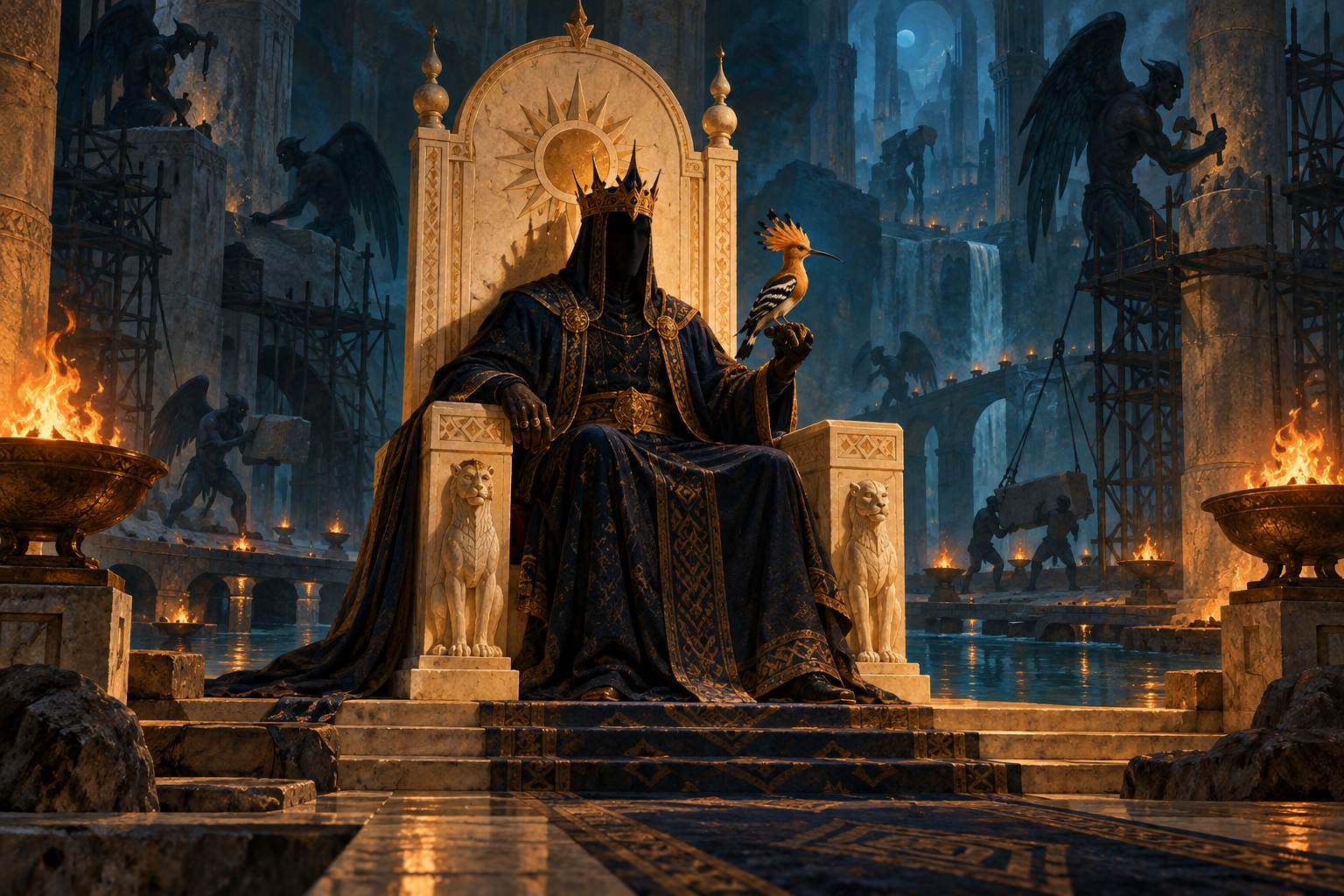
Who was King Solomon? A clear guide to the king of the Bible, the prophet Sulayman of the Quran, the Talmud's master of demons and the magician of legend.
Quick answer: King Solomon was the son of David and Bathsheba and the third king of a united Israel, traditionally dated to about 970 to 931 BCE. The Bible presents him as a king of unmatched wisdom and wealth who built the First Temple in Jerusalem. The Quran calls him Sulayman, a prophet who commanded the wind, the jinn and the birds. The Talmud, the Testament of Solomon and medieval grimoires later made him the master of demons and the model magician of the Western and Islamic occult traditions.
Related guides: King Solomon and the jinn, the First Temple built by Solomon, was King Solomon a real person, the Testament of Solomon explained, how King Solomon died, the Seal of Solomon and its history.
| Source | Date of text | How King Solomon appears | Key passages |
|---|---|---|---|
| Hebrew Bible | Compiled c. 7th to 5th century BCE | Wise king, temple builder, later led astray by foreign wives | 1 Kings 1–11; 2 Chronicles 1–9 |
| Wisdom books | Attributed, various dates | Author of proverbs, songs and reflections | Proverbs, Ecclesiastes, Song of Songs, Wisdom of Solomon |
| Quran | 7th century CE | Prophet Sulayman, ruler of wind, jinn and birds; never a sorcerer | 2:102; 21:78–82; 27:15–44; 34:12–14; 38:30–40 |
| Talmud and midrash | c. 3rd to 6th century CE | Judge, builder who used the shamir, captor of Ashmedai | Gittin 68a–b; Sanhedrin; Song of Songs Rabbah |
| Testament of Solomon | c. 1st to 5th century CE | Receives a ring from an archangel and binds demons to build the Temple | Whole text |
| Grimoires | 13th to 17th century CE | Legendary author of magical books and seals | Clavicula Salomonis; Lemegeton; Ars Notoria |
| Arabian Nights | Medieval, printed from 1704 | Sealer of jinn in brass bottles | The Fisherman and the Jinni; City of Brass |
Key Takeaways
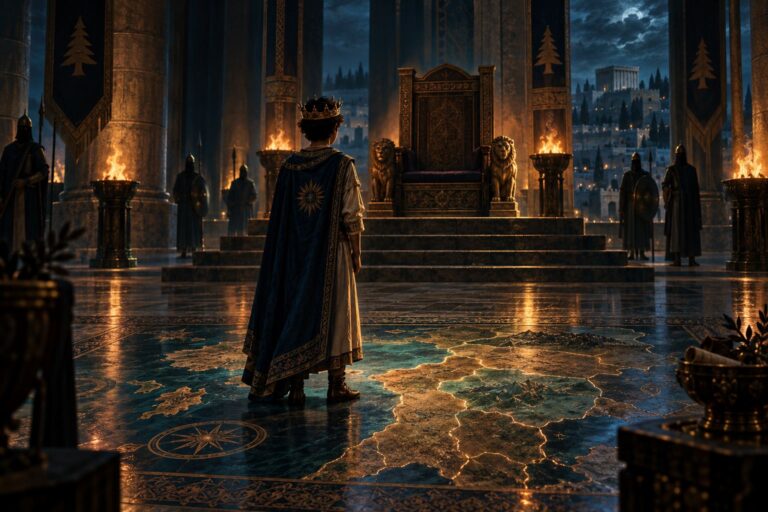
King Solomon (Hebrew Shlomo, from a root meaning peace or wholeness) is introduced in the books of Samuel and Kings as the son of King David and Bathsheba. After a succession struggle described in 1 Kings 1, he is anointed king in Jerusalem and secures his throne. The biblical account of his reign fills 1 Kings 1 to 11 and is retold, with a more flattering emphasis, in 2 Chronicles 1 to 9. The traditional dates of his rule are about 970 to 931 BCE, placing him at the end of the united monarchy of Israel.
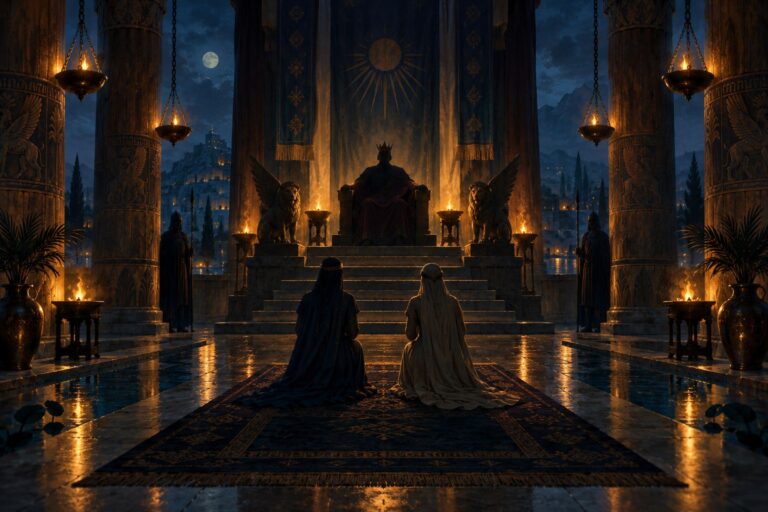
Three themes dominate the biblical King Solomon story. The first is wisdom: at Gibeon he asks God for an understanding heart rather than riches, and the famous judgment between two women claiming one child shows the gift in action (1 Kings 3). The second is building: he spends seven years constructing the Temple in Jerusalem and thirteen on his palace complex (1 Kings 6 to 7). The third is wealth and diplomacy, symbolized by the visit of the Queen of Sheba and by trading fleets that sail to the land of Ophir (1 Kings 9 to 10).
The story does not end in triumph. 1 Kings 11 records that Solomon married many foreign women, who turned his heart toward other gods, and that God therefore decided to tear most of the kingdom from his heir. After his death his son Rehoboam lost the ten northern tribes, and the united monarchy split in two. The biblical writers present Solomon as both a model and a warning.
Jewish and Christian tradition attached three books of the Hebrew Bible to Solomon’s name. Proverbs opens by calling itself the proverbs of Solomon, son of David. Ecclesiastes presents its speaker as a son of David who was king in Jerusalem. The Song of Songs carries his name in its first verse. A later Greek work, the Wisdom of Solomon, written in Alexandria around the first century BCE, is included in Catholic and Orthodox Bibles. Modern scholarship treats these attributions as honorary rather than historical, but they shaped how later readers imagined him.
This reputation for authorship is the root of the occult Solomon. If the king could write proverbs, later generations reasoned, he could also have written down secret knowledge about nature and spirits. Jewish writers of the Second Temple period already spoke of Solomon composing incantations against illness and demons. The historian Josephus, writing in the first century CE, describes an exorcist named Eleazar using a ring and formulas attributed to Solomon in front of the Roman commander Vespasian.
By the medieval period, Greek, Arabic, Hebrew and Latin manuscripts circulated under his name, offering seals, prayers and lists of spirits. These texts are the subject of our guide to grimoires and their famous titles, and they explain why a tenth-century BCE king still appears on the covers of occult books today.
Does this touch your own situation? Many readers come to these pages because something in their home, dreams or family feels unexplained. Reading history helps, but it cannot look at your specific case.
Consult the Sheikh Private, confidential, and free to ask.
In the Quran, Solomon is Sulayman ibn Dawud, a prophet and righteous king. The Quran mentions him in several chapters, and the longest treatment is in Surah An-Naml (27:15–44). There he inherits knowledge from David, understands the speech of birds, marshals an army of jinn, humans and birds, hears an ant warn its colony, and questions the hoopoe, who brings news of the Queen of Sheba. When he asks who can bring her throne, an ifrit from among the jinn offers to do it before Solomon rises from his seat, but one who has knowledge of the Book brings it in the blink of an eye (27:38–40).
Surah Al-Anbiya (21:78–82) says the wind ran at his command and that devils dived for him and did other work. Surah Saba (34:12–14) describes jinn building whatever he wished and reports his death: he died leaning on his staff, and the jinn kept laboring until a creature of the earth gnawed the staff and his body fell, showing that the jinn did not know the unseen. Surah Sad (38:30–40) mentions his love of horses, a trial, and his prayer for a kingdom no one after him would have.
Crucially, Surah Al-Baqarah 2:102 states that Solomon did not disbelieve; it was the devils who disbelieved by teaching people magic. This single verse explains why Islamic tradition can honor Solomon as a prophet while rejecting the magical books attributed to him. The jinn serve him by God’s permission, not through sorcery. For the full picture of this relationship see King Solomon and the jinn.
Rabbinic literature expands the biblical Solomon in two directions: as the ideal judge and as a king who dealt with demons. The most famous story is in the Babylonian Talmud, Gittin 68a–b. Solomon needs the shamir, a creature or substance that cuts stone without iron, because iron tools are forbidden for the Temple. He learns that Ashmedai, king of the demons, knows where it is, and sends his general Benaiah with a chain and a ring inscribed with the divine name to capture him. Ashmedai is brought to Jerusalem and helps with the building, but later seizes the ring, flings Solomon far away and rules in his place until the king returns as a beggar.
The Testament of Solomon, a Greek pseudepigraphal text composed somewhere between the first and fifth centuries CE, tells a parallel story in Christian dress. The archangel Michael gives Solomon a ring bearing a seal, and with it he interrogates and binds a long series of demons, learning their names, their harms and the angels who thwart them, then sets them to work on the Temple. Its catalog of spirits is the ancestor of the later demon lists, and the Testament of Solomon explained covers it in detail.
Together these texts fix the motif of the ring and the seal that later amulets, Arabian Nights tales and the Lesser Key of Solomon all depend on.
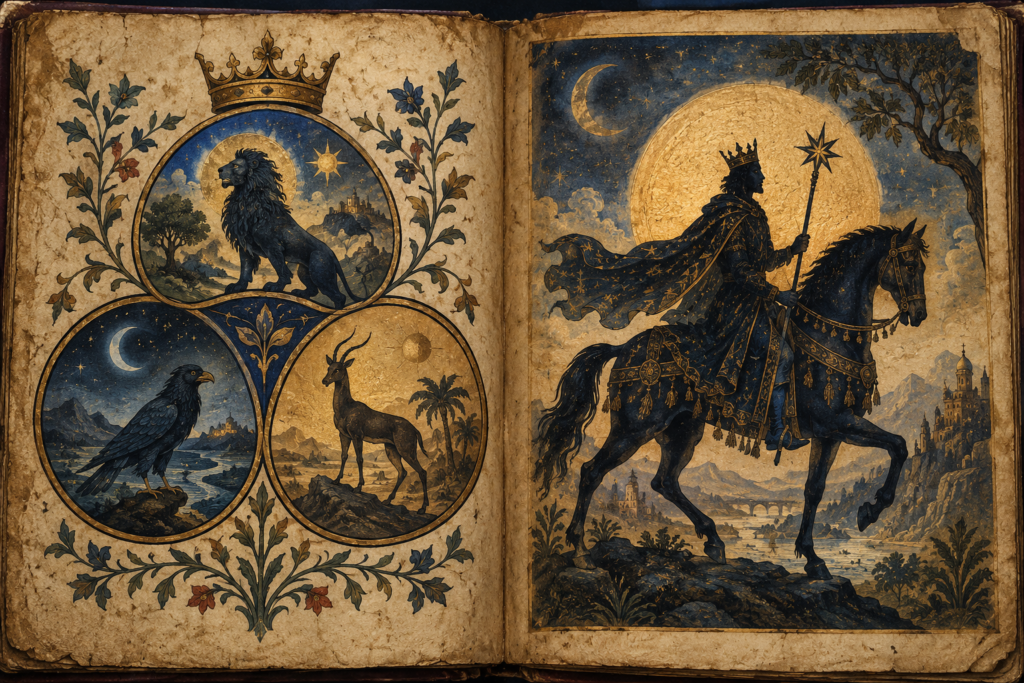
Between the Testament and the Renaissance, Solomon became the patron of an entire literature. The main branches are:
The Clavicula Salomonis, known in Latin, Italian and French manuscripts from the fifteenth century onward, presents prayers, planetary pentacles and instructions supposedly dictated by Solomon to his son Rehoboam. It is the most widely copied grimoire in Europe.
The Lemegeton is a seventeenth-century compilation of five books: Ars Goetia, Ars Theurgia-Goetia, Ars Paulina, Ars Almadel and Ars Notoria. Its first book lists 72 spirits with ranks, seals and offices and claims Solomon sealed them in a brass vessel.
Older than the rest, this medieval text promises learning and memory through prayers and figures and claims Solomon received it from an angel.
Arabic magical texts invoke Solomon’s name alongside the jinn kings, and the Nights repeatedly show jinn sealed in bottles stamped with his ring, most famously in the tale of the fisherman. The City of Brass episode even features bottles of imprisoned jinn from Solomon’s time.
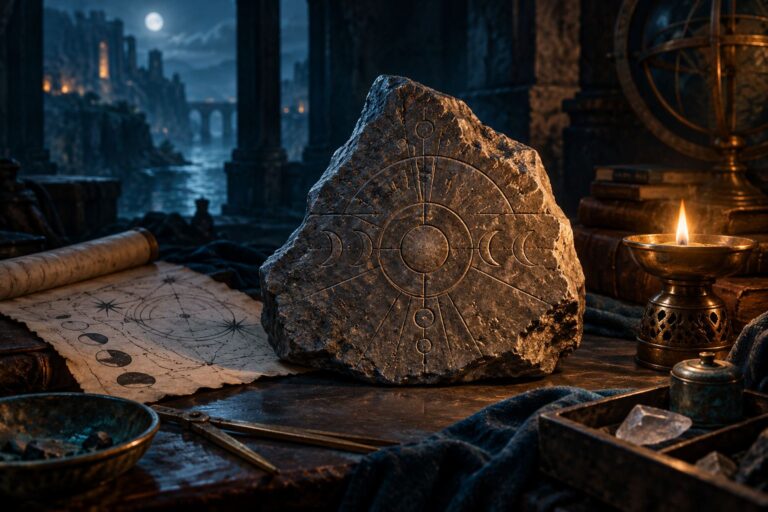
The Seal of Solomon itself, usually drawn as a hexagram or pentagram within a circle, became the single most recognizable symbol of this tradition; its story is told in the Seal of Solomon and its history.
No inscription from Solomon’s own time names him, and the monumental Jerusalem described in Kings has not been found, partly because the Temple Mount cannot be excavated. Archaeologists accept a tenth-century BCE kingdom centered on Jerusalem but disagree sharply about its size. Some see a modest highland chiefdom that later scribes magnified; others point to fortified gates at Hazor, Megiddo and Gezer (1 Kings 9:15) and to copper mining in the Arabah as signs of a more organized state.
The Tel Dan inscription, discovered in 1993, mentions the house of David in Aramaic from the ninth century BCE and confirms that David was remembered as a dynastic founder soon after his era. That supports the existence of the dynasty, though not the details of Solomon’s reign. Most historians therefore treat Solomon as a real king whose memory was expanded over centuries.
None of this affects the religious or literary Solomon. The three figures, historical, scriptural and legendary, simply answer different questions.
The first confusion is about magic. Popular culture often presents Solomon as a sorcerer, but the Bible never says he practiced magic, and the Quran explicitly denies it. The second is about dates: grimoires bearing his name were written two thousand or more years after his death. The third is about symbols. The six-pointed star was used as the Seal of Solomon in Islamic and Jewish magic long before it became a Jewish national emblem.
There is also confusion about his family. The Bible gives him seven hundred wives and three hundred concubines (1 Kings 11:3), a figure most scholars read as symbolic of royal excess. Ethiopian tradition adds Menelik, a son by the Queen of Sheba, absent from the Bible. The manner of his death is told only in the Quran and later literature; Kings simply records that he slept with his fathers.
Finally, Solomon’s mines, made famous by H. Rider Haggard’s 1885 novel, are a literary invention inspired by the biblical gold of Ophir.
Few ancient figures touch so many modern interests at once. Readers of the Bible and the Quran want to know who he was. Students of folklore meet him in the Arabian Nights and in Ethiopian, Persian and Malay legends. Occult-history hobbyists encounter his name on grimoires, on rings and pentacles sold online, and in games and films that borrow the 72 spirits. Searches about his wives, death, temple, mines and historicity all lead back to the same layered figure.
A sensible way to read about him is to ask, for every claim, which Solomon is meant. The Temple’s dimensions come from Kings. Jinn building for him come from the Quran. A ring that binds demons comes from the Testament and the Talmud. Seventy-two named spirits come from a seventeenth-century English manuscript. Keeping the sources apart makes the legend richer, not poorer.
This site covers each of these Solomons separately, from his temple and wisdom to his death, sons and seals. We describe the magical traditions historically and do not provide ritual instructions or claim that any seal or text produces an effect.
Still have a question about your own experience? Describe what you are seeing, feeling or dreaming, and when it started. The Sheikh reads every message personally and replies in private.
Curious how this applies to your own life? Solomon asked for an understanding heart rather than riches, a choice many readers still reflect on. A Full Personal Reading with our partner PuraTarot offers a quiet space to consider a question of your own. Join the free Djinn Guide newsletter and, once you confirm, you will unlock a 50% code for your first reading.
Further reading
As an Amazon Associate we earn from qualifying purchases.
King Solomon was the son of David and the third king of united Israel, reigning about 970 to 931 BCE according to the Bible. He is remembered for his wisdom, for building the First Temple in Jerusalem and for his wealth. The Quran honors him as the prophet Sulayman, and later legend made him a master of jinn and demons.
Solomon is famous for three things: his wisdom, shown in the judgment between two women claiming one baby; his construction of the First Temple in Jerusalem; and his legendary power over spirits. The last theme comes from the Quran, the Talmud, the Testament of Solomon and medieval grimoires rather than from the Bible itself.
Yes. The Quran names him Sulayman and treats him as a prophet. Surah An-Naml 27:15–44 describes his armies of jinn, humans and birds, the hoopoe and the Queen of Sheba. Surah Saba 34:12–14 tells of jinn building for him and of his death. Surah Al-Baqarah 2:102 states that Solomon did not practice magic.
The Bible says Solomon reigned forty years over all Israel in Jerusalem (1 Kings 11:42). Traditional chronology places his reign at roughly 970 to 931 BCE. The round number forty is used elsewhere in the Bible for full or ideal spans, so some historians treat it as approximate rather than exact.
The Bible does not say so. The idea comes from later sources: the Quran describes jinn working for him by God's permission, the Talmud tells of his capture of the demon king Ashmedai, and the Testament of Solomon gives him a ring that binds demons. These are religious and legendary accounts, and this site presents them as traditions rather than as proven history.
Disclaimer
This article summarizes biblical, Quranic, rabbinic and legendary accounts of King Solomon for educational and cultural purposes. Religious teachings are described, not endorsed or disputed, and no magical text, seal or practice associated with Solomon is presented as effective.
Did this guide help you understand the subject? Rate it and share your honest opinion to help other readers. Every review is checked by our editors before it appears.
There are no reviews yet. Be the first one to write one.


Sheikh Youssef
Tayeb El Merzouki
For inquiries about personalized spiritual work, private rituals, and traditional talismans, connect directly with Sheikh Youssef Tayeb El Merzouki.
Chat on WhatsApp