






Join Djinn Guide: Get 50% Off a Personal Reading
Get new guides to jinn, folklore and occult history. Confirm your subscription to unlock a 50% code for a first personal reading with our partner PuraTarot.
Discover the unseen
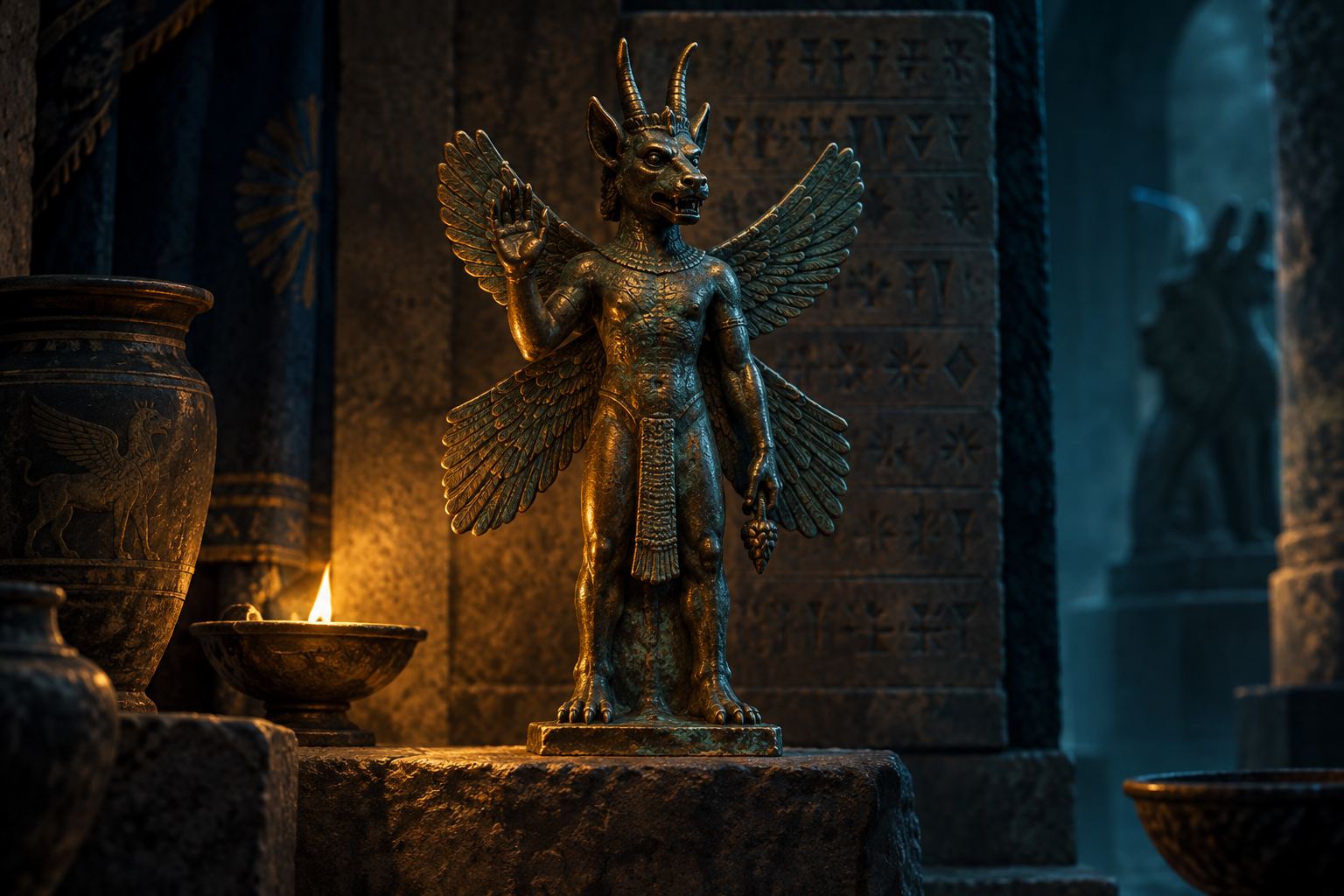
Pazuzu demon explained: who the Mesopotamian wind king was, what his statue and amulets meant, why mothers wore him, and how The Exorcist changed him.
Quick answer: The Pazuzu demon is a Mesopotamian spirit of the first millennium BCE, described in Assyrian and Babylonian texts as the king of the evil wind demons and the son of the god Hanbi. He has a dog-like or lion-like face, bulging eyes, a scaly body, four wings, bird talons and a scorpion tail. Although he was feared as a bringer of the scorching southwest wind, people wore Pazuzu amulets for protection, because he was believed to drive away the child-killing demoness Lamashtu.
Related guides: what demonology actually studies, a list of demon names and origins, amulets and talismans through history, Lilith and the lilu spirits, jinn, ghosts and demons compared, incubus and succubus folklore.
| Aspect | Ancient Mesopotamian evidence | Modern popular image |
|---|---|---|
| Origin | Assyrian and Babylonian texts and objects, roughly 1000 to 500 BCE | Often misdated or treated as a timeless archetype |
| Family | Son of Hanbi (Hanpa), ruler of wind spirits | Rarely mentioned |
| Domain | The hot southwest wind, drought, locusts, fever | Possession and demonic evil in general |
| Appearance | Canine or leonine face, four wings, talons, scorpion tail | Mostly copied from the Louvre statuette |
| Function | Protective: wards off Lamashtu, worn by pregnant women | Antagonist: the possessing entity of The Exorcist |
| Typical objects | Heads, pendants, fibulae, plaques, small statuettes | Film prop statues, horror merchandise |
Key Takeaways
The Pazuzu demon is a supernatural being from ancient Mesopotamia, the region of modern Iraq and parts of Syria. He belongs to the Assyrian and Babylonian religious world of the first millennium BCE, where he was understood as a king of the wind demons. Cuneiform incantations and inscribed objects describe him as the son of Hanbi (also written Hanpa), a shadowy god of evil spirits, and as the ruler of the lilu, a class of restless demons connected with wind, storm and disease. For a wider view of how scholars classify such beings, see what demonology actually studies.
Pazuzu is unusual because he sits on both sides of the line between harmful and helpful. Texts link him with the burning southwest wind that brought drought, locust swarms and fever from the desert. Yet the same texts, and thousands of surviving amulets, show that people deliberately invited his image into their homes and onto their bodies. The logic was that a powerful demon could be turned against other demons, and Pazuzu was the strongest of his kind.
Modern readers usually meet Pazuzu through horror cinema, where he is the entity that possesses a girl in The Exorcist. That story is a twentieth-century invention. In the ancient sources Pazuzu is never described as entering a human body; his business is wind, weather and the protection of the vulnerable from a more dangerous rival, the demoness Lamashtu.
Pazuzu appears comparatively late in Mesopotamian history. There is no clear trace of him in Sumerian or Old Babylonian material from the third and early second millennium BCE. He emerges in the Neo-Assyrian and Neo-Babylonian periods, roughly the ninth to the sixth centuries BCE, and his cult continues into the Persian and Hellenistic eras. His objects have turned up far beyond Mesopotamia, in Iran, the Levant, Cyprus and even Italy, carried by trade and by the movement of people.
The best-known written source is the inscription on a bronze statuette now in the Louvre in Paris. In it the demon speaks in the first person, naming himself Pazuzu, son of Hanbi, king of the evil lilu, and describing how he rose up and came down from the mountains while the winds raged. Similar short texts occur on amulet heads and plaques. Longer incantations mention him among the spirits an exorcist could address when treating illness attributed to wind-borne demons.
Scholars have debated whether Pazuzu was a purely Mesopotamian creation or whether his iconography absorbed elements from Egypt and the Levant, especially the protective dwarf god Bes. His exact origin is unknown. What is certain is that by the Assyrian imperial period he had a fixed name, parentage and appearance recognized across a wide area.
Does this touch your own situation? Many readers come to these pages because something in their home, dreams or family feels unexplained. Reading history helps, but it cannot look at your specific case.
Consult the Sheikh Private, confidential, and free to ask.
The iconography of Pazuzu is remarkably consistent, which is why even a small fragment of a head can be identified with confidence. The standard features, seen most fully on the Louvre statuette and on the many bronze and stone heads, are these:
Objects range from full statuettes a few inches high to tiny pierced heads meant to hang from a cord around the neck. Some are hollow and could be worn as pendants; others have a loop on top of the head, suggesting they were suspended in doorways or over beds. Materials include bronze, stone, terracotta, bone and glass paste, which tells us that both wealthy and ordinary households used them. For the broader history of protective objects of this kind, read about amulets and talismans through history.
The answer lies in a second figure, Lamashtu. In Mesopotamian belief Lamashtu was a female demon, daughter of the sky god Anu, who attacked pregnant women, newborns and nursing mothers. She was blamed for miscarriage, fever and sudden infant death. Because she was divine in origin, ordinary prayers were thought insufficient; she had to be driven off by force.
Pazuzu was the force. Protective plaques from the Neo-Assyrian period show a layered scene: at the top, symbols of the great gods; below, protective spirits; in the middle, a sick person on a bed attended by priests in fish costumes; and at the bottom, Lamashtu being pushed back toward the underworld. Pazuzu’s head peers over the top of the plaque, and his full figure sometimes stands behind Lamashtu, chasing her away. Incantations make the relationship explicit: he is called upon so that she will not approach the house.
This explains the paradox of a feared demon being worn by expectant mothers. The reasoning is familiar from other cultures that use fierce images as guardians, and it is a reminder that ancient categories of good and evil spirit were practical rather than absolute. A being could be dangerous in one context and useful in another.
Pazuzu’s title as king of the lilu connects him to a family of spirits that outlived Mesopotamia. The lilu, lilitu and ardat-lili were wind and night demons associated with illness, sleeplessness and attacks on sleepers. Through Aramaic incantation bowls and later Jewish folklore, the name of the lilitu seems to have fed into the figure of Lilith, the night demoness of rabbinic and medieval texts. Pazuzu himself did not make that journey; his name drops out of the record after the Hellenistic period, and he was effectively forgotten until archaeologists recovered his statues in the nineteenth and twentieth centuries.
He has no place in the Bible, the Quran, the Talmud or the Solomonic grimoires. He is not among the 72 spirits of the Ars Goetia, and he is absent from the medieval demon catalogs that fed the Dictionnaire Infernal. Readers who expect to find him in those lists are usually looking for Abaddon, Beelzebub or similar figures drawn from Near Eastern deities. Some modern authors have proposed that Mesopotamian demon lore influenced later ideas of the jinn, but there is no direct textual line from Pazuzu to any named jinn.
What survives is iconographic. The combination of wings, talons, animal face and raised hand became a visual template for how later artists imagined monstrous spirits, and museum displays of Pazuzu heads helped shape the twentieth-century picture of what a demon should look like.
Because his modern fame comes from fiction, several ideas about Pazuzu circulate that the ancient sources do not support. Pazuzu was not a god of possession; Mesopotamian texts describe him as a wind spirit who afflicted people from outside through weather and fever, not by inhabiting them. He was not Sumerian; his cult belongs to the first millennium BCE, long after the Sumerian city-states had passed into history. He was not a demon of plague alone, nor a lord of the underworld; his sphere was the sky and the winds, and the underworld was where he drove Lamashtu.
A second group of errors concerns the objects. The Louvre statuette is a small bronze, not a monumental statue; the giant figure that appears in The Exorcist was a prop. Pazuzu heads were also not idols in the sense of receiving worship or offerings. They were apotropaic devices, closer in function to a horseshoe over a door than to a cult image. Ancient people did not love Pazuzu; they used him.
Finally, Hanbi, his father, is an obscure figure known mainly from Pazuzu’s own inscriptions. Claims that Pazuzu had a wife or children are modern embroidery.
The modern career of Pazuzu began in 1971, when William Peter Blatty published The Exorcist, and continued in 1973 with the film directed by William Friedkin. The story opens at an archaeological dig in northern Iraq, where a priest finds a Pazuzu amulet and later faces a large statue of the demon. The entity that later possesses a young girl in Washington, D.C., is identified with Pazuzu, though the name is barely spoken in the film. The sequels, television series and countless references in other media cemented the link between the ancient wind king and demonic possession.
This association shapes how people search for him. Queries about the Pazuzu statue and the Pazuzu Exorcist connection far outnumber questions about Assyrian religion. Museums have responded by using the film as a hook to teach the real history, and the Louvre statuette has become one of the most-viewed Mesopotamian objects in the world.
Pazuzu also appears in video games, comics and tabletop role-playing settings, almost always as a villain. To see how he compares with figures from other traditions, the site keeps a list of demon names and origins that separates scriptural, Goetic, Mesopotamian and folkloric beings.
Studying Pazuzu is largely a matter of reading objects. Unlike the Goetic spirits, who exist mainly in books, he survives through hundreds of physical items in museum collections, each with its own findspot, date and inscription. When evaluating a claim about him, ask whether it rests on a published object or text, or on a modern retelling. The scholarly literature on Pazuzu is small but solid, and museum catalogs from Paris, London, Berlin and Baghdad remain the primary points of reference.
It also helps to keep three layers apart: the Assyrian and Babylonian evidence, the long silence between antiquity and the modern excavations, and the fictional Pazuzu of film and games. Mixing them produces the hybrid figure that fills most websites, part archaeology and part screenplay.
This site treats Pazuzu as a subject of cultural and religious history. We describe what the ancient Mesopotamians believed about him and how those beliefs were expressed in objects, and we do not present any ritual, charm or practice as effective. Readers interested in how other feared beings were turned into guardians will find a parallel in the story of Lilith and the lilu spirits.
Still have a question about your own experience? Describe what you are seeing, feeling or dreaming, and when it started. The Sheikh reads every message personally and replies in private.
Drawn to these stories for a reason? Pazuzu’s story shows how people have long tried to make sense of fear and uncertainty. If you have a question of your own, a Full Personal Reading with our partner PuraTarot offers a calm, reflective perspective. Join the free Djinn Guide newsletter and, once you confirm, you will unlock a 50% code for your first reading.
Further reading
As an Amazon Associate we earn from qualifying purchases.
Pazuzu is the Mesopotamian demon of the southwest wind, a hot, dry wind blamed for drought, locusts and fever. Assyrian and Babylonian texts call him king of the evil wind demons and son of the god Hanbi. Despite this, he was used protectively, since his image was believed to drive away the child-killing demoness Lamashtu.
Both, depending on context. Ancient Mesopotamians feared Pazuzu as a destructive wind spirit, yet they wore his image because he was thought to repel Lamashtu, a far more dangerous demon who attacked mothers and infants. He was not worshipped as a god; he was used as a guardian, much as fierce images guard doorways in many cultures.
The ancient figure is real in the sense that Pazuzu was a genuine Mesopotamian demon with surviving statues, amulets and inscriptions. The possession story in The Exorcist, however, is fiction. No Mesopotamian text describes Pazuzu entering a human body; his role was connected with wind, weather and protection against Lamashtu.
The best-known Pazuzu statue is a small bronze statuette in the Louvre Museum in Paris, dating to the first millennium BCE. Its back carries an inscription in which Pazuzu names himself and his father Hanbi. Other Pazuzu heads and plaques are held in the British Museum, the Iraq Museum in Baghdad and several other collections.
Lamashtu was a divine demoness, daughter of the sky god Anu, who preyed on pregnant women and newborns. Pazuzu was a wind demon of lower rank but great force, and Mesopotamians believed his image could chase Lamashtu away. Protective plaques often show Pazuzu's head above the scene and Lamashtu being driven back toward the underworld below.
Disclaimer
This article describes ancient Mesopotamian religious beliefs and later popular culture for educational and historical purposes. Beliefs about Pazuzu and other spirits are presented as beliefs, not as facts, and no protective or ritual practice is endorsed or promised to produce any result.
Did this guide help you understand the subject? Rate it and share your honest opinion to help other readers. Every review is checked by our editors before it appears.
There are no reviews yet. Be the first one to write one.


Sheikh Youssef
Tayeb El Merzouki
For inquiries about personalized spiritual work, private rituals, and traditional talismans, connect directly with Sheikh Youssef Tayeb El Merzouki.
Chat on WhatsApp