





Join Djinn Guide: Get 50% Off a Personal Reading
Get new guides to jinn, folklore and occult history. Confirm your subscription to unlock a 50% code for a first personal reading with our partner PuraTarot.
Discover the unseen
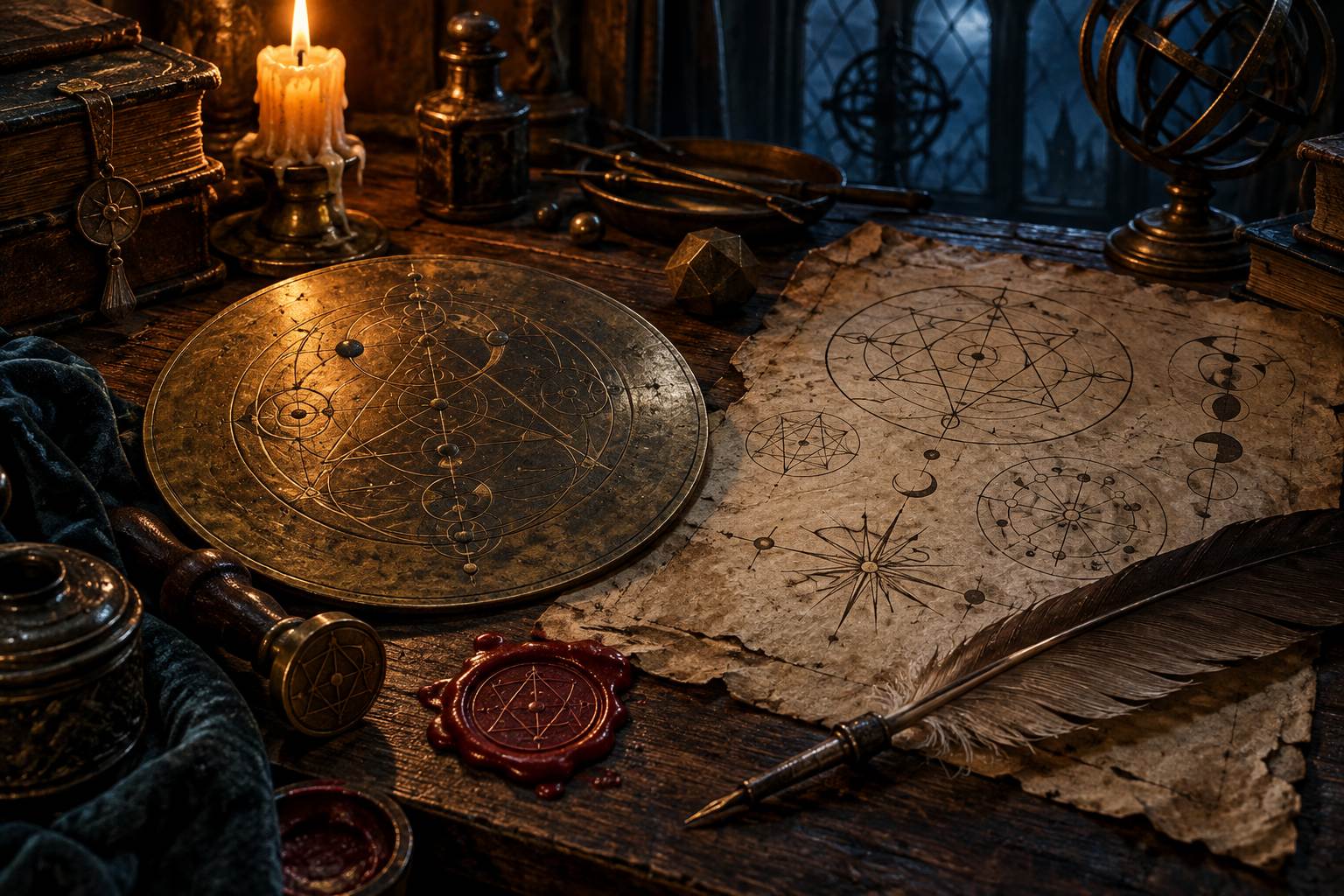
Sigil meaning explained: what a sigil is, where the word comes from, how grimoire seals, planetary sigils and modern sigils differ, and seal vs sigil.
Quick answer: Sigil meaning: a sigil is a symbol regarded as the sign or signature of a spirit, a planet, a name or an intention. The word comes from the Latin sigillum, "little seal." In medieval and Renaissance grimoires, sigils are the seals assigned to angels and demons, such as the seventy-two seals of the Goetia. In the twentieth century, the artist Austin Osman Spare redefined the sigil as a personal glyph condensed from a written wish, a meaning that dominates popular use today.
Related guides: Ars Goetia names and seals, the Seal of Solomon in history, occult symbols and their meanings, amulet vs talisman explained, the 72 Goetia spirits and their seals, pentacles of the Greater Key of Solomon.
| Type of sigil | Period and source | What it represents |
|---|---|---|
| Spirit seal | Medieval and early modern grimoires (Goetia, Key of Solomon) | The identity or signature of a named spirit |
| Planetary sigil | Renaissance; Agrippa's Three Books of Occult Philosophy (1533) | A planet's spirit or intelligence, traced on a magic square |
| Divine seal | Medieval and Renaissance; John Dee's Sigillum Dei Aemeth | Names of God and angels arranged in a protective figure |
| Rose Cross sigil | Late 19th century; Hermetic Order of the Golden Dawn | A name traced over Hebrew letters on a rose diagram |
| Spare-style sigil | Early 20th century; Austin Osman Spare, later chaos magic | A personal intention condensed into an abstract glyph |
| Pop-culture sigil | Contemporary; games, comics, social media | A decorative or narrative mark loosely modeled on the above |
Key Takeaways
A sigil is a symbol that stands for something specific: a spirit, a planet, a divine name, or in modern usage a personal intention. The word is the English form of the Latin sigillum, the diminutive of signum (sign), meaning a small seal or signet. In the Middle Ages, sigillum was the ordinary word for the wax seal on a document, the mark that proved who had issued it. The occult meaning grew out of this legal one: a sigil was the seal of a spirit, the mark that authenticated its name and bound it to the text.
Two senses therefore coexist. In the older sense, found in grimoires from the thirteenth to the seventeenth century, a sigil is a fixed, inherited design attached to a named being, such as the seal of the Goetic spirit Buer or the pentacles of the Key of Solomon. In the newer sense, introduced by the English artist Austin Osman Spare in the early 1900s, a sigil is something a person constructs for themselves, a compressed glyph representing a desire. Both senses are current, and much online confusion comes from mixing them.
The best short definition that covers both: a sigil is a drawn sign treated as the signature of a particular power or purpose.
Seals are among the oldest human technologies. Cylinder seals from Mesopotamia and signet rings from Egypt and Greece impressed an image into clay or wax to mark ownership and authority. A seal already carried a hint of power in antiquity: the Testament of Solomon, a Greek text from the early centuries CE, has the king bind demons with a ring whose engraved seal compels obedience.
Medieval Latin magic developed the concept in two directions. Texts attributed to Solomon, Hermes and other authorities described characteres, angular marks said to belong to angels or planetary spirits, and sigilla, seals to be engraved on rings and metal plates. The Picatrix, a Latin translation of an Arabic astrological manual, transmitted talismanic figures from the Islamic world, where seal-making with magic squares and divine names was already sophisticated.
In 1533, Heinrich Cornelius Agrippa published his Three Books of Occult Philosophy, which printed the seven planetary magic squares and the sigils of their spirits and intelligences. Later, John Dee’s Sigillum Dei Aemeth, a large wax disc covered with names, shows how elaborate a seal could become. By the time the Lesser Key of Solomon was compiled in the seventeenth century, every spirit was expected to have its own seal, and the Ars Goetia’s names, offices and seals fixed the pattern that most people now picture when they hear the word sigil.
Does this touch your own situation? Many readers come to these pages because something in their home, dreams or family feels unexplained. Reading history helps, but it cannot look at your specific case.
Consult the Sheikh Private, confidential, and free to ask.
Sigils are not one thing. The historical record shows several distinct methods, each with its own logic. The descriptions below are historical summaries, not instructions; this site does not provide ritual guidance.
The seals of the Goetia, the Grimoire of Pope Honorius and similar texts are inherited designs copied from manuscript to manuscript. Their origins are mostly unknown. Some may derive from distorted letters or from the characteres of earlier magical alphabets; others seem to have been invented by compilers. What matters within the tradition is that each design is treated as the fixed signature of one spirit.
Agrippa’s method assigns each planet a magic square (the kamea) and converts the letters of a spirit’s name into numbers using Hebrew numerology. A line is traced from cell to cell in the order of those numbers, producing a geometric figure. This procedure has a direct parallel in Islamic talisman-making, where the wafq (magic square) was used with divine names.
The Hermetic Order of the Golden Dawn, founded in 1888, used a diagram of a rose whose petals carried the twenty-two Hebrew letters. A name was traced from letter to letter across the rose, producing a sigil unique to that name.
Spare, writing around 1913, described writing out a sentence of desire, removing repeated letters and fusing the remaining letters into a single abstract glyph, which was then to be forgotten by the conscious mind. The method was adopted by chaos magicians in the late 1970s and 1980s and is the source of nearly every modern “how to make a sigil” article.
The three words overlap, which is why they are so often confused. A symbol is the broadest term: any image that stands for something else, from a national flag to a cross. A seal, in its original sense, is an object or impression that proves authority, like the wax seal on a charter or the Great Seal of a state. A sigil is a drawn sign held to be the signature of a specific power. In grimoire usage, seal and sigil are often interchangeable; Mathers’ Goetia calls the designs “seals,” while modern readers call them sigils.
The Seal of Solomon illustrates the overlap. As a seal, it is the device on the king’s ring in the Testament of Solomon and later lore. As a symbol, it is the hexagram or pentagram associated with him in Islamic, Jewish and European art. As a sigil, it has been treated by some occult writers as a sign that commands spirits. The same image can be all three depending on who is using it and why.
Two further terms are worth knowing. A character in older texts means a magical letter-like mark, often strung into pseudo-alphabets. A pentacle, in the Key of Solomon, is a circular design containing names, verses and figures, closer to a diagram than to a signature.
The most searched sigils are the seventy-two of the Ars Goetia. In the grimoire, each spirit’s seal is described as something to be engraved on a metal disc matched to its rank: gold for kings, copper for dukes, silver for marquises and so on. The text claims that the seal itself compels the spirit; the legend attached to the book says Solomon used these seals to shut the spirits in a brass vessel. Historically, the seals appear in the seventeenth-century Sloane manuscripts and are absent from Johann Weyer’s 1577 catalog of the same spirits, which suggests they were added by the Goetia’s compiler or drawn from a lost intermediate source.
The Key of Solomon (Clavicula Salomonis), an older and separate grimoire, contains no spirit seals at all. Its pentacles are protective and operative designs assigned to the seven planets, filled with Hebrew names and Psalm verses. Readers often lump the two books together, but their approach to symbols is different: the Goetia gives each spirit a signature, the Key gives the operator a set of planetary instruments.
The names and seals of the 72 demons of the Goetia are now reproduced everywhere, on posters, jewelry and game assets. That popularity is why the Goetia has become the default image of a sigil, though it is only one strand of a longer history.
The Islamic world developed an elaborate science of talismanic figures long before the European grimoires. Arabic and Persian manuals describe magic squares, the seven “seals” or signs sometimes called the seal of Solomon in Arabic sources, lunar mansion figures and divine names arranged in geometric patterns. The Picatrix (Ghayat al-Hakim), translated into Latin in the thirteenth century, carried much of this into Europe, and Agrippa’s planetary squares descend from it. Talismans with such figures were worn as amulets.
Ethiopian magic scrolls, produced for individual clients by clergy, combine figures such as the eight-pointed star, interlaced knots called the Net of Solomon, angel images and talismanic script. They show how seal-like designs could be fully integrated into a Christian devotional context.
Hermetic and Neoplatonic philosophy supplied the theory: each planet and spirit had a natural sign, and drawing the sign created a sympathy between image and power. In Southeast Asia, Indonesian and Malay traditions of the khodam, the servant spirit attached to a keris dagger or a person, use Arabic-script talismans and figures on objects, blending Islamic seal-making with local belief. In every case, the sigil is understood as a bridge: a visible sign for an invisible counterpart.
The first is that all sigils are the same kind of thing. A Goetic seal, an Agrippa planetary sigil and a Spare-style wish glyph are three different objects with different histories and rules, and advice about one does not transfer to the others.
The second is that sigils are ancient. The grimoire seals are medieval to early modern; the Spare method is barely a century old. Only the broader idea of a seal with power, as in the Testament of Solomon, reaches back into antiquity.
The third is that a sigil has a universal meaning, like a word in a dictionary. Grimoire seals mean one spirit each within one text; the same design in another book may mean nothing. Pop-culture sigils usually have no traditional meaning at all. The fourth is that sigils are always demonic. The Key of Solomon’s pentacles invoke angels and Psalms, Dee’s seal is covered with divine names, and Ethiopian scrolls are explicitly Christian. Finally, a sigil is not a guarantee of anything. Historical sources make claims about their seals; this site reports those claims and makes none of its own.
Sigil meaning is one of the most searched occult terms because sigils are visually striking and easy to share. They appear as tattoos, in fantasy art, in television series such as Supernatural and in games that borrow Goetic names. Online chaos magic communities have made Spare-style sigils an entry-level practice, which drives much of the interest, along with a wider revival of curiosity about grimoires.
If you want to understand a sigil you have encountered, a few questions sort out most cases.
Read this way, the occult symbols you meet online stop being interchangeable mysteries and become documents with histories. That is the approach this site takes to every seal, sign and sigil it describes.
Still have a question about your own experience? Describe what you are seeing, feeling or dreaming, and when it started. The Sheikh reads every message personally and replies in private.
Want a personal perspective? A sigil began as a signature, a mark standing in for a name, and many people find that the symbols they keep returning to say something about their own path. If you would like to explore that, our partner PuraTarot offers a Full Personal Reading for quiet reflection on your own situation and questions. Join the free Djinn Guide newsletter and, once you confirm, you will unlock a 50% code for your first reading.
Further reading
As an Amazon Associate we earn from qualifying purchases.
A sigil is a symbol treated as the sign or signature of a specific spirit, planet, name or intention. The word comes from the Latin sigillum, a small seal. In grimoires it means the seal of a named spirit; in modern chaos magic it means a personal glyph condensed from a written wish.
A seal is an impression or device proving authority, like a wax seal on a document, and in grimoires the term is used for spirit signatures. A sigil is a drawn sign held to represent a power. In practice the words overlap; Mathers' Goetia says "seal" where modern readers say "sigil."
They first appear in seventeenth-century manuscripts of the Lesser Key of Solomon, such as British Library Sloane 2731 and 3825. Johann Weyer's 1577 catalog of the same spirits has no seals, so the designs were added by the Goetia's compiler or taken from a source that has not survived. Their deeper origins are unknown.
The English artist and occultist Austin Osman Spare, around 1913, described condensing a written desire into an abstract glyph. His approach was adopted by chaos magicians such as Peter J. Carroll in the late 1970s and 1980s, and it underlies most modern popular descriptions of sigils.
Neither by definition. Historical sigils include demonic seals in the Goetia, angelic and divine seals in the Key of Solomon and John Dee's work, Islamic talismans built on divine names, and Christian Ethiopian scroll figures. The meaning depends on the tradition and the text, not on the shape of the sign.
Disclaimer
This article explains the meaning and history of sigils for educational purposes. It describes historical methods without endorsing them or providing ritual instruction, and it makes no claims that any sign, seal or sigil produces an effect.
Did this guide help you understand the subject? Rate it and share your honest opinion to help other readers. Every review is checked by our editors before it appears.
There are no reviews yet. Be the first one to write one.


Sheikh Youssef
Tayeb El Merzouki
For inquiries about personalized spiritual work, private rituals, and traditional talismans, connect directly with Sheikh Youssef Tayeb El Merzouki.
Chat on WhatsApp