





Join Djinn Guide: Get 50% Off a Personal Reading
Get new guides to jinn, folklore and occult history. Confirm your subscription to unlock a 50% code for a first personal reading with our partner PuraTarot.
Discover the unseen
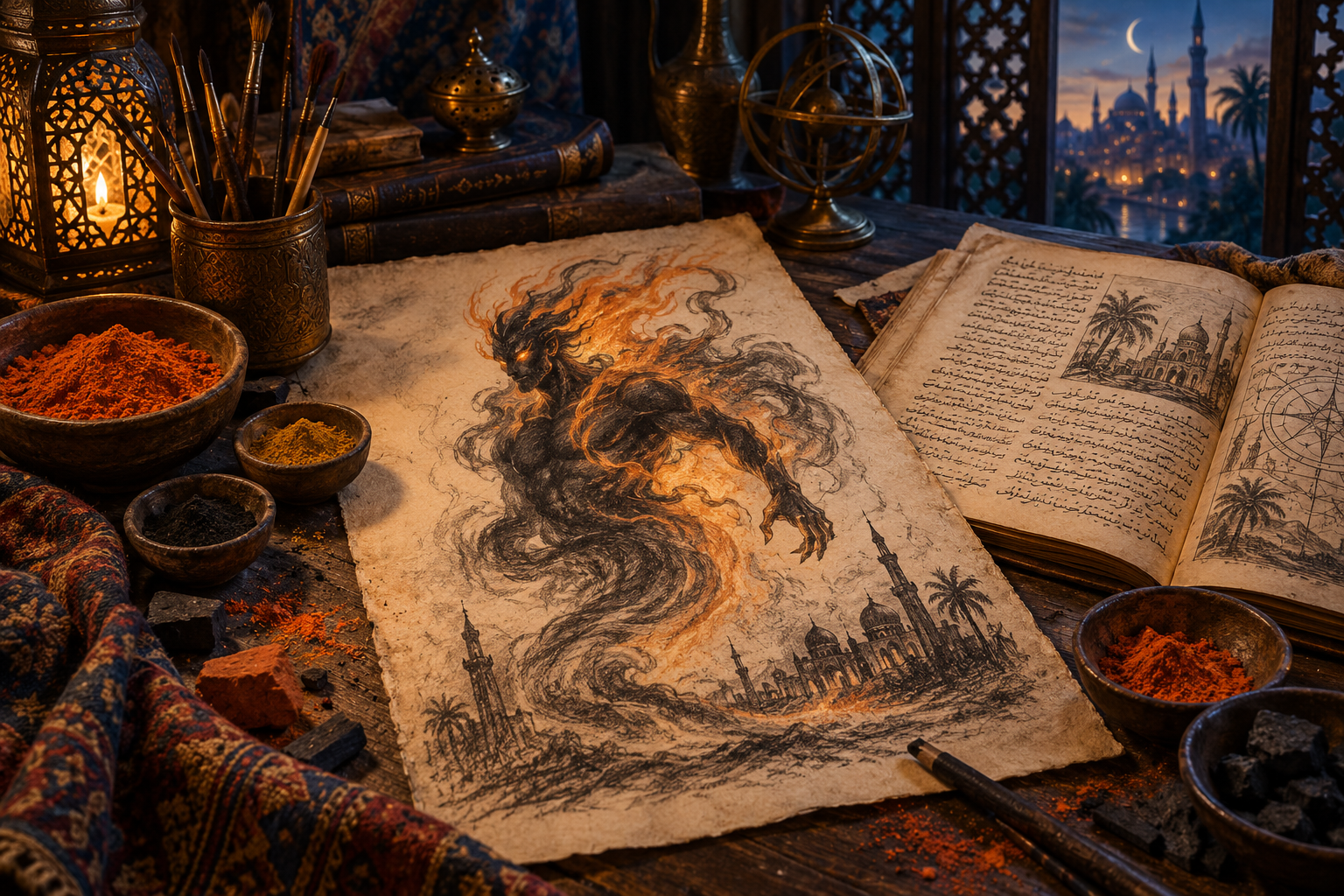
What does an ifrit look like? Compare the Quran, the Arabian Nights, Egyptian folklore and modern art to see where the fiery, horned image came from.
Quick answer: What does an ifrit look like? The earliest source, the Quran, gives no physical description at all: an ifrit of the jinn is named only for its strength. Later storytellers in the Arabian Nights imagined ifrits as towering, smoky giants with cavernous mouths and eyes like lamps, and folklore added shapeshifting. The red-skinned, horned fire demon most people picture today comes mainly from twentieth-century illustration, games and film, not from the classical texts.
Related guides: ifrit meaning in Solomon's court, ifrit vs marid explained, the Fisherman and the Jinni, the main types of jinn, jinn in the Arabian Nights, Surah Al-Jinn explained.
| Source | Date | Ifrit appearance described | Key traits |
|---|---|---|---|
| Quran, Surah An-Naml 27:39 | 7th century CE | None; no physical description | Strength, speed, trustworthiness |
| Classical Arabic lexicons | 8th to 14th century | None; the word is defined by character | Cunning, powerful, rebellious |
| Arabian Nights (Fisherman and the Jinni) | Medieval, printed 18th to 19th c. | Giant rising from smoke, huge limbs, blazing eyes | Size, smoke, menace, shapeshifting |
| Egyptian folklore (Lane, 1836) | 19th century reports | Usually invisible; may appear as animals or people | Ghost-like, tied to places and the dead |
| Islamic manuscript painting | 13th to 16th century | Jinn with animal heads, fangs, tusks, mixed colors | Hybrid, grotesque, courtly |
| Games, comics, film | 20th to 21st century | Red or black skin, horns, flames, muscular build | Fire elemental, boss monster |
Key Takeaways
The honest answer begins with silence. The word ifrit (Arabic ʿifrīt, also spelled afreet or efreet) appears exactly once in the Quran, in Surah An-Naml 27:39, where “an ifrit of the jinn” offers to bring the Queen of Sheba’s throne to Solomon before the king rises from his council. The verse tells us the ifrit is strong and considers itself trustworthy for the task. It says nothing about height, color, horns, wings or fire. The focus is entirely on capability and on Solomon’s authority.
Classical Arabic dictionaries follow the same pattern. Lexicographers gloss ʿifrīt as a powerful, cunning, rebellious being, and some extend the word to describe an unusually sly or forceful human. The term describes a grade of power and temperament within the jinn, not a species with a fixed body. This matters because so much later imagery claims ancient authority it does not have. Anyone asking what an ifrit looks like should know that the oldest texts answer “we are not told.”
What the Quran does provide is the raw material for later imagination. Surah Ar-Rahman 55:15 says jinn were created from a smokeless flame, and Surah Al-Hijr 15:27 speaks of a scorching fire. Those lines, combined with the ifrit’s reputation for strength, gave storytellers and artists a starting point: a being of heat and force that can hide from human eyes. You can read more about the throne episode in our article on the ifrit in Solomon’s court.
Before describing appearance, it helps to settle what is being described. In Islamic tradition, jinn are a class of beings created from fire, possessed of free will, and mostly invisible to humans. Within that broad class, later writers and folklore distinguished several kinds. An ifrit is usually described as one of the stronger and more dangerous grades, often placed just below or beside the marid. The distinction is about power and disposition rather than anatomy.
Because the ranks were never standardized, you will find sources that treat ifrit and marid as near synonyms and others that order them carefully. Our comparison of ifrit vs marid walks through those differences, and our overview of the main types of jinn places both within the wider family of marid, ghul, sila, jann and qareen.
One practical consequence follows from all this. When a story calls a being an ifrit, it is signaling menace and strength to the audience, in the way an English storyteller might say “ogre” or “giant.” The physical details come from the individual narrator, which is why descriptions vary so widely from one tale to the next.
Does this touch your own situation? Many readers come to these pages because something in their home, dreams or family feels unexplained. Reading history helps, but it cannot look at your specific case.
Consult the Sheikh Private, confidential, and free to ask.
The most detailed classical pictures of an ifrit come from the One Thousand and One Nights. In the tale of the Fisherman and the Jinni, a poor fisherman opens a sealed brass bottle and watches smoke pour out, spread across the sky, and gather into a colossal figure. The narrators pile up comparisons: a head like a dome, hands like winnowing forks, legs like ship masts, a mouth like a cavern, and eyes that burn like lamps. The point is overwhelming scale and the sense that the being has condensed out of vapor.
Other Nights stories add further traits. Ifrits fly through the air carrying people or whole buildings, appear and vanish at will, and sometimes take human or animal shape to deceive. In the tale of the Second Kalandar, an ifrit jealously guards an abducted woman in an underground palace and transforms the narrator into an ape. Shapeshifting and flight are therefore as central to the ifrit’s appearance as the giant form, because the giant form is only one option it chooses.
Two cautions apply. First, the Nights is a layered collection with Persian, Indian and Arabic strands, and the tales were edited and expanded for centuries, so no single description is authoritative. Second, the famous English versions by Edward Lane (1838 to 1840) and Richard Burton (1885) shaped the vocabulary that English readers associate with ifrits, including the spelling “afreet.” Our close reading of the Fisherman and the Jinni looks at how the story uses that imagery.
Folklore outside the literary tradition tells a different story. In nineteenth-century Egypt, the scholar Edward Lane recorded that ordinary people used the word afarit (plural of ifrit) for ghost-like spirits, including the spirits of the dead that were believed to linger at the place of a violent death. These afarit were mainly invisible. When they did show themselves, people reported them in the form of cats, dogs, snakes or shadowy human figures rather than giants wreathed in flame.
Similar patterns appear across North Africa and the Levant, where jinn in general are thought to prefer ruins, bathhouses, thresholds and wells. The belief emphasizes presence rather than spectacle: a chill, a sound, a sudden illness, an animal behaving oddly. In this register the question of what an ifrit looks like is almost beside the point, because the being is defined by where it lives and what it does.
The gap between the literary giant and the folkloric shadow is worth keeping in mind. Both are called ifrit, both are jinn, but one belongs to court storytelling and the other to village experience. Readers interested in how such beliefs vary by region can compare our survey of jinn stories across cultures.
Visual art fills the gap that texts leave open, and it has done so in very different ways in different centuries.
Illustrated works such as al-Qazwini’s thirteenth-century cosmography and the fourteenth-century Kitab al-Bulhan show jinn and demons as hybrid creatures: human bodies with animal heads, fangs, tusks, feathers, horns and patchwork colors. These images are rarely labeled “ifrit” specifically, but they established a visual language for powerful jinn that was grotesque and composite rather than simply fiery.
From the eighteenth century, European editions of the Arabian Nights were illustrated by artists who had never seen an Islamic manuscript. They drew ifrits as muscular giants, turbaned and bearded, often emerging from smoke or a bottle. The look borrowed from classical Western giants and demons and set the template for later popular images.
Pulp magazine covers, fantasy art and film in the twentieth century moved the ifrit toward a fire elemental: red or black skin, flames instead of hair, horns and a volcanic setting. This is the image most people now hold.
Role-playing games cast the efreet as a fire genie ruling a city of brass, and video game franchises made Ifrit a recurring flame-wreathed summon or boss. Animation often softens the figure into a comic, lamp-bound genie that owes more to Aladdin than to any ifrit text.
Several ideas circulate widely but have weak roots in the sources. The first is that ifrits are literally made of visible fire. The Quran describes jinn as created from a smokeless flame, which many commentators read as describing their origin or subtle nature, not their everyday appearance. Nothing in scripture says an ifrit glows or burns.
The second is that ifrits have a fixed demonic body with horns and a tail. That design is a modern composite of European devil iconography and fantasy art. The third is that “ifrit” means a specific monster species with one look, when the classical word is closer to a rank or a character type among jinn.
Clearing these away does not make the ifrit less interesting. It simply moves the interest from a stock monster to a layered idea that each era has redrawn.
Most people who ask what an ifrit looks like have met the name in a game, a novel, a television series or a tabletop campaign and want to know where the design came from. Others have encountered the word in religious discussion or in a translated folk tale and want to know whether the fiery monster is the “real” ifrit. A smaller group are writers and artists hoping to portray the being with some cultural accuracy.
For all of these readers the useful takeaway is the same. There is no single canonical ifrit appearance. There is a scriptural ifrit defined by strength, a literary ifrit defined by smoke and scale, a folkloric ifrit defined by haunting and animal forms, and a modern ifrit defined by fire and horns. Each has its own logic, and the modern one is the youngest.
Creators who want to signal respect for the tradition often borrow from the older layers: shapeshifting, flight, invisibility and a connection to ruins and thresholds, rather than the volcanic boss-monster. Those traits are both more faithful to the sources and, arguably, more unsettling than another wall of flame.
If you want to judge any claim about ifrit appearance, start by asking which layer it belongs to. A claim about the Quran should point to 27:39 and nothing more. A claim about the Nights should name the tale and ideally the translation, because Galland, Lane and Burton differ in wording and in which stories they include. A claim about folklore should say where and when it was recorded.
Next, separate description from inference. A text that says an ifrit is strong does not say it is large; a text that says jinn are made from fire does not say they look like fire. Much of the popular image is inference stacked on inference. Finally, treat visual art as evidence of what people imagined, not of what the texts say. A nineteenth-century engraving tells you about nineteenth-century taste.
Djinn Guide describes these beliefs and stories as they appear in their sources; it does not provide ritual instructions or make claims about spirits. For readers new to the subject, the primary scripture on jinn is discussed in our guide to Surah Al-Jinn, and the Solomon episode that introduces the ifrit is covered in our article on Solomon and the Queen of Sheba.
Still have a question about your own experience? Describe what you are seeing, feeling or dreaming, and when it started. The Sheikh reads every message personally and replies in private.
Drawn to these images for a reason? If a dream or a recurring image keeps returning to your thoughts, a Custom Spiritual Session with our partner PuraTarot offers a calm, personal look at your own question. Join the free Djinn Guide newsletter and, once you confirm, you will unlock a 50% code for your first reading.
Further reading
As an Amazon Associate we earn from qualifying purchases.
The Quran gives no physical description. Surah An-Naml 27:39 mentions an ifrit of the jinn who offers to carry the Queen of Sheba's throne to Solomon, and the verse describes only its strength and its claim to be trustworthy. Ideas about size, color, horns or fire come from later stories and modern art, not from scripture.
Islamic tradition says jinn in general were created from a smokeless flame (Surah 55:15). Most commentators treat that as a statement about origin and subtle nature rather than visible appearance. Ifrits in the Arabian Nights are associated with smoke and heat, but the glowing, flame-covered body is largely a twentieth-century fantasy design.
Both are described as powerful classes of jinn. Folklore and later writers often rank the marid as the strongest and the ifrit just below it, though the terms overlap and some stories use them interchangeably. Neither name comes with a fixed physical form; the difference is about power and disposition rather than appearance.
In the Arabian Nights and in regional folklore, yes. Ifrits appear as giants rising from smoke, as humans, as animals such as snakes, dogs or cats, and sometimes as invisible presences. Shapeshifting and flight are among the most consistent traits attributed to them, which is one reason no single appearance can be called definitive.
Modern designs combine the Quranic idea of jinn made from fire with European devil iconography and pulp fantasy art. Role-playing games and video games fixed the image of a muscular, flame-wreathed fire elemental, and later media copied it. The look is effective on screen but is only loosely related to the older textual and folkloric ifrit.
Disclaimer
This article describes religious texts, folklore and artistic traditions for educational and cultural interest. Beliefs about jinn and ifrits are presented as beliefs held within their traditions, not as claims of fact, and no ritual guidance or outcome is offered or implied.
Did this guide help you understand the subject? Rate it and share your honest opinion to help other readers. Every review is checked by our editors before it appears.
There are no reviews yet. Be the first one to write one.


Sheikh Youssef
Tayeb El Merzouki
For inquiries about personalized spiritual work, private rituals, and traditional talismans, connect directly with Sheikh Youssef Tayeb El Merzouki.
Chat on WhatsApp