





Join Djinn Guide: Get 50% Off a Personal Reading
Get new guides to jinn, folklore and occult history. Confirm your subscription to unlock a 50% code for a first personal reading with our partner PuraTarot.
Discover the unseen
King Solomon and demons explained: what the Bible, Josephus, the Testament of Solomon, the Talmud and the Quran say about his power over jinn and spirits.
Quick answer: King Solomon and demons are linked in a tradition that grew in stages. The Hebrew Bible praises Solomon's wisdom but never mentions demons. Jewish writers of the first centuries CE, including Josephus and the author of the Testament of Solomon, added that God gave him power over spirits through a ring. The Quran states that jinn and devils worked for Solomon by God's permission, building and diving for him. Medieval grimoires like the Key of Solomon and the Goetia later claimed to preserve his methods.
Related guides: the Testament of Solomon explained, the ring of Solomon, Seal of Solomon history, the Ars Goetia and its 72 spirits, shedim in Jewish tradition, Solomon and the Queen of Sheba.
| Source | Approximate date | What it says about Solomon and spirits |
|---|---|---|
| 1 Kings 3–11; 2 Chronicles 1–9 | First millennium BCE | Solomon receives wisdom from God, builds the Temple, speaks of plants and animals; no demons mentioned |
| Wisdom of Solomon 7:17–21 | 1st century BCE to 1st century CE | Solomon's God-given knowledge includes the natures of animals and the powers of spirits |
| Josephus, Antiquities 8.2.5 | c. 93–94 CE | God taught Solomon the art against demons; a Jewish exorcist named Eleazar used Solomon's methods and a ring |
| Testament of Solomon | 1st–5th century CE, Greek | Archangel Michael gives Solomon a ring with a seal; he interrogates demons and makes them build the Temple |
| Quran 21:81–82; 27:17; 34:12–14; 38:35–38 | 7th century CE | Jinn and devils build, dive, and labor for Solomon by God's permission; the Quran rejects claims that he practiced magic |
| Babylonian Talmud, Gittin 68a–b | c. 3rd–6th century CE | Solomon captures Ashmedai, king of demons, with a chain and ring to obtain the shamir; Ashmedai later usurps his throne |
| Key of Solomon; Lemegeton | 14th–17th century CE | Grimoires attributed to Solomon claiming to transmit his ritual authority over spirits |
Key Takeaways
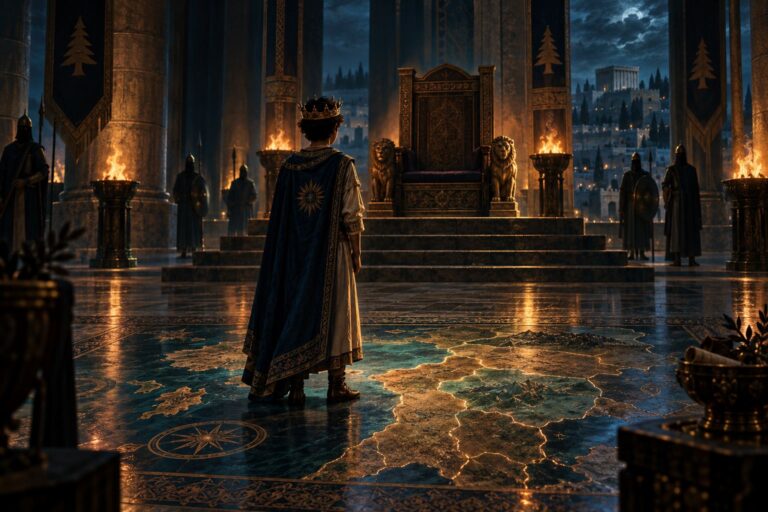
The historical starting point is the biblical portrait of Solomon in 1 Kings and 2 Chronicles. There, Solomon asks God for an understanding heart and receives wisdom beyond all other men (1 Kings 3:9–12). He composes three thousand proverbs and a thousand and five songs, and he speaks about trees, animals, birds, reptiles, and fish (1 Kings 4:32–33). He builds the Temple in Jerusalem with human labor, Phoenician craftsmen, and timber from Lebanon. At the end of his life he turns toward the gods of his foreign wives, and the kingdom is divided after his death.
Nowhere in these books does Solomon control demons, own a magic ring, or command spirits. The idea of king Solomon and demons is therefore not biblical in the narrow sense. It grew from two seeds in the text: Solomon’s unmatched wisdom, which later readers took to include secret knowledge of the unseen, and his mastery of nature, which readers extended to the spirits believed to inhabit it. The Bible’s note that he knew about animals and plants became, in later imaginations, knowledge of the natures of all created things.
By the first century BCE, the Wisdom of Solomon, a Greek book of the Septuagint, has Solomon say that God gave him knowledge of the structure of the world, the cycles of the year, the natures of animals, the tempers of beasts, and the powers of spirits (7:17–21). That phrase is the bridge between the biblical sage and the later master of demons.
The Jewish historian Josephus, writing around 93–94 CE, is the first author to state plainly that God enabled Solomon to learn the art that works against demons for the benefit of humans, and that Solomon composed incantations and left behind methods of exorcism. Josephus adds a story he says he witnessed: a Jew named Eleazar cured possessed men in the presence of the emperor Vespasian by holding a ring under the sufferer’s nose, with a root prescribed by Solomon set under its seal, and drawing the demon out through the nostrils.
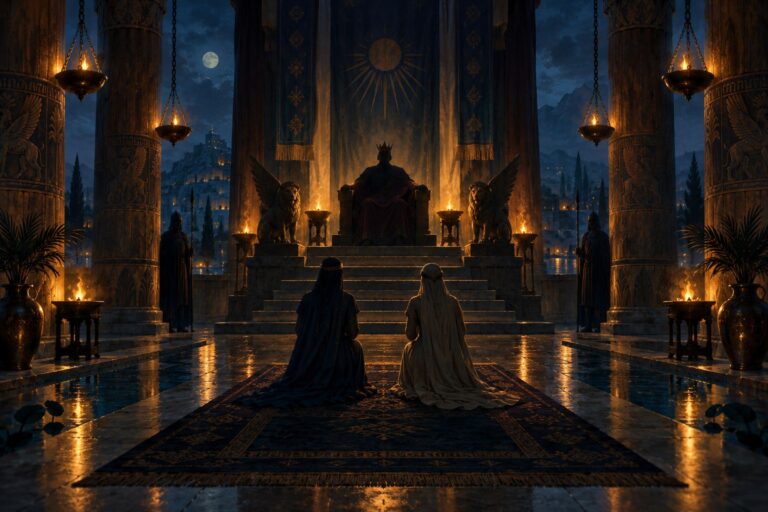
The fullest early account is the Testament of Solomon, a Greek pseudepigraphal text composed somewhere between the first and fifth centuries CE and probably compiled over time. In it, a demon called Ornias torments a boy working on the Temple. Solomon prays, and the archangel Michael brings him a ring engraved with a seal. With the ring Solomon summons demons one by one, learns their names, the harm they do, and the angels that thwart them, and sets them to work on the Temple. Among them are Beelzeboul, Asmodeus, and a female demon called Obyzouth who strangles infants. The book ends with Solomon losing his power after he sacrifices to foreign gods for the love of a woman. Our full summary is in the Testament of Solomon explained.
The Testament is the source of the ring, the seal, and the pattern of Solomon interrogating spirits that later grimoires copied. It also shows that the earliest demon-master Solomon was a figure of Jewish and Christian folk religion, closer to an exorcist than to a magician.
Does this touch your own situation? Many readers come to these pages because something in their home, dreams or family feels unexplained. Reading history helps, but it cannot look at your specific case.
Consult the Sheikh Private, confidential, and free to ask.
The Quran addresses Solomon (Sulayman) in several passages and takes the tradition of his power over spirits for granted while redefining it. Surah Al-Anbiya 21:81–82 says the wind ran at his command and that among the devils (shayatin) were those who dived for him and did other work, while God kept watch over them. Surah Saba 34:12–14 adds that jinn labored before him by his Lord’s permission, making whatever he wished of sanctuaries, images, basins like reservoirs, and fixed cauldrons, and that any jinn who turned from God’s command was made to taste punishment.
The same chapter tells how Solomon’s death was concealed: he remained standing, supported by his staff, until a creature of the earth gnawed through it and he fell, at which point the jinn realized that if they had known the unseen they would not have continued in humiliating labor. Surah Sad 38:35–38 records Solomon’s prayer for a kingdom no one after him would have, and the answer: the wind, and the devils, every builder and diver, and others bound in fetters. Surah An-Naml 27:17 describes his hosts of jinn, men, and birds, and 27:38–40 the ifrit who offers to fetch the Queen of Sheba’s throne, discussed in our article on Solomon and the Queen of Sheba.
Equally important is what the Quran denies. Surah Al-Baqarah 2:102 says that people followed what the devils recited during Solomon’s reign, that Solomon did not disbelieve, but the devils disbelieved and taught people magic. Solomon jinn Quran passages thus present his authority as a prophetic gift from God, exercised over beings who serve under compulsion, and they explicitly separate him from sorcery.
Rabbinic literature developed its own version. The most famous passage is in the Babylonian Talmud, Gittin 68a–b. Solomon needs the shamir, a miraculous creature or stone that cuts rock, in order to build the Temple without iron tools. He learns that Ashmedai, king of the demons, knows where it is. His officer Benayahu captures Ashmedai by substituting wine for the water in the demon’s cistern and binding him with a chain and a ring engraved with the divine Name.
Ashmedai is brought to Jerusalem and the shamir is obtained. Later, Solomon unwisely hands Ashmedai the ring and is flung hundreds of miles away, while the demon takes his throne and his likeness. Solomon wanders as a beggar, insisting he is the king, until the rabbis grow suspicious of the impostor’s behavior and Solomon is restored. The story is a meditation on the fragility of power and the danger of relying on demons, which is a very different lesson from the grimoires’ promise of control.
Jewish tradition also preserved the shedim, spirit-beings with some resemblance to jinn, and Ashmedai’s name reappears as Asmodeus in the Testament of Solomon, the Book of Tobit, and eventually the Ars Goetia. Readers interested in this strand can continue with our article on shedim in Jewish tradition.
Each later community reshaped the Solomon legend for its own needs. A short breakdown shows the range.
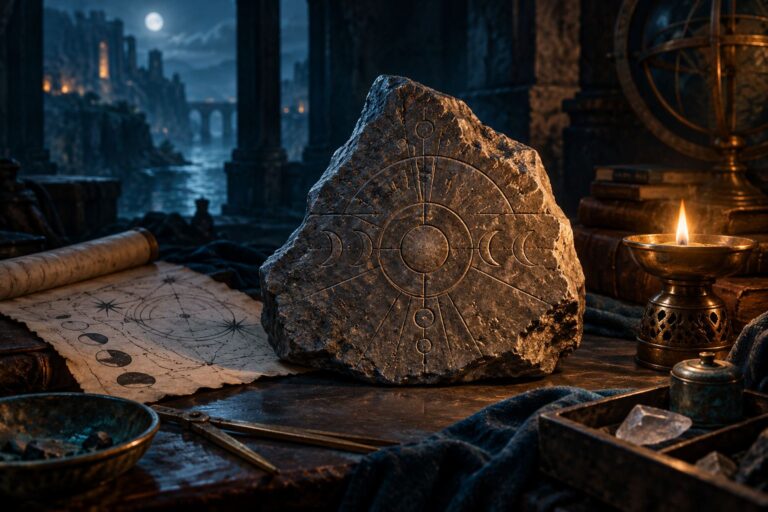
Greek and Aramaic amulets and magic bowls from the third to seventh centuries invoke the seal of Solomon against demons. Many show Solomon as a horseman spearing a female demon, a popular image in Byzantine Palestine and Egypt.
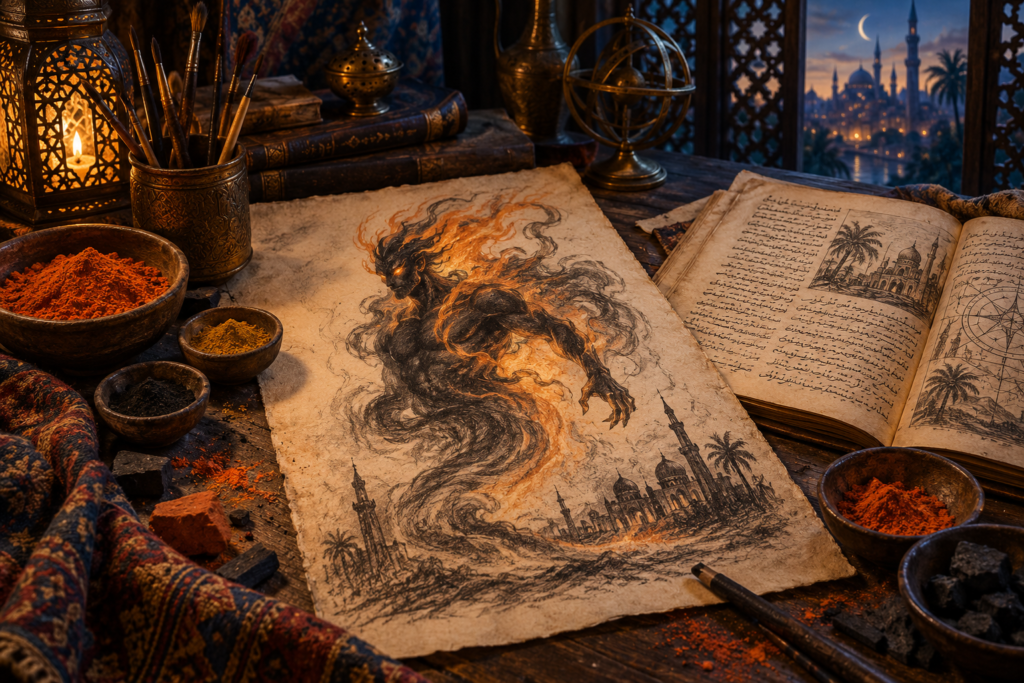
The stories of the prophets literature and the Arabian Nights expanded the Quranic picture with jinn imprisoned in brass bottles stamped with Solomon’s seal, jinn kings ruling under him, and the tale of the devil Sakhr who stole his ring and ruled in his place, a close cousin of the Ashmedai story. The seven kings of the jinn tradition belongs here as well.
Byzantine and Ethiopian Christians kept Solomon as a master of demons in prayers and scrolls, and the Ethiopian Net of Solomon tradition uses his name in protective texts.
From the fourteenth century onward, handbooks of ritual magic circulated under his name, above all the Clavicula Salomonis, the Key of Solomon, and in the seventeenth century the Lemegeton with its Ars Goetia of 72 spirits. Their frame stories say Solomon sealed demons in a vessel that was later opened by curious Babylonians. None of these books has any historical connection to the biblical king.
Because so many layers exist, a few confusions are common.
Keeping these straight is not pedantry. It is the difference between knowing what a religion teaches and knowing what later storytellers imagined.
Solomon controlled demons, in the popular imagination, because the idea answers a deep wish: that wisdom and righteousness, not brute force, can master chaos. The Temple built by subdued spirits is a picture of order imposed on disorder. The ring from heaven is a picture of authority that is granted rather than seized. The fall of Solomon, whether through foreign gods or through handing the ring to Ashmedai, is a warning that such authority can be lost in a moment of pride or weakness. These themes gave the story life in synagogues, mosques, churches, and markets for two thousand years.
Today the legend reaches people through games, novels, and films that use the Goetia’s demons, through Quran study, and through interest in the Seal of Solomon as a symbol. If you want to understand it rather than just enjoy it, read the sources in the order they were written: 1 Kings, the Wisdom of Solomon, Josephus, the Testament of Solomon, the Talmud passage in Gittin, and the Quranic verses listed in the table above. Notice how each adds something and how the moral changes.
Finally, remember that the grimoires are the last and least reliable layer. They are fascinating documents of early modern belief, and this site describes them as such, but they are not evidence about the historical Solomon, and we do not provide their ritual instructions. For the symbol most closely tied to this whole tradition, see the history of the Seal of Solomon.
Still have a question about your own experience? Describe what you are seeing, feeling or dreaming, and when it started. The Sheikh reads every message personally and replies in private.
Curious how this applies to your own life? Solomon’s legend is ultimately about wisdom and how it is used. If you are weighing a question of your own, a Full Personal Reading with our partner PuraTarot offers a quiet, personal perspective. Join the free Djinn Guide newsletter and, once you confirm, you will unlock a 50% code for your first reading.
Further reading
As an Amazon Associate we earn from qualifying purchases.
The Hebrew Bible never says so; it describes his wisdom and Temple-building with human labor. The claim that God gave Solomon power over demons appears in Jewish writings of the Roman period, especially Josephus and the Testament of Solomon, and the Quran states that jinn worked for him by God's permission. Whether this happened is a matter of religious belief.
The Quran says the wind and the jinn were made subject to Solomon by God, that jinn built sanctuaries, images, and basins for him, and that devils dived and labored for him under God's watch (21:81–82; 34:12–14; 38:35–38). It also insists Solomon never disbelieved or practiced magic (2:102).
The earliest references are in Josephus, who describes a Jewish exorcist using a ring with Solomon's methods, and in the Testament of Solomon, where the archangel Michael gives Solomon a ring engraved with a seal. The Talmud and Islamic storytelling tell of the ring being stolen by a demon. Neither the Bible nor the Quran describes the ring.
Ashmedai is the king of demons in the Babylonian Talmud (Gittin 68a–b). Solomon has him captured with a chain and a ring bearing the divine Name to learn the location of the shamir, which cut the Temple stones. Later Ashmedai seizes the ring, flings Solomon far away, and rules in his likeness until Solomon is restored.
No. The Ars Goetia is part of the Lemegeton, compiled in English in the seventeenth century from sixteenth-century sources such as Johann Weyer's list of demons. Attributing magical books to Solomon was a convention that gave them authority. Its 72 spirits do not appear in the Bible, the Quran, or the Testament of Solomon.
Disclaimer
This article surveys scripture, commentary, and legend about King Solomon and spirits for educational and historical purposes. Beliefs are described as their traditions hold them, not endorsed, and the site does not offer instructions for any ritual practice.
Did this guide help you understand the subject? Rate it and share your honest opinion to help other readers. Every review is checked by our editors before it appears.
There are no reviews yet. Be the first one to write one.


Sheikh Youssef
Tayeb El Merzouki
For inquiries about personalized spiritual work, private rituals, and traditional talismans, connect directly with Sheikh Youssef Tayeb El Merzouki.
Chat on WhatsApp