





Join Djinn Guide: Get 50% Off a Personal Reading
Get new guides to jinn, folklore and occult history. Confirm your subscription to unlock a 50% code for a first personal reading with our partner PuraTarot.
Discover the unseen
Ethiopian magic scrolls explained: who made these parchment prayer scrolls, what the Net of Solomon and other talismanic images mean, and how to read them.
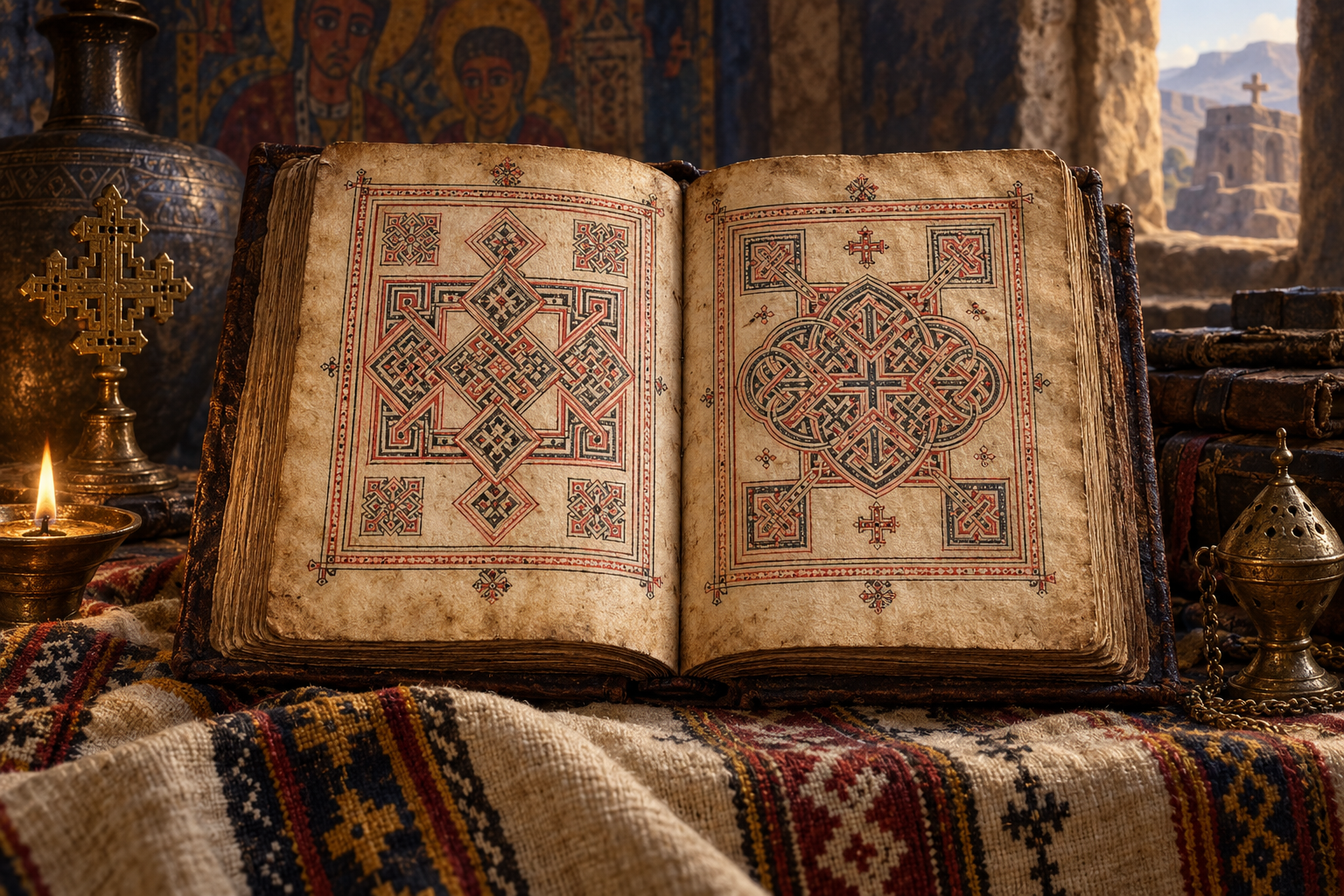
Quick answer: Ethiopian magic scrolls are long parchment strips, written in the Ge'ez language by clerical scholars called debtera, that combine protective prayers, secret names of God and talismanic images meant to guard a person against illness, the evil eye and harmful spirits. They were usually made to the height of the client and worn or hung at home. Their most distinctive image, the Net of Solomon, is a lattice design that tradition says traps demons, echoing the legend of King Solomon's power over spirits.
Related guides: Seal of Solomon meaning and history, amulet vs talisman explained, Solomon and the Queen of Sheba, King Solomon and the demons, occult symbols and their meanings, Testament of Solomon explained.
| Image | Typical form | Traditional meaning | Related story or source |
|---|---|---|---|
| Net of Solomon | Interlaced lattice or grid, often in red and black | A trap that catches and holds demons | Legend of Solomon binding spirits |
| Talismanic face or eyes | Frontal face with large eyes, sometimes inside an eight-pointed star | Stares down the evil eye and hostile spirits | Apotropaic eye tradition across the Horn of Africa and Near East |
| Archangel with sword | Winged figure, raised sword, large eyes | Protection by Michael, Gabriel, Raphael or Fanuel | Ethiopian Orthodox devotion to archangels |
| Saint on horseback | Rider spearing a figure beneath the horse | Saint Susenyos defeating the child-killing spirit Werzelya | Legend of Susenyos, recited to protect mothers and infants |
| Cross and seal designs | Interlaced crosses, circles, knots | Divine power sealing the scroll's prayers | Ethiopian cross iconography; Solomonic seals |
| Bound demon | Chained or caged figure with distorted features | The enemy made harmless by the scroll's names and prayers | Exorcism prayers, Testament of Solomon tradition |
Key Takeaways
Ethiopian magic scrolls, sometimes called Ethiopian prayer scrolls or healing scrolls, are narrow strips of parchment covered in Ge’ez text and painted images, rolled up and kept in a leather or cloth case. They belong to the Ethiopian Orthodox Christian world and were produced for individual clients by debtera, the unordained church scholars who serve as cantors, scribes, teachers and, in this role, makers of protective texts. A typical scroll is a few inches wide and several feet long, made from two or three pieces of parchment sewn end to end.
The purpose of a scroll was protection and healing. A person suffering from illness, infertility, nightmares, misfortune or what was understood as spirit attack would consult a debtera, who would prepare a scroll addressed to that person’s situation. Tradition holds that the parchment was often cut from the skin of an animal sacrificed for the client, and that the scroll was made to match the client’s height so that the protection covered the whole body. The finished scroll was worn rolled in its case, hung by the bed, or unrolled and read aloud.
The term “magic” is a Western label. Within Ethiopian tradition the scrolls are prayers, and they are full of Christian material: the names of God, invocations of the Trinity, the archangels and the saints. What makes them distinctive, and what draws the attention of art historians, is the way text and talismanic images work together as a single protective object.
The debtera occupy a particular place in Ethiopian religious life. They are trained in the church schools in Ge’ez, chant, poetry and sometimes in the esoteric literature of names and prayers, but they are not priests. This dual position, inside the church yet outside its sacramental hierarchy, allowed them to produce scrolls that the clergy might regard with suspicion while ordinary people, including clergy, continued to commission them.
Most scrolls in museum and library collections date from the eighteenth to the twentieth centuries, though the prayers they contain are older and some manuscript prayer books with similar material go back several centuries further. The practice continued through the twentieth century and has not entirely disappeared. European collectors began acquiring scrolls in the nineteenth century, and large groups are now held in institutions in Britain, France, the United States and Ethiopia itself.
The French scholar Jacques Mercier, whose studies in the 1970s and 1990s brought the scrolls to a wider audience, described their imagery as talismanic art: images whose function is not to illustrate but to act, by being looked at and by being present. That framing has shaped how the scrolls are now exhibited and discussed.
Does this touch your own situation? Many readers come to these pages because something in their home, dreams or family feels unexplained. Reading history helps, but it cannot look at your specific case.
Consult the Sheikh Private, confidential, and free to ask.
Among the images on Ethiopian magic scrolls, the one that most often draws questions is the Net of Solomon. It appears as a dense lattice or grid, usually interlaced in red and black, sometimes square, sometimes forming a larger geometric figure, and often paired with faces or eyes at the intersections. The traditional explanation is that the net catches demons: a harmful spirit drawn toward the scroll’s owner is tangled and held in the lattice, where the prayers around it can bind or expel it.
The name points to the broader legend of King Solomon as the ruler of spirits, a story Ethiopia shares with Jewish, Christian and Islamic tradition. Ethiopian Christianity has an especially strong Solomonic identity. The Kebra Nagast, the fourteenth-century national epic, tells how the Queen of Sheba, called Makeda, visited Solomon and bore his son Menelik, founder of the Ethiopian royal line. Solomon’s power over demons, familiar from the Testament of Solomon and related texts, was therefore part of the country’s own sacred history.
The net is best understood alongside the better known Seal of Solomon. Where the seal is a compact sign of authority, the net is an image of capture. Both express the same idea, that disorderly spirits can be constrained by divinely granted power, in different visual forms. For Ethiopia’s own version of the Solomon and Sheba story, see our article on Solomon and the Queen of Sheba.
A scroll is a composite object, and reading one means recognizing its parts.
Lists of asmat, hidden or powerful names, are the engine of the scroll’s protection. Tradition holds that these names were revealed to the righteous and that pronouncing or carrying them repels harm. Many are Ge’ez forms of Hebrew, Greek and Arabic divine names.
Prayers address the Trinity, the Virgin Mary, the archangels Michael, Gabriel, Raphael and Fanuel, and saints known for defeating demons. Prayers against specific afflictions, such as the evil eye, headache, fever and the spirits that trouble women in childbirth, are chosen according to the client’s need.
One of the most common texts tells of Saint Susenyos, a mounted warrior saint, who pursues and defeats Werzelya, a female spirit who kills children, including his own sister’s child. The story ends with Werzelya swearing that she will not approach any place where the saint’s name and story are present. Scrolls made for mothers and infants often center on it.
Painted panels between the texts show frontal faces with enormous eyes, archangels with drawn swords, the saint on horseback spearing the demon, interlaced crosses, and the Net of Solomon. The eyes are the key: tradition says the scroll looks back at the enemy, overpowering the evil eye with a stronger gaze.
The scrolls are an Ethiopian expression of a protective tradition found across the Red Sea and the Near East. Jewish amulets with divine names and angel invocations, Islamic talismans inscribed with Quranic verses and the Seal of Solomon, Coptic prayer papyri and Byzantine protective medallions all share the same logic: sacred words and signs, carried on the body or placed in the home, guard the bearer against unseen harm. Ethiopia, with its ancient ties to Jewish tradition, early adoption of Christianity and long contact with the Islamic world, drew on all of them.
What distinguishes the Ethiopian form is scale and format. Most amulets elsewhere are small, folded or worn in a capsule. The Ethiopian scroll is life-sized, unrolled, read and looked at. It is at once amulet, prayer book and painting. Our comparison of amulets and talismans places it within that broader history of protective objects.
The scroll also belongs to Ethiopia’s medical history. Debtera were, in effect, healers, and a scroll was often one part of a treatment that could also include herbal remedies, holy water and prayer at a church. Understanding the scrolls as part of a healing practice, rather than as isolated magical objects, is closer to how their makers and owners understood them.
The word magic leads many people to expect spells, curses or pacts with spirits. The scrolls contain none of these. They are defensive, Christian in content, and framed as prayer. The names and images are meant to repel and bind harmful spirits, not to call them. Where a demon is depicted, it is shown defeated, chained or caught in the net.
A second misunderstanding is that the Net of Solomon is a uniquely Ethiopian invention. The image is distinctively Ethiopian in style, but the idea behind it, Solomon’s binding of demons, is shared across the region, and lattice and knot designs with protective meaning appear in many cultures. A third is that the scrolls are ancient. Most surviving examples are from the last three centuries, though they transmit older texts.
Interest in Ethiopian magic scrolls has grown with museum exhibitions, art books and online collections that make their striking imagery easy to see. Collectors and art historians value them as a tradition of painting largely independent of European influence. Students of religion see them as a living example of how Christianity absorbed older protective practices. Designers and tattoo artists borrow their faces and lattices, often without knowing what they mean.
For members of the Ethiopian diaspora the scrolls can be family objects, inherited from grandparents, and searches often begin with a wish to understand an heirloom. Readers interested in the occult meet the Net of Solomon through comparisons with Solomonic seals and grimoires and want to know how the Ethiopian material relates. Our survey of occult symbols and their meanings covers the broader family of signs the net belongs to.
Djinn Guide treats the scrolls as cultural and religious history. The beliefs they express, that names and images can protect a person, are reported here as beliefs held within Ethiopian Christian tradition. The site does not sell, make or provide instructions for protective objects, and makes no claim about their effects.
If you encounter a scroll in a museum, a book or a family collection, a few steps make it legible even without Ge’ez. Start with the physical object: note the number of parchment pieces, the seams, the overall length and whether a case survives, since these tell you how it was made and used. Then look for the painted panels and identify them by type: a frontal face or pair of eyes, an angel with a sword, a horseman over a fallen figure, a cross, a lattice.
Next, consider the owner. Scrolls for women often feature Susenyos and prayers for childbirth; scrolls for men more often emphasize the archangels and protection against the evil eye. A named owner is sometimes written into the prayers, and a catalog entry may record it. Finally, place the scroll in time. Pigments, parchment preparation and the style of the faces help specialists date it, and most fall between the eighteenth and twentieth centuries.
Approached this way, the scroll stops being an exotic curiosity and becomes a document of a person’s fears, hopes and faith, expressed through a visual language that connects Ethiopia to the long tradition of Solomon as protector against the unseen. That connection is the thread this site follows across many cultures.
Still have a question about your own experience? Describe what you are seeing, feeling or dreaming, and when it started. The Sheikh reads every message personally and replies in private.
Drawn to these images for a reason? If the scrolls’ lattice designs have stirred a question about your own path, a Full Personal Reading with our partner PuraTarot offers a quiet, personal way to reflect on it. Join the free Djinn Guide newsletter and, once you confirm, you will unlock a 50% code for your first reading.
Further reading
As an Amazon Associate we earn from qualifying purchases.
They were made to protect and heal an individual. A debtera prepared a parchment scroll with prayers, secret names of God, invocations of archangels and saints, and talismanic images, chosen for the client's affliction: illness, the evil eye, nightmares, infertility or spirit attack. The scroll was worn in a case or hung at home.
The Net of Solomon is a lattice or grid image painted on Ethiopian magic scrolls. Tradition says it traps harmful spirits that approach the owner, so that the surrounding prayers can bind them. The name reflects the legend, shared across Jewish, Christian and Islamic traditions, that King Solomon had power to capture and control demons.
Debtera, the unordained scholars of the Ethiopian Orthodox Church, made them. Trained in Ge'ez, chant and religious literature, they also served as scribes and healers. Their position inside the church but outside the priesthood allowed them to produce scrolls that clergy sometimes disapproved of while ordinary people continued to commission them.
They are written in Ge'ez, the classical liturgical language of Ethiopian Christianity, in a script that runs left to right. Owners usually spoke Amharic, Tigrinya or another modern language, so the text was read aloud by the debtera or kept as a sacred object rather than read by the owner.
Most surviving scrolls date from the eighteenth to the twentieth centuries, and the practice continued into recent decades. The prayers, names and legends they contain are considerably older, drawing on medieval Ethiopian manuscripts and on protective traditions shared with the Jewish, Coptic and Islamic worlds.
Disclaimer
This article describes an Ethiopian Christian protective tradition for educational and cultural purposes. The beliefs about spirits, names and images are presented as beliefs held within that tradition, and no claim is made that any scroll or image produces a result.
Did this guide help you understand the subject? Rate it and share your honest opinion to help other readers. Every review is checked by our editors before it appears.
There are no reviews yet. Be the first one to write one.


Sheikh Youssef
Tayeb El Merzouki
For inquiries about personalized spiritual work, private rituals, and traditional talismans, connect directly with Sheikh Youssef Tayeb El Merzouki.
Chat on WhatsApp