





Join Djinn Guide: Get 50% Off a Personal Reading
Get new guides to jinn, folklore and occult history. Confirm your subscription to unlock a 50% code for a first personal reading with our partner PuraTarot.
Discover the unseen
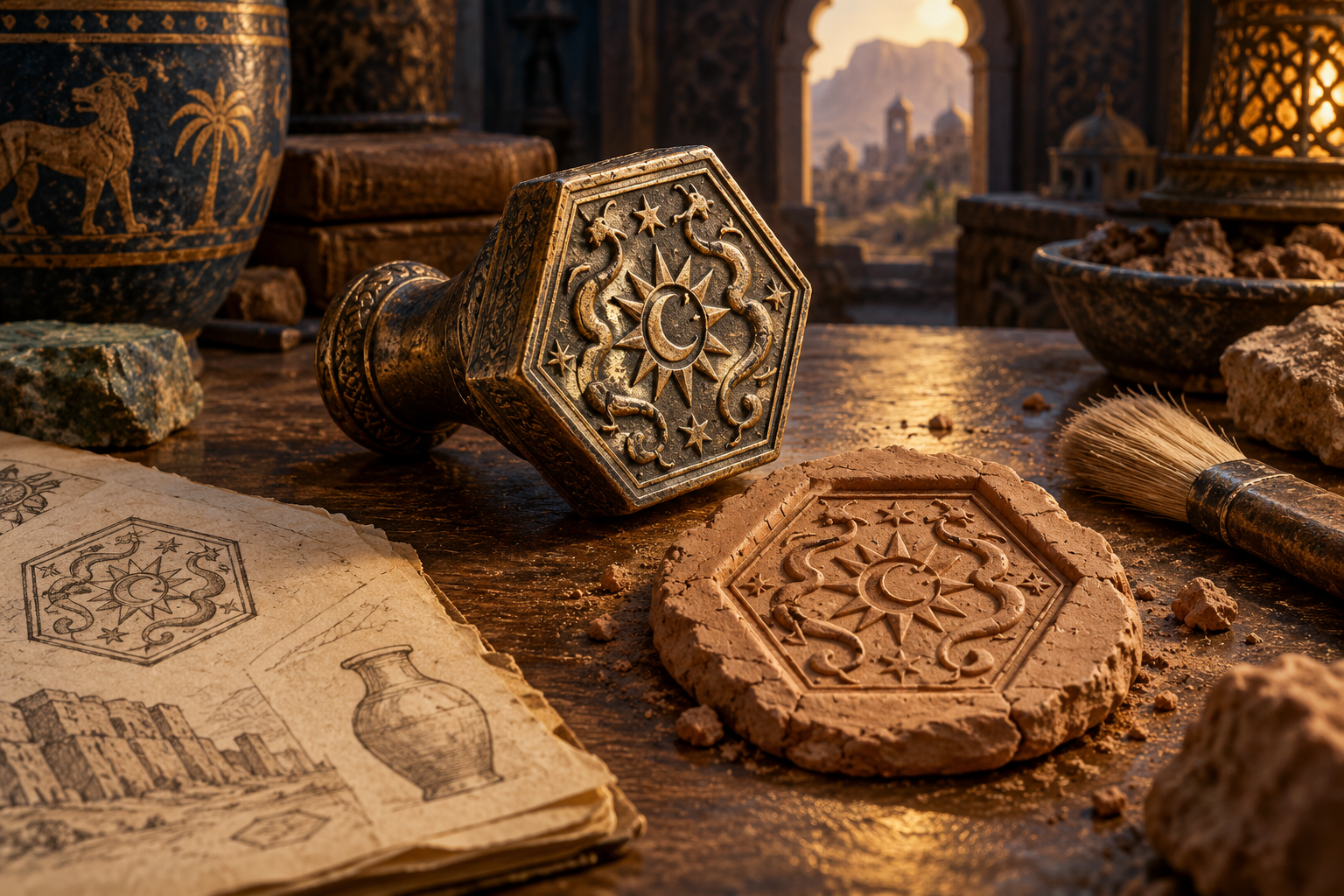
Seal of Solomon explained: what the symbol means, where the ring legend began, hexagram vs pentagram, and how Jewish, Islamic and occult sources use it.
Quick answer: The Seal of Solomon is the legendary signet ring, and the emblem engraved on it, that tradition says gave King Solomon authority over jinn, demons and the natural world. In Jewish, Islamic and later European sources the emblem is usually drawn as a six-pointed star (hexagram) or sometimes a five-pointed star (pentagram). The seal appears in the Testament of Solomon, in Islamic commentary and folklore, in the Arabian Nights, and on amulets and grimoires across centuries.
Related guides: Seal of Solomon vs Star of David, the Ring of Solomon in the Testament, Testament of Solomon explained, Solomon's seal in the Fisherman and the Jinni, King Solomon and the jinn, Net of Solomon in Ethiopian scrolls.
| Tradition | Main sources | Usual form | What the seal means |
|---|---|---|---|
| Hellenistic Jewish / early Christian | Testament of Solomon (c. 1st to 5th century CE) | Engraved ring; some manuscripts describe a pentalpha | Divine authority to bind demons and build the Temple |
| Islamic | Quran commentary, hadith literature, Arabian Nights | Khatam Sulayman, hexagram or pentagram | God-given kingship over jinn, wind and animals |
| Jewish medieval | Kabbalistic amulets, Prague community flag (14th century) | Hexagram (Magen David) | Protective emblem; later a communal symbol |
| European grimoires | Key of Solomon, Lesser Key of Solomon | Pentacles, hexagram, 'Secret Seal' | Tools for the magician's claimed authority over spirits |
| Ethiopian Christian | Prayer scrolls and talismanic art | Net of Solomon lattice | Protective design against harmful spirits |
| Modern states and crafts | Flags, coins, architecture, jewelry | Pentagram (Morocco) or hexagram | National or decorative emblem; protective charm |
Key Takeaways
The Seal of Solomon is best understood as two linked things. First, it is a story: King Solomon, son of David, was granted a signet ring by God, and with it he could command spirits, speak with animals, and direct the wind. Second, it is a symbol: the emblem engraved on that ring, most often drawn as a six-pointed star formed by two overlapping triangles, and sometimes as a five-pointed star. When people ask what the Seal of Solomon means, they usually want both the legend and the shape.
The underlying meaning is consistent across traditions. The seal stands for authority delegated from God to a righteous king, and by extension for protection against harmful unseen forces. In Jewish and Christian sources that authority is over demons; in Islamic sources it is over jinn and the wider created order. The seal is never presented as Solomon’s own power. It is a sign of a grant, which is why every version of the story includes the possibility of the ring being lost or taken away.
Because the emblem is simple to draw, it traveled easily. It appears on medieval coins, mosque tiles, synagogue decoration, Ethiopian prayer scrolls, European grimoires and modern flags. Each context added its own layer of meaning while keeping the central association with Solomon’s wisdom and command.
The Hebrew Bible praises Solomon’s wisdom and wealth (1 Kings 3 to 10) but says nothing about a magic ring or power over spirits. Those elements appear in the centuries after the Bible was written. The Jewish historian Josephus, writing in the first century CE, reports that Solomon composed incantations and that a method of exorcism attributed to him was still in use, which shows the king’s reputation as a master of spirits was already established.
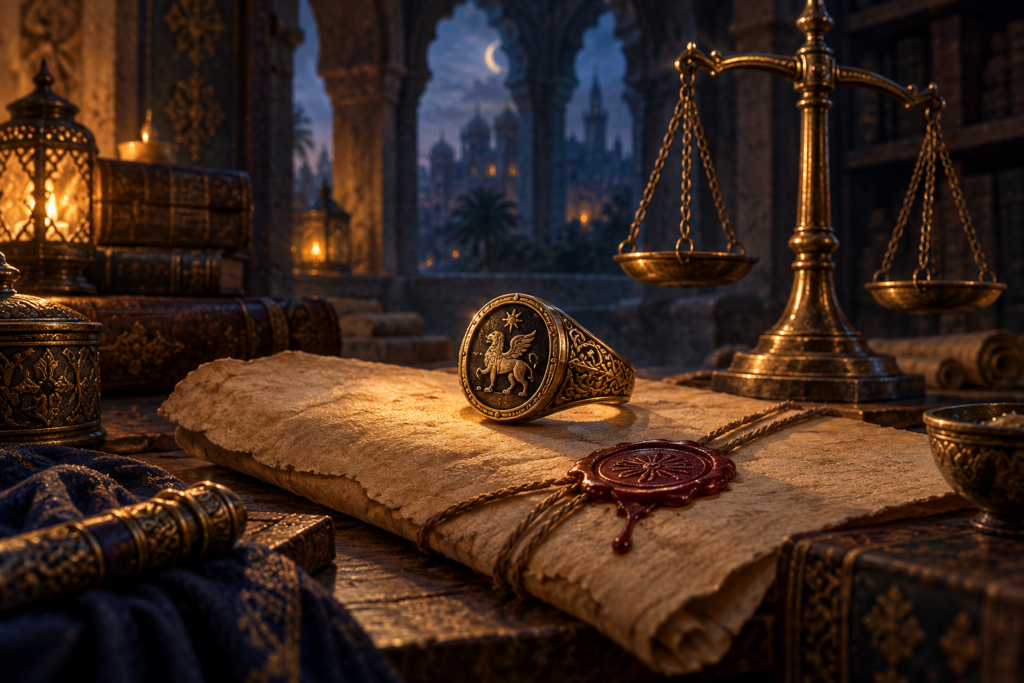
The fullest early account is the Testament of Solomon, a Greek pseudepigraphal text usually dated between the first and fifth centuries CE. In it the archangel Michael delivers a ring to Solomon so he can summon and interrogate demons, learn their names and weaknesses, and set them to work building the Temple. The text describes the ring’s engraved seal, and some manuscripts specify a pentalpha, the five-pointed star. Our detailed guide to the Testament of Solomon covers the narrative in full.
Islamic tradition developed the story independently through Quran commentary. The Quran itself describes jinn working for Solomon (Surah Saba 34:12 to 13) and armies of jinn, men and birds under his command (Surah An-Naml 27:17), but does not mention a ring. The ring enters through later exegesis and story collections, where it is called Khatam Sulayman and becomes the token of his rule. For how the ring functions as a symbol of authority, see our article on the Ring of Solomon.
Does this touch your own situation? Many readers come to these pages because something in their home, dreams or family feels unexplained. Reading history helps, but it cannot look at your specific case.
Consult the Sheikh Private, confidential, and free to ask.
One of the most common questions is whether the king Solomon seal is a six-pointed or five-pointed star. The historical answer is that both were used, often in the same region and century, and the strict division is modern.
Two interlaced triangles form the shape most associated with the seal today. It appears on Islamic coins and architecture from the medieval period, in Mamluk and Ottoman decoration, and in Jewish manuscripts and amulets. In Arabic sources the hexagram is routinely labeled Khatam Sulayman.
The five-pointed star was equally acceptable. Some manuscripts of the Testament of Solomon describe the ring’s engraving as a pentalpha, and Moroccan tradition adopted the pentagram as the Seal of Solomon, which is why it sits at the center of the Moroccan flag adopted in 1915.
Islamic ornament also uses eight-pointed stars and more elaborate interlaced figures, which are sometimes loosely called Solomon’s seal in decorative contexts.
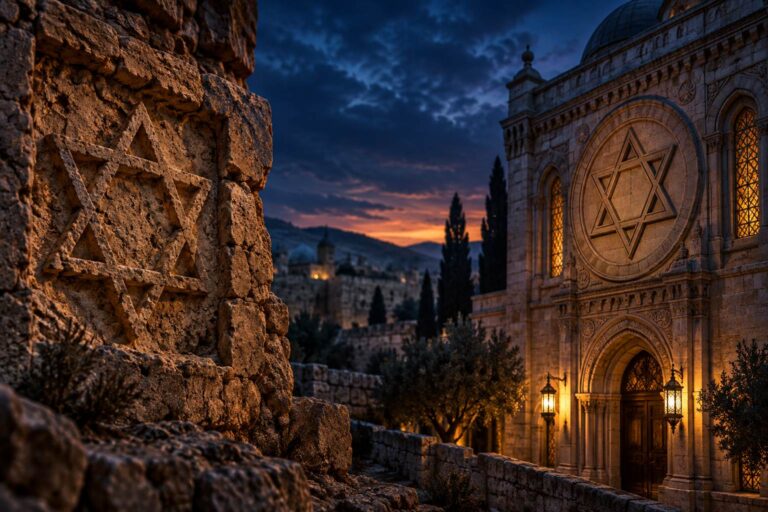
The hexagram was adopted as a communal Jewish emblem in Prague in the fourteenth century and spread widely only in the nineteenth century. Before that it was a shared protective sign across faiths. The relationship is explored in our comparison of the Seal of Solomon and the Star of David.
In Islamic storytelling the seal is inseparable from Solomon’s authority over jinn. Commentators on Surah Sad 38:34, which says that a body was placed on Solomon’s throne before he repented, told a tale in which a jinni named Sakhr stole the ring and ruled in the king’s place for forty days until Solomon recovered it from a fish. The story is widely retold but comes from commentary and folklore rather than from the Quranic text itself, and scholars have long debated its origins.
The Arabian Nights uses the seal as a plot device. In the Fisherman and the Jinni, a brass bottle sealed with lead stamped with Solomon’s seal holds a rebellious jinni imprisoned since the king’s time. The fisherman’s wit in persuading the jinni back into the bottle depends on the seal’s reputation: even a mighty jinni cannot break a vessel closed under Solomon’s name. Our article on Solomon’s seal in the Fisherman and the Jinni looks at this scene closely.
Beyond fiction, the hexagram and pentagram were engraved on bowls, rings and amulets across the Islamic world as protective signs, often alongside Quranic verses and the names of God. The design’s link to Solomon made it a respectable emblem rather than a suspect magical device, which helps explain its appearance on public architecture and coins.
From the late medieval period, European manuals of ritual magic attributed to Solomon made the seal central to their claims. The Key of Solomon (Clavicula Salomonis), known in manuscripts from the fifteenth century onward, contains pentacles, circular designs with Hebrew letters and geometric figures, that the magician was supposed to prepare. The Lesser Key of Solomon, compiled in the seventeenth century, includes a “Secret Seal of Solomon” said to have been used to shut the seventy-two spirits in a brass vessel.
These texts draw on the older legend but reshape it. Where the Testament describes a gift from heaven to one king, the grimoires present the seal as a reproducible instrument any trained operator could claim. That shift, from unique divine token to technical device, is the key difference between the Solomon of scripture and folklore and the Solomon of ceremonial magic.
Djinn Guide describes these books for historical interest only and does not provide ritual instructions. Readers who want the bibliographic background can see our overviews of the Lesser Key of Solomon and the Greater Key of Solomon, which trace the manuscripts and printed editions.
Because the seal is famous, it collects errors. The most frequent is the claim that the hexagram has always been an exclusively Jewish symbol and that Muslim or Christian use is borrowing. The evidence runs the other way: for most of its history the hexagram was shared, and its role as the Jewish communal emblem is comparatively recent.
A second misunderstanding is that the Bible describes the ring. It does not. The ring belongs to post-biblical Jewish lore, early Christian pseudepigrapha and Islamic commentary. A third is that the seal is a satanic or dark symbol. In every tradition that produced it, the seal is on the side of divine order; it binds disorderly spirits rather than invoking them.
Interest in the seal today comes from several directions at once. Fans of fantasy, anime and games meet the symbol as a magic circle and want to know its origin. Readers of religious history encounter it in discussions of the Temple, the jinn or the Star of David. Collectors see it on antique coins, rugs and talismans. And a steady stream of people search for it hoping it will protect them, which is why the term is attached to so many products.
The historical picture helps each of these readers. The symbol’s power in the stories is always borrowed from God and always attached to Solomon’s righteousness and wisdom; it was never understood as working on its own. That framing explains why the seal appears on mosques and synagogues as readily as on amulets, and why it belongs as much to the history of kingship and law as to the history of magic.
For those who come to the seal through the jinn, the wider story of the king’s command over spirits is covered in our article on King Solomon and the jinn, which places the ring within Quranic and folkloric accounts.
When a book, website or product makes a claim about the Seal of Solomon, three questions sort reliable from unreliable information. First, which tradition is speaking? A Jewish amulet, an Islamic commentary and a seventeenth-century grimoire all use the name, but they mean different things by it. Second, which century? Claims about “ancient” seals often rest on early modern or even twentieth-century designs. Third, is the source describing a story or claiming a result? Historical and folkloric sources describe; commercial and occult sources often promise.
Reading the primary texts is easier than it sounds. The Testament of Solomon exists in English translation and is short. The relevant Quranic passages on Solomon are brief and well commented. The Fisherman and the Jinni is a single evening’s reading in any edition of the Arabian Nights. Together they show how one emblem could carry authority, protection and story across three religions and more than a thousand years.
This site presents the seal as a subject of cultural and religious history. The beliefs described here are reported as beliefs, and nothing on this page should be taken as a claim that any object or symbol produces an effect.
Still have a question about your own experience? Describe what you are seeing, feeling or dreaming, and when it started. The Sheikh reads every message personally and replies in private.
Curious how this applies to your own life? Legends of the seal are really about authority and wisdom, and if they have you weighing a decision of your own, a Full Personal Reading with our partner PuraTarot offers a calm, personal perspective. Join the free Djinn Guide newsletter and, once you confirm, you will unlock a 50% code for your first reading.
Further reading
As an Amazon Associate we earn from qualifying purchases.
The Seal of Solomon means divinely granted authority and protection. In the legend, God gave King Solomon a signet ring that let him command jinn or demons, animals and the wind. The emblem engraved on it, usually a six-pointed or five-pointed star, became a protective sign used across Jewish, Islamic, Christian and later occult traditions.
They share the same hexagram shape but have different histories. The hexagram was a general protective and decorative symbol, called the Seal of Solomon in Islamic and Jewish lore, for many centuries. It became the specific Jewish communal emblem known as the Star of David gradually, from fourteenth-century Prague and especially during the nineteenth century.
No. The Bible describes Solomon's wisdom but no magic ring. The Quran describes jinn and wind serving Solomon but does not mention a seal. The ring and its emblem appear in post-biblical Jewish lore, in the Greek Testament of Solomon, in Islamic Quran commentary and in later folklore such as the Arabian Nights.
Both. Some manuscripts of the Testament of Solomon describe a pentalpha, a five-pointed star. Medieval Islamic and Jewish sources most often show a hexagram and call it the Seal of Solomon. Moroccan tradition uses the pentagram, which appears on the national flag. The strict distinction between the two is largely modern.
Yes, in a reinterpreted form. The Lesser Key of Solomon, which contains the Ars Goetia, describes a Secret Seal of Solomon said to have sealed seventy-two spirits in a brass vessel, and the Key of Solomon contains pentacles attributed to the king. These are early modern texts that borrow the older legend for ceremonial magic.
Disclaimer
This article presents the Seal of Solomon as a subject of religious, literary and art history. The beliefs and legends described are reported as held within their traditions and are not endorsed as fact; no ritual instructions or protective outcomes are offered.
Did this guide help you understand the subject? Rate it and share your honest opinion to help other readers. Every review is checked by our editors before it appears.
There are no reviews yet. Be the first one to write one.


Sheikh Youssef
Tayeb El Merzouki
For inquiries about personalized spiritual work, private rituals, and traditional talismans, connect directly with Sheikh Youssef Tayeb El Merzouki.
Chat on WhatsApp