Join Djinn Guide: Get 50% Off a Personal Reading
Get new guides to jinn, folklore and occult history. Confirm your subscription to unlock a 50% code for a first personal reading with our partner PuraTarot.
Discover the unseen
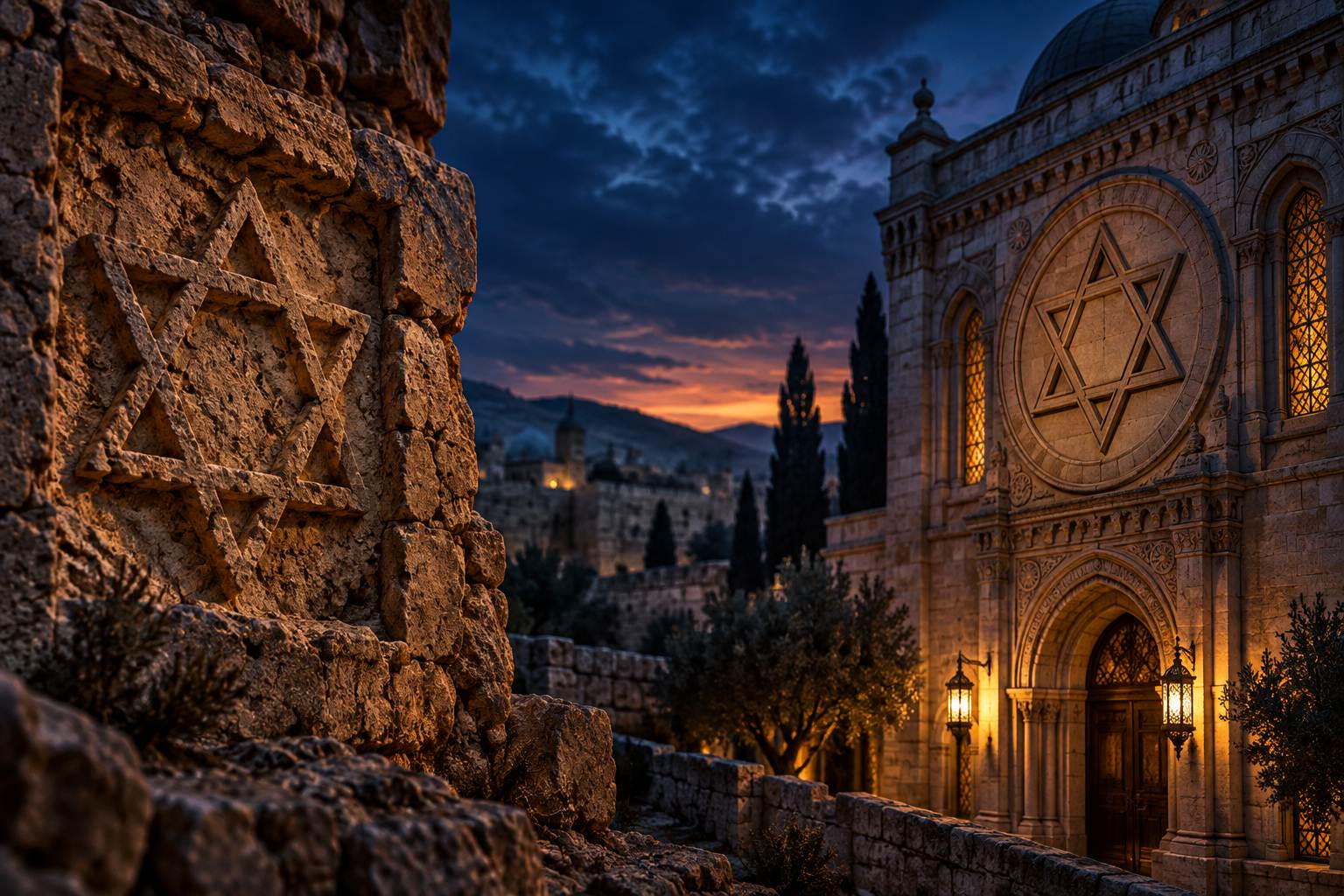
Seal of Solomon vs Star of David explained: the shared hexagram, how the star became a Jewish emblem, and how the Solomon seal grew in magic and legend.
Quick answer: The seal of Solomon vs Star of David question has a short answer: they are usually the same shape, a hexagram of two interlaced triangles, but they belong to two different histories. The Star of David (Magen David) became the emblem of Judaism between the 14th and 19th centuries and now appears on the flag of Israel. The Seal of Solomon is the older name used in Islamic, Jewish and Christian magical tradition for the sign on the legendary ring with which Solomon commanded jinn and demons.
Related guides: the history of the Seal of Solomon, Solomon's ring in the Testament, occult symbols and their meanings, amulets and talismans in history, sigils, seals and signatures, the seal in the Fisherman and the Jinni.
| Feature | Seal of Solomon | Star of David (Magen David) |
|---|---|---|
| Usual shape | Hexagram; sometimes a pentagram in medieval and Islamic sources | Hexagram only |
| Name means | Khatam Sulayman, the signet or seal of King Solomon | Magen David, the "Shield of David" |
| Earliest clear use under this name | Late antique and medieval magical texts; Testament of Solomon describes a ring but no shape | Prague Jewish community, 14th century; widespread as a Jewish emblem from the 17th century |
| Main traditions | Islamic folklore, Arabian Nights, Jewish Kabbalah, Christian grimoires, alchemy | Jewish communal and religious identity; modern Zionism; the State of Israel |
| Function in belief | Protective seal; sign of authority over spirits (legendary) | Communal emblem; sometimes protective in folk use |
| Found on | Rings, amulets, Islamic coins and architecture, magic circles in grimoires | Synagogues, gravestones, flags, jewelry, the Israeli flag since 1948 |
Key Takeaways
Ask what the seal of Solomon vs Star of David difference is and you get two kinds of answer. In terms of geometry, there is often none: both are the hexagram, a six-pointed star formed by two equilateral triangles laid over each other, one pointing up and one pointing down. In terms of history and meaning, the gap is wide. The Star of David is a symbol of a people and a religion. The Seal of Solomon is a symbol of a legend, the story that King Solomon owned a signet ring whose engraved sign gave him authority over spirits, animals and the winds.
The names also come from different languages and periods. Magen David is Hebrew for “Shield of David,” and the phrase was used for the hexagram from the Middle Ages, though for centuries it competed with other names. Khatam Sulayman, “Seal of Solomon,” is Arabic and belongs to Islamic folklore and the magical literature that drew on it; Latin grimoires used Sigillum Salomonis for the same idea. In Jewish mystical writing the term “Seal of Solomon” was also used, and there it could refer to the hexagram or the pentagram.
So when a modern reader sees a hexagram on an old Islamic coin, a Moroccan textile, a Renaissance magic circle or a synagogue wall, the shape alone does not say which tradition it belongs to. Context does. The sections below take each history in turn and then show how they met. For the broader background on the seal itself, see our article on the history of the Seal of Solomon.
The hexagram is a simple figure that appears in many ancient cultures with no particular religious weight. It turns up as decoration on ancient Near Eastern seals, in Roman mosaics, on early Christian church ornaments and in Indian temple art, where the shatkona represents the union of masculine and feminine principles. In Jewish contexts it appears as ornament on a 3rd or 4th century synagogue frieze at Capernaum, alongside a pentagram and a swastika-like motif, which shows that at that date it was a pattern rather than an emblem.
Later interpreters gave the shape symbolic content. Alchemists read the upward triangle as fire and the downward triangle as water, so that the combined figure stood for the union of opposites and, by extension, for the completed work. Medieval Christian and Jewish writers sometimes saw the six points as the six days of creation around a central rest, or as the four elements plus heaven and earth. These are later readings laid over a shape that had none of them originally.
What made the hexagram useful to so many was its simplicity and symmetry: it fills a circle neatly and suggests balance, which is why the same figure could become a communal badge in one tradition and a protective seal in another. Readers interested in how shapes acquire meaning will find more in our guide to occult symbols and their meanings.
Does this touch your own situation? Many readers come to these pages because something in their home, dreams or family feels unexplained. Reading history helps, but it cannot look at your specific case.
Consult the Sheikh Private, confidential, and free to ask.
The Seal of Solomon as an idea is older than the Seal of Solomon as a shape. The Testament of Solomon, a Greek text written somewhere between the first and fifth centuries CE, tells how the archangel Michael gave Solomon a ring with a seal that let him summon and interrogate demons and force them to build the Temple. The text describes the ring’s power but never specifies the engraved design. Our article on Solomon’s ring in the Testament goes through that story in detail.
Islamic tradition took up the legend. The Quran states that Solomon was given command of the wind and of jinn who worked under him (Surah 21:81-82, 34:12-13, 38:36-38), and commentators added the ring, often saying it bore the Greatest Name of God. The Arabian Nights then popularized the image for all later readers: in the Fisherman and the Jinni, a brass bottle is stopped with lead stamped by the seal of Solomon, and the imprisoned jinni cannot escape it. By this stage the seal was a famous object, and artists and amulet-makers needed something to draw.
The hexagram, and sometimes the pentagram, filled that role. Medieval Islamic amulets, coins and buildings used the six-pointed star widely, and the name khatam Sulayman attached to it. Latin grimoires such as the Key of Solomon inherited the association and drew hexagrams and pentagrams into their protective diagrams. In the Islamic world the term could also refer to a pentagram; Moroccan usage in particular has applied the name to both, which is why the two stars appear together on old Moroccan coins and textiles.
The Star of David’s rise as a Jewish emblem is well documented and surprisingly late. The historian Gershom Scholem showed in a classic study that the hexagram had no special Jewish meaning in antiquity and that the menorah, not the star, was the ancient symbol of Judaism. The hexagram appears in medieval Hebrew manuscripts, including a carpet page of the Leningrad Codex of 1008, but as decoration or as a protective sign shared with non-Jewish neighbors.
The decisive step came in Prague. In 1354, Emperor Charles IV granted the Jewish community of Prague the right to bear its own flag, and that flag carried a hexagram. From Prague the usage spread through Central Europe over the following centuries, appearing on synagogue buildings, printers’ marks and communal seals. By the seventeenth century it was common enough to be recognized as a Jewish sign in many cities, and by the nineteenth century, as Jewish communities sought an emblem to parallel the Christian cross, the Magen David was adopted almost universally on synagogues and gravestones.
Modern politics completed the process. The First Zionist Congress in 1897 used the star on its flag, and the flag of the State of Israel, adopted in 1948, placed a blue hexagram between two blue stripes. The Nazi regime’s forced yellow star added a terrible chapter to that history. Today the Magen David is first a symbol of Jewish identity and the Jewish state; any protective meaning is secondary and mostly historical.
The two histories are not entirely separate. Jewish magical and Kabbalistic texts from the Middle Ages used the hexagram as a protective seal and sometimes called it the Seal of Solomon, so the name crossed between communities. The hexagram on a Jewish amulet from Morocco or Yemen may look identical to one on a Muslim amulet. Christian grimoires borrowed both the Hebrew divine names and the Solomon legend, and drew the star into their circles.
Yet the meanings diverged. The following points mark the main lines of difference:
Keeping those distinctions in mind resolves most confusion. The shape is shared; the stories are not.
The first error is assuming that because the hexagram is on the Israeli flag, every hexagram on an older object is Jewish. Hexagrams on Islamic coins, Ottoman mosques, Ethiopian scrolls, Indian temples or European churches usually have nothing to do with Judaism. Conversely, some people claim that the Star of David is “really” an occult sign because it appears in grimoires; that argument reverses cause and effect, since the magical use and the communal use grew side by side from a common decorative source.
A second misunderstanding is that King David or King Solomon personally used the star. There is no evidence from the biblical period for either. The names were attached centuries later: Solomon’s through the Testament and the Islamic legends, David’s through medieval Hebrew usage that is still not fully explained. The Bible itself never mentions a star of David or a seal of Solomon.
A third confusion concerns the pentagram. Because the five-pointed star is sometimes also called the Seal of Solomon, especially in Islamic and Moroccan contexts, readers may conclude that the six- and five-pointed stars are the same symbol. They are not; they simply shared a name in some places. The woodland plant called Solomon’s seal is unrelated to either star.
Interest in the six pointed star meaning rises whenever the star appears in the news, in jewelry or in films about Solomon and the jinn. Collectors find hexagrams on antique coins and amulets and want to know whether they are Jewish, Islamic or magical. And many people simply want a clear answer to the star of david vs seal of solomon question without taking sides.
A few habits help in sorting the evidence. Ask where and when an object was made, because the same shape means different things in 14th-century Prague, 16th-century Fez and 19th-century Berlin. Look for accompanying text: Hebrew lettering, Arabic divine names or Latin conjurations each point to a tradition. Distinguish decoration from emblem, since a hexagram in a tile pattern is not a statement of belief. And note whether a source is scholarly or devotional, because devotional writing often projects later meanings backward.
Read this way, the two symbols stop competing. The Star of David is the story of how a people chose an emblem. The Seal of Solomon is the story of how a legend about wisdom and authority over the unseen took visible form. One shape carries both, and that is exactly what makes it worth understanding. For the material side of that story, see our guide to amulets and talismans in history.
Still have a question about your own experience? Describe what you are seeing, feeling or dreaming, and when it started. The Sheikh reads every message personally and replies in private.
Drawn to this symbol for a reason? One six-pointed figure has carried very different meanings for different communities over the centuries. If a symbol or sign has been on your mind lately, a Custom Spiritual Session with our partner PuraTarot lets you bring that specific question for personal reflection. Join the free Djinn Guide newsletter and, once you confirm, you will unlock a 50% code for your first reading.
Further reading
As an Amazon Associate we earn from qualifying purchases.
Usually they are the same shape, a hexagram of two interlaced triangles, but the names carry different histories. The Star of David is the emblem of Judaism and the State of Israel; the Seal of Solomon is the sign on Solomon's legendary ring in Jewish, Islamic and Christian magical tradition. In some medieval and Islamic sources the Seal of Solomon is a pentagram instead.
The hexagram meaning depends on tradition. In antiquity it was mainly decorative. Alchemists read it as fire and water united; Hindu tradition sees the shatkona as the union of masculine and feminine; Jewish tradition made it the Magen David, a communal emblem; and magical texts treated it as a protective seal linked to Solomon. None of these meanings is original to the shape.
The key moment was 1354, when the Prague Jewish community received the right to a flag bearing a hexagram. Usage spread through Central Europe over the next centuries and became general in the nineteenth century. The First Zionist Congress used it in 1897, and the flag of Israel adopted it in 1948.
The Bible does not mention such a ring. The story comes from the Testament of Solomon, a Greek text of roughly the first to fifth century CE, and from later Islamic commentaries and the Arabian Nights, which describe a signet that gave Solomon authority over demons or jinn. Historians treat the ring as legend; no shape for its seal is given in the earliest sources.
Both, depending on the source. Most medieval Jewish and Christian magical texts, and most Islamic art, use a hexagram and call it the Seal of Solomon. But Islamic and especially Moroccan usage also applied the name to the five-pointed star, and some grimoires use the pentagram for the same purpose. The name describes a function, Solomon's protective seal, more than a fixed geometry.
Disclaimer
This article compares two symbols as a matter of cultural and religious history. The Star of David is treated as the emblem of a living faith, and the Seal of Solomon as a figure of legend and historical magical practice; beliefs about either are described, not endorsed, and no protective or supernatural effect is claimed.
Did this guide help you understand the subject? Rate it and share your honest opinion to help other readers. Every review is checked by our editors before it appears.
There are no reviews yet. Be the first one to write one.


Sheikh Youssef
Tayeb El Merzouki
For inquiries about personalized spiritual work, private rituals, and traditional talismans, connect directly with Sheikh Youssef Tayeb El Merzouki.
Chat on WhatsApp