







Join Djinn Guide: Get 50% Off a Personal Reading
Get new guides to jinn, folklore and occult history. Confirm your subscription to unlock a 50% code for a first personal reading with our partner PuraTarot.
Discover the unseen

Sinbad the Sailor explained: the seven voyages, the roc and the Old Man of the Sea, where the tales came from, and how they joined the Arabian Nights.
Quick answer: Sinbad the Sailor is a merchant of Baghdad who, in a cycle of seven stories, survives shipwreck, giants, serpents, cannibals, and the giant bird called the roc, and returns each time richer than before. The tales are set in the reign of Harun al-Rashid and were probably composed in Abbasid Iraq between the ninth and eleventh centuries, drawing on real sailors' lore from the Indian Ocean trade. They entered the Arabian Nights late, when Antoine Galland added them to his French translation in 1704.
Related guides: history of the Thousand and One Nights, the roc bird of the Arabian Nights, jinn in the Arabian Nights, how the Scheherazade frame story works, Ali Baba and the Forty Thieves, the Fisherman and the Jinni.
| Voyage | Main peril | Marvel or creature | How Sinbad escapes |
|---|---|---|---|
| First | Landing on an island that is a sleeping whale | The whale-island | Clings to a washtub, rescued by a ship carrying his own lost goods |
| Second | Abandoned asleep on an island | The roc and the valley of diamonds | Ties himself to the roc's leg, then to a carcass thrown for eagles |
| Third | Captured by a man-eating giant | Giant with one eye, apes, a great serpent | Blinds the giant with hot spits, flees on a raft |
| Fourth | Buried alive with his dead wife | Cannibals who fatten captives with a drugging herb | Follows an animal through the burial cave to the sea |
| Fifth | Ridden by the Old Man of the Sea | The Old Man, the roc's egg, the apes who throw coconuts | Gets the Old Man drunk on fermented grape juice |
| Sixth | Shipwreck with no way off the island | Underground river to Serendib (Sri Lanka) | Builds a raft and lets the river carry him |
| Seventh | Pirates, slavery, elephants (Burton); mission to Serendib (Galland) | The elephants' graveyard, or flying men | Freed after showing the elephant tusks, or returns home resolved to sail no more |
Key Takeaways
Sinbad the Sailor, in Arabic al-Sindibad al-Bahri, is the hero of a cycle of seven voyage tales usually printed as part of the One Thousand and One Nights. He is not a sailor by trade but a merchant of Baghdad who squandered his inheritance as a young man and went to sea to rebuild it. Each voyage follows the same shape: he sails from Basra with trade goods, disaster strikes, he survives by wit and luck, he finds wealth in a strange land, and he returns home swearing never to sail again. Then restlessness returns and he sails once more.
The stories have a frame of their own. A poor porter, called Sinbad the Porter in most Arabic texts and Hindbad in Galland’s French, rests outside a rich man’s house in Baghdad and complains aloud that fortune is unjust. The owner, the wealthy Sinbad, invites him in and over seven evenings tells him how that fortune was earned, giving him a hundred gold pieces after each tale. The moral is spoken plainly: the wealth was bought with terror and labor, not luck.
The setting is the Baghdad of the caliph Harun al-Rashid, who reigned from 786 to 809, and the port of Basra on the Persian Gulf. That choice is a signal to the audience: this is the golden age of Abbasid trade, when ships sailed from Iraq to India, Sri Lanka, Southeast Asia, and China. The cycle is best read as a merchant’s romance, a celebration of profit and risk, framed by a wider collection whose structure is explained in how the Scheherazade frame story works.
No author is known, and the date can only be estimated. Most scholars place the composition of the Sinbad cycle between the ninth and eleventh centuries in Iraq, a period when the Indian Ocean trade was at its height and when geographers and sea captains were writing down what they had seen and heard. The closest surviving relative is the Book of the Wonders of India attributed to Buzurg ibn Shahriyar, a Persian captain of the tenth century, which collects sailors’ yarns about giant birds, islands that move, cannibal shores, and fabulous pearls.
Several of Sinbad’s adventures have older literary cousins. The one-eyed giant of the third voyage who roasts men on spits and is blinded with a heated iron closely resembles Polyphemus in Homer’s Odyssey; whether the resemblance is borrowing or shared Mediterranean folklore is debated. The island that turns out to be a whale appears in the Greek Physiologus and in the Irish voyage of Saint Brendan. The valley of diamonds, where meat is thrown down so that eagles will carry the stones up with it, is reported as fact by Marco Polo and earlier by Byzantine and Chinese writers.
The name itself is probably Persian in origin, and some scholars connect the cycle to Persian sea lore filtered through Basra. What the Arabic tellers added was the merchant frame, the Baghdad setting, and the moral about wealth earned through hardship. For the long and tangled development of the collection as a whole, see the history of the Thousand and One Nights.
Does this touch your own situation? Many readers come to these pages because something in their home, dreams or family feels unexplained. Reading history helps, but it cannot look at your specific case.
Consult the Sheikh Private, confidential, and free to ask.
The voyages vary in detail between manuscripts and translations, but the sequence below is the one most readers meet in English.
Sinbad’s ship anchors at a green island that turns out to be the back of a vast fish. When the sailors light a fire the creature dives, and Sinbad is left adrift clinging to a wooden tub until he reaches an island kingdom where he recovers his own goods from a passing ship.
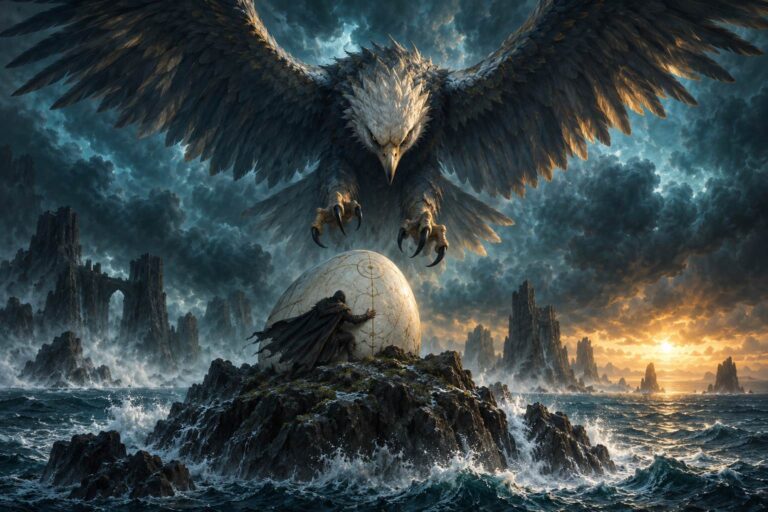
Abandoned asleep on an island, Sinbad finds a huge white dome that is a roc’s egg. He binds himself to the bird’s leg with his turban and is carried to a valley floored with diamonds and patrolled by serpents. He escapes by tying himself to a carcass that merchants have thrown down for eagles to carry up.
Ape-like creatures seize the ship and leave the crew on an island ruled by a giant who eats a man each night. Sinbad and his companions blind him with red-hot spits and flee on rafts, only to face a serpent that swallows the survivors one by one.
Captured by people who fatten strangers with a drugging herb, Sinbad refuses to eat and escapes to a kingdom where he marries. When his wife dies he is lowered alive into a burial cave with her corpse, as local custom demands, and finds a way out to the sea.
The fifth brings the broken roc’s egg, the vengeful parent birds, and the Old Man of the Sea who rides Sinbad’s shoulders until he is tricked with fermented grape juice. The sixth strands him on an island whose river runs underground to Serendib, the old name for Sri Lanka. The seventh exists in two forms: Galland’s version sends Sinbad as the caliph’s envoy to Serendib, while the version in Burton’s translation has him captured by pirates, sold as a slave, and set to hunting elephants until the herd leads him to their graveyard of ivory.
Sinbad’s place in the Nights is a matter of publishing history rather than ancient tradition. The Syrian manuscript that Antoine Galland used as the basis of his French Les mille et une nuits, now in the Bibliotheque nationale, does not contain the Sinbad tales. Galland had translated Sinbad separately, around 1701, from a different Arabic manuscript, and it was while preparing that text that he learned of a larger collection called the Thousand and One Nights. He incorporated Sinbad into the third volume of his translation in 1704, and from then on European readers assumed the two had always belonged together.
Later Arabic printed editions followed suit. The Bulaq edition printed in Cairo in 1835 and the second Calcutta edition of 1839 to 1842 include the voyages, and Edward Lane’s English translation of 1838 to 1840 and Richard Burton’s unexpurgated version of 1885 to 1888 translated them from those texts. This is why Sinbad sits beside Aladdin and Ali Baba in most people’s memory of the Nights, even though all three are late additions; the two famous orphan tales have their own story in Ali Baba and the Forty Thieves.
Inside the frame of the Nights, the voyages are told by Scheherazade across many nights, but they keep their own inner frame of the two Sinbads. That double framing, a storyteller within a storyteller, is one reason the cycle feels complete on its own and is so often printed separately.
The creatures of the Sinbad cycle are drawn from the shared marvels of medieval Arabic geography rather than invented for the tales. The roc, in Arabic rukh, is a bird so large that it feeds its young on elephants; Marco Polo reported it from Madagascar, and the Sinbad tales give it its two most famous scenes, the valley of diamonds and the smashed egg. Its wider career in travel writing and fiction is traced in the site’s article on the roc bird of the Arabian Nights.
The Old Man of the Sea is a different kind of monster: an apparently helpless old man who asks to be carried across a stream, then locks his legs around his bearer’s neck and will not let go. Folklorists compare him to the shape-shifting sea god Proteus and to a wide family of clinging-demon tales from Africa and South Asia. The fermented grape juice that frees Sinbad is a humorous touch that also hints at the tale’s secular, merchant-class audience.
Notably absent are jinn. Unlike the Fisherman, Aladdin, or the Porter and the Three Ladies, Sinbad never meets a jinni in a bottle or lamp; his wonders are zoological and geographical, exaggerations of things sailors actually reported. Readers who want the supernatural side of the collection will find it surveyed in jinn in the Arabian Nights.
Films and children’s editions have reshaped the character so thoroughly that several widespread beliefs do not match the text.
Sinbad’s modern fame rests largely on cinema. Ray Harryhausen’s stop-motion films The 7th Voyage of Sinbad (1958), The Golden Voyage of Sinbad (1973), and Sinbad and the Eye of the Tiger (1977) turned him into an action hero with a sword and a crew of loyal companions, fighting cyclopes and skeletons. DreamWorks’ animated Sinbad: Legend of the Seven Seas (2003) moved him to a Greek-flavored Mediterranean. Rimsky-Korsakov’s orchestral suite Scheherazade (1888) had already given the world a musical image of Sinbad’s ship on a heaving sea. None of these retain much of the merchant frame or the moral about labor and fortune.
For readers who want the text, Burton’s translation is complete but ornate, Lane’s is readable and well annotated, and Husain Haddawy’s modern English translation of the Sinbad cycle, published with his version of the Nights, is the clearest. Comparing Galland’s seventh voyage with Burton’s shows at once how fluid the tradition is. It also helps to read the tales alongside a map of the medieval Indian Ocean: Basra, the Malabar coast, Serendib, and the spice islands are real places, and the tales are a fantastic memory of real trade routes.
The appeal today is the same as it was in Abbasid Baghdad: a person of no special strength goes out into a dangerous world, survives by patience and observation, and comes home. The marvels are the decoration. The pattern of departure, catastrophe, and return is the story.
Still have a question about your own experience? Describe what you are seeing, feeling or dreaming, and when it started. The Sheikh reads every message personally and replies in private.
Facing a crossroads of your own? Each of Sinbad’s voyages begins with a choice to set out again despite the risks. If you are weighing a journey or decision of your own, a Custom Spiritual Session with our partner PuraTarot lets you bring that specific question for personal reflection. Join the free Djinn Guide newsletter and, once you confirm, you will unlock a 50% code for your first reading.
Further reading
As an Amazon Associate we earn from qualifying purchases.
Sinbad the Sailor is a fictional merchant of Baghdad in the time of Harun al-Rashid who tells the story of seven sea voyages to a poor porter. The tales are part of the Arabian Nights in most editions, though they were composed separately, probably in Iraq between the ninth and eleventh centuries.
Seven. Each voyage follows a pattern of departure from Basra, shipwreck or capture, a marvel such as the roc or the Old Man of the Sea, escape, and a wealthy return to Baghdad. The seventh voyage exists in two different versions, one in Galland's French translation and one in Burton's English.
No historical Sinbad is known. The character is a literary creation who stands for the merchant-adventurers of the Abbasid Indian Ocean trade. His adventures draw on real sailors' reports collected by tenth-century writers such as Buzurg ibn Shahriyar, exaggerated into marvels like the whale-island and the valley of diamonds.
Not in the earliest surviving manuscript. The fourteenth- or fifteenth-century Syrian text used by Antoine Galland lacks Sinbad. Galland translated the voyages from a separate manuscript and added them to his French Nights in 1704, after which Arabic printed editions and English translators included them.
The roc, or rukh, is a gigantic bird that appears in Sinbad's second and fifth voyages. In the second, Sinbad ties himself to its leg to escape an island and is carried to the valley of diamonds. In the fifth, sailors break a roc's egg and the parent birds sink their ship with boulders.
Disclaimer
This article discusses the Sinbad tales as literature and folklore, drawing on the standard translations and modern scholarship. Dates and origins are scholarly estimates, and the marvels described are presented as story elements, not as claims about the natural world.
Did this guide help you understand the subject? Rate it and share your honest opinion to help other readers. Every review is checked by our editors before it appears.
There are no reviews yet. Be the first one to write one.


Sheikh Youssef
Tayeb El Merzouki
For inquiries about personalized spiritual work, private rituals, and traditional talismans, connect directly with Sheikh Youssef Tayeb El Merzouki.
Chat on WhatsApp