






Join Djinn Guide: Get 50% Off a Personal Reading
Get new guides to jinn, folklore and occult history. Confirm your subscription to unlock a 50% code for a first personal reading with our partner PuraTarot.
Discover the unseen
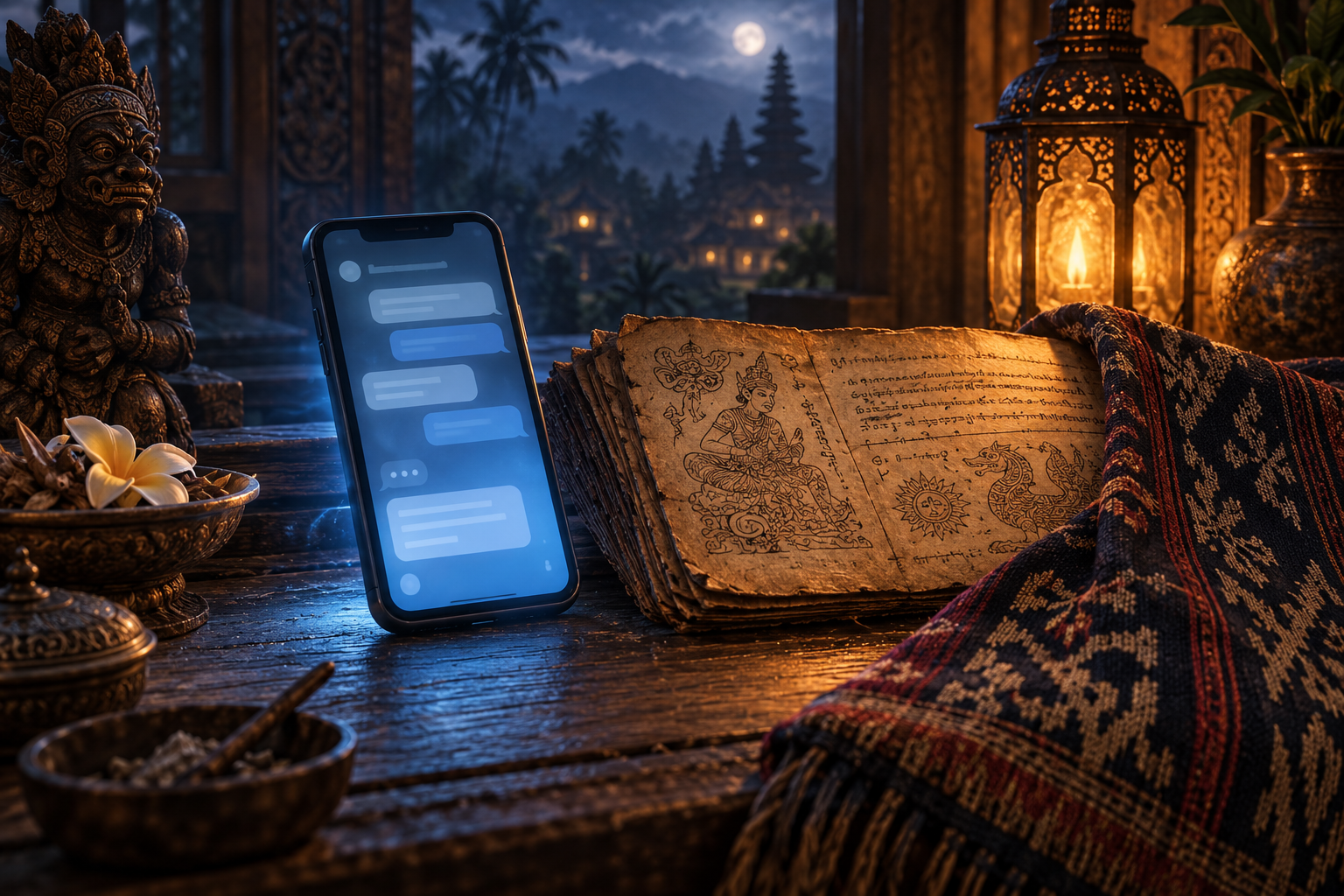
Cek khodam explained: what the viral khodam checker trend is, where the word khodam comes from, how online checks work, and the belief behind the meme.
Quick answer: Cek khodam is Indonesian for "check your khodam", a viral social-media trend in which a host or a web tool tells you the name of the spirit companion that supposedly accompanies you. The word khodam comes from Arabic khādim, meaning servant, and in Indonesian and Malay spiritual tradition it refers to a helper spirit tied to a person or an object. The online khodam checker is mostly entertainment, but it sits on top of a real and much older belief.
Related guides: what a khodam is in belief, khodam and the keris heirloom, khodam versus Solomonic spirits, the qareen companion jinn, beginner guide to jinn, are jinn real.
| Format | How it works | Who gives the answer | How seriously it is meant |
|---|---|---|---|
| Live-stream check | Viewers type their name in the chat; the host announces a khodam | A streamer, sometimes claiming spiritual sight, often joking | Mostly entertainment; answers are rapid and playful |
| Web khodam checker | User enters a name; a script returns a random result | An automated generator | Pure novelty; results are random |
| Chatbot or app check | A prompt returns a khodam with a short description | Software with a scripted list | Novelty; sometimes framed as a personality quiz |
| Traditional consultation | A dukun, kyai or paranormal assesses a person or object | A practitioner within Javanese or Malay tradition | Taken seriously by believers; part of a longer relationship |
| Heirloom assessment | A keris, stone or ring is examined for a resident spirit | A collector or a traditional specialist | Serious within collecting and heirloom culture |
Key Takeaways
Cek khodam is an Indonesian phrase that translates literally as “check khodam” or “khodam check”. In mid-2024 it became one of the most visible trends on Indonesian TikTok, and it spread from there to Malaysia, Singapore and English-speaking audiences who encountered the clips without knowing the background. The format is simple: a live-streamer invites viewers to type their names into the chat, and the host, sometimes with a straight face and sometimes with obvious comedy, announces each person’s khodam.
The answers are the reason the trend went viral. Alongside traditional-sounding spirits like a white tiger, a dragon or a sacred serpent, hosts handed out results such as an orange cat, a fried chicken, a motorcycle or simply kosong, meaning empty. Being told you have no khodam at all became a running joke, and screenshots of absurd results circulated as memes far beyond Indonesia.
Searches for cek khodam online, khodam checker and khodam check followed. Developers built web pages and chatbots that return a random khodam when a name is entered, and the phrase entered English-language internet slang. For most participants the whole thing is a game. But the word khodam is not an invention of the trend, and the belief behind it is explained in the guide to what a khodam is in belief.
Khodam comes from the Arabic khādim, which simply means servant or attendant. The word entered the Malay-Indonesian world with Islam and with the Arabic-language occult literature that circulated in pesantren and among practitioners of traditional knowledge. In that context a khodam is a spirit servant: an unseen being, usually described as a jinn or as a spirit of the ancestors or the land, that is attached to a person, a sacred text, a prayer formula or a physical object.
Traditional accounts describe several ways a khodam is believed to arrive. Some say it is inherited, passing through a family line with an heirloom such as a keris dagger, a stone or a ring. Some say it is acquired by reciting particular prayers or formulas for a set number of days. Some say certain people are simply born with a companion. In each case the khodam is understood as a helper whose character reflects its origin: a tiger spirit from a forest, a royal spirit from a palace heirloom, a pious spirit from a devotional text.
Islamic scholars in the region have long debated whether seeking a khodam is permissible, and many regard the practice as dangerous or forbidden while accepting that jinn exist. Others treat the belief as cultural heritage. The cek khodam meme borrows the vocabulary of this serious debate while discarding its seriousness, which is why older viewers sometimes react with discomfort to the jokes.
Does this touch your own situation? Many readers come to these pages because something in their home, dreams or family feels unexplained. Reading history helps, but it cannot look at your specific case.
Consult the Sheikh Private, confidential, and free to ask.
The khodam checkers that appeared during and after the trend fall into a few recognizable types, and none of them involve anything more than software and showmanship.
The simplest khodam checker is a web page with a text box. The name entered is either ignored or used as a seed, and a script picks a result from a list: animals, mythical creatures, objects and comedy answers. Entering the same name twice often gives different results, which reveals the mechanism.
Some checkers use a chatbot that produces a khodam along with a paragraph of personality description, in the style of a horoscope. These are closer to a personality quiz than to a spiritual reading and are built from the same type of list.
On TikTok Live, the host supplies the answers in real time. A few hosts present themselves as spiritually sensitive; many openly play it for laughs and reward tips with funnier results. The speed at which hundreds of names are answered makes the entertainment nature obvious.
A smaller number of accounts moved from free checks to paid private readings. This is where the meme shades into the older commercial market of paranormal services, and where readers should be most cautious about claims.
In its traditional setting, assessing a khodam is nothing like a rapid-fire live stream. A dukun, kyai, or paranormal in Java might examine a person over several meetings, perform recitations, or handle an heirloom while describing what they perceive. The outcome is a relationship: advice on how to treat the companion, which prohibitions to observe, and sometimes a warning that the spirit is a burden rather than a help.
Heirloom culture is a major part of this. A keris, the asymmetrical Javanese dagger with a wavy or straight blade, is widely believed to be able to house a spirit, and collectors speak of a blade’s isi, its contents, as part of its value. Stones, rings and old manuscripts are treated similarly. The detailed article on khodam and the keris heirloom covers how these objects are described, cleaned and passed on.
The online version flattens all of this into a single word and a punchline. That is not necessarily disrespectful; Indonesian internet culture has a long tradition of humor about the supernatural, and many of the hosts and viewers share the underlying beliefs. But anyone who encounters cek khodam only through memes will miss that the concept has textual roots in Arabic occult manuals, a social role in rural and urban Java, and a contested place in Islamic practice in the region.
Readers from outside Southeast Asia often ask whether a khodam is the same as a jinn. The usual answer in the tradition is that a khodam is a role, not a species. The servant may be a jinn, which in Islamic belief is a being created from smokeless fire with free will, or it may be described as an ancestral or nature spirit depending on the speaker’s worldview. What makes it a khodam is the relationship of service to a person, text or object.
A related Islamic concept is the qareen, the companion jinn that tradition holds is assigned to every person. The qareen is not a servant and is not acquired; it is simply present, and in hadith literature it is described as whispering suggestions. Some cek khodam hosts have blurred the two ideas, telling viewers that everyone has a khodam by default, which is closer to the qareen concept than to the traditional khodam. The difference is laid out in the article on the qareen companion jinn.
There is also a parallel with the European Solomonic tradition, where grimoires describe spirits bound to serve an operator. The vocabulary of service, seals and binding appears in both worlds because both drew on Arabic occult literature, though the Javanese tradition adds its own layer of ancestral and animistic belief. That comparison is developed in the site’s article on khodam versus Solomonic spirits.
Because the trend moved so quickly across languages, several errors are now widespread.
Keeping these distinctions in view makes it possible to enjoy the meme without mistaking it for a description of what people actually believe.
The success of cek khodam says as much about social media as about spirits. Live-stream formats reward participation, and typing a name to receive an instant, shareable label is close to a perfect engagement loop. The results doubled as personality badges, so people compared their khodam with friends the way earlier generations compared zodiac signs. The comedy of being assigned an orange cat or nothing at all gave the trend a self-deprecating tone that traveled well.
It also arrived at a moment when Indonesian horror films, ghost-story podcasts and paranormal content were already popular, so the audience had a shared vocabulary. Outside Indonesia, the trend was often consumed without that context, which produced confused explanations in English and a wave of searches for khodam meaning. Many of those searchers end up reading about jinn, the keris and Islamic debates about spirit helpers for the first time.
For readers of this site, the useful approach is to hold three things apart. The meme is a game. The folk tradition is a set of beliefs with real history, texts and social practice. The religious discussion is a serious argument within Islam about what is permitted. A khodam check online tells you about the first; the articles on jinn, including the beginner guide to jinn, help with the second and third. None of it requires anyone to seek a spirit companion, and this site does not provide instructions for doing so.
Still have a question about your own experience? Describe what you are seeing, feeling or dreaming, and when it started. The Sheikh reads every message personally and replies in private.
Want something more personal than a viral checker? Online khodam checkers are mostly entertainment, but if the trend has you reflecting on your own path, a Full Personal Reading with our partner PuraTarot offers a thoughtful, personal perspective. Join the free Djinn Guide newsletter and, once you confirm, you will unlock a 50% code for your first reading.
Further reading
As an Amazon Associate we earn from qualifying purchases.
Cek khodam is Indonesian for "check your khodam". A khodam is a spirit servant or companion in Indonesian and Malay belief, from the Arabic khādim, servant. The phrase became a viral trend in 2024 when TikTok live-streamers and web tools began announcing a khodam for anyone who typed their name.
Online khodam checkers are random or scripted generators and have no way of assessing anything about a person. Live-stream checks are entertainment delivered by a host. The belief in khodam itself is a genuine tradition, but the online checks are games built on its vocabulary rather than part of the tradition.
In Islamic contexts in Southeast Asia, a khodam is usually understood as a jinn or other unseen being that serves a person, text or object. Many scholars discourage or forbid seeking one, while accepting that jinn exist. Opinions differ by school and region, and the practice remains controversial.
Because the live-stream and generator formats are comedic. Hosts hand out animals, foods and objects for laughs, and kosong, meaning empty, became a punchline for having no spirit at all. In traditional belief, animal spirits such as tigers and serpents do appear, but foods and vehicles are jokes.
No. A qareen is the companion jinn that Islamic tradition says accompanies every person and is not acquired or inherited. A khodam is a servant spirit believed to be attached through inheritance, practice or an object. Some online hosts blur the two, but the concepts are distinct.
Disclaimer
This article describes the cek khodam trend and the beliefs behind it for cultural and educational purposes. Beliefs about spirit companions are presented as beliefs, not facts, and the site does not offer or endorse any method of checking, acquiring or interacting with spirits.
Did this guide help you understand the subject? Rate it and share your honest opinion to help other readers. Every review is checked by our editors before it appears.
There are no reviews yet. Be the first one to write one.


Sheikh Youssef
Tayeb El Merzouki
For inquiries about personalized spiritual work, private rituals, and traditional talismans, connect directly with Sheikh Youssef Tayeb El Merzouki.
Chat on WhatsApp