





Join Djinn Guide: Get 50% Off a Personal Reading
Get new guides to jinn, folklore and occult history. Confirm your subscription to unlock a 50% code for a first personal reading with our partner PuraTarot.
Discover the unseen
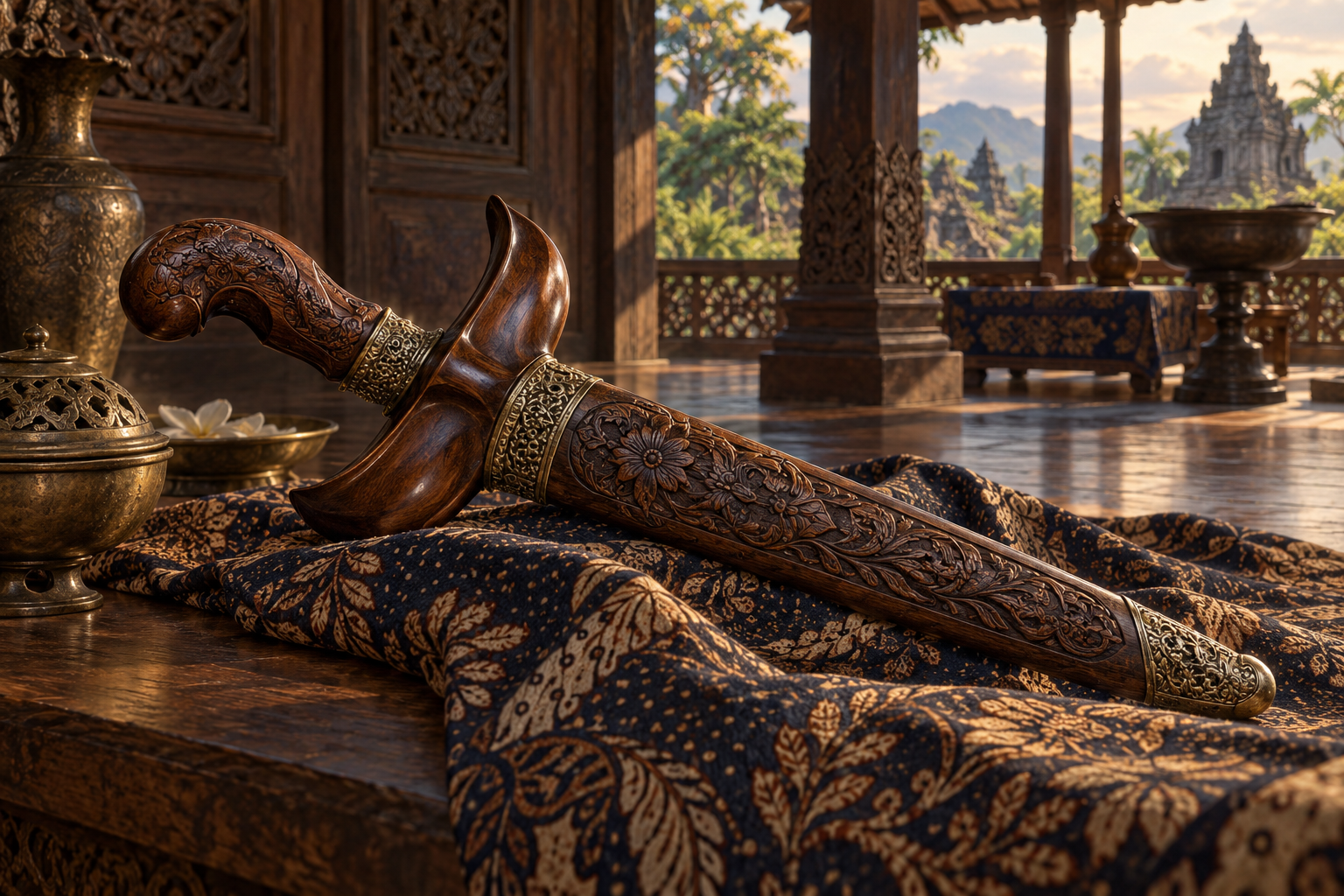
Khodam keris explained: what the keris is, why Javanese tradition believes a spirit can live in it, how heirlooms are kept, and how khodam stones compare.
Quick answer: A khodam keris is a keris, the asymmetrical Javanese dagger, that is believed in Indonesian and Malay tradition to house a khodam, a servant spirit attached to the blade. The belief holds that the smith's prayers, the blade's layered pattern and generations of ownership can give a keris an isi, or spirit content, which serves or tests its keeper. This guide explains the keris itself, the beliefs about its spirit, how heirlooms are cared for, and how khodam stones and rings relate.
Related guides: what a khodam spirit is, the cek khodam checker trend, khodam and Solomonic spirits compared, amulets and talismans through history, jinn beliefs across cultures, reading occult symbols in context.
| Object | What it is | How the spirit is said to arrive | Role in tradition |
|---|---|---|---|
| Keris (kris) | Asymmetrical dagger with a straight or wavy pattern-welded blade | Through the smith's forging and prayers, or through long ownership | Royal regalia, family heirloom, status symbol, ritual object |
| Tombak (spear) and other pusaka | Heirloom spear heads, swords and ceremonial weapons | Same as the keris; forged by an empu with ritual | Palace collections and lineage heirlooms |
| Khodam stone (batu mustika, akik) | A natural stone or a stone said to come from an animal or plant | Found in unusual circumstances, or attached by a practitioner | Personal amulet, worn or kept at home |
| Khodam ring | A ring, often holding a stone, worn on the hand | The stone's spirit, or a spirit attached through recitation | Everyday amulet; popular in the 2010s stone craze |
| Written amulet (rajah, azimat) | Paper or cloth with Arabic letters, squares and names | The khodam of the formula is said to attend the text | Carried for protection; closest to Arabic talisman tradition |
Key Takeaways
The phrase khodam keris joins two words from different languages. Keris, often spelled kris in English, is the distinctive dagger of Java, Bali, Sumatra, the Malay Peninsula and the southern Philippines. Khodam comes from Arabic khādim, servant, and in Indonesian and Malay spiritual vocabulary it means a helper spirit attached to a person, a text or an object. A khodam keris is therefore a keris believed to have a spirit in residence, one that serves, protects or sometimes troubles its keeper.
Not every keris is thought to have a khodam. Many blades are regarded simply as fine craft or as symbols of status and marriage. But the keris occupies a special place among pusaka, the Javanese term for sacred heirlooms, because the process of making one is traditionally understood as a spiritual act. The smith, called an empu, is said to fast, pray and work on auspicious days, and the layered pattern that emerges in the steel is read as a sign of what the blade carries.
Javanese usage often speaks of a blade’s isi, literally its contents, rather than using the Arabic loanword. Khodam became common in the twentieth century as Islamic and Arabic occult vocabulary spread through popular spiritual literature. Both words point to the same belief. For the broader concept of servant spirits, including those attached to prayers and people, see what a khodam spirit is.
Physically, a keris is a dagger with a blade that widens sharply at the base on one side, giving it an asymmetrical profile. The blade may be straight, called lurus, or wavy, in which case the number of curves, called luk, is traditionally odd, commonly three to thirteen. The steel is forged from layers of iron and nickel-bearing metal, and when etched with a solution of arsenic and lime the layers show as a pale pattern called pamor. The hilt, sheath and the metal fittings are separate works of art, often more ornate than the blade.
The keris is old. Reliefs at the ninth-century Borobudur temple show daggers that resemble early forms, and the classic shape is attested by the Majapahit period of the fourteenth and fifteenth centuries. Javanese chronicles tell of famous blades, including the cursed keris of Empu Gandring in the Pararaton, which is said to have killed its commissioner Ken Arok and several of his successors. Such stories are legend, but they show how early the idea of a blade with a will of its own was present.
In 2005 UNESCO proclaimed the Indonesian keris a Masterpiece of the Oral and Intangible Heritage of Humanity, and it was inscribed on the Representative List in 2008. That recognition covers the craft, the ceremonial use and the beliefs, which the listing describes as part of the living tradition without endorsing them.
Does this touch your own situation? Many readers come to these pages because something in their home, dreams or family feels unexplained. Reading history helps, but it cannot look at your specific case.
Consult the Sheikh Private, confidential, and free to ask.
Accounts of the keris spirit differ by region and by the speaker’s religious outlook, but a few recurring ideas appear across Java and the Malay world.
The smith’s ritual preparation is the most commonly cited origin. The empu is said to call a spirit into the steel, or to make the blade with such devotion that a spirit comes to it. Older blades by named smiths are therefore valued most highly, and a blade’s dapur (form) and pamor are read as the smith’s intention.
A keris passed down for generations is believed to absorb the character of its owners. Some families say an ancestor’s spirit accompanies the blade, which makes the keris a focus for remembering the dead as much as a talisman.
Tuah is the believed influence of a blade: good fortune in trade, authority, courage, protection or harmony. A keris whose tuah does not match its owner is said to be cocok or not cocok, compatible or incompatible, and an incompatible blade is thought to bring illness or bad luck until it is passed on.
Believers describe dreams, a feeling of weight or heat, sounds in the house, or a blade that appears to move in its sheath. These are reported as experiences of believers; this site records them as such and makes no claim about their cause.
Whatever one thinks about spirits, the care of a keris follows practical customs that also preserve the steel. The most important is jamasan, the ritual cleaning, traditionally carried out once a year in the Javanese month of Sura, which corresponds to the Islamic Muharram. The blade is washed, often with coconut water or lime juice, re-etched with the arsenic solution if the pamor has dulled, and oiled with fragrant oils. Palaces such as the Yogyakarta and Surakarta kraton perform jamasan of their regalia publicly, and families do the same at home.
Storage is also governed by custom. Heirlooms are kept in a clean, high place, sometimes with offerings of flowers or incense, and are handled with the right hand. Many families observe prohibitions: the keris is not drawn casually, not pointed at people, and not sold without thought. A keris passed to a new keeper is often accompanied by a story about what the blade likes and dislikes, which is how the khodam’s “personality” is transmitted.
Modern collectors range from strict traditionalists to people who treat the keris purely as metalwork and art. The two groups share a vocabulary and often attend the same exhibitions. For readers interested in how objects become carriers of belief across cultures, the history of inscribed and worn charms is covered in amulets and talismans through history.
The belief that an object can host a servant spirit is not limited to blades. In Indonesia and Malaysia, stones called mustika or batu akik are widely believed to carry khodam. A mustika is said to be a stone of unusual origin, found inside an animal, a tree, a coconut or the earth under special circumstances, and its spirit is described as taking the form of its origin: a tiger, a serpent, a bird. During the Indonesian gemstone craze of the mid-2010s, agate rings were sold everywhere, and sellers routinely advertised rings with a khodam attached.
A khodam ring is usually a ring holding such a stone, though some are plain metal rings said to have been prepared by a practitioner reciting formulas over them. Written amulets, called rajah or azimat, extend the idea to paper and cloth inscribed with Arabic letters, magic squares and divine names; the khodam of the formula is believed to attend whoever carries it. This is the part of the tradition closest to the Arabic talisman literature that gave the region the word khodam in the first place.
The online cek khodam trend of 2024 drew on this familiar vocabulary when it turned the idea of a personal spirit into a live-stream game. The connection between the serious belief and the meme is traced in the article on the cek khodam checker trend.
Because the keris is so photogenic and the word khodam so new to English, several mistaken ideas circulate.
The tradition itself is more careful than the marketing around it, and most elders warn that treating a keris as a tool for personal gain is a misunderstanding of what an heirloom is for.
Interest in the khodam keris has grown for several reasons at once. Indonesian horror cinema and ghost-story channels use the keris constantly as a prop. Collectors share photographs of pamor patterns and ask online whether a blade has isi. The gemstone and khodam ring markets of the 2010s, followed by the cek khodam meme, introduced the vocabulary to millions of people who had never handled a blade. And diaspora families in the Netherlands, Malaysia and the United States inherit heirlooms with stories attached and want to understand them.
Reading about the subject well means separating three kinds of sources. Craft and museum literature describes the metallurgy, the forms and the history, and it is the most reliable guide to what a keris is. Ethnographic accounts and family traditions describe what people believe about the spirit and how they care for the blade, and they should be read as records of belief. Commercial listings and viral videos describe what sellers and entertainers want you to think, and they deserve the most skepticism.
Islamic teaching in the region adds a fourth voice. Many scholars accept that jinn exist but hold that seeking a spirit’s help through an object is forbidden, while others treat heirloom customs as culture rather than worship. The parallel with European grimoires, where spirits are also described as servants bound to objects and seals, is explored in khodam and Solomonic spirits compared. Readers who keep these voices distinct will find the keris both easier to understand and more interesting than any single claim about it.
Still have a question about your own experience? Describe what you are seeing, feeling or dreaming, and when it started. The Sheikh reads every message personally and replies in private.
Does a family story hold a question for you? If an inherited object or a tale passed down in your family has left you with a question about your own life, a Custom Spiritual Session with our partner PuraTarot gives you room to reflect on it personally. Join the free Djinn Guide newsletter and, once you confirm, you will unlock a 50% code for your first reading.
Further reading
As an Amazon Associate we earn from qualifying purchases.
A khodam keris is a Javanese or Malay keris dagger believed to house a khodam, a servant spirit. Tradition holds that the spirit comes from the smith's ritual forging, from generations of ownership, or from the blade's inherent character, and that it protects, serves or tests the keeper. The belief is cultural and religious, not verifiable.
Keris, or kris, is the name of an asymmetrical dagger from Java and the wider Malay world. Its blade is forged from layered iron and nickel, producing a pattern called pamor, and may be straight or wavy with an odd number of curves. The keris is used as a weapon, regalia, wedding attire and heirloom.
No. Tradition distinguishes ordinary blades from pusaka, sacred heirlooms thought to carry isi or a khodam. Many keris are made and sold as craft or costume with no spiritual claim. Whether a blade has a spirit is a question of belief and family tradition, and no objective test exists.
A khodam stone, called mustika or batu akik in Indonesian, is a stone believed to carry a servant spirit, often said to come from an animal, plant or unusual find. A khodam ring is a ring holding such a stone or one prepared by a practitioner. Both became popular during the Indonesian gemstone craze of the 2010s.
The customary method is jamasan, an annual cleaning usually performed in the Javanese month of Sura. The blade is washed, re-etched with an arsenic and lime solution to restore the pamor, and oiled. Heirlooms are stored in a clean, high place and handled respectfully, with customs varying by family and region.
Disclaimer
This article presents Javanese and Malay beliefs about the keris and khodam for cultural and historical understanding. Beliefs about spirits in objects are described, not endorsed, and the site makes no claims about any effect of a keris, stone or ring and provides no instructions for acquiring or interacting with spirits.
Did this guide help you understand the subject? Rate it and share your honest opinion to help other readers. Every review is checked by our editors before it appears.
There are no reviews yet. Be the first one to write one.


Sheikh Youssef
Tayeb El Merzouki
For inquiries about personalized spiritual work, private rituals, and traditional talismans, connect directly with Sheikh Youssef Tayeb El Merzouki.
Chat on WhatsApp