







Join Djinn Guide: Get 50% Off a Personal Reading
Get new guides to jinn, folklore and occult history. Confirm your subscription to unlock a 50% code for a first personal reading with our partner PuraTarot.
Discover the unseen
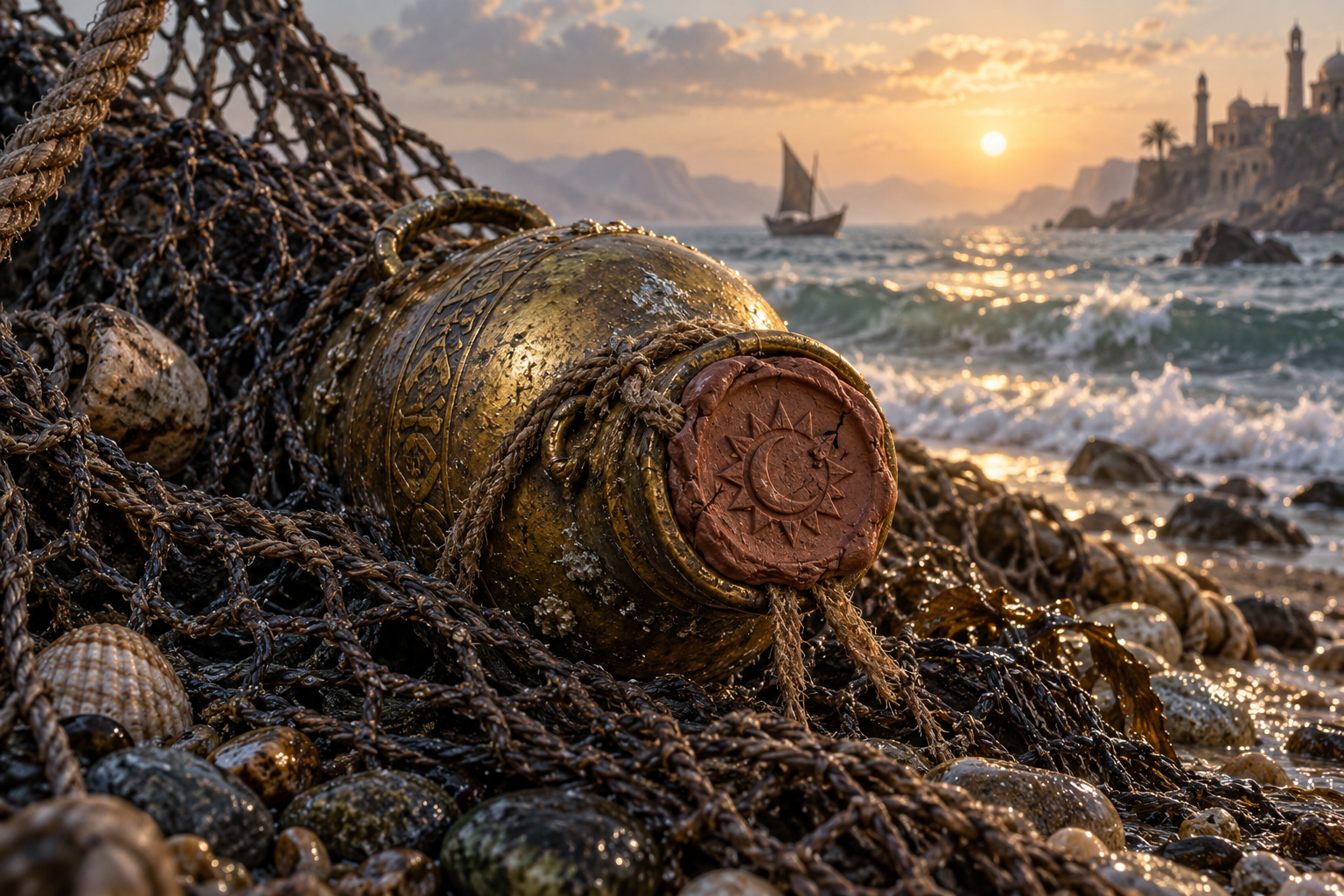
Solomon's seal in the Arabian Nights keeps a jinni in a brass bottle. See what the Fisherman tale says about the seal, its Quranic roots and later artwork.
Quick answer: Solomon's seal in the Arabian Nights is the stamp on the lead stopper of a brass bottle that a poor fisherman pulls from the sea. Inside is a jinni whom King Solomon imprisoned centuries earlier for rebellion. The seal, bearing the Most Great Name of God, is what keeps the jinni bound, and the fisherman's trick is to lure him back under it. The episode turns the seal from a royal emblem into a story device about authority, confinement and wit.
Related guides: the Fisherman and the Jinni story analysis, history of the Seal of Solomon, Scheherazade and the frame story, jinn throughout the Arabian Nights, King Solomon's authority over jinn, Seal of Solomon versus Star of David.
| Element | What the tale says | Older source or parallel |
|---|---|---|
| The vessel | A yellow brass bottle, heavy, with a lead stopper | Quran 34:12-13: jinn make basins and cauldrons for Solomon |
| The seal | Lead stamped with the seal of Solomon son of David | Testament of Solomon: a ring with a seal that binds demons |
| The power | The Most Great Name engraved on the seal holds the jinni | Islamic tradition on the greatest name of God |
| The captor | Solomon's vizier Asaf ibn Barkhiya captures the rebel jinni | Islamic lore of Asaf as keeper of the Name |
| The punishment | Bottle sealed and cast into the sea | Quran 38:37-38: others bound in fetters |
| The shape | Not described in the text | Six-pointed or five-pointed star in later art |
Key Takeaways
In the Arabian Nights, Solomon’s seal appears as a physical object: the stamp pressed into the lead stopper of a brass bottle. The tale of the Fisherman and the Jinni, one of the earliest stories Scheherazade tells, describes a poor fisherman who casts his net four times in a day. The first three casts bring up a dead donkey, a jar of sand and mud, and broken pottery. The fourth brings up a heavy bottle of yellow brass, its mouth stopped with lead, and on the lead is the impression of the seal of Solomon, son of David.
The fisherman recognizes the seal at once and expects the bottle to hold something valuable. When he pries the stopper loose, smoke pours out, rises to the sky, and condenses into an enormous jinni, described in most versions as an ifrit. The jinni’s first words are a confession of faith and a plea to Solomon not to kill him, because he does not yet realize that Solomon has been dead for centuries.
This is the core of the solomon seal story as the Nights tell it. The seal is not a decoration; it is the reason the jinni could not escape. The whole tale turns on getting the jinni back under the authority of the name engraved on it.
Once the fisherman convinces the jinni that Solomon is long gone, the jinni tells his own history. He says he was one of the rebellious jinn who refused to obey Solomon. Solomon sent his vizier, named in the Arabic text as Asaf ibn Barkhiya, to bring him in. The jinni was brought before the king, refused submission, and was confined in the brass bottle. The stopper was sealed with lead stamped with the Most Great Name, and Solomon ordered the bottle thrown into the sea. Some retellings give the jinni the name Sakhr, a figure from Islamic Solomon legend; the oldest manuscripts leave him unnamed.
The jinni then explains the famous sequence of vows. For the first hundred years he promised to enrich whoever freed him; nobody came. For the next hundred he promised the treasures of the earth, and for four hundred more he promised three wishes. Finally, in anger, he swore to kill his rescuer and only grant the manner of death. The fisherman, having just freed him, is offered that grim choice.
Readers who want a fuller treatment of the story’s plot and its embedded tales, including King Yunan and the Sage Duban, can read our analysis of the Fisherman and the Jinni. Here the focus stays on the seal and what it represents.
Does this touch your own situation? Many readers come to these pages because something in their home, dreams or family feels unexplained. Reading history helps, but it cannot look at your specific case.
Consult the Sheikh Private, confidential, and free to ask.
The Nights assume a reader who already knows Solomon as a prophet-king with power over jinn. That picture comes from the Quran. Surah An-Naml 27:17 describes Solomon’s hosts of jinn, humans and birds. Surah Saba 34:12-13 says jinn worked for him, making whatever he wished, including basins and fixed cauldrons. Surah Sad 38:36-38 describes the devils placed under his command, including builders and divers and others bound in fetters. The Nights’ brass bottle and sealed stopper read like a folk elaboration of exactly these verses.
The seal’s power in the tale comes from the Most Great Name of God, which Islamic tradition holds was known to Solomon and engraved on his ring. The vizier Asaf ibn Barkhiya appears in exegesis as the one who knew the Name and brought the Queen of Sheba’s throne in an instant. By making Asaf the captor, the storyteller is signaling that the seal works through divine knowledge, not through Solomon’s personal strength. For the wider picture of how commentators and storytellers built this image, see our guide to King Solomon’s authority over jinn.
None of this requires the seal to look like anything in particular. The text says only that the lead bore the seal of Solomon. The star shapes people associate with the phrase come from a different history, discussed below.
The Fisherman tale is the most famous use of Solomon’s seal in the collection, but not the only one. The jinni of the Nights are repeatedly described as subject to Solomon, and sealed vessels recur. The clearest parallel is the tale of the City of Brass, in which the caliph Abd al-Malik sends an expedition to find the brass bottles in which Solomon imprisoned jinn. The travelers find bottles on the shore, open one, and a jinni emerges swearing loyalty to Solomon just as the fisherman’s jinni did.
Taken together, these motifs show how thoroughly the collection assumes a world in which Solomon’s authority still structures relations between humans and jinn. Our overview of jinn throughout the Arabian Nights traces the pattern across more tales.
Three bodies of literature give three different pictures of Solomon’s seal. The Greek Testament of Solomon, a pseudepigraphal text composed between roughly the first and fifth centuries CE, presents it as a ring delivered by an archangel, with which Solomon questions and compels demons to build the Temple. The emphasis is on interrogation: each demon confesses a name, a harm and the angel who stops him.
The Quran and its commentaries present Solomon as a prophet whose power over jinn is a divine gift, with the engraved Name as the link. Later Islamic legend adds the story of a jinni, often called Sakhr, who steals the ring and rules in Solomon’s place for forty days, which explains why later Arabic storytellers thought of the seal as something that could be lost, found and misused.
The Nights takes this inheritance and makes it narrative furniture. The seal is a known object the fisherman can recognize by sight. It can be reused: the fisherman tricks the jinni back into the bottle and replaces the stopper, so the seal does its work again. The Nights are not interested in the theology of the seal, only in its reliability as a plot mechanism. Readers can follow the older layers in our history of the Seal of Solomon.
The first misunderstanding is that the Nights describe a six-pointed star. They do not. The Arabic text speaks of the seal of Solomon stamped in lead without describing its form. The hexagram became attached to Solomon’s name in medieval Arabic and Jewish magical manuscripts, and illustrators of European translations later drew it on the bottle. The pentagram is sometimes used as well. The identification of the seal with any particular star is a matter of later art and occult tradition, as our comparison of the Seal of Solomon and the Star of David explains.
A second misunderstanding is that the jinni in the bottle grants wishes. He does not. The three-wishes element in his monologue is a promise he made and withdrew; what he actually offers is a choice of death. The wish-granting genie in a vessel is the Aladdin lamp jinni, a figure added to the collection through Galland’s French edition in the early eighteenth century.
A third is that the fisherman defeats the jinni with magic. He uses doubt. He asks how so large a being could fit in so small a bottle, the jinni demonstrates, and the fisherman replaces the stopper. The seal does the binding; the fisherman supplies only wit. That division is exactly the point of the tale.
The image of a spirit sealed in a vessel is one of the most durable things the Nights gave world culture. The phrase “genie in a bottle” comes directly from this tale, even though most people picture a lamp. The brass bottle also seeded a long line of stories, from nineteenth-century retellings to modern novels and films, in which a sealed container holds a dangerous or helpful spirit.
People search for the seal in this context for several reasons. Some are students reading the Nights and want to know whether the seal is an invention or has roots in scripture. Some are interested in the Seal of Solomon as a symbol and find their way to the fisherman through it. In each case, the answer is the same: the tale is old, the motif is older, and the specific star shape is the newest part of the package.
The story’s framing also matters. It is one of the first tales Scheherazade tells, and like her, the fisherman survives by talking. Our page on Scheherazade and the frame story shows how the brass bottle tale mirrors the larger structure of the collection.
If you want to read this story well, hold three layers apart. The scriptural layer, mainly Quran 27, 34 and 38, gives Solomon jinn servants and bound devils but no bottle and no stopper. The legendary layer, built by commentators and popular Islamic storytellers, adds the ring, the Name, Asaf and the thief Sakhr. The literary layer, the Nights, selects from that legend what makes a good story: a recognizable seal, a reusable stopper and a jinni with a grudge.
Translation choices also shape what you see. Antoine Galland’s French version of 1704 to 1717 smoothed the tale for a courtly audience. Edward Lane’s English edition in the 1830s added notes on Islamic belief about jinn. Richard Burton’s 1885 translation kept the rough edges and used the word Ifrit.
Finally, keep the seal’s function in view. In every version it binds, and in every version it works only because of what is written on it. That makes the fisherman’s tale less a story about magic than a story about names, authority and the limits of brute force, which is why it has outlasted the specific beliefs that produced it.
Still have a question about your own experience? Describe what you are seeing, feeling or dreaming, and when it started. The Sheikh reads every message personally and replies in private.
Drawn to these stories for a reason? If the fisherman’s bottle has you thinking about a turning point of your own, a Full Personal Reading with our partner PuraTarot offers a calm, personal space to reflect on it. Join the free Djinn Guide newsletter and, once you confirm, you will unlock a 50% code for your first reading.
Further reading
As an Amazon Associate we earn from qualifying purchases.
In the Fisherman and the Jinni, Solomon's seal is stamped into the lead stopper of a brass bottle and keeps a rebellious jinni imprisoned. The tale says the seal bears the Most Great Name of God. When the fisherman tricks the jinni back inside and replaces the stopper, the seal binds him again.
The text does not say. The Nights describe only the impression of Solomon's seal in lead, with no shape given. The six-pointed star and sometimes the pentagram were added by later illustrators and by occult tradition that already linked those stars to Solomon in magical manuscripts.
According to the jinni's own account, Solomon's vizier Asaf ibn Barkhiya captured him after he rebelled, and Solomon had him sealed in the bottle with lead and cast into the sea. Asaf is a figure from Islamic legend who was believed to know the Most Great Name of God.
No. He says he once vowed to grant three wishes to whoever freed him, but after centuries of waiting he replaced that vow with a promise to kill his rescuer. The wish-granting genie most people imagine comes from the Aladdin story, which entered the Nights through Galland's French edition.
The brass bottle episode is not in the Quran. The Quran describes Solomon's command over jinn and devils, some of them bound in fetters, in Surahs 27, 34 and 38. The bottle, the stopper and the sealed Name come from later Islamic legend that the Nights turned into a tale.
Disclaimer
This article discusses a literary tale and the religious and legendary traditions behind it for educational purposes. Beliefs about Solomon's seal, jinn and sacred names are described as beliefs held within those traditions, not endorsed as fact, and no claims are made about any object or practice.
Did this guide help you understand the subject? Rate it and share your honest opinion to help other readers. Every review is checked by our editors before it appears.
There are no reviews yet. Be the first one to write one.


Sheikh Youssef
Tayeb El Merzouki
For inquiries about personalized spiritual work, private rituals, and traditional talismans, connect directly with Sheikh Youssef Tayeb El Merzouki.
Chat on WhatsApp