





Join Djinn Guide: Get 50% Off a Personal Reading
Get new guides to jinn, folklore and occult history. Confirm your subscription to unlock a 50% code for a first personal reading with our partner PuraTarot.
Discover the unseen
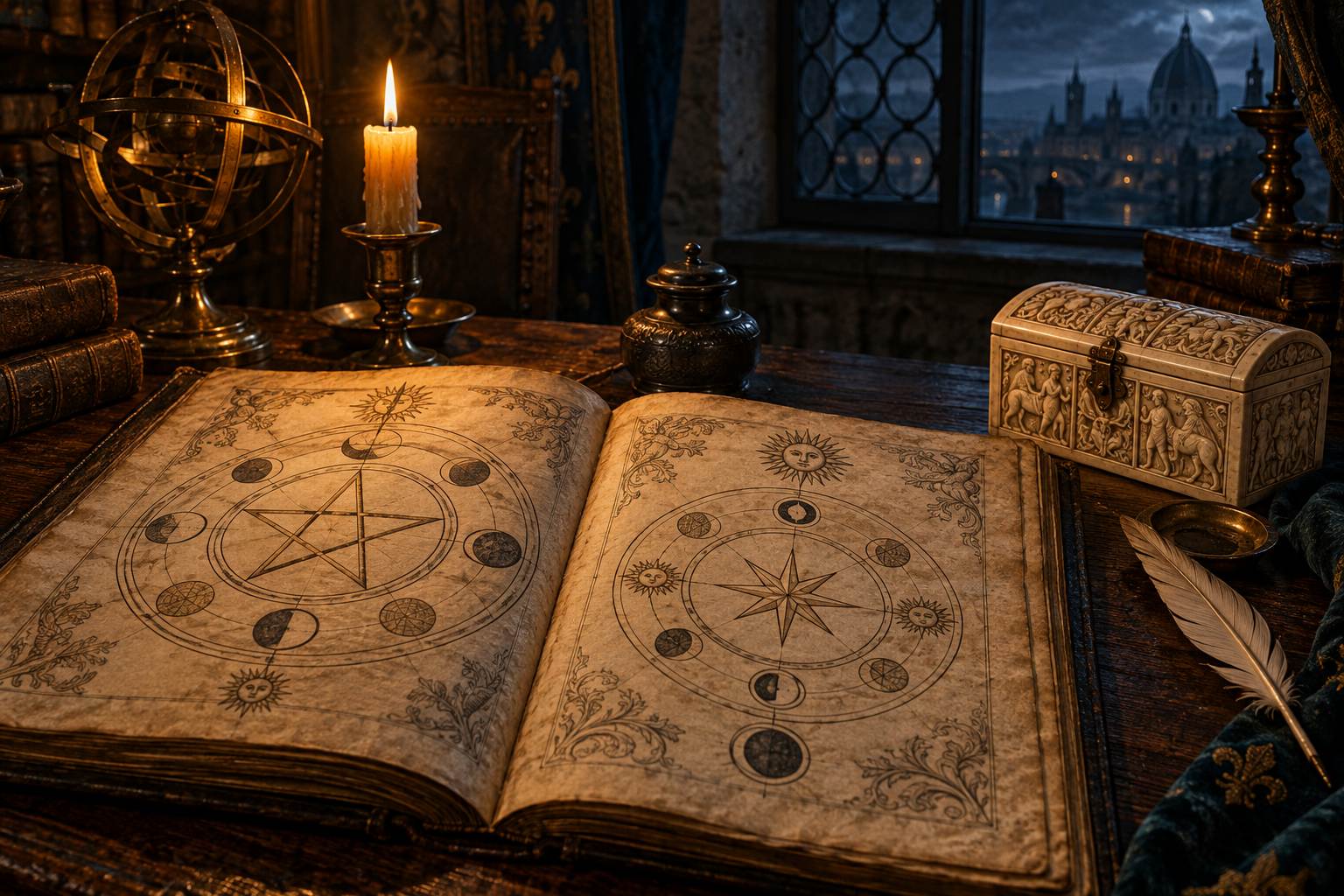
Greater Key of Solomon explained: what the Clavicula Salomonis contains, its manuscripts and Mathers edition, and how it differs from the Lesser Key.
Quick answer: The Greater Key of Solomon, known in Latin as the Clavicula Salomonis, is a Renaissance grimoire attributed to King Solomon that survives in Latin, Italian, French, and Hebrew manuscripts from the late fifteenth century onward. It is divided into two books: the first describes operations, conjurations, and the famous planetary pentacles, and the second describes the preparation, tools, garments, and timing the text requires. It is a separate work from the Lesser Key (Lemegeton) and contains no list of 72 demons.
Related guides: the Lesser Key of Solomon and its five books, the Seal of Solomon in history, the Testament of Solomon, how to read occult manuscripts, grimoire meaning and famous grimoires, King Solomon and the jinn.
| Feature | Greater Key (Clavicula Salomonis) | Lesser Key (Lemegeton) |
|---|---|---|
| Earliest manuscripts | Late 15th to 16th century; Greek precursor earlier | 17th century English compilations |
| Languages | Latin, Italian, French, Hebrew, English | English, drawing on Latin sources |
| Structure | Two books | Five books (Goetia, Theurgia-Goetia, Paulina, Almadel, Notoria) |
| Spirit catalog | None; spirits addressed generally | 72 named spirits with seals in the Ars Goetia |
| Signature feature | 44 planetary pentacles | Seals of the 72 spirits |
| Best-known edition | S. L. MacGregor Mathers, 1889 | Mathers and Crowley, 1904; Peterson, 2001 |
Key Takeaways
The Greater Key of Solomon is the English name for the Clavicula Salomonis, a book of ceremonial magic that presents itself as the teaching of King Solomon to his son Rehoboam. The word greater is a modern convenience used to distinguish it from the Lesser Key, the Lemegeton. The manuscripts themselves simply call the work the Key, or the Key of Solomon, and in Hebrew Mafteah Shelomoh. Despite the attribution, no scholar dates the text anywhere near Solomon’s lifetime.
In form the Key is a manual rather than a catalog. It sets out how, according to its authors, a practitioner should prepare, what hours and days belong to which planet, how a circle should be drawn, which prayers and conjurations to recite, and how to make and consecrate tools, garments, parchment, and the pentacles that carry much of the book’s reputation. Its tone is pious throughout, invoking the God of the Bible constantly.
This site describes the Key as a historical document and does not provide instructions for any practice it contains. What follows explains where the book came from, what its two books hold, how it relates to the Lesser Key of Solomon, and which modern editions are reliable for readers who want to study the text itself.
The oldest known relative of the Key is a Greek text usually called the Hygromanteia, or the Magical Treatise of Solomon, preserved in manuscripts from the fifteenth century and probably older in content. It already contains planetary hours, prayers, and instructions framed as Solomon’s advice to Rehoboam. Latin and Italian versions of the Clavicula appear in the late fifteenth and sixteenth centuries, and the book spread rapidly in the seventeenth and eighteenth, when most surviving copies were made.
Manuscripts differ a great deal. Some contain long sequences of experiments, others concentrate on the pentacles, and the number and design of the pentacles vary from copy to copy. French versions from the eighteenth century, often titled Les Clavicules de Salomon, were widely circulated and later printed. A Hebrew version was edited by Hermann Gollancz in 1903 and 1914, which shows the work moving between Christian and Jewish readers rather than belonging to one community.
The text is pseudepigraphal, meaning it borrows Solomon’s name to claim authority, a practice that goes back to the Testament of Solomon in late antiquity. The Key’s actual authors were anonymous scribes and compilers working within a tradition that mixed Jewish names of God, Christian prayers, classical astrology, and Arabic-influenced astral magic.
Does this touch your own situation? Many readers come to these pages because something in their home, dreams or family feels unexplained. Reading history helps, but it cannot look at your specific case.
Consult the Sheikh Private, confidential, and free to ask.
Most manuscripts, and Mathers’ edition, divide the Key into two books with a short prefatory narrative. In that preface Solomon instructs Rehoboam to hide the book in an ivory casket in his tomb, where it is later discovered by Babylonian philosophers who can read it only after an angel explains it. The story is a standard device of grimoire literature, asserting antiquity and divine sanction at once.
Book I opens with chapters on the planetary days and hours and on which kinds of operation belong to which planet. It then gives the conjurations by which spirits are to be addressed, descriptions of their appearance, and a series of experiments: for invisibility, for love, for recovering stolen goods, for making oneself respected, and others. Mathers left out two or three experiments he judged to be black magic.
Book II is practical in a different way. It prescribes fasting, bathing, and confession before an operation, the garments to be worn, the construction of the circle, and the making and consecration of implements: the knife with the white hilt and the knife with the black hilt, the sword, the staff and wand, the pen and ink, the virgin parchment, the perfumes, and the water and aspergillum. It reads like a craftsman’s manual framed in prayer.
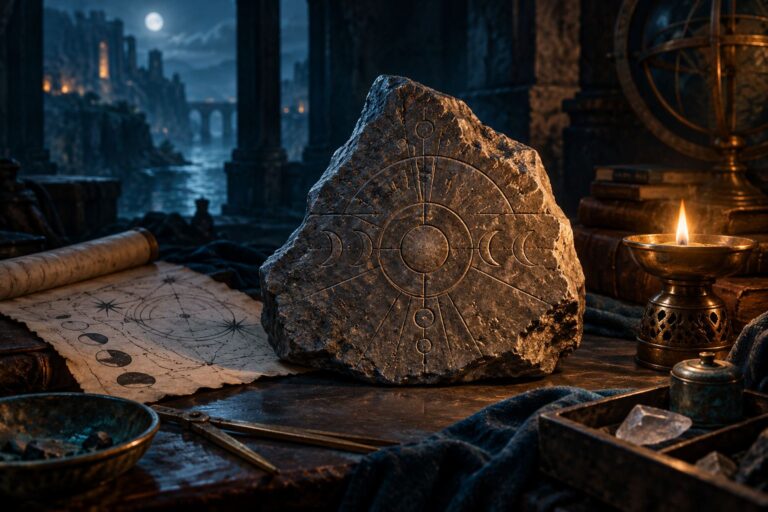
The pentacles, placed at the end of Book I in most editions, are the part of the Key that readers remember. They are circular figures bearing Hebrew divine names, biblical verses, and geometric or symbolic designs, grouped under the seven classical planets and said to serve purposes matched to each planet. Their design draws on the same Hebrew-name tradition seen in the Seal of Solomon.
Mathers’ edition prints 44 pentacles, and that number has become standard even though individual manuscripts add, drop, or redraw them freely. The text assigns each group to one of the seven classical planets, following the astrological logic that runs through the whole book, and describes the purposes it attributes to them. They are distributed as follows:
Each pentacle carries an inscription, often a verse from the Psalms in Hebrew or Latin, and a design that may include the hexagram, a magic square, angelic names, or figures of hands and animals. The text claims specific effects for each; this article reports those claims as the content of a historical document, not as fact. The pentacles were copied into countless later manuscripts, printed in nineteenth-century French occult books, and are now sold as jewelry and prints, usually with little awareness of their origin.
The two Keys are regularly confused, partly because both carry Solomon’s name and partly because both were edited in English by S. L. MacGregor Mathers. They are different books with different histories. The Greater Key is older, international, and organized around planetary pentacles and general conjurations. The Lesser Key, the Lemegeton, is a seventeenth-century English compilation of five separate treatises, the first of which, the Ars Goetia, catalogs 72 named spirits with their seals and ranks.
Put simply, the Greater Key tells its reader how an operation should be prepared and conducted, while the Goetia tells its reader whom the operation addresses. The Greater Key does not list Bael, Paimon, or Astaroth; the Lemegeton does not contain the 44 pentacles. Material from the Key, including the circle design and some prayers, does reappear in Lemegeton manuscripts, which shows that compilers read both and borrowed between them.
The confusion is worth correcting because online sellers and video channels often market a Key of Solomon that is in fact the Goetia, or quote the 72 spirits as if they came from the Clavicula. Readers who want the spirit catalog should look to the Lesser Key; readers interested in the pentacle tradition and the oldest layer of Solomonic ceremonial magic should look to the Greater Key.
The edition most people encounter is The Key of Solomon the King, published in London in 1889 by S. L. MacGregor Mathers, a founder of the Hermetic Order of the Golden Dawn. Mathers compiled his text from seven manuscripts in the British Museum, now the British Library, in French, Latin, and Italian, and translated and harmonized them into one English version. He redrew the pentacles, added notes, and openly omitted a few passages he considered dangerous.
Mathers’ work made the Key available but also fixed one editor’s choices as the standard. Later scholarship has gone back to the manuscripts. Joseph H. Peterson’s 2004 edition presents a text based primarily on a single reliable manuscript and compares others, correcting errors and restoring material Mathers dropped. A translation of the Greek Hygromanteia by Ioannis Marathakis appeared in 2011, letting readers see the Key’s ancestor directly.
Beyond these, there are many reprints, facsimiles of French manuscripts, and uncredited online copies of Mathers’ text, which entered the public domain long ago. For understanding how such texts were produced, who copied them, and why editions differ, see our guide to reading occult manuscripts in context; the Key is one of the clearest case studies in how a grimoire changes from copy to copy.
The first misunderstanding is authorship. Nothing links the Clavicula to the historical Solomon; the attribution is a literary convention shared by the Testament, the Lemegeton, and many other works. The second is the idea that the Key is a book of demon summoning. Its spirits are addressed in general terms, and the book spends far more pages on prayer, purification, and craft than on anything resembling the catalogs of the Goetia.
A third error is to treat the pentacles as ancient Jewish symbols. They are Renaissance compositions that use Hebrew names and Psalm verses, drawing on real Jewish practice but assembled by Christian and Jewish scribes centuries after the biblical period. A fourth is to assume Mathers’ text is the original. It is a composite, and readers who compare it with Peterson’s edition or a facsimile will notice the differences quickly.
People search for the Greater Key today for several reasons: curiosity after seeing the pentacles in films or tattoos, academic interest in Renaissance magic, and the broader revival of interest in grimoires as cultural history. The Key is a primary document for how early modern Europeans imagined the relationship between prayer, astrology, and power, and the long story of King Solomon’s authority over spirits runs straight through it.
Still have a question about your own experience? Describe what you are seeing, feeling or dreaming, and when it started. The Sheikh reads every message personally and replies in private.
Want a personal perspective? The Key of Solomon was written for readers who believed every undertaking had its proper hour, and that instinct to look for the right moment is still very human. If you are weighing the timing of a decision of your own, our partner PuraTarot offers a Custom Spiritual Session, a personal reading built around the question you bring. Join the free Djinn Guide newsletter and, once you confirm, you will unlock a 50% code for your first reading.
Further reading
As an Amazon Associate we earn from qualifying purchases.
The Greater Key of Solomon, or Clavicula Salomonis, is a grimoire attributed to King Solomon and compiled in the Renaissance from older Greek and Latin material. It has two books: one on operations, conjurations, and the planetary pentacles, and one on preparation, tools, and timing. It is distinct from the Lesser Key, the Lemegeton.
No one knows. The text claims Solomon as its author, but scholars regard it as pseudepigraphal, written by anonymous medieval and Renaissance compilers. Its Greek ancestor, the Hygromanteia, survives in fifteenth-century manuscripts, and Latin, Italian, French, and Hebrew versions of the Clavicula followed over the next three centuries.
The Greater Key is older and organized around planetary pentacles, general conjurations, and ritual preparation. The Lesser Key, or Lemegeton, is a seventeenth-century English compilation of five books, the first of which, the Ars Goetia, lists 72 named spirits with seals. The Greater Key contains no such catalog.
Mathers' 1889 edition prints 44 pentacles: seven each for Saturn, Jupiter, Mars, and the Sun, five each for Venus and Mercury, and six for the Moon. Manuscripts vary, and some contain more or fewer. Each pentacle combines Hebrew divine names, Psalm verses, and symbolic designs tied to its planet.
It is a careful but composite translation. Mathers combined seven British Museum manuscripts, harmonized their differences, and omitted a few passages he considered black magic. Joseph Peterson's 2004 edition, based more closely on individual manuscripts, corrects errors and restores omitted material, so serious readers usually consult both.
Disclaimer
This article describes the Greater Key of Solomon as a historical and literary document. The practices and claims it contains are reported for educational purposes only, not endorsed, and this site does not provide ritual instructions or promise any outcome.
Did this guide help you understand the subject? Rate it and share your honest opinion to help other readers. Every review is checked by our editors before it appears.
There are no reviews yet. Be the first one to write one.


Sheikh Youssef
Tayeb El Merzouki
For inquiries about personalized spiritual work, private rituals, and traditional talismans, connect directly with Sheikh Youssef Tayeb El Merzouki.
Chat on WhatsApp