






Join Djinn Guide: Get 50% Off a Personal Reading
Get new guides to jinn, folklore and occult history. Confirm your subscription to unlock a 50% code for a first personal reading with our partner PuraTarot.
Discover the unseen
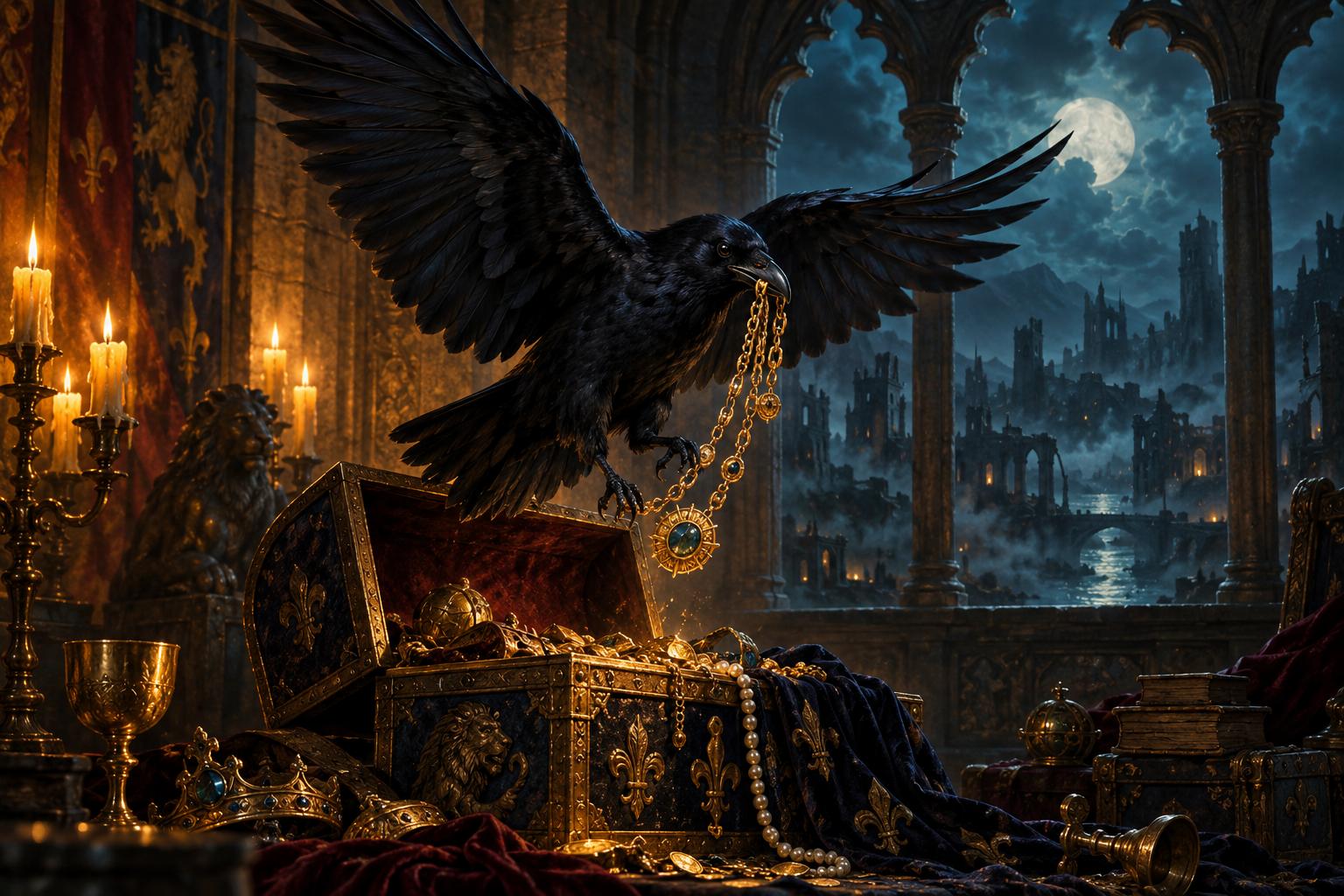
Raum demon explained: the 40th spirit of the Ars Goetia, an earl who appears as a crow and steals from kings. Rank, legions, offices, sigil and sources.
Quick answer: Raum (also spelled Raim or Raym) is the 40th spirit of the Ars Goetia, ranked as a great earl and said to command 30 legions. The Lemegeton describes Raum appearing first as a crow and then, when commanded, in human form. His offices are to steal treasure from the houses of kings and carry it where directed, to destroy cities and the dignities of men, to tell of past, present and future, and to cause love between friends and foes. The text adds that he once belonged to the angelic order of Thrones.
Related guides: all 72 demons of the Goetia, the rank of earl in the Goetia, how Goetia offices and seals work, Malphas, the crow president, Halphas, the stork earl, Andras, the owl-headed marquis.
| Spirit | Number and rank | Legions | Form in the Lemegeton | Main offices |
|---|---|---|---|---|
| Raum | 40, Earl | 30 | A crow, then human shape | Steals royal treasure; destroys cities and dignities; prophecy; reconciles friends and foes |
| Malphas | 39, President | 40 | A crow, then a hoarse-voiced man | Builds houses and towers; gathers artificers; exposes enemies' plans |
| Halphas | 38, Earl | 26 | A stork with a hoarse voice | Builds towers; furnishes weapons; sends men to war |
| Andras | 63, Marquis | 30 | Angel's body with an owl's head, riding a black wolf | Sows discord; the text warns he is dangerous to the operator |
Key Takeaways
The Raum demon is the fortieth spirit in the Ars Goetia, the first book of the Lemegeton or Lesser Key of Solomon. In the 1904 edition prepared by S. L. MacGregor Mathers and Aleister Crowley, the entry describes him as a great earl who appears at first in the form of a crow and, after the command of the operator, puts on human shape. He is said to govern 30 legions of spirits and to have belonged, before his fall, to the angelic order of Thrones.
His offices are four. He steals treasures out of kings’ houses and carries them where he is commanded. He destroys cities and the dignities of men, meaning reputations and high offices. He tells all things past, present and to come. And he causes love between friends and foes. The mixture is striking: a thief and a wrecker who is also a prophet and a peacemaker. Few of the 72 demons of the Goetia combine so many contradictory functions in one entry.
Spelling varies. Weyer gives Raum or Raim; some manuscripts have Raym. All describe the same crow-formed earl with the same offices and the same 30 legions.
The earliest printed description is in Johann Weyer’s Pseudomonarchia Daemonum (1577), which Reginald Scot translated in his Discoverie of Witchcraft (1584). In Scot’s English, Raum or Raim is a great earl who is seen as a crow and, when he takes human shape at the exorcist’s command, steals wonderfully out of the king’s house and carries it where he is assigned. He destroys cities, holds great spite toward dignities, knows things present, past and future, reconciles friends and foes, was of the order of Thrones, and governs thirty legions. Weyer wrote to ridicule magic; his list was meant to show how absurd the spirit catalogs were.
The Lemegeton manuscripts of the seventeenth century preserve the same profile and add the seal. The Mathers edition prints this text with small modernizations. Across three centuries the substance of the entry does not change, which is typical of the Goetia and shows how faithfully the catalog was copied even by people who disapproved of it.
Collin de Plancy’s Dictionnaire Infernal (1818) summarizes Weyer in French. The 1863 edition includes Louis Le Breton’s engraving of Raum as a crow with spread wings, perched and alert. As with the other Le Breton plates, the picture interprets the text rather than preserving any older image.
Does this touch your own situation? Many readers come to these pages because something in their home, dreams or family feels unexplained. Reading history helps, but it cannot look at your specific case.
Consult the Sheikh Private, confidential, and free to ask.
The Raum sigil printed in the Mathers edition is a broad, roughly horizontal figure with a long central stroke, several short branches ending in small circles, and a few angular turns. It reads as an abstract signature rather than a picture of a bird. Manuscript versions of the Lemegeton differ in the number of branches and terminal circles, so no single drawing is authoritative.
The Goetia calls the seal the spirit’s character and treats it as part of the spirit’s identity, much as a coat of arms identifies a noble house. Djinn Guide does not reproduce the ritual framework around these seals; the description is given only so readers can recognize the symbol in historical sources. For how the seals relate to names and offices in the catalog, see how Goetia offices and seals work.
Each part of the Raum entry draws on older European ideas, and separating them makes the profile easier to understand.
Crows and ravens were birds of ill omen and of battlefields across medieval Europe, and folklore gave them a reputation for stealing bright objects. A spirit who appears as a crow and steals royal treasure is an almost literal translation of the bird’s folk character into a demon.
Treasure-finding and treasure-moving spirits appear throughout late medieval and Renaissance magic. The specific office of robbing kings’ houses reflects both the fantasy of sudden wealth and the catalog’s habit of imagining spirits as agents in a world of courts and princes.
Several Goetia spirits are credited with ruin and discord. Raum’s targets, cities and the dignities of men, suggest political rather than physical destruction: the fall of reputations, offices and perhaps whole governments.
The Lemegeton assigns former angelic ranks to a number of spirits, drawing on the celestial hierarchy of Pseudo-Dionysius, in which Thrones are the third of nine orders. The detail signals that Raum is a fallen angel of high standing, which matches the Christian framework of the grimoire.
Causing love between friends and foes is an office Raum shares with Amon and others. It sits oddly beside destruction, but the Goetia often credits spirits with both halves of a power, to break and to mend.
Raum is best understood alongside the spirits around him. Malphas, number 39, also appears as a crow before taking human form, but he is a president who builds towers and gathers craftsmen. Halphas, number 38, is an earl in the form of a stork who builds and arms towers. Together 38 through 40 form a small cluster of bird-formed spirits concerned with building and destruction, probably reflecting the order of an older source list. Where Malphas constructs, Raum tears down.
Andras, number 63, is another bird-headed spirit with a destructive office: an angel-bodied figure with an owl’s head who sows discord. Unlike Raum, Andras carries an explicit warning that he will kill the operator and assistants if they are careless. Raum’s entry contains no such caution, despite his thieving and wrecking.
At 30 legions Raum ranks modestly. The earl was a middling rank in the catalog’s imitation of a feudal court, below king, duke and prince. For what the ranks were thought to mean, see our guide to Goetia ranks and hierarchy. The table above sets the four spirits side by side.
The first misunderstanding is that Raum and Malphas are the same spirit under different names. They are separate entries with different ranks, legion counts and offices. The shared crow form and adjacent positions explain the confusion but do not support it.
The second is that Raum has an ancient or biblical origin. The name does not appear in the Bible, the Testament of Solomon or classical demonology. Suggested links to Hebrew words are modern speculation. Like most of the Goetia’s obscure names, Raum appears to originate within the late medieval grimoire tradition.
The third is that “of the order of Thrones” is a unique honor. The Lemegeton gives former angelic orders to many spirits, from Seraphim and Cherubim down to Angels, as a way of fitting the catalog into Christian cosmology. It tells us about the compilers’ theology, not about Raum specifically.
The fourth is that Le Breton’s 1863 crow is traditional iconography. It is a nineteenth-century illustration of a sixteenth-century description and has no older pedigree.
Searches for the Raum demon today come mostly from games and fiction. The Shin Megami Tensei and Persona series include Raum as a recruitable demon, usually drawn as a crow or a crow-like humanoid. The name turns up in tabletop role-playing bestiaries, collectible card games and web fiction that borrow the Goetia’s roster, and in metal and electronic music projects that use it for its sound.
These adaptations keep the crow and the name and discard the rest. None is a source for the historical entry. The interest of Raum for a reader of occult history lies in what the entry reveals about Renaissance ideas of birds, theft, fallen angels and political ruin, not in any modern character design. The site treats him, like the whole Goetia, as part of the history of demonology as a field of study.
Start with Weyer’s 1577 Latin and Scot’s 1584 English, then compare the Lemegeton manuscripts and the Mathers edition. Note that the substance is stable and that only the seal is added. Treat the Dictionnaire Infernal as a tertiary summary with an influential picture. Be wary of modern commentaries that attach planets, colors, days or elaborate personalities to Raum; those come from nineteenth- and twentieth-century occult systems, not from the early texts.
Then read the entry for what it says about its audience: people who dreamed of hidden wealth, feared the fall of the powerful, wanted to know the future and hoped to mend quarrels. Djinn Guide presents the Goetia as cultural history and provides no instructions for invoking, binding or working with any spirit.
Still have a question about your own experience? Describe what you are seeing, feeling or dreaming, and when it started. The Sheikh reads every message personally and replies in private.
Want a personal perspective? Raum’s crow form and his place in the old lists invite many readings, from loss to reconciliation. If one of those themes touches a question in your own life, a Full Personal Reading with our partner PuraTarot offers a calm space to reflect on it. Join the free Djinn Guide newsletter and, once you confirm, you will unlock a 50% code for your first reading.
Further reading
As an Amazon Associate we earn from qualifying purchases.
Raum is the 40th spirit of the Ars Goetia, a great earl said to rule 30 legions. The Lemegeton describes him as a crow who takes human form on command. His offices are stealing treasure from kings, destroying cities and dignities, telling past, present and future, and reconciling friends and foes.
In the Lemegeton and in Weyer's Pseudomonarchia Daemonum he first appears as a crow and then, when commanded, in human shape. Louis Le Breton's 1863 engraving for the Dictionnaire Infernal shows him as a crow with spread wings, the image most modern references and games follow.
The Lemegeton says Raum was of the order of Thrones, the third of the nine angelic orders in the hierarchy of Pseudo-Dionysius. Many Goetia spirits are given such former ranks. It reflects the grimoire's Christian framework, in which all 72 spirits are understood as fallen.
Both appear as crows and sit next to each other in the list, but Malphas is number 39, a president with 40 legions who builds towers and gathers craftsmen, while Raum is number 40, an earl with 30 legions who steals treasure and destroys cities. All sources treat them as separate spirits.
He appears as a crow-form demon in the Shin Megami Tensei and Persona video games and in various tabletop and card-game bestiaries that draw on the Goetia. These are modern fictional uses and say nothing about the historical grimoire entry beyond borrowing its name and bird form.
Disclaimer
This article discusses a figure from early modern grimoires for historical and educational purposes. Descriptions of spirits, offices and seals are reported from the sources, not endorsed, and Djinn Guide provides no ritual instructions and makes no claims that any spirit or symbol produces results.
Did this guide help you understand the subject? Rate it and share your honest opinion to help other readers. Every review is checked by our editors before it appears.
There are no reviews yet. Be the first one to write one.


Sheikh Youssef
Tayeb El Merzouki
For inquiries about personalized spiritual work, private rituals, and traditional talismans, connect directly with Sheikh Youssef Tayeb El Merzouki.
Chat on WhatsApp