




Join Djinn Guide: Get 50% Off a Personal Reading
Get new guides to jinn, folklore and occult history. Confirm your subscription to unlock a 50% code for a first personal reading with our partner PuraTarot.
Discover the unseen
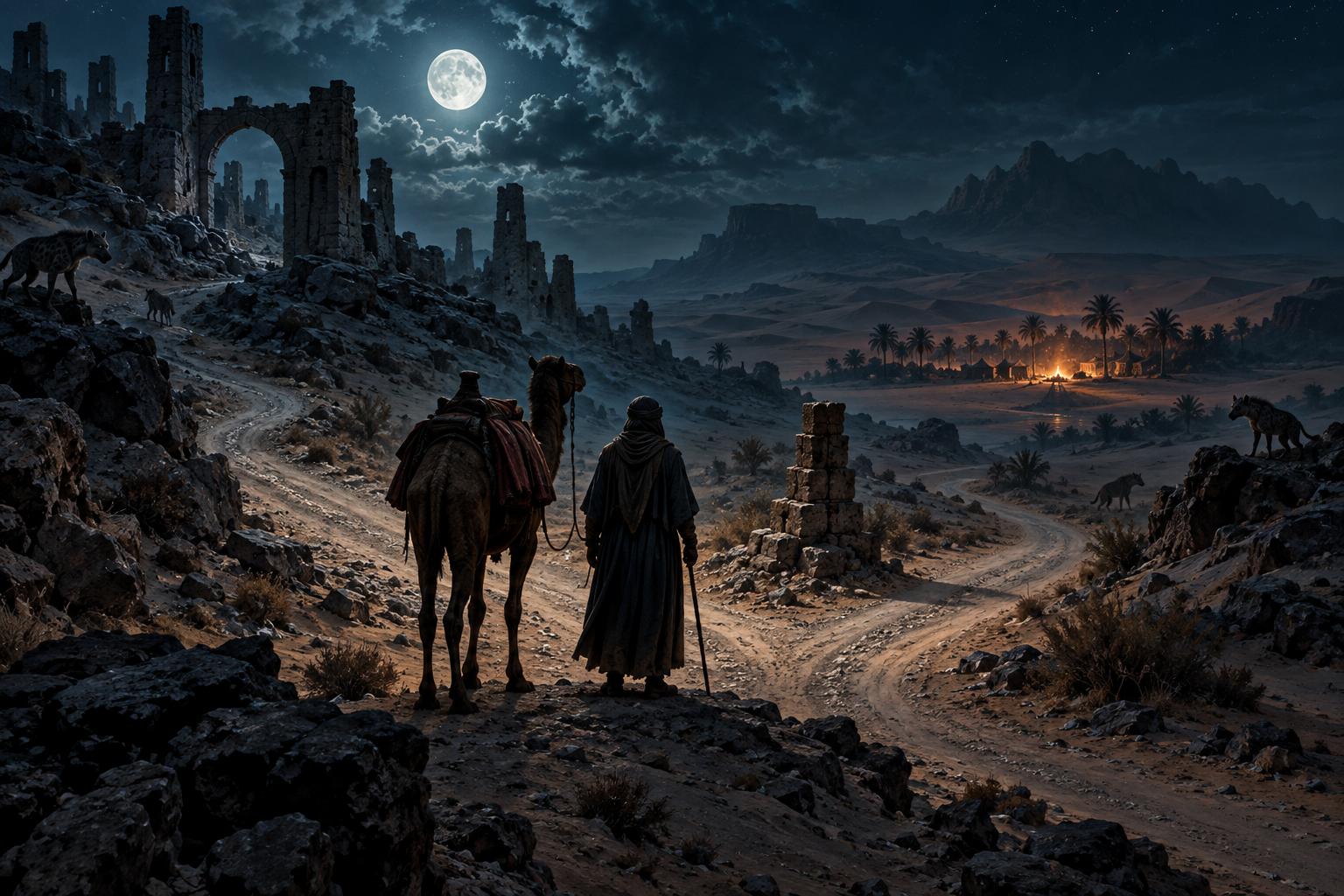
Ghul explained: what the ghoul is in Arabic folklore, the desert shapeshifter of pre-Islamic poetry, the hadith on it, and how it became the ghoul.
Quick answer: The ghul (Arabic ghūl, plural ghīlān) is a shape-shifting creature of Arabic folklore, usually counted among the jinn, that haunts deserts, ruins, and graveyards, lures travelers off their path, and feeds on the dead. The word comes from a root meaning to seize or destroy. It appears in pre-Islamic poetry, is mentioned in a hadith, and entered European languages as ghoul through eighteenth-century translations of the Arabian Nights. The modern flesh-eating ghoul of horror fiction descends directly from it.
Related guides: the main types of jinn, ifrit vs marid, jinn in the Arabian Nights, the nasnas, a half-human jinn, jinn folklore across cultures, what jinn are said to fear.
| Feature | Arabic ghul | Western ghoul |
|---|---|---|
| Nature | A jinn or jinn-like being, often female (ghula) | Undead or demonic monster; later a zombie-like creature |
| Habitat | Deserts, wastelands, ruins, graveyards | Cemeteries, crypts, tombs |
| Signature trait | Shape-shifting and luring travelers astray | Eating corpses |
| Earliest sources | Pre-Islamic poetry (6th century); al-Jahiz; al-Qazwini | Galland (1712); Beckford's Vathek (1786); Byron (1813) |
| Related names | Si'lat, qutrub, ghilan | Ghoul, goule |
| Religious status | Negated or limited by a hadith in Sahih Muslim | None; purely literary |
Key Takeaways
A ghul is a monster of Arabic folklore, most often classed as a kind of jinn, that lives in empty places and preys on people who stray. The Arabic word ghūl comes from the root gh-w-l, which carries the sense of seizing, destroying, or taking by surprise. The same root gives the verb used for a traveler being swallowed by the desert. A female ghul is a ghula, and the plural is ghilan. Medieval writers also used the related term si’lat for a female of the type.
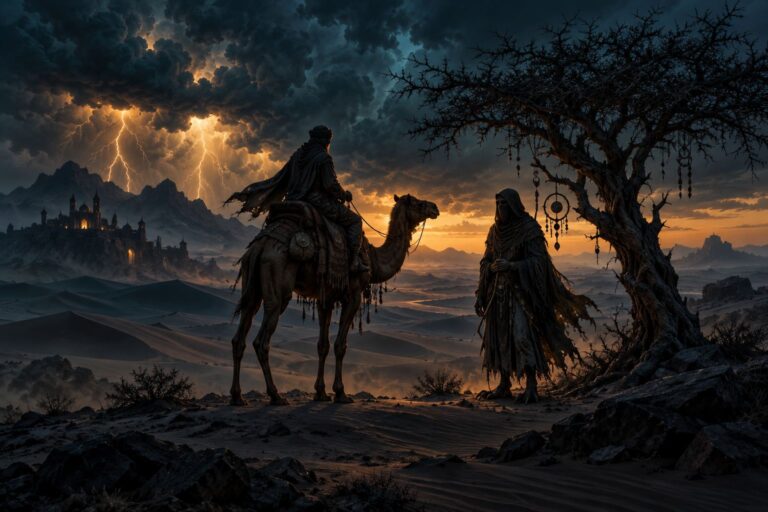
Three traits define the ghul in the older sources. It changes shape, often appearing as a beautiful woman, an animal, or a familiar landmark in order to deceive. It haunts the margins: deserts, abandoned ruins, roadsides at night, and graveyards. And it eats flesh, including the flesh of the dead, which is the trait that survived into modern English. Later folklore adds that a ghul betrays itself by donkey’s hooves or by failing a test with fire.
Among the many types of jinn, the ghul stands apart because it is almost never described as intelligent, religious, or capable of good. Where the Quran presents jinn as moral agents, the ghul of story is closer to an animal predator with a cunning streak, which is one reason some Arabic writers doubted that it belonged among the jinn at all.
The ghul is older than Islam. It belongs to the world of the Bedouin, for whom the desert at night was full of real dangers and imagined ones, and it appears in the poetry of the sixth century as a familiar hazard of travel. Poets boast of crossing wastes where the ghilan howl, and the sound of the ghul calling in the dark became a stock image of desolation, alongside the hyena and the owl.
The most famous early account is a poem attributed to Ta’abbata Sharran, a pre-Islamic outlaw poet. In it he describes meeting a ghula on a desert road at night, fighting and killing her with his sword, and then lying beside the body until dawn to see what he had slain. The description he gives in the morning is deliberately monstrous: a cat-like head, a split tongue, misshapen legs, and a dog’s back. The poem shows the ghul fully formed before the seventh century.
In this early layer the ghul is not a corpse eater so much as a misleader. The great fear was of being drawn off the track by a voice or a light and left to die of thirst, and the ghul personified that fear. The word for a traveler lost this way, taghawwul, comes from the same root, so the creature and the catastrophe shared a name.
Does this touch your own situation? Many readers come to these pages because something in their home, dreams or family feels unexplained. Reading history helps, but it cannot look at your specific case.
Consult the Sheikh Private, confidential, and free to ask.
The ghul is not mentioned in the Quran, but it does appear in the hadith. A report in Sahih Muslim, narrated by Jabir, records the Prophet Muhammad saying that there is no contagion, no evil omen, and no ghul. Scholars have read this in two ways. Some, including al-Nawawi in his commentary, took it to deny the Bedouin belief that the ghul could change shape and lead travelers to their deaths, not the existence of such a creature. Others read it as denying the ghul outright.
A weaker report, found in Musnad Ahmad, advises that when the ghilan appear, one should call the adhan, the call to prayer. Because its chain of transmission is considered weak, scholars give it less weight, but it shows that the ghul remained part of popular religious life. Over time the ghul was folded into the broad category of jinn, and the phrase ghul became a loose label for any jinn that frightens travelers, as the article on what jinn are said to fear discusses.
Medieval Arabic naturalists took up the question. Al-Jahiz, writing in the ninth century in his Book of Animals, treats the ghul with evident skepticism, grouping it with things the Bedouin claim to have seen but no one can verify. Al-Qazwini’s thirteenth-century cosmography, the Wonders of Creation, describes it as a demonic animal that leads people astray, and al-Mas’udi reports tales of it in his histories. The scholarly tone is consistently cautious.
Folklore across the Arabic-speaking world gives the ghul a recognizable set of habits, even though details shift from region to region. The following are the most widely repeated traits in the stories collected by travelers and folklorists from Arabia, Egypt, the Levant, and North Africa over the past two centuries.
The female ghula is the more common figure in stories, often appearing as a mother or a bride, and the related si’lat is sometimes described as the cleverer of the two. The qutrub, another name from the same family, is a smaller, more animal-like creature. These overlapping names show that the ghul was less a single species than a cluster of fears given different labels in different places.
The One Thousand and One Nights carried the ghul into world literature. In the cycle of the Fisherman and the Jinni, the vizier tells the king the story of a prince who follows a weeping woman into a ruin, overhears her promising to feed him to her children, and realizes she is a ghula; he escapes by praying. The tale of Gharib and Ajib features a ghul named Sa’dan who converts and becomes an ally, a rare case of a sympathetic ghul.
The most influential story is one that Antoine Galland added to his French translation from an oral source, the tale of Sidi Nu’man. A husband notices that his new wife eats only a few grains of rice at dinner, follows her at night, and finds her in a cemetery sharing a corpse with a ghoul. The scene fixed the image of the ghoul as a graveyard flesh-eater in the European mind, and it is the direct source of the modern meaning.
These stories differ from the desert tradition. The ghul of the Nights is urban and domestic as often as it is wild, and it is defeated by cleverness or piety rather than by a sword. The broader cast of spirits in the collection is surveyed in our article on jinn in the Arabian Nights, where the ghul sits alongside the ifrit, the marid, and the jinni of the bottle.
Galland’s volumes of Les mille et une nuits appeared between 1704 and 1717, and the Sidi Nu’man story, with its goule, was published in 1712. The French spelling passed into English as ghoul by the late eighteenth century. William Beckford’s Gothic novel Vathek, written in French and published in English in 1786, used the word freely in an orientalist setting, and Lord Byron’s poem The Giaour of 1813 helped make it a standard item of Romantic vocabulary.
As the word spread, its meaning narrowed. The Arabic ghul was above all a shape-shifter and a misleader; the English ghoul became almost exclusively a creature that haunts graveyards and eats the dead. By the twentieth century, writers such as H. P. Lovecraft had turned the ghoul into a subterranean race of corpse eaters, and when George Romero made Night of the Living Dead in 1968 he called his creatures ghouls, not zombies.
The word also lives on in ordinary English. A ghoulish interest is a morbid one, and a ghoul in journalism is someone who profits from tragedy. Few people who use these expressions know they are speaking a loan from Arabic, carried through a fairy tale told to a French scholar by a Syrian storyteller three centuries ago.
Arabic tradition names several kinds of jinn, and the ghul is usually placed near the bottom in power and intelligence. The ifrit is strong and cunning, the marid proud and rebellious, the sila a clever trickster, and the jann a general term for the ordinary jinn of the wilds. The ghul is the predator of the group: dangerous to the lone traveler but not credited with the knowledge, speech, or rank of the others. The pairing of ifrit and marid shows how differently the tradition treats its more formidable spirits.
The nasnas and the shiqq, half-human creatures of folklore, are sometimes grouped with the ghul as monsters of the waste, and in some regional accounts the ghul is said to be born from the union of a shiqq and a human. These genealogies are storytellers’ inventions rather than doctrine, but they show that the ghul belonged to a family of boundary creatures, beings that mark the edge between the settled world and the wild.
Interest in the ghul today comes mostly from fiction and games, where the ghoul is a stock monster, and from readers who meet the Arabic word in translations of the Nights or in discussions of jinn and want to know its origin. A smaller group searches from within Muslim communities, where stories of ghilan are still told and where the hadith is sometimes quoted in arguments about superstition.
When reading about the ghul, keep the layers separate. The pre-Islamic poems and the hadith give the oldest and most restrained picture: a desert hazard whose reality was already debated. The medieval naturalists add cautious description. The Arabian Nights supplies the vivid stories, including the graveyard scene that Europe adopted. Modern horror has little to do with any of these beyond the name. Sources that present the ghoul as an undead being from Islamic belief have confused the last layer with the first.
Still have a question about your own experience? Describe what you are seeing, feeling or dreaming, and when it started. The Sheikh reads every message personally and replies in private.
Drawn to these desert stories for a reason? If the ghul and the night roads of old Arabia keep returning to your thoughts, a Full Personal Reading with our partner PuraTarot offers a quiet way to reflect on what that pull means in your own life. Join the free Djinn Guide newsletter and, once you confirm, you will unlock a 50% code for your first reading.
Further reading
As an Amazon Associate we earn from qualifying purchases.
A ghul is a shape-shifting creature of Arabic folklore, usually counted among the jinn, that haunts deserts, ruins, and graveyards. It lures travelers off their path by imitating voices or taking a familiar form, and it feeds on the dead. The word derives from a root meaning to seize or destroy.
The Quran does not mention the ghul. A hadith in Sahih Muslim records the Prophet saying there is no contagion, no omen, and no ghul. Commentators such as al-Nawawi read this as denying the ghul's supposed power to mislead travelers rather than its existence, while others take it as a flat denial.
In Arabic tradition, yes, the ghul is generally classed as a kind of jinn, specifically a low, predatory one without the intelligence or rank of the ifrit or marid. Some medieval writers, including al-Jahiz, doubted it existed at all. The Western ghoul of horror fiction is a separate literary creature that borrowed only the name.
Ghoul comes from the Arabic ghul by way of French. Antoine Galland used goule in his 1712 translation of the Arabian Nights tale of Sidi Nu'man, in which a wife eats corpses in a cemetery. English writers adopted the word by the late eighteenth century, notably in Beckford's Vathek (1786) and Byron's The Giaour (1813).
The Arabic ghul is a desert shape-shifter whose chief trick is leading travelers astray; eating the dead is one trait among several. The English ghoul, shaped by Gothic fiction, Lovecraft, and film, is primarily a graveyard corpse-eater and later a zombie-like undead monster. The two share a name and a cemetery, little else.
Disclaimer
This article presents folklore, poetry, hadith commentary, and literary history for educational purposes. The creatures and beliefs described are reported as tradition holds them, not endorsed as fact, and nothing here promises protection or any other outcome.
Did this guide help you understand the subject? Rate it and share your honest opinion to help other readers. Every review is checked by our editors before it appears.
There are no reviews yet. Be the first one to write one.


Sheikh Youssef
Tayeb El Merzouki
For inquiries about personalized spiritual work, private rituals, and traditional talismans, connect directly with Sheikh Youssef Tayeb El Merzouki.
Chat on WhatsApp