





Join Djinn Guide: Get 50% Off a Personal Reading
Get new guides to jinn, folklore and occult history. Confirm your subscription to unlock a 50% code for a first personal reading with our partner PuraTarot.
Discover the unseen
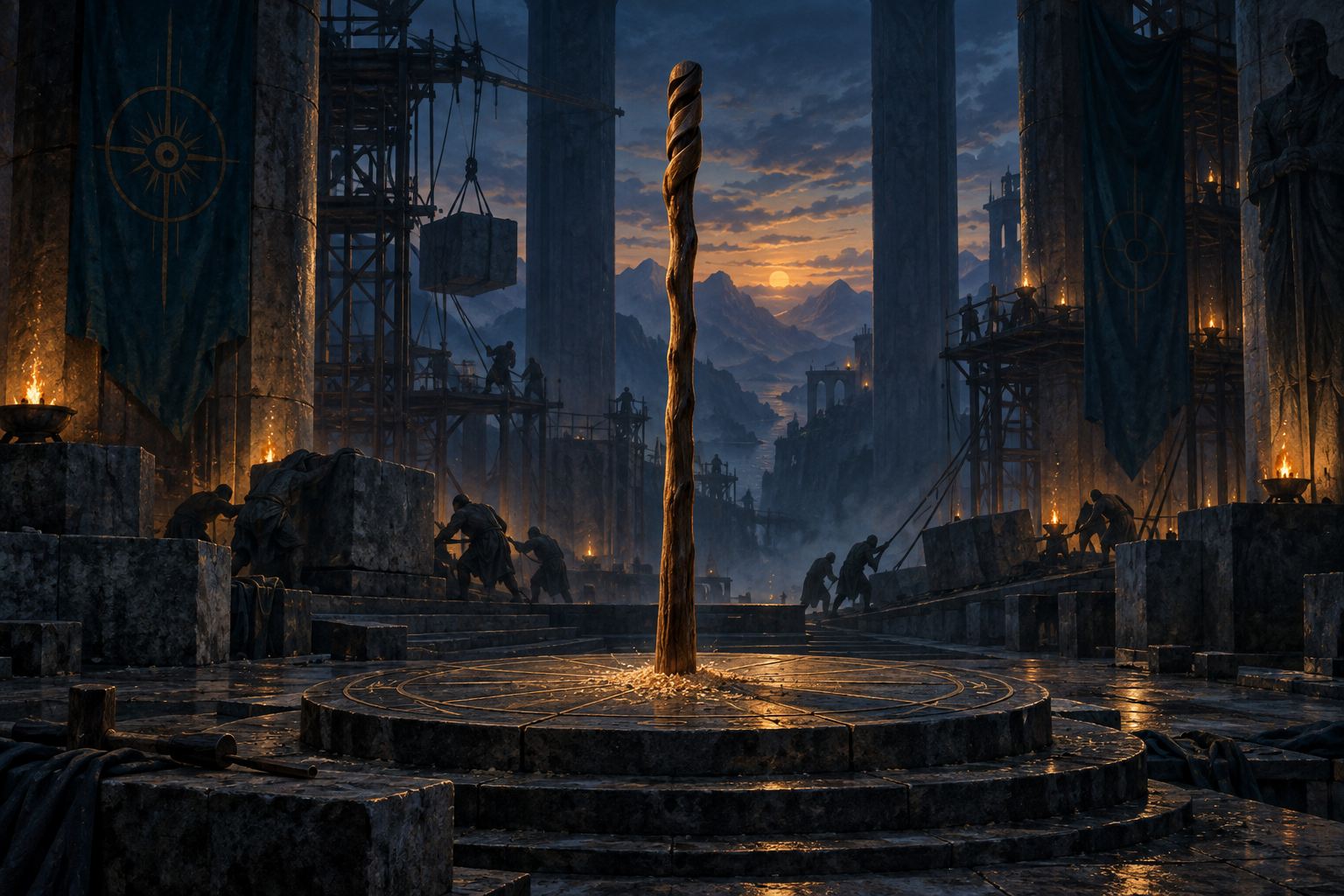
How did King Solomon die? What 1 Kings 11 says, how old he was by Josephus and rabbinic reckoning, and the Quran's story of the jinn and the staff (34:14).
Quick answer: The Bible does not say how King Solomon died. 1 Kings 11:41 to 43 reports only that he reigned forty years in Jerusalem, died, was buried in the City of David and was succeeded by his son Rehoboam, with no cause of death and no age. The Quran, in Surah Saba 34:14, adds a famous scene: Solomon died standing, leaning on his staff, and the jinn kept working until a creature of the earth gnawed through the staff and his body fell.
Related guides: who King Solomon was across traditions, King Solomon's authority over the jinn, verses about jinn in the Quran, Solomon's sons and who ruled after him, whether King Solomon was a real person, the Testament of Solomon explained.
| Source | What it says about Solomon's death | Age or length of reign |
|---|---|---|
| 1 Kings 11:41 to 43 | Solomon slept with his fathers, was buried in the City of David; Rehoboam succeeded him | Forty-year reign; no age given |
| 2 Chronicles 9:29 to 31 | Same summary, with reference to lost records of Nathan, Ahijah and Iddo | Forty-year reign; no age given |
| Josephus, Antiquities 8.7.8 | Died in old age after a long and prosperous reign | Reigned eighty years, lived ninety-four |
| Rabbinic chronology (Seder Olam) | Died after a forty-year reign that began in boyhood | King at twelve, died at fifty-two |
| Quran, Surah Saba 34:14 | Died leaning on his staff; the jinn worked on until a creature of the earth ate the staff | No age or reign length |
| Talmud, Gittin 68b | Lost his throne for a time to the demon Ashmedai before his death | No age given |
| Testament of Solomon | Lost his power over demons through idolatry late in life | No age given |
Key Takeaways
The biblical account of Solomon’s death is brief to the point of silence. 1 Kings 11:41 to 43 reads, in summary, that the rest of Solomon’s acts and his wisdom are written in the book of the acts of Solomon, that he reigned forty years in Jerusalem over all Israel, that he slept with his fathers and was buried in the city of David his father, and that Rehoboam his son reigned in his place. 2 Chronicles 9:29 to 31 repeats the same formula and refers readers to the records of Nathan the prophet, Ahijah the Shilonite and Iddo the seer, none of which survive.
The phrase slept with his fathers is the standard biblical formula for a peaceful, natural death, used for David and for most kings of Judah who did not die violently. Nothing in either passage mentions illness, injury, battle or assassination. For the biblical writers the question how did King Solomon die was simply not interesting; what mattered was the succession and the judgment on his reign.
That judgment is given a few verses earlier. 1 Kings 11:1 to 13 records that in his old age Solomon’s many foreign wives turned his heart toward other gods, that he built high places for Chemosh and Molech, and that God declared the kingdom would be torn from his son. The chapter then introduces three adversaries, Hadad the Edomite, Rezon of Damascus and Jeroboam, whose rebellion after Solomon’s death split the kingdom. The death notice closes a reign that the narrator presents as glorious in its first half and compromised in its second.
The Bible gives Solomon’s reign as forty years but never states his age at accession or at death. Two later traditions filled the gap in very different ways. The first-century historian Josephus, in Antiquities of the Jews 8.7.8, writes that Solomon reigned eighty years and lived to ninety-four, doubling the biblical reign and presenting the king as dying in extreme old age after a prosperous life. Most scholars treat the eighty years as a textual corruption or an exaggeration rather than independent information.
Rabbinic chronology went the other way. The Seder Olam and related traditions hold that Solomon became king at twelve, reading 1 Kings 3:7, where he calls himself a little child, and 1 Chronicles 22:5, where David calls him young and tender, as literal statements of youth. A forty-year reign from age twelve gives a death at fifty-two. This figure is widely repeated in Jewish commentary and is the source of the common claim that Solomon died relatively young.
Modern historians who accept a historical Solomon date his reign to roughly 970 to 931 BCE, with the division of the kingdom following at once. On that dating his death falls around 931 BCE, but his birth year and therefore his age remain unknown. Anyone who tells you with confidence that Solomon died at fifty-two or at ninety-four is reporting a tradition, not a record.
Does this touch your own situation? Many readers come to these pages because something in their home, dreams or family feels unexplained. Reading history helps, but it cannot look at your specific case.
Consult the Sheikh Private, confidential, and free to ask.
The Quran supplies the single most vivid scene connected with Solomon’s death. Surah Saba 34:12 to 14 describes the jinn who worked for Solomon by his Lord’s permission, building palaces, statues, basins like reservoirs and fixed cauldrons, and then says that when God decreed his death, nothing showed the jinn that he had died except a creature of the earth eating his staff. When he fell, the jinn realized that if they had known the unseen, they would not have remained in humiliating labor.
The verse is compact, and the classical commentators expanded it. Tafsir literature, including Ibn Kathir, explains that Solomon died standing while leaning on his staff, that his body remained upright, and that the jinn, seeing him apparently at prayer, kept working. The creature of the earth, dabbat al-ard, is usually identified as a termite or woodworm. Some reports say the jinn worked for a full year before the staff gave way; the Quran itself gives no duration. These additions are commentary, not scripture, and readers should keep the two layers apart.
The point of the passage in context is theological rather than biographical. It demonstrates that the jinn, for all their power, do not know the unseen, a theme that recurs in the Quran’s verses about jinn. Solomon’s death becomes the proof: beings who could build him palaces could not tell that their master was dead. The scene is also the clearest statement that Solomon’s authority over the jinn, discussed in the article on King Solomon and the jinn, came from God’s permission rather than from any power of his own.
Neither the Bible nor the Quran narrates Solomon’s last days in detail, and later storytellers supplied what scripture withheld. Three legend cycles are especially influential.
The Babylonian Talmud, in Gittin 68a to 68b, tells how Solomon captured the demon king Ashmedai to obtain the shamir for building the Temple, and how Ashmedai later flung him far away and sat on his throne in his likeness. Solomon wandered as a beggar until he was recognized and restored. A related saying in Sanhedrin 20b states that Solomon was king, then a commoner, then king again. The story is about the fragility of power, and it is not a death narrative.
The pseudepigraphal Greek Testament of Solomon, composed somewhere between the first and fifth centuries CE, ends with Solomon confessing that he sacrificed to foreign gods for love of a Jebusite woman, after which the spirit of God left him and the demons he had bound were released. Again the emphasis is on loss of power late in life rather than on the manner of his death.
Islamic qisas al-anbiya collections, such as those of al-Thalabi and al-Kisai, retell the staff episode with added detail: Solomon’s awareness that death was near, his choice to remain standing so that the jinn would finish the Temple, and the angel of death coming while he leaned on the staff. These versions turn the Quranic verse into a complete story with motives and timing, which is why so many modern retellings include elements the Quran never states.
The three traditions that honor Solomon disagree about how to weigh his end. The Hebrew Bible’s book of Kings frames the death notice with an account of idolatry and divine anger; the book of Chronicles, written later, omits the sins entirely and presents an unblemished king. Rabbinic literature inherited both pictures and debated them openly. One passage in Sanhedrin records a dispute over whether Solomon has a share in the world to come, with later authorities generally concluding that he did, and midrashic sources treat his book of Ecclesiastes as the reflection of an old man who had learned the limits of wealth and wisdom.
Islamic tradition takes a different position. Solomon, Sulayman, is a prophet, and prophets are protected from the grave sins the Bible attributes to him. Surah Sad 38:30 to 40 describes a test and a sincere repentance, after which God grants him a kingdom unlike any other. His death in Surah Saba is therefore not a punishment but a lesson aimed at the jinn and at readers. Classical commentators emphasize that he died in a posture of worship.
Because the sources are short, popular accounts often fill them with details that belong elsewhere. A few corrections are worth stating plainly.
A final confusion concerns succession. Rehoboam was Solomon’s only son named in the Bible, and his harsh answer to the northern tribes at Shechem in 1 Kings 12 triggered the split of the kingdom. Ethiopian tradition adds Menelik, the son of Solomon and the Queen of Sheba, as the founder of its royal line. Both figures are discussed in the article on Solomon’s sons and his successors.
Start with the primary texts and read them in full. 1 Kings 11 and 2 Chronicles 9 take minutes; Surah Saba 34:12 to 14 and Surah Sad 38:30 to 40 take less. Note what each text says and, just as important, what it does not say. The absence of an age, a cause and a scene in the Bible is a fact about the sources, and it should not be papered over with figures from Josephus or the Seder Olam presented as biblical.
Then move to the commentaries and legends with their dates in mind. Josephus wrote in the first century CE, the Talmud was compiled by around 500 CE, the Testament of Solomon falls somewhere in the first five centuries, and the Islamic stories of the prophets were collected from the tenth century onward. Each adds something, and each tells you about the community that produced it. A modern article that merges them all into one seamless biography is doing something the sources never did.
This site treats Solomon’s death as a subject of scripture, history and folklore. Beliefs about jinn, demons and the afterlife are described as beliefs, and no ritual instruction or claim of outcome is offered. The question how did King Solomon die has a short honest answer and a long fascinating history, and it is worth keeping both in view.
Still have a question about your own experience? Describe what you are seeing, feeling or dreaming, and when it started. The Sheikh reads every message personally and replies in private.
Have a question of your own? Stories about how a great life ends often raise quieter questions about our own path. If something here touched a question you are carrying, a Full Personal Reading with our partner PuraTarot offers a calm space for personal reflection. Join the free Djinn Guide newsletter and, once you confirm, you will unlock a 50% code for your first reading.
Further reading
As an Amazon Associate we earn from qualifying purchases.
The Bible does not give a cause. 1 Kings 11:41 to 43 says Solomon reigned forty years, slept with his fathers, was buried in the City of David and was succeeded by Rehoboam. The phrase slept with his fathers is the standard formula for a natural, peaceful death.
Scripture does not say. Josephus claims Solomon lived ninety-four years and reigned eighty, while rabbinic chronology makes him king at twelve and dead at fifty-two after the biblical forty-year reign. Modern dating places his death around 931 BCE, but his age remains unknown.
Surah Saba 34:14 says that when God decreed Solomon's death, the jinn did not realize it until a creature of the earth ate his staff and he fell. Commentators explain that he died standing, leaning on the staff, and that the creature was a termite. The lesson is that jinn do not know the unseen.
No. In the Quranic account the jinn do not harm Solomon; they continue their labor unaware that he has died. The episode demonstrates their ignorance of the unseen rather than any rebellion. No Jewish, Christian or Islamic source describes Solomon being killed by jinn or demons.
His son Rehoboam succeeded him in Jerusalem. According to 1 Kings 12, Rehoboam's refusal to lighten the people's burdens led the ten northern tribes to break away under Jeroboam, dividing the kingdom into Israel in the north and Judah in the south.
Disclaimer
This article compares what the Bible, the Quran, Josephus and later Jewish and Islamic traditions say about King Solomon's death. Religious accounts are described as the traditions present them, not endorsed or ranked, and no spiritual claims are made.
Did this guide help you understand the subject? Rate it and share your honest opinion to help other readers. Every review is checked by our editors before it appears.
There are no reviews yet. Be the first one to write one.


Sheikh Youssef
Tayeb El Merzouki
For inquiries about personalized spiritual work, private rituals, and traditional talismans, connect directly with Sheikh Youssef Tayeb El Merzouki.
Chat on WhatsApp