






Join Djinn Guide: Get 50% Off a Personal Reading
Get new guides to jinn, folklore and occult history. Confirm your subscription to unlock a 50% code for a first personal reading with our partner PuraTarot.
Discover the unseen

Djinn meaning explained: what the Arabic word jinn means, why English has three spellings, how djinn is pronounced, and why a genie is not quite a jinn.
Quick answer: Djinn meaning: djinn is simply an alternative English spelling of the Arabic word jinn, which refers to a class of unseen, intelligent beings created from smokeless fire in Islamic belief and older Arabian folklore. The word comes from a root meaning "hidden" or "concealed." Genie is a separate French-derived word that eighteenth-century translators used for jinn, and it now carries the lamp-and-wishes image of Aladdin. All three words are pronounced with a soft j, like gin.
Related guides: what are jinn: beginner guide, where the genie in the lamp came from, jinn in Islamic belief, the main types of jinn, Scheherazade and the Arabian Nights, are jinn real.
| Word | Origin | Pronunciation | What it usually means | Where you see it |
|---|---|---|---|---|
| Jinn | Arabic jinn, root j-n-n (hidden) | JIN (rhymes with gin) | The beings themselves; collective noun | Quran translations, academic writing, Islamic contexts |
| Jinni (m.) / jinniyya (f.) | Arabic singular forms | JIN-ee / jin-NEE-ya | One individual jinn | Arabian Nights, scholarly texts |
| Djinn | French transliteration of jinn (dj for Arabic jim) | JIN, identical to jinn | Same as jinn; often preferred in fiction | Fantasy novels, games, older European scholarship |
| Genie | French génie, from Latin genius (guardian spirit) | JEE-nee | A wish-granting spirit, often in a lamp or bottle | Aladdin, cartoons, popular culture |
| Genius / genii | Latin, Roman religion | JEE-nee-us / JEE-nee-eye | Tutelary spirit of a person or place | Classical studies; the source of 'genie' |
Key Takeaways
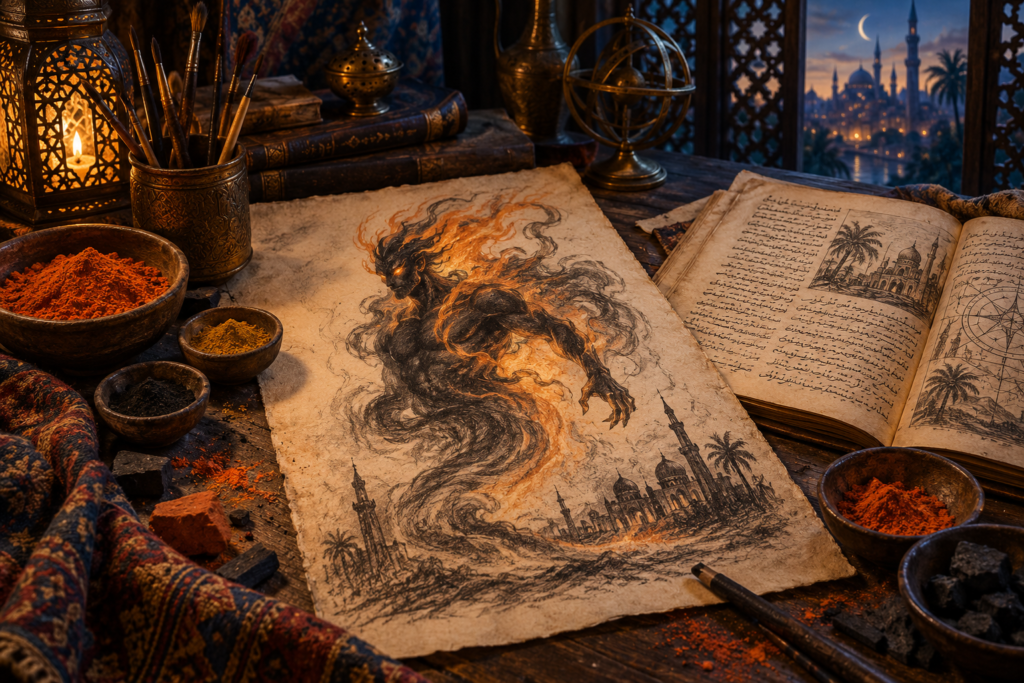
The djinn meaning is the jinn meaning, because djinn is just another way of writing the Arabic word jinn (الجن) in the Latin alphabet. In Arabic the word is a collective noun for a category of beings that Islamic belief and pre-Islamic Arabian folklore describe as intelligent, invisible to humans, created from smokeless fire, and capable of belief or unbelief. A single male member is a jinnī and a single female a jinniyya.
The word’s root, j-n-n, carries the sense of covering or hiding. The same consonants appear in janna, a garden hidden by foliage and the Quranic word for paradise; in janīn, a fetus hidden in the womb; and in majnūn, a person whose reason is veiled, traditionally understood as possessed by jinn. Jinn, then, are literally the concealed ones, beings that exist alongside humans but out of sight.
This etymology shapes the jinn definition in every serious source. Jinn are not defined by wickedness, by living in lamps or by granting wishes. They are defined by being hidden. Whether a particular jinni is good, bad, powerful or weak is a separate question, and the Quran states plainly that jinn include both the righteous and the unjust. For the beliefs themselves, see our beginner guide to what jinn are.
The Arabic letter jīm is written with a plain j in English transliteration, giving jinn. French orthography, however, needed dj to represent the same sound, because a lone j in French is pronounced like the s in measure. French Orientalists of the eighteenth and nineteenth centuries therefore wrote djinn, and the spelling passed into English through translations and scholarship, and later through fantasy fiction that found the dj visually exotic.
Neither spelling is wrong. Academic writing in English, Quran translations and most dictionaries prefer jinn. Novels, role-playing games and comics often prefer djinn, and some writers use the two forms to distinguish a religious context (jinn) from a fictional one (djinn). That distinction is a stylistic convention, not a difference in meaning.
Plural forms cause more trouble. In Arabic, jinn is already plural or collective, so “jinns” and “djinns” are technically redundant, like saying “sheeps.” They are nonetheless common in English and understood by everyone. Older English spellings include jinnee, djinnee and ginn, all of which appear in nineteenth-century translations of the Arabian Nights.
Does this touch your own situation? Many readers come to these pages because something in their home, dreams or family feels unexplained. Reading history helps, but it cannot look at your specific case.
Consult the Sheikh Private, confidential, and free to ask.
Djinn pronunciation is simpler than the spelling suggests. The d is silent in English; the word is said JIN, exactly like the drink gin and exactly like jinn. The singular jinni is JIN-ee, with the stress on the first syllable, and some speakers lengthen it to JEE-nee, which is how the word collided with genie in the first place.
Genie is pronounced JEE-nee, the same as the final syllables of Latin genii. Its spelling and sound are French, from génie, which in modern French still means both a guardian spirit and a person of genius. English borrowed the word in the Aladdin sense in the early 1700s.
The jinn vs genie question has a precise historical answer. In 1704 the French scholar Antoine Galland began publishing Les mille et une nuits, the first European translation of the Arabian Nights. When he met the Arabic word jinnī he rendered it with the French génie, a word already in use for the Roman genius, the guardian spirit attached to a person or a place. The two words sounded alike and both described a spirit, so the choice was natural, and English translators followed it as genie.
The Latin genius had nothing to do with fire, invisibility or Solomon. It was a protective presence honored on birthdays and at household shrines. By attaching it to the jinn of the Nights, Galland created a hybrid: an Arabian being with a Latin name, filtered through French taste. Over the next three centuries that hybrid picked up the lamp, the bottle, the three wishes and the comic manner that now define the genie in popular culture.
Those additions come from specific stories, above all Aladdin, which was not in the Arabic manuscripts Galland used. He added it from the telling of a Syrian storyteller, Hanna Diyab, in 1709. Our article on Aladdin’s ring and lamp genies traces how that single tale shaped the modern image. A genie, in short, is a jinni as reimagined in Europe.
The same word carries different weight depending on the source.
Jinn are a created species with free will, addressed by revelation and judged like humans. Surah Al-Jinn (72) records jinn who believed; Surah Ar-Rahman says they were made from smokeless fire. Iblis, the devil, is identified as one of the jinn in Surah Al-Kahf 18:50. Our guide to jinn in Islam covers this in full.
Jinn were spirits of the wilderness, associated with particular valleys, ruins and animals, and sometimes honored or appealed to for safety. Poets were said to have jinn companions who inspired them.
Jinn and ifrits are characters: imprisoned in bottles by Solomon, serving rings and lamps, abducting brides, transforming people into animals. This is where the fictional genie’s traits were born.
From Morocco to Indonesia, jinn absorbed local spirit beliefs, producing figures like the Moroccan Aisha Kandisha and the Southeast Asian khodam. The categories of marid, ifrit, ghul and sila, discussed in our overview of the types of jinn, come largely from this layer.
Djinn tends to mean a serious, often dangerous spirit in horror and fantasy; genie means a friendly wish-granter. Both are descendants of the same Arabic word.
The most frequent error is treating genie as a translation of jinn. It is a replacement rather than a translation, and it brings in Latin and French associations that the Arabic word never had. A reader who assumes that jinn in the Quran grant wishes, live in lamps or serve whoever rubs a vessel has imported Galland’s genie into scripture.
A second error is the belief that djinn is the “authentic” or “original” spelling and jinn the Westernized one. The reverse is closer to the truth: jinn is the direct transliteration, and djinn is the French-shaped form. A third is the idea that jinn simply means demon. Islamic sources distinguish jinn, a species, from shayatin, devils, who are the rebellious among jinn and humans.
Finally, many people assume the word is related to the English word genius in the sense of great intelligence. The link runs the other way and only through genie: genius came from Latin into English on its own, and genie borrowed its sound from the same Latin root when Galland needed a word for jinni. The Arabic jinn has no connection to Latin at all.
The spike in searches for djinn meaning tracks the word’s spread through popular culture. Television series, horror films, video games and fantasy novels have adopted the djinn spelling to signal a creature darker and more serious than the cartoon genie. Readers meeting the word for the first time want to know whether it is the same thing, how to pronounce it, and whether it is a real belief or an invention.
The answers are reassuring. Yes, it is the same word as jinn. Yes, it is a real belief held by hundreds of millions of Muslims and reflected in centuries of folklore, and it should be described respectfully as such. No, the horror-movie djinn with a single fixed set of powers is not what the sources describe; the sources describe a varied community of hidden beings. For the question of existence itself, our article on whether jinn are real sets out how belief, scripture, folklore and science each approach it.
Writers and game designers who want to use the word well can take a simple rule from this history: jinn or djinn for the hidden beings of Arabian and Islamic tradition, genie for the wish-granting figure of European retellings, and jinni when one individual is meant.
When you see jinn, djinn or genie in a text, ask three questions. First, what is the source language? An Arabic or Islamic source means jinn, however it is spelled. A French or English literary source from after 1704 may mean the Galland genie. Second, is the word used as a species name or as a character type? The Quran uses it as a species; the Nights use ifrit, marid and jinni as character types. Third, what powers are assumed? Wishes and lamps point to the European tradition; invisibility, shapeshifting and moral choice point to the Arabic one.
For English readers, three translations of the Arabian Nights set the vocabulary: Galland’s French (1704 to 1717), Edward Lane’s English (1838 to 1840) and Richard Burton’s (1885). Each spells the words differently and each adds its own notes on what jinn are. Comparing a single tale across them is a short, revealing exercise, and our article on Scheherazade and the frame story is a good place to start.
Djinn Guide describes the beliefs behind these words as beliefs and the stories as stories. The vocabulary matters because it carries history: a hidden being from Arabia, a guardian spirit from Rome and a French translator’s choice, all folded into three short words.
Still have a question about your own experience? Describe what you are seeing, feeling or dreaming, and when it started. The Sheikh reads every message personally and replies in private.
Want a personal perspective? If the story behind these words has you curious about a question in your own life, a Full Personal Reading with our partner PuraTarot offers a calm, personal way to explore it. Join the free Djinn Guide newsletter and, once you confirm, you will unlock a 50% code for your first reading.
Further reading
As an Amazon Associate we earn from qualifying purchases.
Djinn is an English spelling of the Arabic word jinn, meaning a class of unseen intelligent beings created from smokeless fire in Islamic belief and Arabian folklore. The root j-n-n means hidden or concealed. Djinn and jinn are the same word; djinn reflects French transliteration and is common in fiction and games.
They share an origin but not a meaning. Genie comes from French génie and Latin genius, and was used by Galland in 1704 to translate jinni in the Arabian Nights. Over time genie came to mean the wish-granting lamp spirit of Aladdin, while djinn and jinn still refer to the hidden beings of religious and folk tradition.
Djinn is pronounced JIN, exactly like gin and exactly like jinn; the d is silent in English. The singular jinni is JIN-ee, and the feminine jinniyya is jin-NEE-ya. Genie is pronounced JEE-nee. In Egyptian Arabic the first consonant is a hard g, which explains older spellings such as ginn.
Jinn is the collective or plural form in Arabic, referring to the beings as a category. Jinni is the masculine singular, one individual jinn, and jinniyya is the feminine singular. English often uses jinn for both singular and plural, and the forms jinns or djinns, though redundant, are widely understood.
No. In Islamic sources jinn are a species with free will, including believers and wrongdoers. The Arabic word for devils is shayatin, used for the rebellious among both jinn and humans. Iblis is described as a jinni who refused to bow to Adam, so some jinn are devils, but the word jinn itself is neutral.
Disclaimer
This article explains vocabulary and its history for educational purposes. Beliefs about jinn are described as held within Islamic and folk traditions and are neither endorsed nor dismissed; no claims are made about the existence or powers of any being.
Did this guide help you understand the subject? Rate it and share your honest opinion to help other readers. Every review is checked by our editors before it appears.
There are no reviews yet. Be the first one to write one.


Sheikh Youssef
Tayeb El Merzouki
For inquiries about personalized spiritual work, private rituals, and traditional talismans, connect directly with Sheikh Youssef Tayeb El Merzouki.
Chat on WhatsApp