






Join Djinn Guide: Get 50% Off a Personal Reading
Get new guides to jinn, folklore and occult history. Confirm your subscription to unlock a 50% code for a first personal reading with our partner PuraTarot.
Discover the unseen
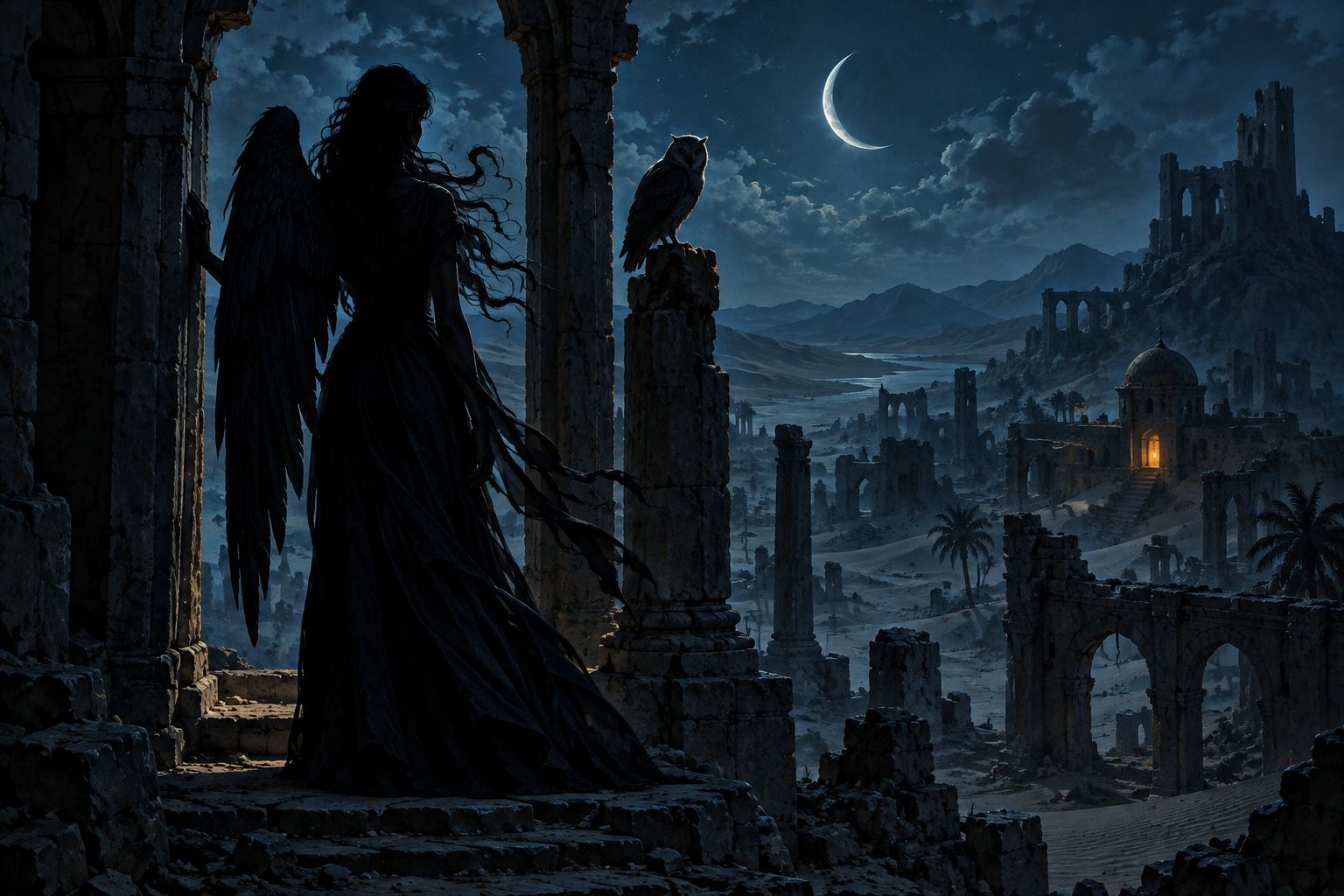
The Lilith demon explained: Mesopotamian roots, the single Bible verse, the Talmud, the Ben Sira story of Adam's first wife, and her modern revival.
Quick answer: Lilith is a female night demon whose name goes back to Mesopotamian spirits called lilu and lilitu, blamed for harming infants and seducing men in their sleep. She appears once in the Hebrew Bible, in Isaiah 34:14, as a creature haunting ruins. Rabbinic and later Jewish texts developed her into a winged, long-haired demon, and the medieval Alphabet of Ben Sira made her Adam's first wife, who refused to submit and fled Eden. That story is the Lilith most people know today.
Related guides: shedim and Jewish demon lore, Azazel and the Watchers, Aisha Kandisha, Morocco's night jinniya, protective amulets through history, what demonology covers, the ghul in Arabic folklore.
| Source | Date | What it says about Lilith |
|---|---|---|
| Mesopotamian incantations | 2nd–1st millennium BCE | Lilu, lilitu and ardat-lili: wind and night spirits that attack sleepers and infants |
| Isaiah 34:14 | Hebrew Bible | A lilith rests among wild animals in the ruins of Edom; the only biblical mention |
| Dead Sea Scrolls (Songs of the Sage) | 1st century BCE | Lilith listed among destroying spirits to be warded off |
| Aramaic incantation bowls | 5th–7th century CE | Lilith and liliths named and bound; some bowls show a chained female figure |
| Babylonian Talmud | c. 500 CE | Lilith has long hair and wings; sleeping alone in a house is risky |
| Alphabet of Ben Sira | c. 8th–10th century CE | Lilith as Adam's first wife; flees Eden; three angels pursue her; amulets for newborns |
| Zohar | 13th century | Lilith as consort of Samael and mother of demons |
| Rossetti, Lady Lilith | 1866–1868 | Pre-Raphaelite painting and sonnet that fixed her image as a beautiful temptress |
Key Takeaways
Lilith is the most famous female demon in Western tradition, but her identity has changed so much over three thousand years that the name belongs to several different figures. The oldest layer is Mesopotamian. Sumerian and Akkadian texts speak of a class of spirits called lilu (male), lilitu (female) and ardat-lili, the maiden lilitu. They were wind or storm spirits, associated with the open steppe and the night, and they were blamed for the deaths of infants, for miscarriages and for troubling men and women in their sleep. Magical texts prescribe incantations against them.
The lilith meaning that many websites give, from the Hebrew word laylah, night, is a folk etymology. The name entered Hebrew from Akkadian, where it already described a spirit; its resemblance to the word for night is a coincidence that later writers were happy to exploit. By the time the name appears in Hebrew it already carries the sense of a dangerous female night creature.
What the later traditions add is a biography. Rabbinic literature gives her a body, with wings and long hair. The Alphabet of Ben Sira gives her a past as Adam’s first wife. The Zohar gives her a husband, Samael, and a role as queen of the demonic realm. Nineteenth-century poets and painters give her beauty and tragic glamour, and twentieth-century feminists give her a cause. Each layer is real, and part of understanding Lilith is learning which story comes from where.
Lilith in the Bible amounts to one word in one verse. Isaiah 34 describes the devastation of Edom, a land turned to desert and inhabited only by wild creatures. Verse 14 lists them: wildcats meeting hyenas, goat-demons calling to each other, and the lilith settling there to find rest. The context is a catalog of desolate things, and the word sits among animals and spirits of the wasteland, much as the lilitu sat among the steppe spirits of Babylon.
Translators have handled the word in very different ways. The Greek Septuagint rendered it as a kind of donkey-centaur, the Latin Vulgate as lamia, a Greek child-eating monster, and the King James Version as screech owl. Modern translations variously give night creature, night monster or simply Lilith. The variety shows that the ancient translators did not have a settled picture, only the sense of something eerie that belonged in ruins.
The Dead Sea Scrolls fill in a little more. A hymn known as the Songs of the Sage, from the first century BCE, lists Lilith among the destroying angels, bastard spirits and demons that the speaker intends to frighten away with praise of God. This shows that by the late Second Temple period Lilith was a recognized demon name in Jewish communities, not just a poetic image. For the larger Jewish demonology she belongs to, see shedim and Jewish demon lore.
Does this touch your own situation? Many readers come to these pages because something in their home, dreams or family feels unexplained. Reading history helps, but it cannot look at your specific case.
Consult the Sheikh Private, confidential, and free to ask.
The Babylonian Talmud, compiled around 500 CE, mentions Lilith a handful of times, always briefly. One passage says she has long hair; another that she has wings; another warns that a man who sleeps alone in a house may be seized by Lilith. A discussion of Adam’s time apart from Eve after the expulsion says that he fathered demons during those years, which later writers linked to Lilith. These scattered remarks are not a narrative, but they fix the image of a winged, long-haired female spirit who preys on the solitary and the sleeping.
Archaeology confirms how seriously this was taken. Hundreds of Aramaic incantation bowls, buried upside down under the thresholds and corners of houses in Sasanian Mesopotamia between roughly the fifth and seventh centuries, carry spiral inscriptions binding demons away from a named household. Lilith and liliths, male and female, appear in many of them. Some bowls show a crude drawing of a bound female figure with loose hair, chained hand and foot. A few even frame the spell as a divorce document, formally expelling the lilith from the home.
The bowls were used by Jews, Christians, Mandaeans and others, which suggests that fear of Lilith was a shared regional belief rather than a specifically Jewish one. They are also the clearest evidence that the Talmudic references reflect everyday practice and not just scholarly speculation.
The story that made Lilith famous appears in a medieval Hebrew work called the Alphabet of Ben Sira, composed somewhere between the eighth and tenth centuries. The book is satirical and sometimes crude, and scholars debate whether its Lilith tale was meant seriously or as parody. Either way, it became the standard account.
The story explains why newborns need protection. God, it says, created Adam’s first companion from the earth as he had created Adam, and called her Lilith. The two quarreled at once, because Lilith refused to lie beneath Adam, arguing that since both were made from the same earth they were equals.
When Adam would not yield, Lilith pronounced the ineffable name of God, rose into the air, and flew away. Adam complained, and God sent three angels, Senoy, Sansenoy and Semangelof, to bring her back. They found her at the Red Sea and threatened that a hundred of her children would die each day if she refused. She refused, and declared that she had been created to harm infants, but swore that wherever she saw the three angels’ names or images on an amulet she would leave the child alone.
That ending turned the story into a charter for protective practice. Jewish amulets for mothers and newborns, printed and handwritten from the medieval period into modern times, carry the angels’ names and sometimes the phrase forbidding Lilith entry. The tale thus links the ancient child-stealing lilitu to a Genesis-style origin, which is why readers interested in protective amulets through history so often encounter her.
The Zohar, the central text of Kabbalah composed in thirteenth-century Spain, took the medieval Lilith and placed her inside a mystical cosmology. There she is the consort of Samael, the chief of the forces of impurity, and the pair form a dark counterpart to the union of God and the Shekhinah. She is described as mother of demons, as a seducer who gathers the seed of men who sleep alone, and as a figure associated with the dangerous side of the night and the new moon. Some kabbalistic texts speak of two Liliths, an elder and a younger, married to different demon princes.
Later Jewish folklore kept her close to the household. Customs recorded in Eastern Europe include keeping a lamp burning in the room of a newborn, drawing a circle on the wall with the angels’ names, and reciting specific psalms. These practices were defensive, and they treated Lilith less as a mythological queen than as a persistent domestic danger. The queen and the thief lived side by side in the same communities.
It is worth noting what Lilith is not in this tradition. She is never a figure to be invoked or honored. Jewish texts describe her only to warn against her or to bind her. The idea of Lilith as a goddess or a positive spiritual patron belongs to the modern period, as the next sections explain.
None of this makes the modern Lilith illegitimate; it simply means that the goddess of twentieth-century imagination and the demon of the incantation bowls are different beings who share a name, much as Azazel and the Watchers differ from the Azazel of television.
Lilith’s transformation from household menace to cultural icon began with the Romantics. Goethe put her briefly in Faust, where Mephistopheles identifies her as Adam’s first wife and warns of her beautiful hair. Dante Gabriel Rossetti painted Lady Lilith between 1866 and 1868, a sensual woman combing her hair before a mirror, and paired it with a sonnet describing her as the first witch whose enchanted hair ensnares men. George MacDonald’s 1895 fantasy novel Lilith made her a tragic figure capable of redemption. These works kept the danger but added glamour and interiority.
The twentieth century completed the reversal. Feminist writers in the 1970s reread the Alphabet of Ben Sira and found in Lilith’s refusal to lie beneath Adam a story of a woman punished for demanding equality. A Jewish feminist magazine took her name in 1976, and the Lilith Fair music festival of the late 1990s made it a mainstream symbol of female independence. In parallel, modern pagan and occult movements adopted Lilith as a dark goddess, a role she never held in any ancient or medieval source.
Today she appears in television series, comics, video games and novels, usually as a powerful first demon or mother of monsters. For readers who want to understand the figure rather than any single portrayal, the sources above can be read in a few hours: Isaiah 34, the Talmud passages, the Ben Sira story, and a Zohar excerpt. Reading them in order shows how a Mesopotamian wind spirit became the Lilith demon of Jewish folklore and then, very recently, something close to its opposite. Comparing her with night-women figures elsewhere, such as Aisha Kandisha, Morocco’s night jinniya, shows how widely this pattern of a beautiful, dangerous female spirit recurs.
Still have a question about your own experience? Describe what you are seeing, feeling or dreaming, and when it started. The Sheikh reads every message personally and replies in private.
Thinking about balance in your own relationship? Lilith’s best-known legend turns on equality between partners, a question many couples still face, and our partner PuraTarot offers a Relationship Harmony Ritual for readers who want to reflect calmly on harmony with a partner. Join the free Djinn Guide newsletter and, once you confirm, you will unlock a 50% code for your first reading.
Further reading
As an Amazon Associate we earn from qualifying purchases.
Lilith is a female night demon with roots in Mesopotamian spirits called lilitu, blamed for harming infants and troubling sleepers. She appears once in the Hebrew Bible, in Isaiah 34:14. Jewish tradition later described her as winged and long-haired, and the medieval Alphabet of Ben Sira made her Adam's first wife, who fled Eden rather than submit.
Only once. Isaiah 34:14 lists a lilith among the wild creatures inhabiting the ruins of Edom. Translations render the word as screech owl, night monster, night creature or Lilith. She is not named in Genesis; the story that she was Adam's first wife comes from a medieval Hebrew text, not from scripture.
The name comes from the Akkadian lilitu, a class of female wind and night spirits in Mesopotamian belief. The often repeated idea that it derives from the Hebrew word laylah, meaning night, is a folk etymology. The resemblance helped later writers associate Lilith with darkness, but the name was a spirit's name before it entered Hebrew.
The Alphabet of Ben Sira, a Hebrew work from roughly the eighth to tenth century, says God made Lilith from the earth as Adam's first companion. She refused to lie beneath him, claiming equality, spoke the divine name and flew away. Three angels pursued her, and she agreed to spare infants protected by amulets bearing their names.
No. Lilith does not appear in the Ars Goetia or elsewhere in the Lesser Key of Solomon, and she has no Solomonic seal. Her tradition runs through Mesopotamian incantations, the Talmud, the Alphabet of Ben Sira and the Zohar. Modern sigils attributed to her are recent inventions.
Disclaimer
This article describes Lilith as a figure in ancient religion, Jewish tradition, literature and modern culture for educational purposes. Beliefs about demons and protective practices are reported as beliefs, not endorsed, and no claims are made about their reality or effects. Djinn Guide does not provide ritual instructions.
Did this guide help you understand the subject? Rate it and share your honest opinion to help other readers. Every review is checked by our editors before it appears.
There are no reviews yet. Be the first one to write one.


Sheikh Youssef
Tayeb El Merzouki
For inquiries about personalized spiritual work, private rituals, and traditional talismans, connect directly with Sheikh Youssef Tayeb El Merzouki.
Chat on WhatsApp