





Join Djinn Guide: Get 50% Off a Personal Reading
Get new guides to jinn, folklore and occult history. Confirm your subscription to unlock a 50% code for a first personal reading with our partner PuraTarot.
Discover the unseen
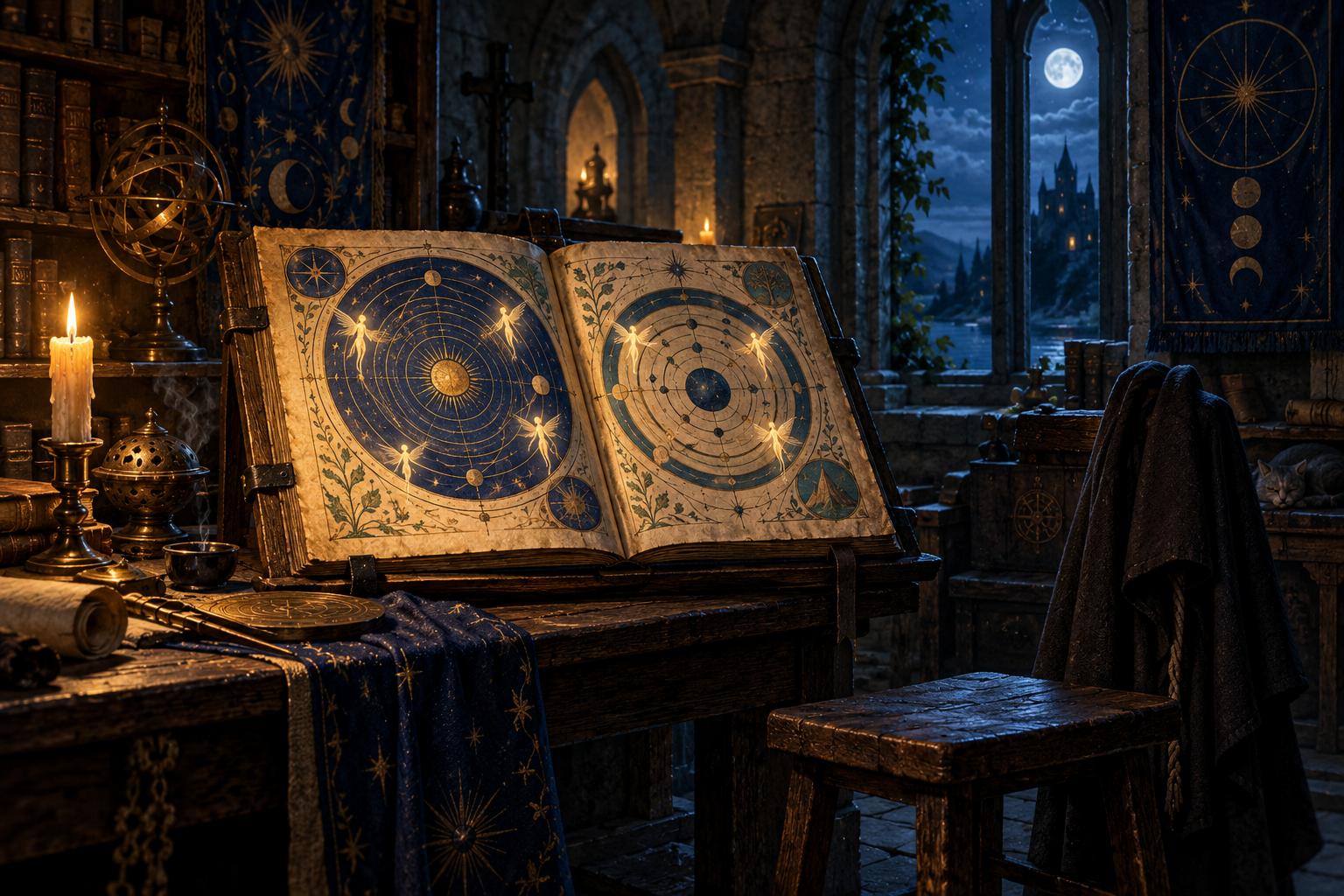
Ars Notoria explained: the medieval Notory Art credited to Solomon, its prayers and figures for learning, its condemnation, and its role in the Lesser Key.
Quick answer: The Ars Notoria, or Notory Art, is a medieval Latin text of prayers and diagrams attributed to King Solomon that promised the rapid acquisition of knowledge, memory, and eloquence in the liberal arts. It appeared in northern Italy around 1200, was condemned by theologians including Thomas Aquinas, and was later attached to the Lesser Key of Solomon as its fifth book. Unlike the Goetia, it summons no demons; it asks angels for understanding.
Related guides: the five books of the Lesser Key, grimoire meaning and famous grimoires, who King Solomon was, the Heptameron of Pietro d'Abano, the Greater Key of Solomon, King Solomon's wisdom in scripture.
| Book | Spirits addressed | Stated aim | Date of composition |
|---|---|---|---|
| Ars Notoria | God and angels, through prayer | Knowledge of the liberal arts, memory, eloquence | c. 1200, northern Italy; oldest of the five |
| Ars Goetia | 72 demons with ranks and seals | Compelling spirits to perform tasks | Compiled 17th century from 16th-century sources |
| Ars Theurgia-Goetia | Aerial spirits of the compass points, part good and part evil | Knowledge of secrets and hidden things | 17th century, drawing on Trithemius |
| Ars Paulina | Angels of the hours and of the zodiac signs | Personal angel and planetary angels | 17th century |
| Ars Almadel | Angels of the four 'altitudes' | Answers delivered through a wax tablet | 15th to 17th century |
Key Takeaways
Ars Notoria is Latin for ‘the Notory Art,’ and the name refers to the notae, or ‘notes,’ at the center of the text: elaborate diagrams of circles, rings, letters, and figures that the practitioner was to contemplate while reciting prayers. The text presents itself as a revelation given by God to King Solomon through an angel, offering a shortcut to wisdom. Where ordinary students spent years at the university, the Ars Notoria promised mastery of grammar, logic, rhetoric, arithmetic, geometry, music, astronomy, philosophy, and theology in a matter of months.
The claim rests on the biblical account of Solomon’s request for wisdom (1 Kings 3), in which God grants the young king an understanding heart. Medieval readers reasoned that if Solomon received knowledge directly from heaven, a method he supposedly recorded might do the same for others. The Ars Notoria is therefore part of the long tradition that made Solomon the patron of hidden learning, a tradition explored in the article on who King Solomon was.
It is important to be clear about what the text is not. It contains no demons, no seals of spirits, and no commands to bind anything. Its prayers are addressed to God, Christ, and the angels, and its tone is devotional. That is exactly why it worried the Church: it looked like prayer but worked like magic.
The earliest manuscripts of the Ars Notoria date from the first half of the thirteenth century, and the text was probably composed in northern Italy, perhaps in the university milieu of Bologna, shortly before or after 1200. The French scholar Julien Véronèse, who produced the critical edition in 2007, distinguishes a shorter early form (often called version A) from a later expanded form with an extensive gloss (version B) that circulated from the late thirteenth century onward. A reworked ‘new art’ (ars nova) also appears in some copies.
The text claims an older pedigree. It calls itself the Flores aurei, ‘golden flowers,’ of Apollonius, presenting the Greek sage Apollonius of Tyana as the transmitter of Solomon’s revelation to later ages. This framing is fictional, but it shows the compilers reaching for authorities respected in medieval learning. The strings of foreign-sounding words in the prayers are described as Hebrew, Greek, and Chaldean, and the text warns that they must not be translated into Latin because their power lies in their sound.
The Ars Notoria spread quickly through Europe and survives in dozens of manuscripts, often richly illustrated with the notae in color. It was read by clerics and students, the people who most wanted what it offered. Its popularity is one reason it drew the attention of theologians, as the next section describes. For the wider world of such books, see grimoire meaning and famous grimoires.
Does this touch your own situation? Many readers come to these pages because something in their home, dreams or family feels unexplained. Reading history helps, but it cannot look at your specific case.
Consult the Sheikh Private, confidential, and free to ask.
Historians describe the method of the Ars Notoria from the manuscripts; this site presents it as a historical account only. The text organizes its material into a sequence that a practitioner was to follow over an extended period, timed by the phases of the moon.
The core consists of Latin orations, some long and theological, some made up of untranslatable words. The text groups them in sets and assigns each set to a stage of the work. Reciting them in order, at the proper times, was believed to prepare the mind to receive knowledge.
Each liberal art had one or more notae, diagrams that combined geometric figures, angelic names, and sometimes small pictures. The practitioner was to ‘inspect’ a note while praying, so that its form would impress the corresponding art upon the memory. Grammar, for instance, had several notes; theology had its own.
The text required confession, fasting, chastity, and a clean and quiet place. It also demanded faith: the art, it said, would fail for anyone who doubted it or used it for a bad purpose. These conditions resemble those of other Solomonic texts such as the Heptameron of Pietro d’Abano, which also prescribes purity and set times.
Within a lunar month or a few months, the user was supposed to find the subject understood, remembered, and ready on the tongue. The text calls this a gift of God, not a trick, which is why it insisted so strongly on devotion.
Theologians were not persuaded. Thomas Aquinas addressed the Ars Notoria by name in the Summa Theologiae (II-II, question 96, article 1), asking whether it was lawful to practice the Notory Art. His answer was no: the figures and unknown words have no natural power to produce knowledge, so any effect must come from a pact with demons, however pious the user’s intention. He added that the art does not actually work, which, he noted, its own practitioners sometimes admitted. The argument became the standard position.
The most famous case involves John of Morigny, a Benedictine monk in the diocese of Sens in France. Around 1300, John used the Ars Notoria as a student and, by his own account, experienced disturbing visions. He concluded the art was tainted and composed a replacement, the Liber florum celestis doctrine (Book of Flowers of Heavenly Teaching), with prayers to the Virgin Mary and his own set of figures, intended to deliver the same benefits without the danger. The University of Paris was not reassured. In 1323 John’s book was publicly burned, an event recorded in the Grandes Chroniques de France.
Later inquisitorial manuals and lists of forbidden books included the Ars Notoria among the illicit arts. Yet copies kept circulating, and the text was never fully suppressed. Its survival in so many manuscripts shows that readers found its blend of prayer and promise hard to resist.
In the seventeenth century, English compilers gathered several Solomonic texts into a single collection called the Lemegeton, or Lesser Key of Solomon. Its five books are the Ars Goetia, the Ars Theurgia-Goetia, the Ars Paulina, the Ars Almadel, and the Ars Notoria. The Ars Notoria is by far the oldest of the five, and its inclusion gives the Lesser Key a shape that runs from commanding demons at the start to praying for wisdom at the end. The structure is described in the five books of the Lesser Key.
The English version that entered the Lemegeton was Robert Turner’s translation, printed in London in 1657 as Ars Notoria: The Notory Art of Solomon. Turner worked from a Latin printed edition and, crucially, omitted the notae themselves, so that English readers for three centuries had the prayers without the diagrams that gave the art its name. Manuscripts of the Lemegeton in the British Library (the Sloane collection) copy Turner’s text.
This explains a common surprise. Readers who approach the Lesser Key expecting five books of demon lore find that the last one is a set of long Christian prayers for learning. The Ars Notoria sits oddly beside the Goetia, but the pairing is historically meaningful: both claim Solomon, and both belong to the medieval idea that the king’s wisdom included power over the unseen.
Because the Ars Notoria travels with the Goetia, it is often assumed to be demonic. It is not; its prayers invoke God and the angels, and its condemnation came precisely because theologians argued that demons must be secretly involved, not because the text names any. A second misunderstanding is that it is a late invention. The Ars Notoria predates the Goetia by roughly four centuries and the printed Greater Key by even more.
A third error concerns the figures. Many online reproductions of the ‘Ars Notoria’ are based on Turner’s 1657 text and contain no notae, or substitute diagrams from other sources. The genuine medieval figures were only made widely available in the twenty-first century through Véronèse’s edition and later translations that reproduce the manuscript illustrations. A fourth confusion is with the Ars Nova and with John of Morigny’s Liber florum, which are related but distinct works. Finally, the Ars Notoria is sometimes described as a memory technique in the tradition of classical mnemonics. There is some overlap in purpose, but the text’s method is prayer and contemplation, not the architectural memory palaces of Cicero and Quintilian.
Interest in the Ars Notoria has grown for several reasons. Academic study of medieval magic has flourished since the 1990s, and the text is a favorite case study because it sits on the border between religion and ritual. Véronèse’s critical edition made serious study possible, and a 2023 English translation by Matthias Castle, published with the figures, brought the full text to general readers for the first time. The notae themselves, with their intricate circles and angelic names, appeal to anyone interested in sacred art and diagrams.
Modern occult writers have also revived the text, sometimes presenting it as a working system. This site does not evaluate such claims and does not provide instructions; it describes the book as a historical document. Readers encountering the Ars Notoria in that context should know that the medieval text was addressed to Christian clerics and students, that its promises were disputed in its own time, and that its authors insisted its benefits depended on faith and virtue rather than technique.
The text also matters for the history of universities. Its appearance around 1200, as the new institutions of learning took shape, shows that the pressure to master difficult subjects quickly is not a modern anxiety.
For readers who want to understand the Notory Art rather than practice it, a few habits help. Start with a translation that includes the notae, since the figures are half the text. Compare the early thirteenth-century form with the glossed version to see how later editors expanded and explained it. Read Aquinas’s article alongside it to understand how contemporaries judged the work. And consider John of Morigny’s story as a window into how a devout reader experienced the text.
It is also useful to set the Ars Notoria next to the other Solomonic books. The Greater Key is about talismans and planetary pentacles; the Goetia is about spirits and seals; the Ars Notoria is about prayer and the mind. Together they show the range of what medieval and early modern Europe attributed to Solomon, from command over demons to the gift of wisdom. The Ars Notoria is the branch that grew closest to the Bible and furthest from the sorcery its critics feared.
Still have a question about your own experience? Describe what you are seeing, feeling or dreaming, and when it started. The Sheikh reads every message personally and replies in private.
Weighing a decision about study or work? The Ars Notoria grew from a very human wish to learn faster and understand more, and our partner PuraTarot offers a Custom Spiritual Session for readers who want a personal perspective on a specific question about their studies, career or next step. Join the free Djinn Guide newsletter and, once you confirm, you will unlock a 50% code for your first reading.
Further reading
As an Amazon Associate we earn from qualifying purchases.
The Ars Notoria, or Notory Art, is a medieval Latin text of prayers and diagrams attributed to King Solomon. It promised rapid knowledge of the liberal arts, memory, and eloquence through devotion and the contemplation of figures called notae. It dates from around 1200 and later became the fifth book of the Lesser Key of Solomon.
No. Its prayers are addressed to God, Christ, and the angels, and it contains no spirit names, seals, or commands of the kind found in the Goetia. Theologians such as Aquinas condemned it on the argument that demons must secretly be involved, not because the text invokes them.
Thomas Aquinas argued in the Summa Theologiae that unknown words and figures have no natural power to give knowledge, so any effect would come from demons; he also said the art did not work. In 1323 the University of Paris burned a revision of it by the monk John of Morigny.
Yes. It is the fifth book of the Lemegeton, alongside the Ars Goetia, Ars Theurgia-Goetia, Ars Paulina, and Ars Almadel. The English version in that collection is Robert Turner's 1657 translation, which omits the diagrams.
The notae are the diagrams that give the text its name: circles, rings, letters, and angelic names, each assigned to a liberal art such as grammar or astronomy. The practitioner was to gaze at the figure while praying so that the art would be impressed on the memory.
Disclaimer
This article describes the Ars Notoria as a historical and literary document for educational purposes. The beliefs and claims of the text are reported, not endorsed, and no instructions for its use are provided.
Did this guide help you understand the subject? Rate it and share your honest opinion to help other readers. Every review is checked by our editors before it appears.
There are no reviews yet. Be the first one to write one.


Sheikh Youssef
Tayeb El Merzouki
For inquiries about personalized spiritual work, private rituals, and traditional talismans, connect directly with Sheikh Youssef Tayeb El Merzouki.
Chat on WhatsApp