







Join Djinn Guide: Get 50% Off a Personal Reading
Get new guides to jinn, folklore and occult history. Confirm your subscription to unlock a 50% code for a first personal reading with our partner PuraTarot.
Discover the unseen
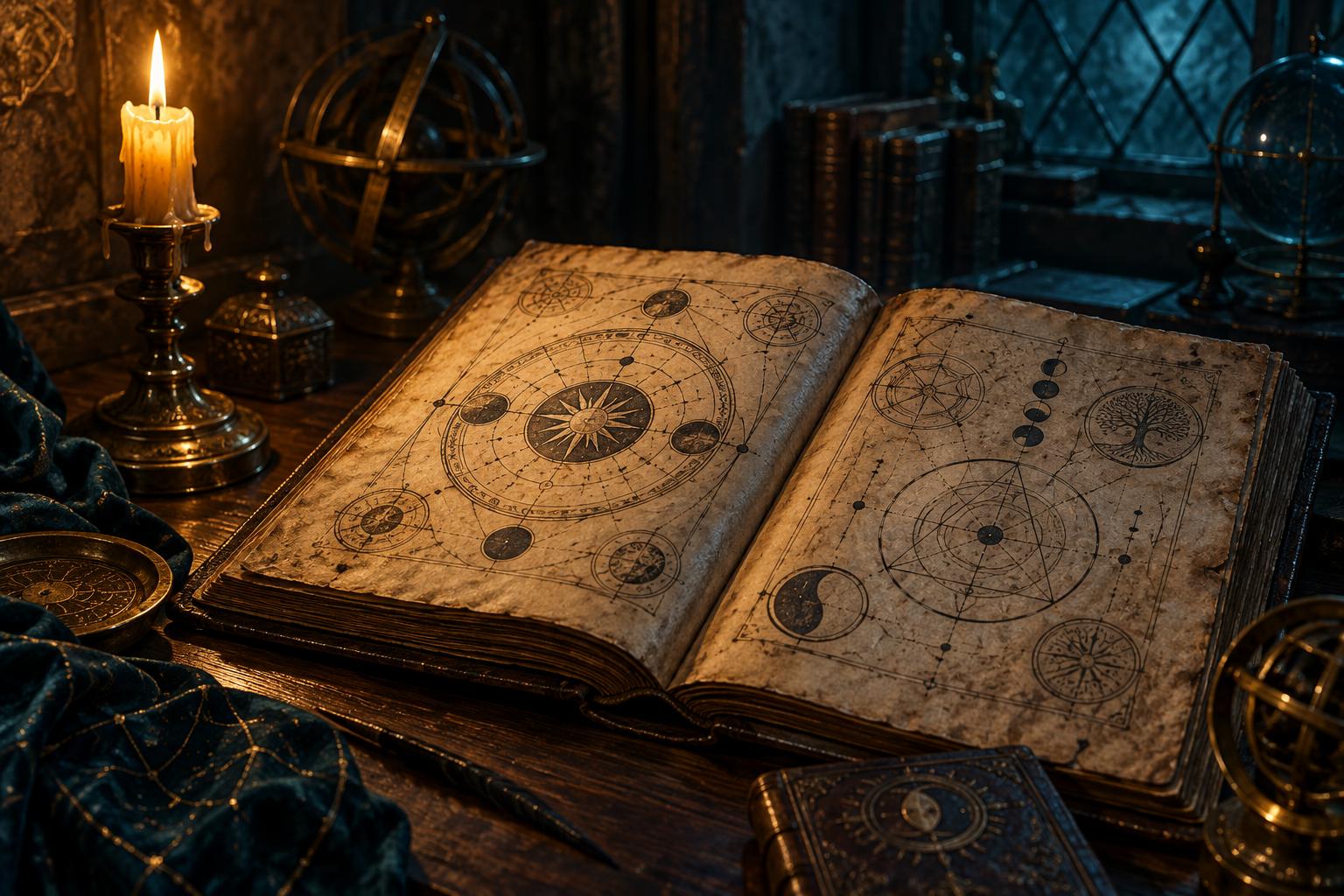
Grimoire meaning explained: where the word comes from, what a grimoire contains, and a guide to famous grimoires from the Key of Solomon to the Picatrix.
Quick answer: The grimoire meaning is simple at its core: a grimoire is a book of magic, usually a manual that lists spirits, symbols, prayers, and the procedures its author believed would call on them. The word comes from the French grammaire, "grammar," because to ordinary readers a book of Latin learning looked like a book of secret power. The famous grimoires include the Key of Solomon, the Lesser Key of Solomon, the Picatrix, the Book of Abramelin and the Grand Grimoire.
Related guides: how to read a grimoire manuscript, the five books of the Lemegeton, the Greater Key of Solomon, the Picatrix and astral magic, the Book of Abramelin explained, what a sigil means.
| Grimoire | Language and period | Best known for |
|---|---|---|
| Key of Solomon (Clavicula Salomonis) | Latin and Italian manuscripts, 14th-15th century onward | Pentacles, planetary hours, ritual preparation; the model Solomonic text |
| Lesser Key of Solomon (Lemegeton) | English and Latin, compiled 17th century | Five books including the Ars Goetia with its 72 spirits |
| Picatrix (Ghayat al-Hakim) | Arabic, 10th-11th century; Latin, 13th century | Astral magic, talismans, planetary spirits |
| Book of Abramelin | German manuscripts, earliest dated 1608; French copy used by Mathers | Months-long operation to contact a guardian angel; word squares |
| Sworn Book of Honorius (Liber Juratus) | Latin, 13th-14th century | Early medieval ritual text with a divine vision as its goal |
| Heptameron | Latin, printed 16th century, attributed to Pietro d'Abano | Short daily-angel system that later grimoires copied |
| Grand Grimoire and Grimorium Verum | French, 18th-19th century | Cheap printed pacts and spirit lists; the Red Dragon |
| Sixth and Seventh Books of Moses | German, 18th-19th century; popular in American hoodoo | Seals attributed to Moses, widely reprinted in the US |
Key Takeaways
The grimoire meaning most dictionaries give is “a book of magic spells and invocations.” That is accurate, but the history of the word adds something. Grimoire is French, and it descends from grammaire, the ordinary word for grammar. In medieval and early modern France most grammars were Latin grammars, and Latin was the language of the clergy, the law and learned magic. For people who could not read it, any thick Latin book could look like a manual of hidden power, and the word for grammar drifted into the word for a spellbook.
French usage in this magical sense is documented from the eighteenth century, and English writers borrowed the word in the nineteenth. Before that, English speakers simply said “book of magic,” “conjuring book” or “black book.” The same drift produced the English word “glamour,” a Scots corruption of “grammar” that once meant a magical illusion.
So what is a grimoire in practice? Usually a working manual rather than a theory book. It tells the reader which spirits exist, what they are said to govern, which symbols belong to them, what hours and materials matter, and what words are to be spoken. Some include prayers and long instructions on purification; others are little more than lists. The genre ranges from elaborate Latin manuscripts for educated magicians to pocket chapbooks sold at fairs.
Although grimoires vary a great deal, most share a recognizable structure built from a few parts. Recognizing those parts helps a reader know what kind of book is in front of them.
What a grimoire generally does not contain is an explanation of why any of it is supposed to work. The theory, where it exists, sits in separate works such as Agrippa’s Three Books of Occult Philosophy (1533) or the first part of the Picatrix. The grimoire proper is a procedure book, and readers today study it the way historians study a cookbook or a medical recipe collection: as evidence of what people believed and did. This site describes those contents historically and does not provide ritual instructions.
Does this touch your own situation? Many readers come to these pages because something in their home, dreams or family feels unexplained. Reading history helps, but it cannot look at your specific case.
Consult the Sheikh Private, confidential, and free to ask.
A handful of books dominate any discussion of famous grimoires. They are grouped below by tradition rather than date, because the traditions borrow from one another.
The Key of Solomon, or Clavicula Salomonis, survives in Latin, Italian, French and English manuscripts from the fourteenth or fifteenth century onward and claims the authority of King Solomon. It is the source of the planetary pentacles that later books copied endlessly. The Lesser Key of Solomon, or Lemegeton, is a seventeenth-century English compilation of five books: the Ars Goetia, Ars Theurgia-Goetia, Ars Paulina, Ars Almadel and Ars Notoria. Our guide to the five books of the Lemegeton walks through each.
The Picatrix is the Latin name of the Ghayat al-Hakim, “The Goal of the Sage,” an Arabic work of the tenth or eleventh century translated into Spanish and then Latin at the court of Alfonso X of Castile in the thirteenth century. It is a book of astral magic and talismans, and it fed Renaissance thinkers such as Marsilio Ficino. The Shams al-Ma’arif attributed to al-Buni belongs to the same Arabic world of letters, squares and divine names.
The Sworn Book of Honorius and the Heptameron attributed to Pietro d’Abano are shorter, older than the Lemegeton, and strongly Christian in vocabulary. The Heptameron’s system of daily angels was lifted wholesale into later books.
The Book of Abramelin, known in German manuscripts dated from 1608 and in the French copy that S. L. MacGregor Mathers translated in 1898, describes a months-long devotional operation to obtain the “knowledge and conversation” of a guardian angel, followed by word-square talismans. It deeply influenced the Golden Dawn and Aleister Crowley.
From the eighteenth century, French and German printers produced small, lurid books: the Grand Grimoire (also called the Red Dragon), the Grimorium Verum, the Petit Albert, the Black Pullet and the Sixth and Seventh Books of Moses. These sold widely, crossed the Atlantic, and shaped folk magic in Louisiana, the Caribbean and West Africa.
Grimoire history runs in three broad phases. In the first, roughly the twelfth to the fifteenth century, magical texts circulated in Latin manuscripts among clerics, physicians and university men, many of them translated from Arabic in Spain and Sicily. Copying was slow and expensive, so each copy differed, and ownership could be dangerous: church and civil authorities periodically condemned such books, and some owners were tried.
In the second phase, the sixteenth and seventeenth centuries, printing changed everything. Agrippa’s Occult Philosophy, Johann Weyer’s Pseudomonarchia Daemonum (1577) with its list of spirits, and Reginald Scot’s Discoverie of Witchcraft (1584), which reproduced conjurations in order to mock them, put material in front of thousands of readers. Ironically, skeptical and hostile books became sources for later magicians. The Lemegeton was compiled in this environment, drawing on Weyer, the Heptameron and older manuscripts.
In the third phase, from the eighteenth century onward, grimoires became popular literature. French colporteurs sold the Grand Grimoire and the Petit Albert to farmers and soldiers. German emigrants carried the Sixth and Seventh Books of Moses to Pennsylvania, where it entered American folk practice. Then, in the late nineteenth and twentieth centuries, occult revivalists such as Mathers, Crowley and later scholars such as Joseph H. Peterson produced the critical and semi-critical editions that most English readers now encounter. The story of those editions is told in our article on manuscript and printed Goetia.
Although the word grimoire is European, the type of book it names exists across cultures. In the Islamic world the tradition of ilm al-huruf, the science of letters, produced works that combine Quranic verses, divine names, magic squares and the names of jinn kings. The Shams al-Ma’arif is the most famous, and it remains controversial among Muslim scholars, many of whom reject its practices. Stories of Solomon commanding the jinn with a ring and seal gave this literature its legendary ancestor.
Jewish tradition contributed the Sefer Raziel and the Sword of Moses, as well as the Hebrew divine names and Psalms that fill Christian grimoires. The Testament of Solomon, a Greek pseudepigraphal text from roughly the first to fifth century CE, sits at the junction of Jewish, Christian and later Islamic ideas, and it is the earliest full narrative of Solomon binding demons with a ring.
Beyond the Mediterranean, Ethiopian Christian scribes produced protective scrolls and prayer books with their own net-like diagrams, and in Southeast Asia Malay and Javanese kitab collections record practices connected to khodam servant spirits. These are not grimoires in the French sense, but they answer the same human wish for a written key to the unseen. Comparing them shows that the grimoire is less a European invention than a widespread genre with regional dialects.
The first misunderstanding is age. Many grimoires claim to be ancient, written by Solomon, Moses, Hermes or a pope, and readers often repeat these claims. In almost every case the surviving manuscripts are centuries younger than the attributed author, and the attribution is a traditional way of lending authority. The Key of Solomon has no connection to the biblical king beyond its title and its stories.
The second is uniformity. There is no single “the grimoire.” Each manuscript of the Key of Solomon differs from the others, and printed editions silently merge, correct and rearrange them. Readers comparing a Mathers translation with a Peterson edition are often reading different underlying texts.
The third is the assumption that the books were used by witches. The classic grimoires were learned, male and usually Christian in vocabulary, aimed at clergy, scholars and treasure hunters. The witch trials, by contrast, mostly targeted people who owned no books at all. Fictional grimoires such as the Necronomicon, invented by H. P. Lovecraft in the 1920s, have added a further layer of confusion by blending the real genre with horror. Keeping the historical record separate from fiction is the first step in reading these texts well; our guide on reading occult manuscripts in context goes deeper into that skill.
Interest in grimoires has grown with fantasy fiction, video games and television, where “grimoire” has become a stock term for any book of power. Readers who meet the word in a game then look for the real thing and find a genuine, documented history behind it. Historians now treat grimoires as sources for the history of religion, science and reading.
For a reader approaching the famous grimoires for the first time, a few practices help. Start by asking which manuscript or edition you are looking at and when it was made, not what its title page claims. Read the spirit catalogs as cultural documents that record how people imagined the unseen, and notice how often the same names and seals pass from book to book. Compare an Arabic source such as the Picatrix with its Latin descendants to see how ideas moved. And keep the distinction between describing a historical practice and performing it; this site does the former only.
Understood that way, the grimoire meaning widens from “spellbook” to something more interesting: a record of what educated and ordinary people across a thousand years hoped the written word could do.
Still have a question about your own experience? Describe what you are seeing, feeling or dreaming, and when it started. The Sheikh reads every message personally and replies in private.
Drawn to these old books for a reason? Grimoires were, at heart, attempts to answer very human questions about love, luck and fate. If you have a question of your own in mind, a Full Personal Reading with our partner PuraTarot offers a calm, personal way to reflect on it. Join the free Djinn Guide newsletter and, once you confirm, you will unlock a 50% code for your first reading.
Further reading
As an Amazon Associate we earn from qualifying purchases.
A grimoire is a book of magic: a manual that lists spirits, their symbols, the materials and timing an operator was believed to need, and the prayers or conjurations to be spoken. The word comes from the French grammaire, "grammar," because learned Latin books looked like books of secret power to people who could not read them.
The most cited are the Key of Solomon, the Lesser Key of Solomon (Lemegeton, containing the Ars Goetia), the Picatrix, the Book of Abramelin, the Sworn Book of Honorius, the Heptameron, the Grand Grimoire, the Grimorium Verum and the Sixth and Seventh Books of Moses. Agrippa's Three Books of Occult Philosophy is often listed too, though it is a theory book rather than a manual.
No. The Necronomicon was invented by H. P. Lovecraft for his horror fiction in the 1920s. Several books with that title have been published since, but all are modern creations inspired by the stories. Real historical grimoires, such as the Key of Solomon or the Picatrix, survive in dated manuscripts and printed editions that scholars can trace.
No. The surviving manuscripts of the Key of Solomon date from the late Middle Ages and Renaissance, far later than the biblical king. Attributing a book to Solomon was a traditional way of lending it authority, drawing on legends, found in the Testament of Solomon and in Islamic sources, that he commanded spirits with a ring.
In everyday use the words overlap, but historians usually reserve grimoire for the historical genre of European and Mediterranean magic manuals from the Middle Ages to the nineteenth century, with their spirit catalogs, seals and conjurations. "Spellbook" is a looser modern term that also covers fictional books and contemporary practice. All grimoires are spellbooks in that broad sense; not all spellbooks are grimoires.
Disclaimer
This article describes grimoires as historical and cultural documents. The beliefs and practices recorded in them are described, not endorsed, and no claim is made that any book, symbol or procedure produces results. The site does not provide ritual instructions.
Did this guide help you understand the subject? Rate it and share your honest opinion to help other readers. Every review is checked by our editors before it appears.
There are no reviews yet. Be the first one to write one.


Sheikh Youssef
Tayeb El Merzouki
For inquiries about personalized spiritual work, private rituals, and traditional talismans, connect directly with Sheikh Youssef Tayeb El Merzouki.
Chat on WhatsApp


