






Join Djinn Guide: Get 50% Off a Personal Reading
Get new guides to jinn, folklore and occult history. Confirm your subscription to unlock a 50% code for a first personal reading with our partner PuraTarot.
Discover the unseen
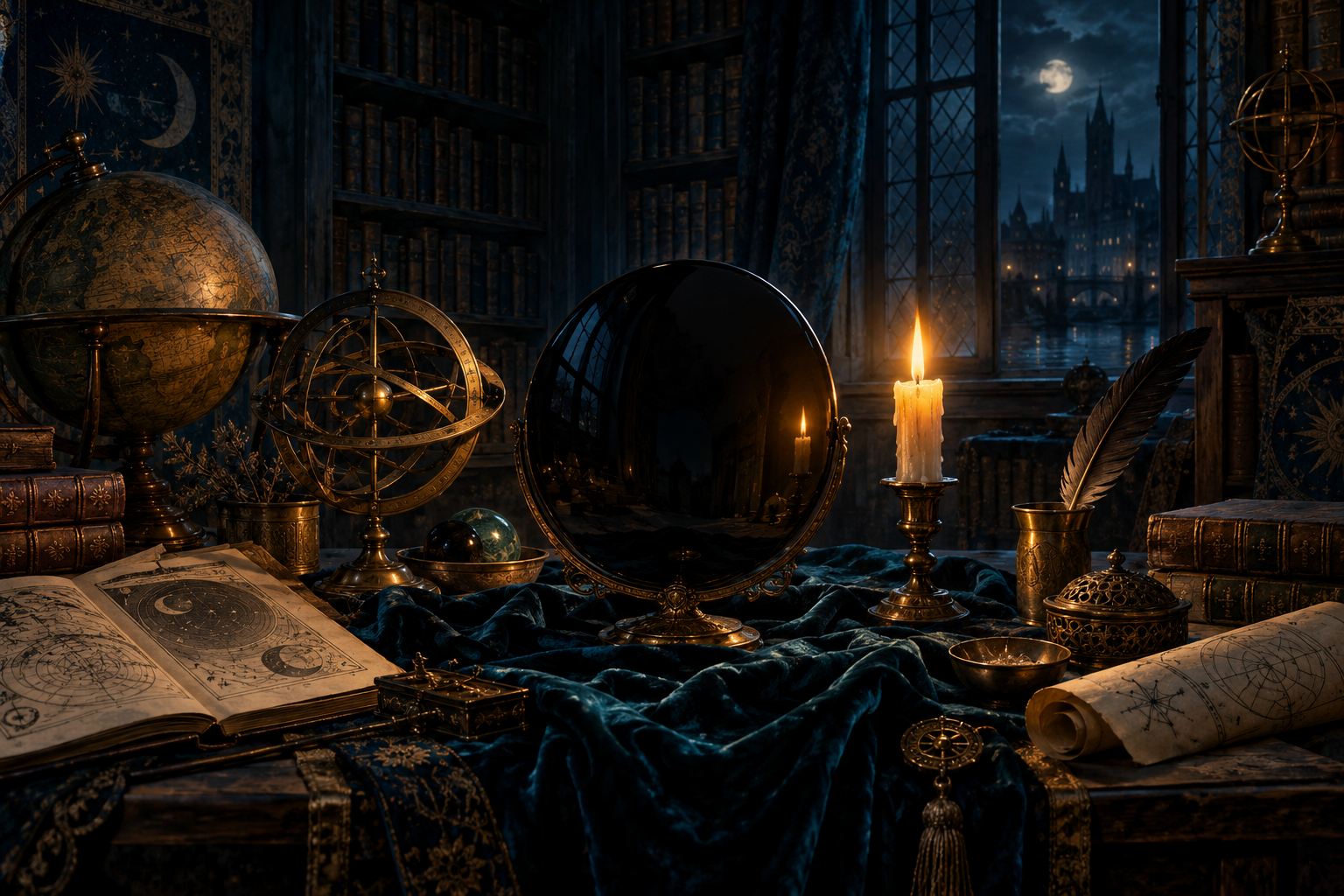
John Dee was Elizabeth I's adviser, a leading mathematician and an occult scholar who recorded talks with angels. His life, library and legacy explained.
Quick answer: John Dee (1527 to about 1609) was an English mathematician, astronomer, geographer and occult philosopher who advised Queen Elizabeth I and built one of the largest private libraries in England at Mortlake. From 1582 he worked with the medium Edward Kelley on a series of "angelic conversations" that produced the Enochian language and a body of visionary records. Dee saw no conflict between his science and his magic; both were attempts to read the structure of creation.
Related guides: Enochian magic and the angelic keys, Hermeticism and Renaissance magic, Agrippa's Three Books of Occult Philosophy, famous grimoires and how to read them, what Kabbalah is, what the occult means.
| Year | Event | Why it matters |
|---|---|---|
| 1527 | Born in London to a family of Welsh descent | Rises through Cambridge on merit, not inherited rank |
| 1546 | Founding fellow of Trinity College, Cambridge | Earns early fame for a mechanical stage effect in Aristophanes |
| 1555 | Arrested under Queen Mary on charges linked to astrology | Shows how dangerous occult study was in Tudor England |
| 1558 | Chooses the coronation date for Elizabeth I | Begins a long, if intermittent, royal connection |
| 1564 | Publishes the Monas Hieroglyphica | His most famous esoteric work, a single symbol of creation |
| 1570 | Writes the Mathematical Preface to Euclid in English | A landmark in making mathematics available to craftsmen |
| 1582 | Begins working with Edward Kelley | Start of the angelic conversations and Enochian records |
| 1583 to 1589 | Travels through Poland and Bohemia with Kelley | Meets Rudolf II; library at Mortlake is looted in his absence |
| 1595 | Appointed Warden of Christ's College, Manchester | A late, unhappy post under James I's growing suspicion of magic |
| c. 1608 to 1609 | Dies at Mortlake in poverty | Exact date uncertain; parish records for the period are lost |
Key Takeaways
John Dee was born in London on 13 July 1527, the son of a textile merchant with a minor post at the court of Henry VIII. He entered St John’s College, Cambridge, at fifteen, reportedly studying eighteen hours a day, and became a founding fellow of Trinity College in 1546. He then studied at Louvain, where he met the cartographer Gerardus Mercator, and lectured on Euclid in Paris to crowded rooms. By his late twenties Dee was known across Europe as one of England’s leading mathematicians.
What makes John Dee difficult to classify is that he never separated this work from what we now call the occult. For Dee, as for many Renaissance thinkers, mathematics, astrology, alchemy and the study of angels were branches of one science of hidden correspondences. He read Cornelius Agrippa, the Hermetic texts and Kabbalistic writers in the same spirit in which he read Euclid. For the intellectual background, see Hermeticism and Renaissance magic.
Dee’s career therefore has two faces. One is the practical adviser on navigation, calendar reform and imperial policy. The other is the scholar in his study at Mortlake, kneeling before a crystal with Edward Kelley and recording what the angels said. Both faces belonged to the same man, and he saw no contradiction between them.
Dee’s relationship with the Tudor court began badly. In 1555, under Queen Mary, he was arrested after casting horoscopes for the queen and for the Princess Elizabeth, and he faced charges that included conjuring. He was examined by Bishop Bonner and eventually released. When Elizabeth came to the throne in 1558, the connection paid off: Dee was asked to select an astrologically favorable date for her coronation, and he remained a figure she consulted for the rest of his active life.
His services were wide-ranging. He advised explorers such as Martin Frobisher on navigation and wrote on the mathematics of the voyages. In 1577 he produced General and Rare Memorials pertayning to the Perfect Arte of Navigation, arguing for a standing navy and the expansion of English claims overseas; the phrase “British Empire” appears in his writings, and he is usually credited with popularizing it. He advised on the reform of the calendar when the Gregorian system was introduced in Catholic Europe in 1582, though England did not adopt it.
Elizabeth visited Mortlake more than once and apparently valued Dee, but she never gave him the secure income he hoped for. Promised positions went to others. Dee’s letters from the 1590s show a man who had served the crown for decades and still had to petition for a living. The John Dee Queen Elizabeth story is one of real influence without real reward.
Does this touch your own situation? Many readers come to these pages because something in their home, dreams or family feels unexplained. Reading history helps, but it cannot look at your specific case.
Consult the Sheikh Private, confidential, and free to ask.
Dee’s house at Mortlake, on the Thames west of London, held what was probably the largest private library in England, estimated at 3,000 to 4,000 printed books and manuscripts, along with navigational instruments, globes and alchemical equipment. It functioned as an informal academy; scholars, courtiers and sailors came to consult the books and their owner. Dee had proposed a national library to Queen Mary in 1556 and, when that failed, built his own.
His best-known esoteric work is the Monas Hieroglyphica (1564), dedicated to Emperor Maximilian II. It presents a single glyph combining the symbols of the sun, moon, cross and the sign of Aries, and argues in a series of dense theorems that this “hieroglyphic monad” encodes the unity of creation. Dee believed the symbol summarized mathematics, astronomy and alchemy at once. Readers have argued about its meaning ever since, and Dee himself said that those who understood it would see things he could not state openly.
His Mathematical Preface to Henry Billingsley’s English Euclid (1570) is a different kind of landmark. Written for craftsmen and navigators rather than Latin scholars, it surveys the mathematical arts and defends their usefulness. Historians of science treat it as one of the most important English texts of its century. The same man wrote both works within six years.
Dee had tried to contact angels through crystal-gazing since at least 1581, using scryers because he could not see visions himself. In March 1582 a man calling himself Edward Talbot, soon known as Edward Kelley, arrived at Mortlake and proved to be an extraordinarily productive seer. Over the following seven years the two men held hundreds of sessions, which Dee recorded in detail in his spirit diaries. The resulting system is the subject of Enochian magic and the angelic keys.
Kelley reported seeing angels in a crystal or obsidian “shew-stone” and relayed their words. Dee transcribed everything: the angels’ names, their dictated tables of letters, an alphabet, a language the angels called the speech of Adam, and a set of forty-eight “calls” or keys. Dee believed this was the original language of creation, lost since Babel.
In 1583 the Polish nobleman Albrecht Laski invited Dee and Kelley to Poland. They traveled on to Prague, where Dee attempted to interest Emperor Rudolf II in the angelic messages, and then to Trebon in Bohemia under the patronage of Vilem Rozmberk. Kelley’s alchemical claims won him favor; Dee’s angelic mission did not.
In Trebon Kelley reported an angelic command that the two men share their wives. Dee, after agonized resistance recorded in his diary, agreed. The episode effectively ended the partnership. Dee returned to England in 1589; Kelley stayed, was knighted by Rudolf, was later imprisoned, and died around 1597 after a fall during an escape attempt.
Scholars disagree about Kelley. Some read him as a fraud exploiting a credulous patron, others as a sincere visionary, others as someone whose motives shifted. Dee’s own sincerity is rarely doubted. The diaries are a primary source for early modern belief, not evidence that angels spoke.
Dee was not a grimoire magician in the Goetic sense. He never, as far as the records show, attempted to summon the spirits of the Lesser Key of Solomon, and his angelic work was framed as prayer and petition rather than command. His sources were Agrippa’s Three Books of Occult Philosophy, Trithemius’s Steganographia, the Hermetic corpus, Christian Kabbalah and the medieval tradition of angel magic represented by texts such as the Ars Notoria.
What he added was scale and system. The Enochian material is the largest and most internally elaborate body of angelic revelation produced in the Renaissance. Later movements, especially the Hermetic Order of the Golden Dawn in the 1880s and 1890s, built entire ritual structures on Dee’s tables and keys, and Aleister Crowley continued the practice. Much of what modern occultists mean by “Enochian” is this later reconstruction rather than Dee’s own practice.
Historians such as Frances Yates placed Dee at the center of an Elizabethan Hermetic movement, with influence on figures like Philip Sidney and possibly on Shakespeare’s Prospero. Later scholars have questioned how far this network really extended. What is not in doubt is that Dee embodied a moment when the line between natural philosophy and magic had not yet been drawn.
The first is that Dee was a court magician who performed spells for the queen. He cast horoscopes and offered astrological advice, which was mainstream in the sixteenth century, but there is no evidence of ritual magic done on Elizabeth’s behalf. His angelic work was private and, by his own account, devotional.
The second is that Dee was a charlatan or a fool. The charlatan charge is usually directed at Kelley; Dee’s scientific reputation was earned and his religious sincerity is clear from the diaries. The “fool” reading underestimates how widely his assumptions were shared by educated contemporaries.
The third is the spy story. The idea that Dee signed his letters “007” and was the model for James Bond comes from a twentieth-century popular writer and has no documentary basis. Dee did correspond with intelligence figures such as Francis Walsingham, as most courtiers did, but he was not a secret agent.
The fourth is that the Enochian language was a hoax by Kelley. Linguists note that Enochian has real grammatical features and that its dictation under session conditions would have required unusual skill to fake. That does not prove supernatural origin; it shows that the simple fraud explanation is also incomplete.
Dee turns up in novels, television, video games and music, usually as the archetypal Elizabethan magus in a black skullcap with a long white beard. The British Museum displays objects associated with him, including an obsidian mirror of Aztec origin, wax seals and a crystal, which draw steady visitors. Damon Albarn wrote an opera about him in 2011. Occult communities study his Enochian material, historians of science study his navigation and mathematics, and readers of Renaissance history meet him beside Walsingham, Raleigh and Sidney.
He also appeals because his life is a cautionary tale. A man of genuine brilliance, patronized by a queen, ended his days selling books to buy food, having lost his library and his wife, Jane, who died in the 1604 plague. His reputation as a sorcerer, which he resisted all his life, was fixed in 1659 when Meric Casaubon published the spirit diaries as A True and Faithful Relation with a hostile preface. The grimoire tradition he stood apart from absorbed him anyway; see famous grimoires and how to read them.
Dee’s own writings survive in several layers. The spirit diaries, published by Casaubon and in modern scholarly editions, record the sessions with Kelley. His private diary, kept in the margins of almanacs, notes visitors, dreams and household events. The Monas, the Mathematical Preface and the navigation treatises are printed works. Reading across these layers is the only way to see the whole man rather than the magus of legend.
Be cautious with anything that presents Enochian as a finished system. Dee left tables and transcripts, not a manual; the system was assembled by others three centuries later. Djinn Guide describes this history for educational purposes and does not provide instructions for angelic or spirit work of any kind.
Still have a question about your own experience? Describe what you are seeing, feeling or dreaming, and when it started. The Sheikh reads every message personally and replies in private.
Have a question you keep returning to? John Dee spent years pursuing answers to questions he could not set aside. If there is one question in your own life you keep coming back to, a Custom Spiritual Session with our partner PuraTarot lets you bring that specific question for personal reflection. Join the free Djinn Guide newsletter and, once you confirm, you will unlock a 50% code for your first reading.
Further reading
As an Amazon Associate we earn from qualifying purchases.
John Dee (1527 to about 1609) was an English mathematician, astronomer, navigator and occult philosopher who advised Queen Elizabeth I. He is best known today for his Mortlake library, the Monas Hieroglyphica, and the angelic conversations he recorded with Edward Kelley that produced the Enochian language.
He chose the date of her coronation in 1558 on astrological grounds, advised on navigation and overseas expansion, consulted on calendar reform, and offered astrological and medical advice over several decades. The queen visited his house at Mortlake, but he never received the stable income he sought.
Dee believed he did, through the medium Edward Kelley, who reported visions in a crystal while Dee transcribed. Historians treat the diaries as a sincere record of early modern religious experience rather than as evidence of angelic contact. Whether Kelley was sincere, deceptive or both is still debated.
While Dee was in Central Europe from 1583 to 1589, his Mortlake house was broken into and many books and instruments were stolen or scattered. He recovered some on his return. Surviving volumes with his annotations are now held in collections including the British Library and the Royal College of Physicians.
Dee died at Mortlake in late 1608 or early 1609, aged about 81, in poverty after his pension requests were ignored by James I. The exact date is unknown because the parish registers for those years are lost. He was reportedly buried in the chancel of Mortlake church.
Disclaimer
This article presents the life and ideas of John Dee as history. Angelic conversations, astrology and Enochian material are described as beliefs and records of their period, not endorsed, and nothing here constitutes instruction in magical practice.
Did this guide help you understand the subject? Rate it and share your honest opinion to help other readers. Every review is checked by our editors before it appears.
There are no reviews yet. Be the first one to write one.


Sheikh Youssef
Tayeb El Merzouki
For inquiries about personalized spiritual work, private rituals, and traditional talismans, connect directly with Sheikh Youssef Tayeb El Merzouki.
Chat on WhatsApp


