




Join Djinn Guide: Get 50% Off a Personal Reading
Get new guides to jinn, folklore and occult history. Confirm your subscription to unlock a 50% code for a first personal reading with our partner PuraTarot.
Discover the unseen

The Belial demon explained: what Belial means in Hebrew, how he appears in the Bible and Dead Sea Scrolls, and his place as a king in the Ars Goetia.
Quick answer: The Belial demon is a figure who began as a Hebrew word, not a being. In the Hebrew Bible, beliyya'al means "worthlessness," and "sons of Belial" describes lawless people. By the time of the Dead Sea Scrolls and the New Testament, Belial had become a personal name for the leader of the forces of darkness. Centuries later the Ars Goetia listed Belial as the 68th spirit, a king who appears as two beautiful angels in a chariot of fire.
Related guides: Ars Goetia names and offices, the Goetia demon hierarchy, the full list of 72 demons, Bael and Paimon, Goetia kings, what demonology studies, the Lesser Key of Solomon.
| Source | Period | How Belial appears |
|---|---|---|
| Hebrew Bible (Deuteronomy, Judges, Samuel, Kings) | c. 8th-5th century BCE | A noun meaning worthlessness or wickedness; "sons of Belial" are lawless men |
| Dead Sea Scrolls (War Scroll, Community Rule) | c. 2nd century BCE-1st century CE | Personal name of the angel of darkness who leads the wicked |
| Jubilees, Testaments of the Twelve Patriarchs | 2nd century BCE-2nd century CE | Beliar as a tempter and prince of deceit |
| 2 Corinthians 6:15 | 1st century CE | "What accord has Christ with Belial?" as the opposite of Christ |
| Ascension of Isaiah | 1st-2nd century CE | Beliar as ruler of this world who inhabits a wicked king |
| Pseudomonarchia Daemonum (Weyer) | 1577 | A king created immediately after Lucifer, speaking fair and ruling 80 legions |
| Ars Goetia (Lemegeton) | 17th century | 68th spirit, a king appearing as two angels in a chariot of fire |
| Paradise Lost (Milton) | 1667 | An eloquent, lewd fallen angel who counsels inaction |
Key Takeaways
The Belial meaning starts in Hebrew grammar rather than in demonology. The word beliyya’al is usually explained as a compound of beli, “without,” and ya’al, “worth” or “profit,” giving “worthlessness” or “uselessness.” Some scholars prefer a derivation meaning “the place from which none rises,” connecting it to the underworld, but the “without worth” reading is the most widely accepted. In either case, in its earliest uses it is a common noun, not a name.
The Hebrew Bible uses the word about twenty-seven times, almost always in the phrase “sons of Belial” or “daughters of Belial.” It describes idolaters in Deuteronomy 13:13, the men of Gibeah in Judges 19:22, the corrupt sons of Eli in 1 Samuel 2:12, and the false witnesses hired against Naboth in 1 Kings 21:10. In every case it means something like “scoundrels” or “lawless men.” The King James Version kept the Hebrew word untranslated, which is why English readers came to see Belial as a proper name.
That translation choice had lasting effects. A reader of the King James Bible meets “sons of Belial” and naturally imagines a father figure behind them. By the seventeenth century, poets, preachers and grimoire writers had all taken the hint. The path from adjective to demon is one of the clearest examples of how a word can grow into a personality, and it makes the Belial demon a useful case study for anyone interested in what demonology actually studies.
Belial in the Bible is therefore two different things depending on which part you read. In the Hebrew Bible, as described above, it is a noun of contempt. In the New Testament it appears exactly once, in 2 Corinthians 6:15, where Paul asks what agreement there can be between Christ and Belial (Greek manuscripts often read Beliar). Here it is unmistakably a personal name for the power opposed to Christ, used as a near-synonym for Satan.
The transformation between those two usages happened in the Jewish literature of the last centuries BCE. The Dead Sea Scrolls, discovered at Qumran from 1947, give Belial a central role. The War Scroll describes a final battle between the Sons of Light and the Sons of Darkness, whose army is led by Belial. The Community Rule speaks of the “dominion of Belial” as the present evil age, and liturgical texts curse Belial and his lot. For the Qumran community, Belial was the angel of darkness who ruled the world until God intervened.
Related writings carry the same picture. The Book of Jubilees asks God not to let the spirit of Beliar rule over Israel. The Testaments of the Twelve Patriarchs repeatedly warn against Beliar as the source of deceit, anger and lust, and promise that the Messiah will bind him. The Ascension of Isaiah, a Christian text of the first or second century, makes Beliar the ruler of this world who enters the wicked king Manasseh. By the time Paul wrote, Belial was already an established name for the chief adversary in some Jewish circles.
Does this touch your own situation? Many readers come to these pages because something in their home, dreams or family feels unexplained. Reading history helps, but it cannot look at your specific case.
Consult the Sheikh Private, confidential, and free to ask.
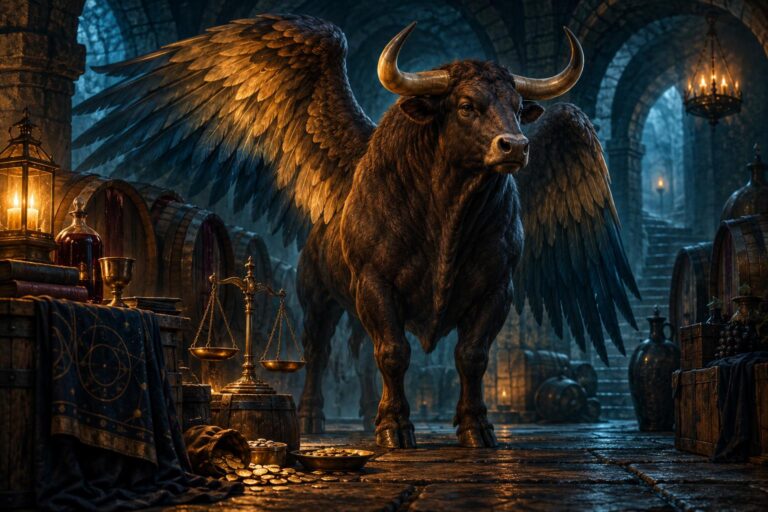
The Belial Goetia entry is the version most readers meet today. In the Ars Goetia, the first book of the Lesser Key of Solomon, Belial is the 68th of the 72 spirits and holds the rank of king. The description, which closely follows Johann Weyer’s Latin list of 1577, says he appears in the form of two beautiful angels sitting in a chariot of fire, speaks with a pleasant voice, and was created next after Lucifer. The text claims he fell first among the worthier angels and stresses that he must be given offerings and sacrifices, or he will not answer truthfully.
His offices, as the Goetia lists them, are to distribute presentations and senatorships, to give the favor of friends and enemies, and to provide familiars. He is said to govern 80 legions of spirits. The entry also carries the legend, repeated from Weyer, that King Solomon shut Belial and his legions in a brass vessel and cast it into a lake in Babylon, and that the Babylonians who later opened it, expecting treasure, released the spirits.
For how these ranks fit together, see our guide to the Goetia demon hierarchy, and for the full numbered list, the 72 demons of Solomon. This site describes the Goetia as a historical document and does not provide instructions for its procedures.
No single tradition owns Belial, and each one shaped him differently. In Jewish writing he grew from an abstraction into the leader of darkness, then faded as later rabbinic literature preferred other names for the adversary. In Christian theology the Pauline verse kept him alive as a title for Satan, and medieval preachers used “Belial” freely in that sense. A fifteenth-century Latin work, the Processus Belial attributed to Jacobus de Teramo, even imagined a lawsuit in which Belial sues Christ for trespassing on hell, a story that was printed and illustrated many times.
The occult tradition inherited Belial through Weyer, who placed him among the kings in the Pseudomonarchia Daemonum, and through the Lemegeton. Reginald Scot’s Discoverie of Witchcraft (1584) translated Weyer’s entry into English, which is how the brass-vessel legend reached later grimoires. In the twentieth century, Anton LaVey’s Satanic Bible (1969) named Belial one of four “crown princes,” associating him with the element of earth, a modern symbolic use with no basis in the older sources.
Literature gave Belial his most memorable portrait. In Milton’s Paradise Lost (1667), Belial is the fallen angel of smooth words and empty argument, “timorous and slothful,” who urges the devils to accept their fate rather than fight. Milton draws on the biblical “sons of Belial” when he describes the lust and riot of Belial’s followers in cities at night. That picture of a graceful, eloquent, morally hollow figure is the one most English readers now carry, and it is quite different from the warlike angel of darkness of Qumran.
Because several names are used for the chief adversary, readers often ask how the Belial demon relates to Satan, Lucifer and Beelzebub. The honest answer is that the relationships change by source. In the Dead Sea Scrolls Belial effectively is the Satan figure; the name Satan appears there rarely. In Paul’s letter Belial stands opposite Christ exactly as Satan does elsewhere. Later Christian writers treated the names as interchangeable titles for one devil.
The grimoires moved in the other direction, splitting the titles into separate spirits with their own ranks and offices. Weyer and the Goetia make Belial a king subordinate to Lucifer and created just after him, so that Belial is a distinct person in a hierarchy. Beelzebub, Satan and Lucifer appear as a ruling trio in some grimoires such as the Grand Grimoire, with Belial among the many below them. Milton keeps Satan as leader and gives Belial, Beelzebub, Moloch and Mammon separate voices in the council of hell.
The practical lesson is that “who outranks whom” is a question with no fixed answer, only a series of answers that depend on the text. The jinn kings of Arabic tradition offer a parallel: there too, lists multiply and no single ruler is agreed. The same pattern appears with the other great names, and our article on Bael and Paimon, the Goetia kings shows how even the first spirit in the list carries competing claims to seniority.
The first misunderstanding is reading the Hebrew Bible’s “sons of Belial” as evidence of an ancient demon cult. In those passages the word is a noun of insult, and modern translations render it as “worthless fellows” or “scoundrels.” The personal Belial is a development of the Second Temple period, not of the earliest biblical books.
The second is treating the Goetia’s description as ancient lore. The entry is a seventeenth-century English rendering of a sixteenth-century Latin list, which itself drew on medieval manuscripts. The chariot of fire, the two angels and the 80 legions are details of that late tradition, not of the Bible or the scrolls. The brass-vessel story is a floating legend that also attaches to other spirits and to the jinn of the Arabian Nights.
The third is the modern elemental scheme in which Belial equals earth and stands beside Satan, Lucifer and Leviathan. This comes from twentieth-century religious Satanism, and while it is a real contemporary usage, it should not be projected onto older texts. Finally, some popular sources confuse Belial with Beliar, Belphegor or Baal. Beliar is simply the Greek spelling of the same name; Belphegor and Baal are separate figures with their own histories.
Belial’s name circulates widely in popular culture, which drives most searches. He appears in video games, anime, tabletop role-playing games, television dramas and heavy-metal lyrics, usually as a powerful demon lord. Readers who meet him there often want to know whether he is “real” in the sense of being biblical, and the answer is layered: the word is biblical, the personal demon is post-biblical, and the chariot-riding king is early modern.
To read the sources well, keep three questions in mind. First, is Belial a noun or a name in this passage? The Hebrew Bible and the Dead Sea Scrolls answer differently. Second, what genre is the text? Apocalyptic literature, a Pauline letter, a grimoire and an epic poem each use the figure for their own purposes. Third, what did this source copy from an earlier one? Much of the Goetia’s Belial comes straight from Weyer, and much of Weyer’s from lost medieval lists.
Approached with those questions, Belial becomes a clear example of how a demon is built: a word of contempt, a name for the enemy in a time of crisis, a title for Satan in Christian preaching, a ranked king in Renaissance magic, and finally a character in poetry and games. Each layer is historical, and each is worth knowing on its own terms.
Still have a question about your own experience? Describe what you are seeing, feeling or dreaming, and when it started. The Sheikh reads every message personally and replies in private.
Curious how this applies to your own life? Belial began as a Hebrew word for worthlessness and grew into one of the best-known names in demonology. If the story leaves you reflecting on a choice of your own, a Full Personal Reading with our partner PuraTarot offers a calm, personal perspective. Join the free Djinn Guide newsletter and, once you confirm, you will unlock a 50% code for your first reading.
Further reading
As an Amazon Associate we earn from qualifying purchases.
Belial is a figure whose name began as the Hebrew word beliyya'al, meaning worthlessness. In the Dead Sea Scrolls he is the angel of darkness leading the wicked, in 2 Corinthians 6:15 he is the opposite of Christ, and in the Ars Goetia he is the 68th spirit, a king who appears as two angels in a chariot of fire and commands 80 legions.
In the Hebrew Bible, belial is a noun usually understood as "worthlessness" or "wickedness." The phrase "sons of Belial" describes lawless or corrupt people, such as the sons of Eli in 1 Samuel 2:12. The King James Version left the word untranslated, which encouraged readers to treat it as a personal name.
It depends on the source. In the Dead Sea Scrolls and in 2 Corinthians, Belial functions as the chief adversary, equivalent to Satan. In the Goetia and Weyer's list, Belial is a separate king created after Lucifer and ranked below him. Later Christian writers often used Belial simply as another title for the devil.
Belial is the 68th of the 72 spirits in the Ars Goetia and holds the rank of king. The text says he appears as two beautiful angels in a chariot of fire, speaks pleasantly, governs 80 legions, and distributes titles and favor. It also claims he was created immediately after Lucifer and that Solomon sealed him in a brass vessel.
In Milton's Paradise Lost (1667), Belial is one of the fallen angels who speak in the council of hell. He is eloquent and graceful but, in Milton's words, counsels "ignoble ease and peaceful sloth," urging the devils to accept their punishment rather than fight. Milton also links him to lust and nighttime riot, echoing the biblical "sons of Belial."
Disclaimer
This article describes Belial as he appears in biblical, Second Temple, Christian, occult and literary sources. These accounts are presented for historical and cultural understanding; the site does not endorse the beliefs described and does not provide ritual instructions of any kind.
Did this guide help you understand the subject? Rate it and share your honest opinion to help other readers. Every review is checked by our editors before it appears.
There are no reviews yet. Be the first one to write one.


Sheikh Youssef
Tayeb El Merzouki
For inquiries about personalized spiritual work, private rituals, and traditional talismans, connect directly with Sheikh Youssef Tayeb El Merzouki.
Chat on WhatsApp