Join Djinn Guide: Get 50% Off a Personal Reading
Get new guides to jinn, folklore and occult history. Confirm your subscription to unlock a 50% code for a first personal reading with our partner PuraTarot.
Discover the unseen
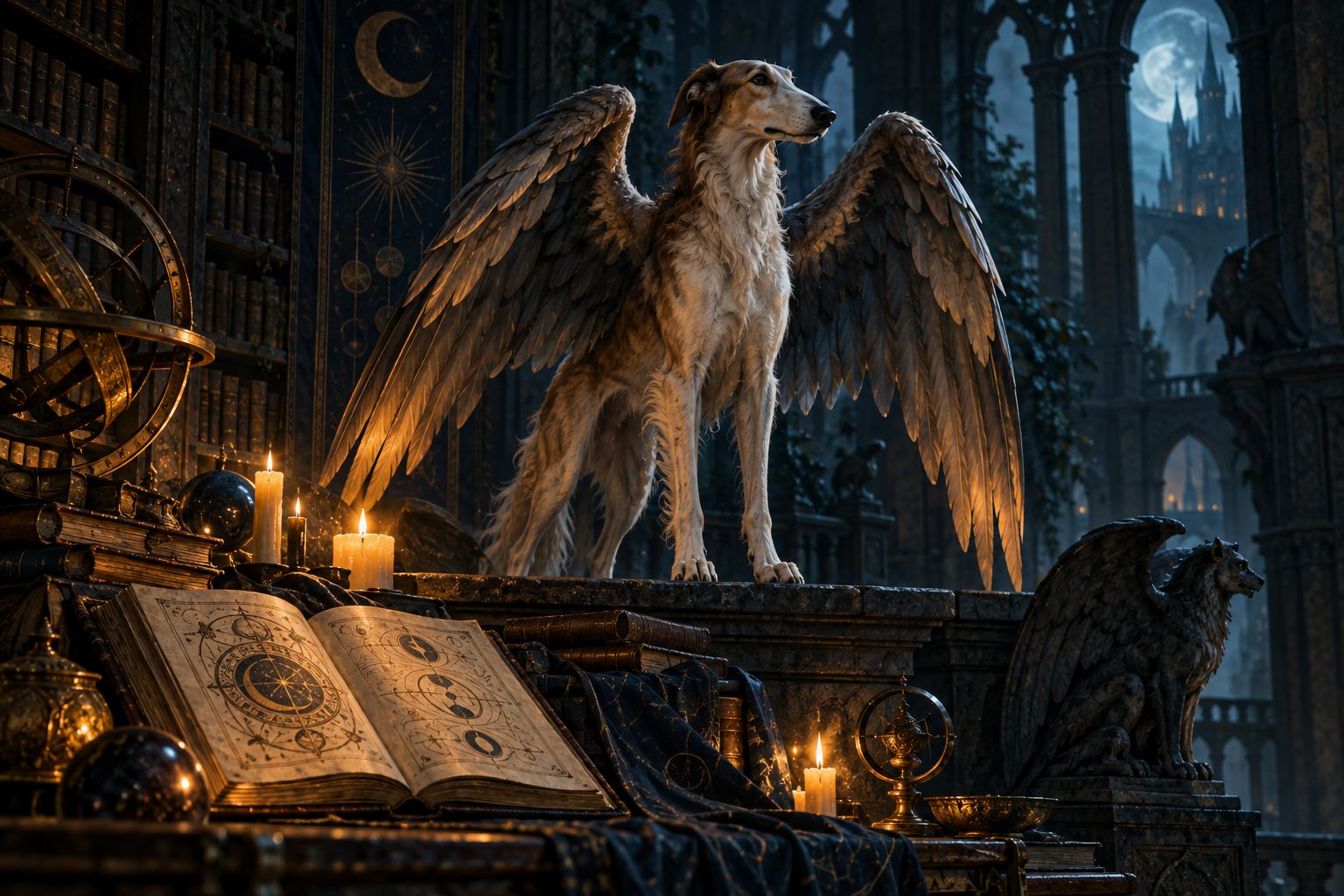
Glasya-Labolas is the 25th spirit of the Ars Goetia, a president appearing as a dog with griffin wings. Rank, legions, offices, sigil, Weyer and de Plancy.
Quick answer: Glasya-Labolas is the twenty-fifth spirit of the Ars Goetia, described as a mighty president (some editions add earl) who commands thirty-six legions and appears as a dog with the wings of a griffin. The Lemegeton says he teaches all arts and sciences instantly, knows past and future, can win the love of friends and foes, makes a person invisible, and is "an author of bloodshed and manslaughter." Johann Weyer listed him in 1577 under the alternative names Caacrinolaas and Caassimolar.
Related guides: Ars Goetia names, offices and seals, the full list of 72 demons, Goetia ranks explained, Marbas, the lion president, Amon, the wolf marquis, Buer, the teaching president.
| Spirit | Number and rank | Legions | Form in the Lemegeton | Main offices |
|---|---|---|---|---|
| Glasya-Labolas | 25, President (and Earl) | 36 | Dog with griffin wings | Arts and sciences, bloodshed, invisibility, past and future |
| Marbas | 5, President | 36 | Great lion, then a man | Hidden things, disease and cure, mechanical arts |
| Naberius | 24, Marquis | 19 | Black crane | Rhetoric, arts and sciences, restoring lost honors |
| Buer | 10, President | 50 | Form described only as appearing in Sagittarius | Philosophy, logic, herbs, healing |
Key Takeaways
Glasya-Labolas occupies the twenty-fifth place in the Ars Goetia, the catalogue of seventy-two spirits that opens the Lesser Key of Solomon. The 1904 Mathers and Crowley edition introduces him as “a Mighty President and Earl” who “showeth himself in the form of a Dog with Wings like a Gryphon.” His legion count is thirty-six, the same as Marbas, which places him in the middle of the catalogue in terms of stated power. The double rank is unusual; most spirits hold one title, and the combination of president and earl is shared with only a few others, such as Marax and Ronove in some editions.
The offices listed are a mix that readers often find jarring. On one hand he “teacheth all Arts and Sciences in an instant” and “teacheth all things Past, and to Come,” which puts him among the scholarly spirits like Buer and Marbas. On the other, he is “an Author of Bloodshed and Manslaughter,” a phrase that makes him one of the few openly violent entries in the Goetia. He can also, the text says, cause the love of friends and foes and make a person invisible. Our overview of Ars Goetia names, offices and seals shows how these standard categories of office recur across the list.
The name itself has no accepted meaning. It looks like a corruption of something older, possibly Latin or Greek, but no scholar has traced it convincingly, and the alternative forms given by Weyer suggest that the copyists were already unsure of it in the sixteenth century.
The elements of a Goetia entry can be set out one at a time, and for this spirit each one has a small story behind it.
President is the lowest of the Goetia’s standard ranks and, in the planetary scheme that later commentators attached to the list, is associated with Mercury, the planet of learning. The added title of earl, linked to Mars, fits the violent side of his offices. Thirty-six legions is the figure in every edition. See Goetia ranks explained for how these titles were understood.
A dog with griffin wings. The Goetia does not give him a human form, unlike Amon or Marbas, so the animal image is all there is. The griffin, a lion-eagle hybrid, was a guardian creature in classical and medieval art, and the wings may be meant to signal speed and watchfulness.
Instant teaching of arts and sciences; knowledge of past and future; authorship of bloodshed; procuring the love of friends and foes; invisibility. The last two are shared with many spirits; the first and third make the entry distinctive.
The seal of Glasya-Labolas in the Mathers edition is a compact figure built on a central vertical stem with short horizontal bars, small circles at several terminals and curved strokes at the top that give it a crowned look. Copies differ in detail. Like all Goetia seals it is a signature of the spirit rather than a picture.
Does this touch your own situation? Many readers come to these pages because something in their home, dreams or family feels unexplained. Reading history helps, but it cannot look at your specific case.
Consult the Sheikh Private, confidential, and free to ask.
The Goetia entry descends from Johann Weyer’s Pseudomonarchia Daemonum, the catalogue of spirits printed in 1577 as an appendix to his De praestigiis daemonum. Weyer gives the name as “Glasya Labolas, alias Caacrinolaas, or Caassimolar,” and describes “a great president, who cometh forth like a dog, and hath wings like a griffin.” He “giveth the knowledge of arts, and is the captain of all manslayers,” understands things present and to come, “gaineth the minds and love of friends and foes,” makes a man invisible, and rules thirty-six legions. The English wording is Reginald Scot’s, from The Discoverie of Witchcraft of 1584, which translated Weyer’s list and carried it into the English-speaking world.
Comparing Weyer with the Lemegeton shows how little the entry changed. “Captain of all manslayers” became “author of bloodshed and manslaughter”; “knowledge of arts” became “all arts and sciences in an instant.” The alternative names dropped out of the Goetia but survive in de Plancy and in modern reference works. Weyer’s own purpose was skeptical. He printed the catalogue to show the absurdity of the magicians’ claims, and he omitted the conjurations on purpose. The spirits he catalogued therefore reached later readers stripped of their ritual context, which is partly why the Goetia reads like an inventory.
Jacques Collin de Plancy’s Dictionnaire Infernal, first published in 1818, gives Glasya-Labolas a short entry that follows Weyer almost word for word, keeping the alternative name Caacrinolaas. The 1863 edition added engravings by Louis Le Breton for many of the spirits, and his Glasya-Labolas is one of the most reproduced: a lean dog, mouth open, with large feathered wings spread from its shoulders and an alert, almost heraldic pose. There is nothing in the picture to suggest bloodshed; the animal looks more like a watchdog than a killer.
Le Breton’s engraving is the source of nearly every modern image of the spirit. Artists for games, card sets and book covers copy its pose and add details, usually making the dog larger and more menacing, sometimes giving it eagle feet or a lion’s tail to emphasize the griffin element. Readers who want to see how the Dictionnaire’s illustrations shaped the modern look of the Goetia as a whole should compare the engravings with the text; in almost every case, as with the Amon entry, the picture adds or changes details that the words do not support.
It is worth noting that no manuscript of the Lemegeton contains pictures of the spirits. The seals are drawn; the creatures are not. The entire visual tradition is a nineteenth-century creation layered on a sixteenth-century text.
The combination of learning and violence in this entry is a useful window onto how the Goetia was assembled. The list is not a coherent demonology with a theory behind it. It is a compilation of services that magicians of the late medieval and early modern period hoped to obtain, grouped under names, and the services reflect the anxieties and ambitions of that world. Knowledge of the sciences and of the future, the favor of powerful people, invisibility, treasure and the ability to harm enemies appear again and again. Glasya-Labolas simply happens to carry several of them at once.
The phrase “author of bloodshed” probably reflects a category of spirit, found in older sources, that was blamed for wars and murders. Andras, who “soweth discords” and can kill the operator, and Leraje, who causes battles, belong to the same group. Set beside the teaching spirits, they show that the compilers were cataloguing every kind of power they could imagine, not building a pantheon.
This site describes these claims as historical material. We do not provide ritual instructions, and no spirit, seal or ceremony has been shown to produce any result. The value of an entry like this one lies in what it reveals about the hopes, fears and reading habits of the people who copied it.
A few corrections are worth making, because the entry is short and later writers have filled the gaps freely.
Keeping to the text removes most of the drama but makes the spirit easier to place in the history of the catalogue.
Most people who look up Glasya-Labolas today have met the name in a game. The Shin Megami Tensei series and its spin-offs include him as a recruitable demon, drawn as a winged dog in a design that owes much to Le Breton. He appears in mobile and card games that use the Goetia as a character roster, in a few manga and light novels, and occasionally in heavy metal lyrics and album art. The combination of a striking animal form and an awkward, memorable name makes him a favorite of illustrators.
A smaller group of readers arrives from the history of magic, often after reading about the Lesser Key of Solomon or the Dictionnaire Infernal and wanting to know which of the spirits are original to the Goetia and which come from Weyer. Glasya-Labolas is a good test case, because his entry can be traced cleanly from 1577 to 1904 with only small changes.
For anyone reading further, the sensible order is Weyer first, then the Mathers and Crowley Goetia, then de Plancy for the picture. The full list of 72 demons on this site gives the context of the whole catalogue, and the profiles of Marbas, Buer and Amon show how the teaching and beast-formed spirits compare.
Still have a question about your own experience? Describe what you are seeing, feeling or dreaming, and when it started. The Sheikh reads every message personally and replies in private.
Drawn to these stories for a reason? The Goetia credits Glasya-Labolas with teaching every art and science, and readers who linger on figures like him are often weighing what they want to learn or become themselves. If that question is yours, our partner PuraTarot offers a Full Personal Reading for calm, personal reflection on where you stand and where you are heading. Join the free Djinn Guide newsletter and, once you confirm, you will unlock a 50% code for your first reading.
Further reading
As an Amazon Associate we earn from qualifying purchases.
Glasya-Labolas is the twenty-fifth spirit of the Ars Goetia, a president (and in some editions earl) commanding thirty-six legions. He appears as a dog with griffin wings and is said to teach arts and sciences, know past and future, grant invisibility, win the love of friends and foes, and be an author of bloodshed.
The Lemegeton describes him only as a dog with the wings of a griffin, with no human form. The 1863 Dictionnaire Infernal engraving by Louis Le Breton shows a lean, alert dog with large feathered wings, and nearly all modern pictures copy that image with added menace.
Caacrinolaas, with the variant Caassimolar, is the alternative name Johann Weyer gives for Glasya-Labolas in his 1577 Pseudomonarchia Daemonum. Its meaning is unknown. Both names appear to be corruptions of an older form that the sixteenth-century copyists no longer understood.
He is a president, the lowest of the standard Goetia ranks, which later commentators linked to Mercury. The Mathers and Crowley edition also styles him an earl, a rank linked to Mars. This double title is shared with only a handful of spirits in the list.
He is a recurring demon in the Shin Megami Tensei video game series and its spin-offs, and appears in mobile and card games, manga and metal album art that draw on the Goetia. These portrayals are based on the de Plancy engraving rather than on any older source.
Disclaimer
This profile describes Glasya-Labolas as a figure in historical grimoires and later art and games, for educational purposes. The claims of those texts are reported, not endorsed, and the site provides no ritual instructions or promises of any result.
Did this guide help you understand the subject? Rate it and share your honest opinion to help other readers. Every review is checked by our editors before it appears.
There are no reviews yet. Be the first one to write one.


Sheikh Youssef
Tayeb El Merzouki
For inquiries about personalized spiritual work, private rituals, and traditional talismans, connect directly with Sheikh Youssef Tayeb El Merzouki.
Chat on WhatsApp