








Join Djinn Guide: Get 50% Off a Personal Reading
Get new guides to jinn, folklore and occult history. Confirm your subscription to unlock a 50% code for a first personal reading with our partner PuraTarot.
Discover the unseen
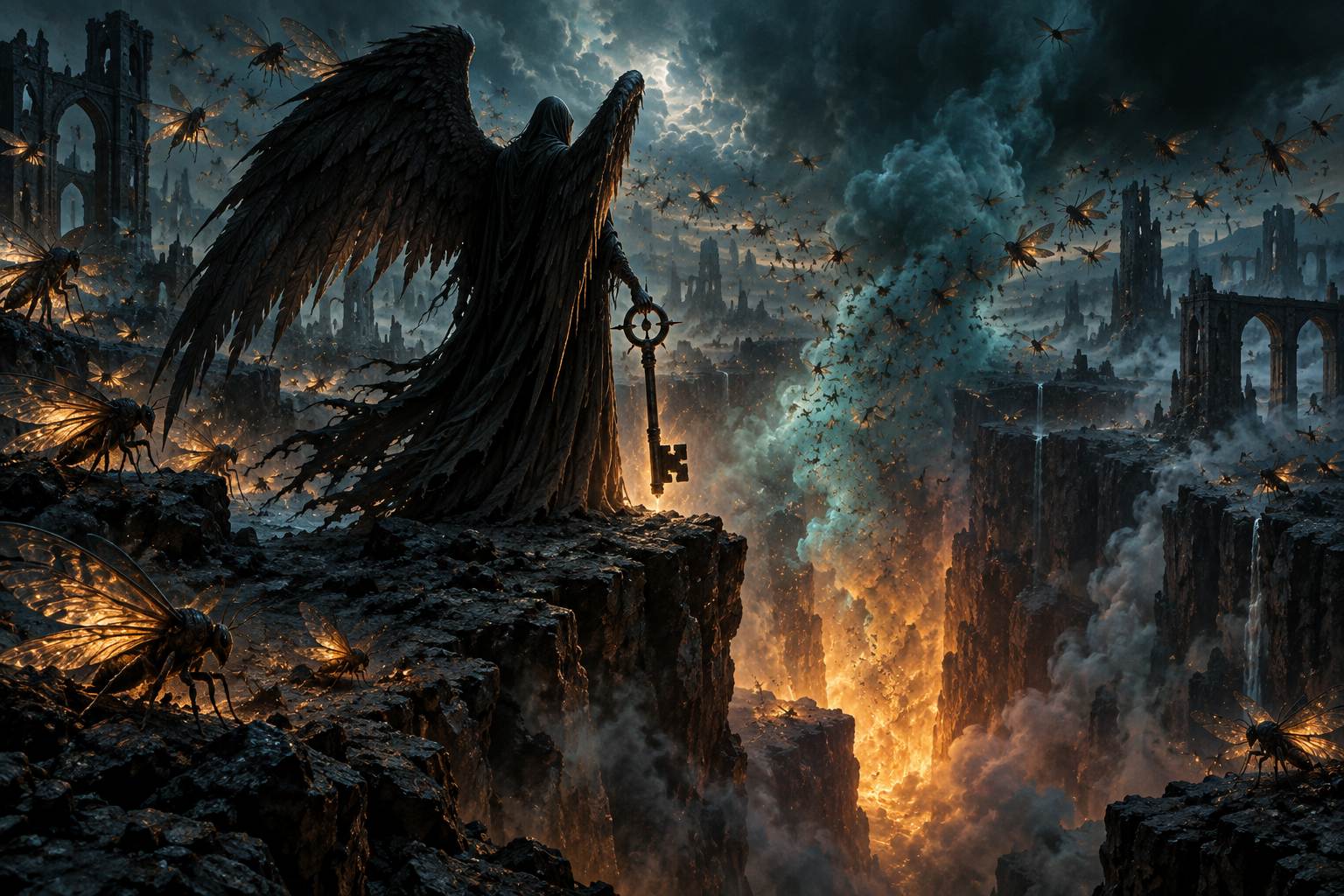
Abaddon explained: Hebrew word for destruction, the realm beside Sheol in Job, and the angel of the abyss called Apollyon in Revelation 9. Meaning, lore.
Quick answer: Abaddon is a Hebrew word meaning destruction or the place of destruction. In the Hebrew Bible it names a realm of the dead alongside Sheol, as in Job 26:6 and Proverbs 15:11. In the New Testament, Revelation 9:11 turns the place into a person: the angel of the abyss who rules an army of locusts, called Abaddon in Hebrew and Apollyon, the Destroyer, in Greek. Later Jewish, Christian and occult writers treated Abaddon as a demon, a fallen angel or an agent of divine judgment.
Related guides: how demonology classifies spirits, demon names from the Bible and the grimoires, angels and demons compared, Azazel, the wilderness spirit of Leviticus, Beelzebub, lord of the flies, Samael, angel of death and accuser.
| Source | Form | What Abaddon is | Notes |
|---|---|---|---|
| Job 26:6; 28:22; 31:12 | Noun, place or power | Realm of the dead beside Sheol; fire that consumes to Abaddon | Earliest uses, poetic |
| Psalm 88:11; Proverbs 15:11; 27:20 | Noun, place | The grave, never satisfied, open before God | Paired with Sheol |
| Dead Sea Scrolls (Hodayot) | Place | Pits and torrents of Abaddon in the underworld | Second to first century BCE |
| Revelation 9:11 | Angel | King of the locusts from the abyss; Greek name Apollyon | Only personification in the Bible |
| Talmud, Eruvin 19a | Place | One of seven names of Gehinnom | Rabbinic usage stays spatial |
| Agrippa, Occult Philosophy (1533) | Demon prince | Ruler of the seventh order of devils, the Furies | Renaissance demonology |
| Bunyan, Pilgrim's Progress (1678) | Fiend | Apollyon, winged monster who fights Christian | Literary image |
Key Takeaways
Abaddon (Hebrew avaddon) is built on the root a-b-d, which means to perish, be lost or be destroyed. The noun therefore means destruction, ruin, or the place where things are destroyed. It occurs six times in the Hebrew Bible, always in poetry and always as a place or a personified power of the underworld. In Job 26:6 Sheol is naked before God and Abaddon has no covering; in Job 28:22 Abaddon and Death speak together about the hiddenness of wisdom; and in Job 31:12 adultery is a fire that burns down to Abaddon.
Psalm 88 asks whether God’s faithfulness can be declared in Abaddon, treating it as a synonym for the grave. Proverbs 15:11 says Sheol and Abaddon lie open before the Lord, and Proverbs 27:20 says they are never satisfied, just like human eyes. In every case the word points to the depth of the dead, the lowest and most final part of the cosmos, rather than to a demon. Ancient Greek translators rendered it with apoleia, destruction, confirming that they read it as an abstract noun.
This is the first and most important point about the Abaddon meaning: in its original setting it is a where, not a who. The transformation into a named being happened later, in the apocalyptic imagination of the first century CE, and that later figure is the one most people have in mind when they search for the name.
The personal Abaddon appears once, in Revelation 9:1–11, the fifth trumpet of John’s vision. A star falls from heaven and is given the key to the shaft of the abyss. When it is opened, smoke pours out and from the smoke come locusts with the power of scorpions. They are told not to harm the grass but only people who lack God’s seal, and they torment them for five months without killing them. The locusts look like horses prepared for battle, with crowns like gold, human faces, women’s hair, lions’ teeth, iron breastplates and tails that sting.
Then comes the verse that created the demon: they have as king over them the angel of the abyss, whose name in Hebrew is Abaddon and in Greek Apollyon. John gives both names, which is unusual, and both mean the same thing, destroyer. The locust army and its king are released as a plague of judgment, parallel to the plagues of Egypt, and they are followed by the sixth trumpet with its four bound angels at the Euphrates.
Nothing in the passage says that the angel is a fallen one. He is an agent within a sequence of judgments that God permits. Some commentators have proposed that Apollyon is a deliberate echo of Apollo, the Greek god whose symbols included the locust and with whom the emperor Domitian associated himself, so that the name mocks imperial Rome. Others read the angel as Satan, and still others as a holy angel. The text leaves the question open, which is why later tradition could pull Abaddon in several directions.
Does this touch your own situation? Many readers come to these pages because something in their home, dreams or family feels unexplained. Reading history helps, but it cannot look at your specific case.
Consult the Sheikh Private, confidential, and free to ask.
Jewish literature kept Abaddon largely as a place. The Thanksgiving Hymns from Qumran, written in the second or first century BCE, speak of the pits and torrents of Abaddon as part of the terrifying geography of the underworld, continuing the usage of Job and Proverbs. The Babylonian Talmud, in Eruvin 19a, lists seven names for Gehinnom, the realm of punishment, and Abaddon is the second, after Sheol, with a proof text from Psalm 88. In this reading Abaddon is a region of the afterlife, one of the compartments where the wicked are judged.
Medieval Jewish mystical texts occasionally describe Abaddon as a level or chamber within the underworld through which souls pass, and some kabbalistic lists of the seven hells preserve the name. Personification is rare. When Jewish tradition needed an angel of destruction or death, it used figures like Samael or the Malakh ha-Mavet rather than Abaddon, as described in Samael, angel of death and accuser.
This divergence is instructive. The same Hebrew word produced a place in Jewish thought and a person in Christian thought, because Revelation, not the Hebrew Bible, was the text that gave him a crown and an army. Readers tracing Abaddon’s history should therefore expect two parallel traditions that rarely touch.
Because Revelation does not say whose side the angel of the abyss is on, Christian interpreters have offered three main views.
Many medieval and modern readers identify the angel with the devil, since he rules a demonic-looking army from the pit. The fallen star of Revelation 9:1 is linked to the fall of Satan described in Luke 10:18 and Revelation 12.
Others treat him as a distinct evil spirit, a chief among demons but not Satan himself. This is the reading adopted by Renaissance demonologists and by most modern fiction.
A minority of commentators, ancient and modern, argue that the angel is God’s servant, since he holds a key given from heaven and carries out a limited, divinely commanded punishment. Jehovah’s Witnesses go further and identify Abaddon with the risen Christ, an interpretation most other churches reject.
Historical and symbolic readings see the locust king as an image of imperial power or of destructive forces in general, without a specific spirit in view.
The disagreement shows how thin the source is. One verse, two names and no description of the angel himself have supported centuries of debate. A fuller picture of how such beings were sorted into ranks is given in angels and demons compared.
Renaissance demonology gave Abaddon an official rank. Heinrich Cornelius Agrippa, in the third book of his Occult Philosophy (1533), describes nine orders of evil spirits as a dark mirror of the nine angelic choirs. The seventh order is the Furies, sowers of mischief, discord and war, and their prince is Abaddon, whom Agrippa notes the Greeks call Apollyon. Francis Barrett copied this scheme into The Magus in 1801, and from there it passed into Victorian and modern occult reference books.
Abaddon is not one of the 72 spirits of the Ars Goetia, nor does he appear in Weyer’s Pseudomonarchia Daemonum. The Solomonic grimoires generally reserved biblical names for the highest powers invoked or commanded rather than for the spirits listed, and Abaddon’s biblical status as an angel kept him out of the catalog of bound demons. He does appear in some conjuration texts as a name of power, and the 1863 Dictionnaire Infernal includes a brief entry treating him as the exterminating angel and king of the locusts. For how the catalogs were built, see how demonology classifies spirits.
Later occult writers, especially in the twentieth century, placed Abaddon among the princes of hell alongside Beelzebub, Astaroth and Belial, and some modern Satanist and left-hand-path systems treat him as a figure of necessary destruction and renewal. These are recent developments with no root in the biblical text.
The most frequent error is to assume that Abaddon is a demon throughout the Bible. In the Old Testament he is not a being at all, and even in Revelation he is called an angel, not a demon. A second error treats Abaddon and Apollyon as two different entities; they are one name in two languages. A third confuses him with the fallen star of Revelation 9:1, who opens the pit. The text can be read either way, but the star and the king of the locusts are not explicitly identified.
There is also confusion with Azazel, the wilderness figure of Leviticus 16, and with Beelzebub, the Philistine god turned prince of demons. All three are biblical names that later demonology promoted, but they have separate origins, as explained in Azazel, the wilderness spirit of Leviticus. Finally, the image of Apollyon as a winged, scaled, fire-breathing monster comes from John Bunyan’s Pilgrim’s Progress (1678), where he battles Christian in the Valley of Humiliation, not from Revelation, which describes the locusts in detail but never the angel.
Keeping these distinctions in mind prevents the layered Abaddon of fiction from being read back into scripture.
Abaddon’s modern fame rests on his name and his title. The angel of the abyss is a ready-made villain, and the word Apollyon sounds like an apocalypse in itself. He has appeared as a Knight of Hell in the television series Supernatural, as a playable hero in the game Dota 2, as a boss or faction in the Darksiders, Diablo and Final Fantasy franchises, and in countless comics and metal albums. Bunyan’s Apollyon remains a staple of Christian literature, and the name appears in sermons about the end times.
Searches for Abaddon meaning, Abaddon in the Bible and the angel of the abyss reflect this mix of religious and pop-cultural curiosity. Many readers want to know whether a character they met in a game or show has a scriptural basis; others are studying Revelation and want to understand the Hebrew and Greek names. Both groups are served by the same answer: a word for destruction that became a place, then an angel, then a demon, then a character.
This site presents Abaddon as a subject of religious and literary history. We describe the scriptural passages, the interpretive debates and the later legends, and we do not treat any demonological claim or practice as fact.
Still have a question about your own experience? Describe what you are seeing, feeling or dreaming, and when it started. The Sheikh reads every message personally and replies in private.
Want a personal perspective? Abaddon’s story traces how a single word grew into a figure of judgment and change. If a question about change in your own life is on your mind, a Full Personal Reading with our partner PuraTarot offers a calm, reflective perspective. Join the free Djinn Guide newsletter and, once you confirm, you will unlock a 50% code for your first reading.
Further reading
As an Amazon Associate we earn from qualifying purchases.
Abaddon is a Hebrew word meaning destruction or the place of destruction. In the Old Testament it names a realm of the dead alongside Sheol. In Revelation 9:11 it becomes the name of the angel of the abyss who rules an army of locusts, called Apollyon in Greek. Later tradition treated him as a demon or fallen angel.
The Bible calls him an angel, the angel of the bottomless pit, and never uses the word demon for him. Whether he is a fallen angel serving Satan or a holy angel executing judgment is a matter of interpretation, and Christians have argued both positions. Renaissance demonology made him a prince of devils, which is the view most modern fiction follows.
There is no difference in meaning. Revelation 9:11 gives the same name in two languages: Abaddon in Hebrew and Apollyon in Greek, both meaning destroyer or destruction. John probably supplied both so that Jewish and Greek-speaking readers would understand. Some scholars think Apollyon also puns on the god Apollo.
Yes, six times, in Job 26:6, 28:22 and 31:12, Psalm 88:11, and Proverbs 15:11 and 27:20. In all of these passages Abaddon is a place or power of the underworld, paired with Sheol or Death, not a personal being. The personified angel appears only in the New Testament book of Revelation.
No. Abaddon is not among the 72 spirits of the Ars Goetia and does not appear in Weyer's Pseudomonarchia Daemonum. His rank in demonology comes from Agrippa's Occult Philosophy (1533), which makes him prince of the seventh order of devils, the Furies, and from later reference works such as The Magus and the Dictionnaire Infernal.
Disclaimer
This article discusses Abaddon as he appears in scripture, rabbinic literature, demonology and popular culture for educational purposes. Religious interpretations are described, not endorsed, and no claim is made that any spirit, text or practice has real-world effects.
Did this guide help you understand the subject? Rate it and share your honest opinion to help other readers. Every review is checked by our editors before it appears.
There are no reviews yet. Be the first one to write one.


Sheikh Youssef
Tayeb El Merzouki
For inquiries about personalized spiritual work, private rituals, and traditional talismans, connect directly with Sheikh Youssef Tayeb El Merzouki.
Chat on WhatsApp


